

The influencer marketing manager ran the same checks she always does before signing a new creator. The creator, a lifestyle account with 87,000 followers, cleared every one of them in under ten minutes: comment sections with actual questions—replies to other users, references to specific posts.
She screened him through her creator discovery platform, confirmed his audience authenticity score, and checked for suspicious follower spikes. Everything passed, fast. The kind of clean approval that used to mean the vetting was working.
Three months later, she pulled the conversion data: 1,400 link clicks and nine purchases. His metrics hadn’t moved. Nothing added up.
The speed that felt like efficiency was actually the problem. A vetting process built to approve quickly is a vetting process built to catch what’s easy to see, and nothing else.
- The two categories of influencer fraud your vetting process needs to account for
- The fake-follower checks fraudsters already know how to pass
- 5 types of influencer fraud draining programs in 2026
- Influencer fraud prevention: the essential steps to take before you pay
- What to do when you find fraud in your program
- Influencer fraud doesn’t stop after vetting—and neither should you
- FAQs
The two categories of influencer fraud your vetting process needs to account for
You’re probably treating influencer fraud as one category—that’s why you’re missing the kind that costs the most.
Audience and conversion fraud keep evolving as influencer marketing grows. What you can reliably catch today wasn’t the problem three years ago.
The fake-follower checks fraudsters already know how to pass
If you’re screening creators for fake followers, you’re doing the right thing. According to Influencer Marketing Hub’s “2026 Influencer Marketing Benchmark Report”, fake or bot followers account for 56.5% of reported influencer fraud and quality issues.
The signs that your prospective partner has fake followers includes:
- Follower-to-engagement ratio mismatches
- Sudden spikes in followers
- Comment sections flooded with generic emojis or single-word reactions
The problem is that these checks are widely known—fraudsters know what you’re looking for, and they build profiles to pass it. You should have a process for catching fake followers, but if that’s where you stop, you’re still losing budget.
Source: Influencer Marketing Hub’s “2026 Influencer Marketing Benchmark Report”
5 types of influencer fraud draining creator programs in 2026
Your fraud losses follow a consistent pattern: the more detectable the type, the earlier it lands on your vetting checklist. The types costing you the most tend to appear last—or not at all.
| Fraud type | How it works | What it costs you | Detection difficulty |
|---|---|---|---|
| Fake followers | Purchased profiles inflate follower counts; follower profiles often have minimal data or random usernames. | Inflated reach claims, wasted partnership spend | Low—large follower spikes and ratio mismatches are visible in most discovery tools |
| Engagement fraud | Bots spam comment sections with emojis and generic phrases; engagement pods (real users in a coordinated group) trade likes and comments across members’ posts | Inflated engagement rates that don’t reflect genuine audience interest | Moderate—bot comments are detectable by specificity; coordinated groups often show the same accounts appearing across multiple posts |
| Lead generation fraud | Bots affiliated with fake-follower networks actively fill out lead forms and trigger conversion events | Inflated cost-per-acquisition (CPA) counts; commissions paid for conversions that never turn into customers | High—looks identical to a legitimate lead at the time it’s generated; only visible in downstream revenue data |
| Promo code scraping | Affiliate codes scraped by coupon aggregators are used by shoppers with no relationship to the creator | Commissions paid for sales the creator didn’t drive | High—registers as a valid conversion event; the creator relationship is invisible in the transaction |
| Post-approval fraud | Creators buy followers after passing initial vetting, knowing the audit happens at sign-up | Steady commission drain on a creator whose audience was never real | Very high—the creator’s profile looked clean at approval; this only surfaces through ongoing monitoring |
Influencer fraud prevention: the essential steps to take before you pay
Most vetting stops at recruitment: check follower ratios, read comments, approve, onboard. The five steps below add what catches fraud built to clear a standard review.
Step 1. Ask your vetting tool what its scores actually measure
Audience authenticity scores vary across discovery platforms in accuracy, methodology, and the fraud types they’re built to detect.
When evaluating an influencer marketing platform, ask two questions: what specific signals does this score draw from, and what doesn’t it catch? That question usually comes down to where the data lives.
| Data source | What it is | Can it be gamed? |
|---|---|---|
| First-party API data | Pulled directly from the platform a creator posts on | No—it reflects what’s actually there |
| Estimated or crawled data | Inferred from public-facing signals | Yes—by anyone who understands which signals the estimate relies on |
A platform that responds with a general assurance rather than a specific methodology can’t tell you whether fraudsters have already optimized their profiles to pass its checks—the same way follower count fraud became detectable once programs learned to check ratios.
If a scoring approach can be understood, it can be gamed.
Step 2. Focus on comment specificity instead of volume
High comment volume is easy to manufacture, but genuine audience interest isn’t.
The difference between bot-generated comments and authentic ones is about relevance. Bots and engagement pods produce volume: generic phrases, single-word reactions, emoji strings, comments that could have been posted under any piece of content on any account.
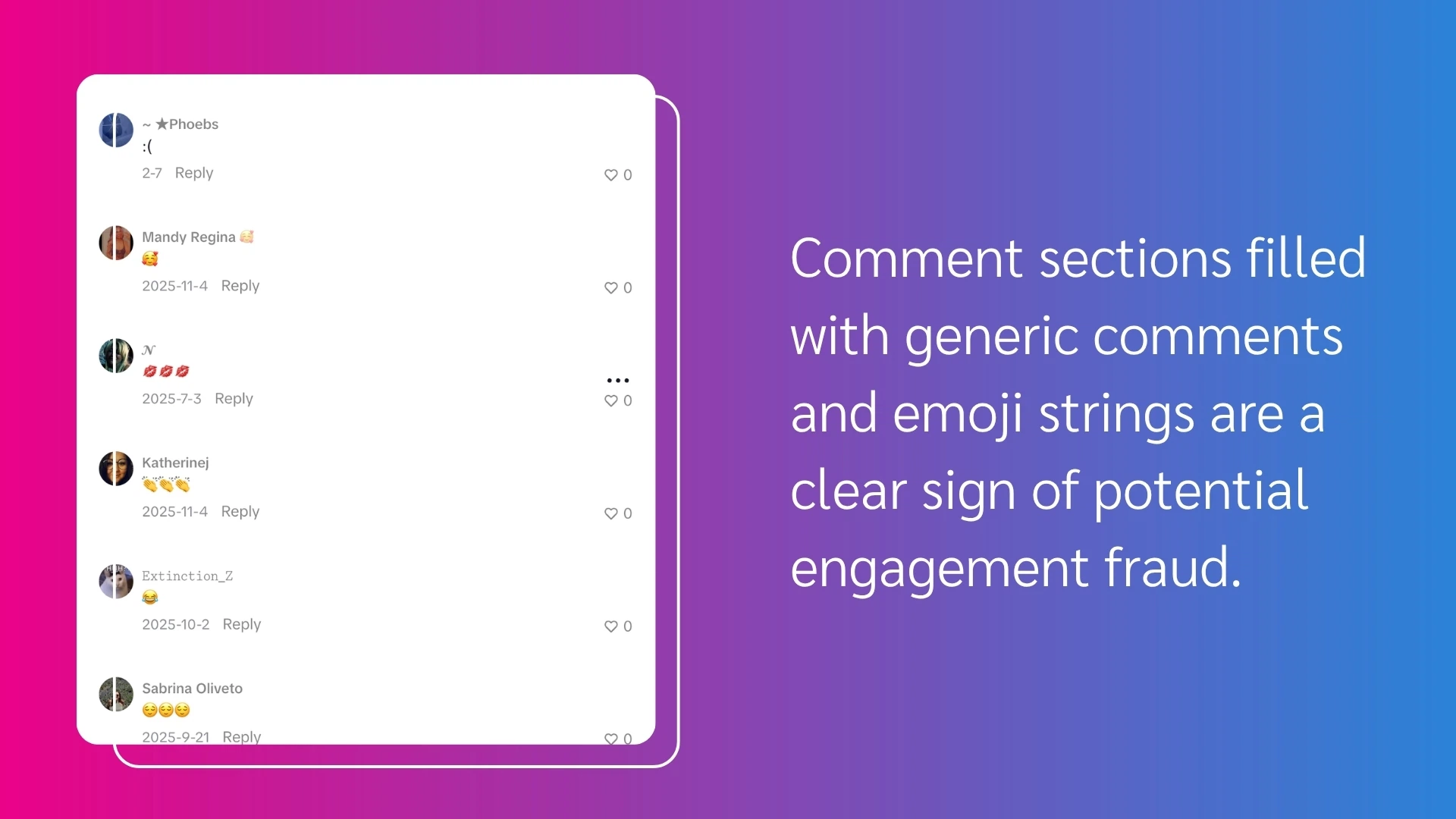
Real audiences produce specificity, which looks like:
- Questions about the product featured in a post
- Personal reactions tied to the specific content
- Comments that only make sense if the reader actually engaged with what the creator shared
Pod detection follows the same logic: engagement pods trade comments within a closed group, so the same 10-15 accounts often appear across a creator’s entire post history. You can easily see that pattern with a manual review of multiple posts.
Step 3. Treat your payment window as a fraud defense tool
Two timelines give payment windows their teeth:
- How long a chargeback can stay open
- How fast a bot-generated lead reveals itself in downstream data
| Fraud signal | Timeline | Payment window implication |
|---|---|---|
| Credit card chargebacks | Up to 90 days post-transaction | Hold minimum 90 days for new/high-risk partners |
| Bot-generated leads | Fails within days–weeks post-conversion | Review downstream data before releasing payment |
If your hold period doesn’t account for these timelines, you’re exposed. A 30-day hold applied to all partners regardless of risk level means promo code fraud and bot leads can clear payment before the signals show up.
Match your hold period to partner maturity, and you close this gap without penalizing established partners. Your new partners—particularly those with short track records and growing payouts—carry the most post-approval fraud risk and warrant tighter holds. As their record builds, you can shorten holds.
Step 4. Hold your platform and agency accountable for fraud visibility
Fraud detection is often described as something the platform “handles on the back end.” That’s true, but background handling only protects you if you can see it happen.
Brand-visible fraud detection looks like:
- Signals appearing in your dashboard
- Creator-level reports in a form your team can interpret and export
When a creator’s audience quality score drops after onboarding, you can see it. When a traffic cluster looks anomalous, you can document it. These signals shouldn’t be buried in a vendor’s internal model.
When a creator’s audience quality score drops after onboarding, you can see it. When a traffic cluster looks anomalous, you can document it. These signals shouldn’t be buried in a vendor’s internal model.
Step 5. Re-audit creators after onboarding
You likely vet your creators once, at sign-up—and post-approval fraud is timed to exploit that. Creators who know audits happen at sign-up buy followers after they’ve cleared it. That’s where re-auditing comes in.
You don’t need to monitor every creator constantly to run a practical re-audit cadence. Creators with growing payouts are high-priority targets—if a creator’s commissions are increasing, the stakes of missed fraud increase with them.
A quarterly check of your highest-earning partners, combined with an automated alert for unusual follower velocity in your discovery tool, covers most of the risk without significant added overhead. For faster-moving problems, such as traffic source anomalies, automated alerts work best.
What to do when you find fraud in your influencer program
Finding fraud is disheartening, but it means your monitoring layer is working. What you do next determines whether you create a lasting fix or just a one-time correction.
Document before you act
Before removing a creator or adjusting a payout, pull:
- Date-stamped screenshots
- Attribution reports
- Traffic data
This documentation is necessary for any payment disputes, internal audits, and updating vetting criteria later. You want to have solid evidence you can point to in a payment dispute.
Expect fraud to cluster
If one creator in your recruitment cohort is fraudulent, others approved in the same window are worth a closer look. Fraudulent creators often arrive in clusters because they tend to:
- Come through the same sourcing channels
- Pass the same vetting process
- Exploit the same gaps in recruitment criteria
Use your contract terms
Payment lock windows and performance-linked commission structures are the operational tools for addressing fraud retroactively, allowing you to act on any fraud you might discover later. But these levers only work if your contract defined fraudulent behavior upfront and reserved your right to terminate and recover commissions.
Update your influencer vetting criteria
Every fraud discovery is a data point about where you had a gap. When a creator slips through, identify the specific signal that should have flagged them and add it to your checklist. Your influencer vetting process gets stronger when you update it based on what actually got through—not just best-practice templates.
Influencer fraud doesn’t stop after vetting—and neither should you
You don’t need the best fraud detection tool. You need to stop treating vetting as a gate and start treating it as a system—multiple checkpoints, ongoing monitoring, and a feedback loop that gets stronger with every discovery.
The five detection steps above cover two problems: catching the fraud already in your program, and building a vetting process sophisticated enough to catch what a single checkpoint misses.
You likely have the first layer. Closing the second is what separates you from the programs still losing budget to fraud they can’t see.
Read more about how to run your creator program while protecting your brand:
- Addressing quality and brand safety in performance marketing: Partnership strategies that deliver results (blog)
- How to find influencers at scale: Why speed and automation are the keys to building a thriving creator program (blog)
- Navigating Influencer Marketing Compliance in 2025 [+ how to automate campaign regulations] (blog)
FAQs
Evaluate fraud detection by asking whether platforms and agencies surface fraud signals to your team, or manage them exclusively in the background—the latter leaves you unable to justify spend to leadership, act on patterns in real time, or produce an audit trail for a dispute.
Ask specifically: how are audience authenticity scores generated (first-party API data vs. estimated data), what happens when a creator triggers a fraud flag after onboarding, and can you export fraud-related signals.
These questions apply whether you work with a discovery platform directly or through an agency
Avoiding influencer fraud requires multiple checkpoints across the partnership life cycle, not just at recruitment.
At sign-up, screen for follower velocity spikes and engagement ratio mismatches using a discovery tool that pulls first-party API data. Read comment sections with the specificity test: genuine audience comments reference details specific to the post, while bot and pod comments are generic enough to appear anywhere.
After onboarding, re-audit creators quarterly and prioritize those with growing payouts, and configure payment hold periods around fraud timelines—the 90-day chargeback window is the baseline for new partners. Confirm with your platform or agency what fraud signals are visible to your team.
SociaVault Labs’ “2026 State of Influencer Fraud Report”, which analyzed 100,000 social media accounts across TikTok and Instagram, found that 37.2% of influencer followers show signs of being fake, purchased, or inauthentic.
You can easily catch this type of fraud before a contract gets signed. Most of those signals surface with a few basic checks: a follower-to-engagement ratio out of line with a creator’s niche, a sudden spike with no viral moment behind it, or a comment section with no post-specific replies.
The clearest signal that a creator purchased followers is a sudden spike in follower count with no viral post or coverage event behind it.
Two more signs confirm it: a follower-to-engagement ratio out of line with similar accounts in the same niche and tier, and a comment section that lacks post-specific engagement.
Cross-referencing those signals in a discovery tool with reliable data gives the best read—and once a creator is in your program, the same spike-with-no-trigger pattern is what you’re watching for on an ongoing basis.