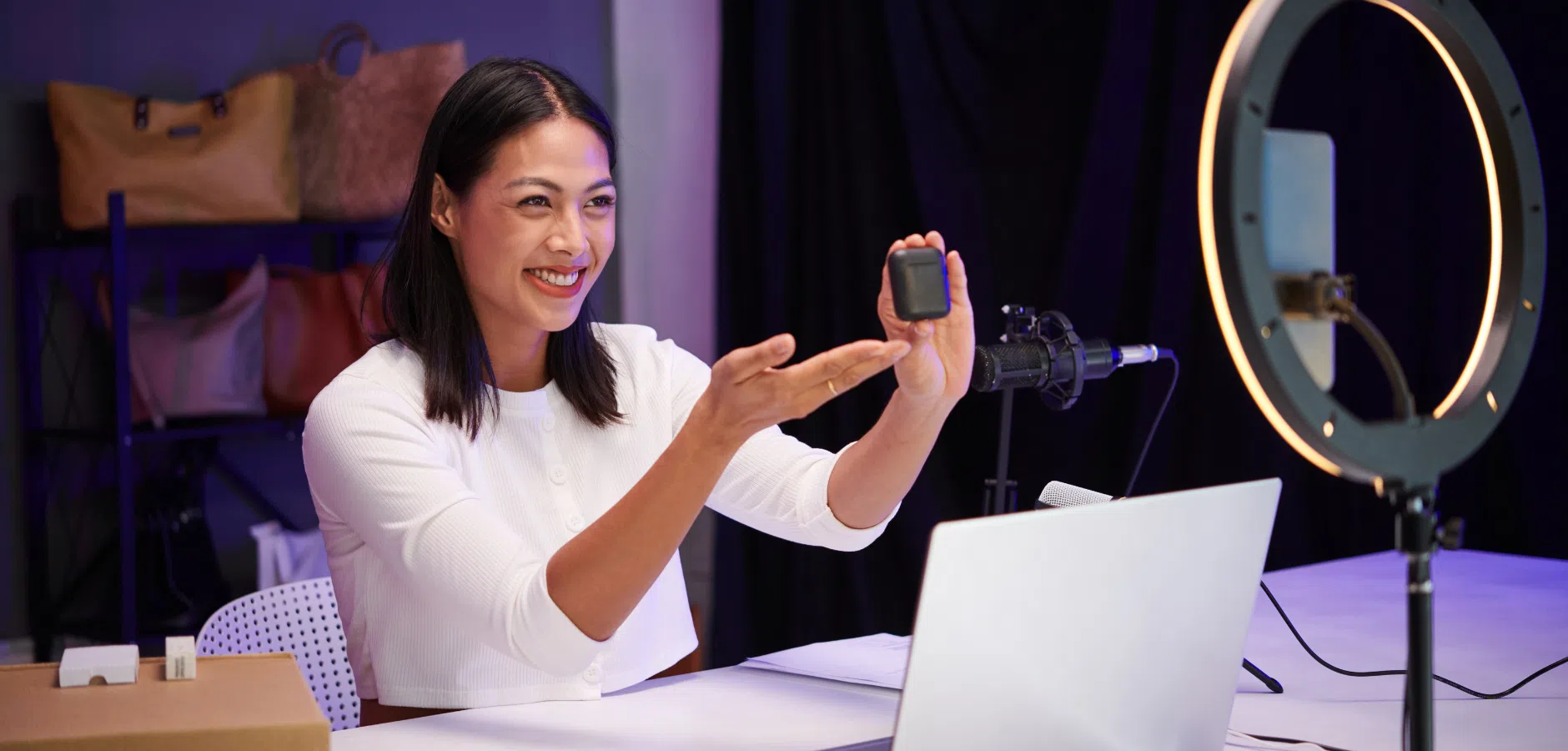

When iStock by Getty Images expanded its long-running affiliate program to creators for the first time, it built the new program around two non-negotiables: upfront payments to keep creators motivated, and immediate access to its Generative AI product to inspire testing and posting during peak excitement. By generating 15+ million impressions as a result of this faster infrastructure, iStock proved that building a better infrastructure is the definitive answer to how to find influencers at scale.
Stagnant creator programs aren’t usually a talent problem. They’re a gatekeeping problem that can be solved by replacing manual bottlenecks with strategic vetting and automated onboarding processes that empower partners from day one.
Consider the “silent week” that kills most recruitment efforts: A creator finds your brand on a Tuesday, loves your product, and applies that afternoon. By Friday, they haven’t heard back. By the following Tuesday, they’ve signed with your competitor. That silent week is gatekeeping—the ordinary kind where a slow process does the rejecting for you.
This guide will show you how to move past the traditional gatekeeping mindset to become a gold standard recruiter. You’ll learn how to compress recruitment, vetting, and onboarding into a system that activates creators in hours instead of weeks, ensuring your brand never loses a high-performer to a faster competitor again.
How to find influencers: Expanding recruitment across every owned channel
Gatekeeping doesn’t always look like rejection. More often, it looks like invisibility—creators who would have been a great fit never finding a way in.
Many brands mistake a sourcing bottleneck for talent shortages, but the real challenge is usually distribution. Recruitment funnels often live in one isolated tool or marketplace when they should be active everywhere your brand already commands attention.
Think of recruitment as a marketing campaign for your program. If you’re not running it across every brand touchpoint, you’re inadvertently capping your growth.
According to impact.com’s Global State of Affiliate Marketing 2025 report, 74% of leading brands generate up to 30% of their total company revenue through partnerships. If your recruitment isn’t everywhere your audience is, you’re leaving a significant portion of potential revenue on the table.
Creator recruitment in 2026: The traditional gatekeeper vs the gold standard recruiter
Before getting into the channels, it’s worth naming the mindset shift that makes them work. Most underperforming programs are run by gatekeepers. The strongest ones are run by performance-first recruiters.
| Influencer recruitment optimization: Gatekeepers vs gold standard recruiters | ||
|---|---|---|
| Program lever | Traditional gatekeeper | Gold standard recruiters |
| Vetting approach | Manual review of every applicant | Automated workflows with brand-safety filters |
| Response time | Days to weeks | Minutes to hours |
| Primary goal | Avoid risk | Drive return on investment (ROI) at scale |
| Compensation model | Rigid flat fees or commissions | Hybrid models that match the creator and campaign type |
| Recruitment channels | One or two sourcing tools | Marketplaces, Social Listening, owned channels, referrals |
| Creator experience | Wait, prove yourself, then maybe get access | Apply, get approved, get a product, start creating |
Without the gold standard mindset, more channels just mean additional applications stuck in queues.
Where can brands recruit top-performing creators?
The fastest-growing creator programs treat recruitment as an always-on, multi-channel function, not a quarterly project.
| How to find influencers: Top recruitment channels for brands in 2026 | ||
|---|---|---|
| Channel | Gold standard action | Strategic benefit |
| Creator marketplaces | Use Extended Search to run up to 5 active searches simultaneously—each with up to 3 keywords—outside your network. Filter partners by audience, niche, and engagement quality. | Access a pre-vetted pool of creators who are already opted-in and ready for brand partnerships. |
| Social Listening | Set up Social Listeners to monitor organic brand mentions and category keywords. | Turn existing brand advocates into a recruitment pipeline. |
| Owned channels | Place direct “join” links in your website footer, email lists, and Instagram story highlights. | Convert loyal customers into partners instantly. These recruits already have the brand affinity required for authentic content. |
| Creator referrals | Build an always-on referral program with incentives like tier upgrades or commission boosts for your top 10% performers. | Invert the vetting problem by using peer-level trust. Your best creators become an extension of your recruitment team with zero added headcount. |

How to run an influencer marketing campaign: Why most brands fail before they start
Most brands approach influencer marketing backwards by recruiting creators before their infrastructure is worth building on, causing performance issues down the line. This guide covers the gold standards impact.com’s expert creator team uses to build performance creator programs that compound over time.
Why creator referral programs work best: Your 4-step playbook
Referral programs are the highest-leverage recruitment tactic, and they work because they invert the gatekeeping problem. Instead of your team vetting strangers, your strongest existing partners are vouching for people they already know—which is a far stronger signal than any application form.
By building an always-on creator program, you turn your existing roster into a continuous sourcing engine that functions with minimal manual oversight.
The structure for a successful referral engine is simple:
- Identify your top 10–20% of performers. These are the creators whose content converts and whose values match your brand.
- Offer a performance-based bonus for successful referrals. A one-time payment triggered only after a referred creator hits a specific performance milestone is more effective than a flat fee for the initial introduction because it filters for quality.
- Make it simple to refer. A single link, a one-line message, a tracked code. Friction kills referral programs faster than anything.
- Recognize referrers publicly. A monthly shoutout, a leaderboard, a tier badge. Recognition compounds participation.
Done well, a referral program turns your top performers into an extension of your recruitment team, with zero added headcount. The mechanics work because they remove your brand’s vetting load and replace it with peer-level trust.
SharkNinja demonstrated the power of this automated, always-on approach by adding 900+ partners and growing revenue by 30% in a single quarter. For your brand, this proves that a stalled program is rarely a talent problem. It is a structural problem that can be fixed with a system designed to recruit creators at scale.
How to vet at scale while protecting brand safety
While recruitment gaps are often unintentional, manual vetting is typically a deliberate safeguard that can inadvertently limit your program’s scale. The logic feels right. A human reviews every applicant, flags risks, and protects the brand.
The reality is that human review queues create the exact delay window in which creators lose interest, find competing programs, or simply forget they applied.
Refining this stage into a strategic, automated process allows you to protect your brand while significantly increasing partnership recruitment.
The fix isn’t to vet less. It’s to vet faster by including your brand’s non-negotiables into the system itself. Automation, in this context, doesn’t mean letting everyone in. It means building your standards into your platform’s filters so the system protects the brand the moment an application comes in.
What strategic vetting actually looks like
A gold standard vetting workflow is built around four layers of automated filters:
- Audience composition. Minimum percentage of audience in your target geography, age range, and interest categories. Set these once, and the system enforces them forever.
- Engagement quality. Minimum engagement rate floors, plus filters for follower-to-engagement ratios that flag inflated audiences.
- Brand safety. Keyword or topic filters that flag content categories your brand can’t be associated with and AI-driven sentiment analysis to catch tonal mismatches a keyword list would miss.
- Performance history. For creators already in a marketplace, prior campaign performance becomes a filter: conversion history, dispute rates, and content quality scores.
When those four layers are in place, an application that meets all the criteria can be auto-approved on submission. An application that fails one is routed to human review. The team’s time goes to nuanced creators who require hands-on vetting, not to obvious approvals. This is where speed compounds into volume.
The hidden cost of the approval delay
Consider the high-performing creators your brand lost this quarter because a competitor replied faster.
While your internal reports show tool costs, they cannot capture the revenue lost when a top-tier partner tires of waiting. This hidden opportunity cost is the real price of a slow process. It creates a silent drag on growth, giving your competitors the first pick of the best talent.
The brands that move fastest aren’t waiting for perfection—they’re automating the routine approvals so their team can focus on the creators that require nuanced judgment. Speed becomes the variable under your control.
For brands building this internally, the path is clear: encode your standards into your platform and let the system do the filtering. For brands that want expert guidance implementing these workflows, working with an external creator team can compress the timeline significantly. impact.com’s creator services team, for example, builds programs around this exact gold standard playbook—automated vetting, fast onboarding, and measurable velocity.
But whether you build it yourself or work with a partner, the principle remains the same: automation replaces gatekeeping.
The gold standard for creator onboarding and partner activation
The second half of the gatekeeping problem isn’t which creators you let in—it’s what you do with them once they’re in. A perfect recruit will still underperform if you don’t give them the tools to perform on day one.
Onboarding should be viewed less as an administrative chore and more as the first act of partnership. A gold standard program treats it that way because creator excitement has a half-life.
The window between approval and activation is your prime opportunity to capture a creator’s peak inspiration. Providing immediate support (briefs, mood boards) and incentives (upfront payments, gifting) empowers your partners to turn that enthusiasm into authentic advocacy.
Building your influencer portfolio: A strategic framework for scaling brands
This comprehensive guide provides the essential frameworks to build your ideal roster of creators to achieve your brand’s objectives.
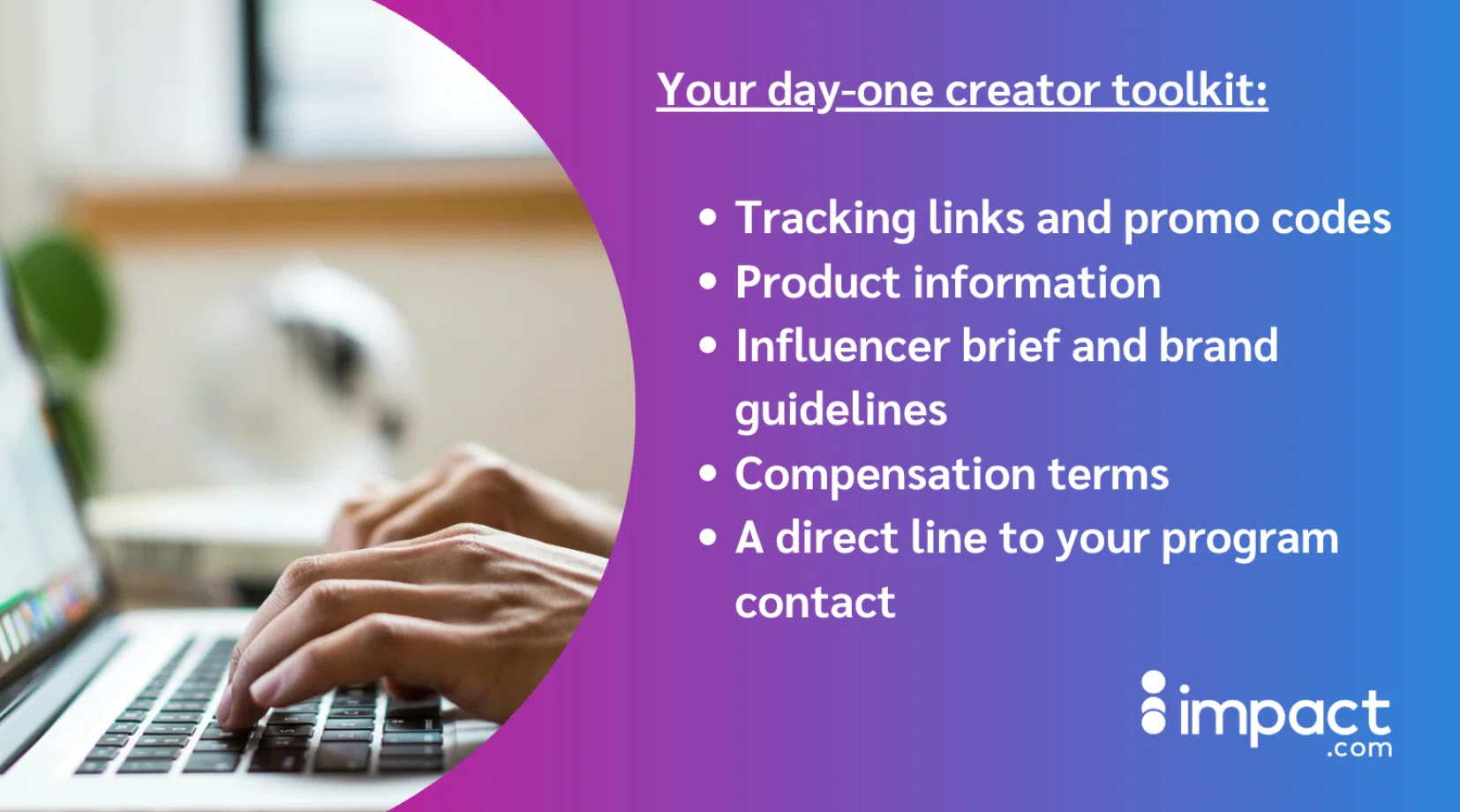
What to include in your day-one creator toolkit
Treat the onboarding package as a prerequisite for success. The minimum viable kit should include:
| Your day-one creator toolkit | ||
|---|---|---|
| Toolkit item | Why it matters | Timing |
| Tracking links and promo codes | Allows creators to start posting and earning immediately without back-and-forth. | Pre-generated on approval |
| Product information and top-performing angles | Gives creators a head start by sharing what actually converts, reducing guesswork. | Within minutes of kickoff |
| Influencer brief & brand guidelines | Empowers creative freedom while ensuring brand safety through positive direction. | Included in day-one package |
| Compensation and incentive terms | Builds trust through transparency regarding payouts, bonuses, and milestones. | Immediate/contract phase |
| Direct line to a team member | Humanizes the brand and provides a safety net for urgent questions or tech issues. | Ongoing from day one |
Everything in that list should hit the creator’s inbox within minutes of approval. Not a “welcome to the program” email with a PDF attached three days later, but the actual working materials, ready to use.
Use product gifting to shorten the time between approval and first post
Sending a creator a product the moment they’re approved is a performance move. It gives them something concrete to talk about while their excitement is at its peak, and it shortens the gap between approval and first post from weeks to days.
iStock’s creator campaign for Generative AI ran a digital version of this play. The brand offered small upfront payments and product access to creators before they produced content. To further incentivize them, same-day payments were processed once the content went live.
The mechanic that makes this work at scale is integration. When your creator program is connected to your Shopify store or product catalog, gifting can be triggered automatically the moment a creator is approved. The creator picks from a pre-set list (you control which products and the price range), the order ships, and the brand never touches the workflow.
Building a creator community to automate peer-led support at scale
The brands running the strongest creator programs invest in peer-to-peer community—Slack workspaces, Facebook groups, Discord servers—where creators can ask each other questions, share what’s working, and feel like part of something larger than a transactional brief.
Your top creators end up onboarding your new creators, and the brand’s role shifts from gatekeeper to host.
The creative honeymoon period: Why the first 48 hours dictate long-term ROI
The psychological window of a new partnership is the moment a creator is most inspired, most invested, most likely to produce their best work. This window opens the second they get approved and closes within days.
If they’re stuck in a two-week vetting queue, that inspiration fades. By the time they get the green light, the brand is just another item on their content calendar. The brands that capture that window get authentic advocacy. The brands that miss it get check-the-box content.
A seamless entry signals to the creator that your brand is a professional, high-tier partner. That first impression sets the tone for the entire relationship. High-performing creators stay where the friction is lowest. Retention starts the moment they realize working with your brand is easy.
FAQs
The highest-converting creators come from four places: pre-vetted creator marketplaces with intelligent search, Social Listening tools that surface customers and creators already mentioning your brand, owned channels, and referrals from your existing top-performing partners.
Once you’ve sourced them, conversion rates depend less on who you found and more on how fast you can get them creating. Speed from approval to first post is one of the strongest predictors of program performance, because creator excitement has a half-life, and slow processes lose authentic advocacy to competitor brands with faster onboarding flows.
Automated recruitment tools fall into three categories: discovery, vetting, and onboarding. For discovery, look for platforms that combine a pre-vetted marketplace with extended keyword search across out-of-network creators, Social Listening for brand mentions, and AI-driven creator matching.
For vetting, the best tools let you encode your brand’s non-negotiables—audience composition, engagement quality floors, brand safety filters, and performance history— directly into automated workflows, so applications that meet all criteria can be auto-approved upon submission.
For onboarding, look for integration with your e-commerce platform so product gifting can be triggered automatically the moment a creator is approved. impact.com’s platform combines all three layers into a single workflow that gold-standard programs are built on.
A gold standard vetting workflow uses four layers of automated filters: audience composition, engagement quality, brand safety, and performance history.
When all four layers are in place, applications that meet all criteria can be auto-approved upon submission, while those that fail any one criterion are routed to human review. Your team’s time goes toward creators that require human vetting rather than obvious approvals, and brand safety becomes a property of the system rather than a bottleneck in the workflow.
Yes, Social Listening tools set up automated monitors that surface creators and customers posting about your brand, products, or your vertical in real time.
Turning those organic mentions into a recruitment pipeline means pairing the listening tool with a fast outreach workflow—ideally one where an interested creator can apply, get approved, and start producing content within hours rather than weeks. The brands that win at this treat enthusiastic mentions as inbound sales leads, not as feel-good engagement metrics.
The fastest way to scale recruitment without growing your team is to stop running it like a manual process.
First, automate vetting by encoding your brand’s criteria into platform filters, so the system handles routine approvals and your team reviews creators that aren’t immediate approval cases. Second, build a creator referral program. Third, integrate onboarding workflows so day-one materials, tracking links, and product gifting are triggered automatically the moment a creator is approved, rather than requiring manual handoffs.
Together, these shifts can compress recruitment work that previously required a full-time hire into oversight time on an existing team. For brands that need to move faster than internal process changes allow, working with an external creator services team is the most direct path.
Next steps: Auditing your recruitment funnel for speed and scalability
The brands building the strongest creator programs in 2026 aren’t doing it with bigger talent pools or budgets—they’re doing it by treating recruitment, vetting, and onboarding as the program itself.
The gap between a stagnant creator program and a high-yield one isn’t measured by the number of creators discovered or contracts signed. It’s measured by the rate of friction your process puts between a willing creator and their first piece of content. Remove that friction, and the program scales. Leave it in place, and no amount of sourcing will fix it.
So if you’re auditing your program, here’s where to start:
- Time your own funnel. How many hours does it take for the average creator to move from application to first post? If you don’t know, that’s your first finding.
- Interview five current partners. Ask them what was confusing, slow, or frustrating about getting started. The patterns will be obvious within the first three conversations.
- Map your vetting criteria to filters. Anything currently being checked manually that could be encoded into a workflow is a candidate for automation.
- Audit your day-one toolkit. If a newly approved creator can’t start producing content within 24 hours of approval, the toolkit is incomplete.
- Open a recruitment channel you’re not currently using. Social Listening, an owned-channel sign-up, and a referral program are your best bets—pick one to start and run it for a quarter.
The creator economy rewards the brands with the shortest distance between interested and creating. That distance is your program.
For brands that want to move faster than an internal audit allows, working with an external creator team can significantly compress the timeline. impact.com’s creator services team builds and manages programs against the gold standard playbook. That same approach helped iStock generate more than 15 million impressions on a first-of-its-kind creator campaign—recruitment, contracts, payments, and reporting all handled inside one platform, with creators paid within a day of going live.
Ready to rebuild your recruitment and vetting process? Talk to our creator services team about implementing the gold standard at your brand.
Discover more content here:
- How to run an influencer marketing campaign: Why most brands fail before they start [blog]
- Building your influencer portfolio: A strategic framework for scaling brands [ebook]
- Micro-influencer marketing: How to partner with smaller content creators in 2026 [blog]
- The Partnership Economy podcast: AI, Creators, and What Comes Next
- Influencer marketing trends 2026: 13 experts weigh in on the future of performance-driven growth [blog]
- How Hamilton Beach achieved viral success with TikTok creator partnerships