

When Pepperstone launched its creator program across key APAC markets, every piece of content needed regulatory sign-off before going live—the kind of bottleneck that stalls most compliance-heavy programs before they scale. Pepperstone could’ve kept everything in-house. Instead, the team took a hybrid approach: impact.com’s platform paired with a managed services team that functioned as an extension of its marketing arm. The result was 18 million impressions across the campaign, with content staying on-brand across every market and zero added headcount.
Most influencer programs hit a narrower version of the same problem: real creator interest and momentum, but no internal process built to keep pace with it.
Influencer programs don’t stall from choosing between in-house or managed services. They stall when brands treat that choice as a hand-off and lose visibility into who owns what.
Whether you’re scaling into new markets or just growing past ad hoc management, this guide draws on impact.com’s creator solutions team to break down the three models, the real cost math behind outsourcing, and the RACI framework that keeps any of them running.
Self-serve vs. managed services: how to choose the right model for your influencer program
Which of these three models you choose matters less than whether everyone stays clear on who owns what inside it. Getting this right isn’t about which box you check—it’s about understanding the trade-off built into the option you pick.
This guide uses “self-serve” and “in-house” interchangeably—both describe a brand’s team running the program directly, rather than a managed services model in which an external team executes specific functions on the brand’s behalf.
| In-house vs. managed services vs. hybrid: How the three influencer program models compare | |||
|---|---|---|---|
| Model | What it means | Best suited for | Trade-off |
| In-house | The brand’s team handles sourcing, vetting, negotiation, and relationships directly. | Brands with an established program, deep institutional creator relationships, and enough internal bandwidth to keep pace with growth. | Full control and institutional knowledge, but scaling is capped by internal headcount and platform fluency. |
| Managed services | An embedded team (platform plus human expertise) executes specific functions on the brand’s behalf, typically starting with manual vetting and phasing into automation as trust builds. | Brands entering new markets, categories, or scale points faster than their internal team can build the expertise for. | Faster access to expertise and the systems to support it, but only works if the brand stays visible on who owns what and how the program is performing. |
| Hybrid | Brand and managed-services partner split ownership explicitly, typically through a RACI framework, with strategy and top relationships staying in-house and repetitive or specialized execution moving outside. | Most programs at meaningful scale, though the right split varies by brand rather than one fixed ratio. | Requires an explicit, revisited ownership map. Without one, the split creates friction instead of efficiency. |
The real scaling bottleneck isn’t headcount, it’s pending applications
Influencer program management often stalls due to an overflow of creator applications, and that’s a directional and ownership problem long before it’s ever a model or staffing issue.
What an unreviewed queue costs you
Claire Taylor, Creator Strategy Team Lead, Global Enablement at impact.com, has watched this exact bottleneck stall more programs than any other single issue. “Pending applications are the biggest bottleneck we see that then hurts performance,” Taylor said. Brands come back to her team saying the same thing every time: there’s no one keeping up with the volume of applications coming in. This gap stalls creators and the brand’s program before it ever gets going.
The pattern is almost always the same. A brand’s creator community starts talking among themselves. Interest builds, and applications start coming in faster than anyone can review them. Once a creator is sitting in that queue, there’s no time to negotiate terms, no time to get a contract signed, and no reason for that creator to keep waiting when a competing brand responds faster.
Aimee Crankshaw, Account Manager on impact.com’s Creator Solutions Team, sees the same tipping point from the operations side. “When partnership managers spend around 80% of their time on manual tasks, performance actively begins to suffer,” Crankshaw revealed. That’s the point where the team stops being proactive and starts being reactive, and that reactive turn shows up in stalled recruitment rates, delayed payments, and growing contracting backlogs.
Crankshaw compares this to a creator applying for a job. Ghost the application, and it doesn’t just cost you that one candidate. In a community where creators compare notes on which brands respond and which ones go quiet, it could cost you the next ten.
Automation clears the queue without adding headcount
That capacity crunch isn’t unique to any one program size. According to impact.com’s Global State of Affiliate Marketing in 2025 report, 33% of solo program managers believe their current team size is sufficient, while 43% consider it insufficient. It’s tempting to read that and conclude the fix is more hiring, but the real fix is automation built around clear vetting criteria, not another seat on the team.
Set the parameters once for geography, audience fit, category alignment, whatever your brand’s non-negotiables are, and let your partnership platform auto-accept or auto-reject against them.
What’s left for your team is the smaller set of applications that need judgment, which is how programs open recruitment up without adding a single hire. Clearing that queue buys back the time Crankshaw says separates strong programs from stalled ones. She adds that a strong program spends “significantly more time on high-level strategy and less time on repetitive tasks that can be delegated or automated.”
Automation’s real value is buying back the hours to do the part of the job that actively moves your program forward.

“A strong program spends significantly more time on high-level strategy and less time on repetitive tasks that can be delegated or automated.”
– Aimee Crankshaw, Account Manager, impact.com’s Creator Solutions Team
How managed services work in practice: the manual-to-automated trust curve
Managed services function less as a static hand-off on day one and more as a relationship built to evolve. The most common misconception brands bring to a managed services engagement is that outsourcing means handing over full control immediately.
Taylor described a deliberate sequence instead. The first move is manual vetting. The creator strategy team reviews applicants and sends the brand a recommended list of who to accept, proving they understand what that brand is looking for. Only once a brand trusts that judgment does the team suggest and help configure automation on top of it.
That sequence runs on three things working together rather than in order:
- Education on the creator life cycle
- Hands-on execution support
- Platform fluency
Get the tech without the judgment behind it, and you end up automating the wrong criteria. Get the manual support without ever learning the platform, and you stay dependent indefinitely.
The right managed services become an extension of your team
Crankshaw has watched the same phase play out from the account management side, and the surprise brands report is rarely just operational relief. A well-run creator solutions team functions like an external brand manager, bringing cross-brand intelligence about which creators are converting right now across an entire vertical, not just executing against a brief.
The goal, Taylor says, is never to gatekeep that knowledge. Her team functions as an extension of the brand, aiming to help the brand understand the creator life cycle well enough to manage parts of it itself. The outcome brands find most surprising isn’t the expertise they expected. It’s the moment they realize that they’ve absorbed enough to run it themselves.
The creator team lays the foundation, walks a brand through best practices, and hands ownership back as trust builds. From there, the team moves to the next strategy, with the brand circling back on what’s working as new challenges surface at each stage of growth.
Is outsourcing your influencer program more expensive?
The same hand-off instinct that costs brands visibility elsewhere shows up here as a pricing mistake, treating a managed services engagement as a fixed cost to buy rather than a relationship to manage together. The cost math is wrong because they’re comparing outsourcing to the entirely wrong baseline.
“One of the biggest misconceptions is that brands often compare a managed service agency retainer directly against the salary of a single internal influencer manager,” Crankshaw said. That comparison falls apart on its own terms. One salary rarely covers recruitment, vetting, contracting, negotiation, and reporting at real scale. A single hire pushed to that bandwidth ceiling has no capacity left to optimize the program, let alone grow it.
Brands also tend to leave out the fragmented software stack a consolidated platform replaces (discovery, CRM, gifting, payments, tax compliance) and the better rates a managed services team can negotiate across a high volume of creator relationships.
| Legacy lump-sum vs. tiered, performance-based creator compensation | ||
|---|---|---|
| Dimension | Legacy lump-sum model | Tiered, performance-based model |
| How it works | One large flat fee to a single big-name creator, paid upfront, one and done. | Smaller upfront cost (often product gifting) plus a commission or bonus structure that scales as a creator proves results. |
| Expected timeline | Assumes near-immediate conversion. | Requires a ramp period, roughly weeks to months for initial setup, with fuller trust-building closer to nine months, before return on ad spend (ROAS) climbs. |
| What it looks like in practice | Spend is concentrated in one relationship with no guarantee of trust or conversion. | Requires budget segmentation discipline across teams (social, affiliate, paid). Without it, brands misjudge how much runway they actually have. |
| Why brands default to it anyway | Feels safer and easier to plan around a single upfront number. | Feels riskier upfront because ROAS looks lower in the early weeks, even though that’s expected, not a failure signal. |
What cost-neutral content means for your budget
Taylor calls the long-term version of a tiered-performance model “cost-neutral content” which is scaling creator content that earns back what it costs to produce as trust builds, rather than spend increasing at the same rate as reach.
It only works if a brand understands how its existing budget is segmented, something many programs discover they’ve never mapped clearly across social, affiliate, and paid teams.
None of this means hybrid or fully outsourced is always cheaper. Costs vary by program size and how disciplined the budgeting is to begin with. What’s consistent is that most brands are running the wrong comparison before they ever get to a number.
The RACI framework: assigning who owns what, whichever model you choose
Every problem this guide has covered, from the application queue to the cost math, comes back to the same missing piece: an explicit answer to who owns what.
“What are you going to own? What am I going to own?” Taylor asked, describing the first conversation her team has with any new brand. “We call it a RACI, roles and responsibilities to remain aligned on who owns what along the way.” It sounds simple, but naming ownership out loud at the start is what keeps a model from underperforming later.
Taylor’s own engagements tend to land close to a 50/50 split between guidance and execution—though she’s clear that’s one data point from her vantage point, not a universal ratio. A fully in-house program and a fully outsourced one will land differently on the same map, and that’s expected.
Some functions stay internal no matter which model you run, because staying hands-on is non-negotiable at every stage of the program.
| Required for any model: The RACI ownership map for influencer programs | ||
|---|---|---|
| Program function | Stays owned internally, regardless of model | Can shift to a managed-services partner |
| Vetting criteria and automation setup | Defining who counts as a fit (audience, category, region) | Configuring auto-accept/auto-reject rules and platform automation once the criteria are trusted |
| Contract and commission structuring | Approving the commission philosophy and budget | Drafting and setting up the recommended template terms |
| Platform configuration and compliance workflows | Final sign-off on compliance requirements | Building and maintaining the review workflow |
| KPIs, leadership alignment, and benchmarks | Setting and owning the KPIs that matter to leadership | Reporting against those KPIs and flagging when performance shifts |
| High-touch relationship nurturing | Owning top-tier creator relationships, events, and community | Supporting the logistics and platform tools that make nurturing scalable |

“What are you going to own? What am I going to own? We call it a RACI, roles and responsibilities to remain aligned on who owns what along the way.”
– Claire Taylor, Creator Strategy Team Lead, Global Enablement at impact.com
Diagnosing where your program stands: a three-part checkpoint
Wherever your program sits today, the following three checkpoints focus on whether ownership is still clear, not on whether you picked the right model.
Checkpoint 1: Haven’t decided yet? Run this self-diagnostic this week
- Write down what’s currently working and what a realistic next step looks like, before assuming a bigger change is needed.
- Pull your actual budget split across social, affiliate, and paid teams, and test your assumption that outsourcing costs “more” against that real number, not a guess.
- Ask whether a managed-services partner could slot in alongside your existing affiliate and social teams, rather than replace them.
- Track where your team’s time goes for one week before deciding you need more headcount, then check how much of it a platform could automate instead.
Checkpoint 2: Already using managed services? Check this failure pattern
| Common influencer program obstacles, root causes, and fixes | ||
|---|---|---|
| Symptom | Root cause | Fix |
| Budget runs out unexpectedly | No one on the brand side was tracking spend against a growing program. | Designate one internal owner who stays in constant contact on budget and KPIs. |
| Program scales faster than the support in place | Full outsourcing without a feedback loop back to the brand. | Keep the managed-services team as an extension of the brand, not a silo, through regular alignment on leadership benchmarks. |
| Execution drifts from brand goals over time | The brand handed off execution without also maintaining a clear, ongoing vision. | Revisit the RACI regularly. Treat friction as a signal to re-clarify ownership, not a signal that the model failed. |
Crankshaw has seen exactly what this drift looks like from the outside. “When a brand outsources without keeping a firm hybrid grip on brand identity, the content very quickly starts feeling generic, inauthentic, and disconnected from their broader marketing calendar,” she said. A few months in, post volume looks fine on paper, while engagement quietly drops because the brand’s identity is missing from the work. Her prescribed fix: pause new recruitment, then re-establish a structured sync between the internal team and the partner before recruiting resumes.
Checkpoint 3: Already running well? Confirm these signs, whichever model you use
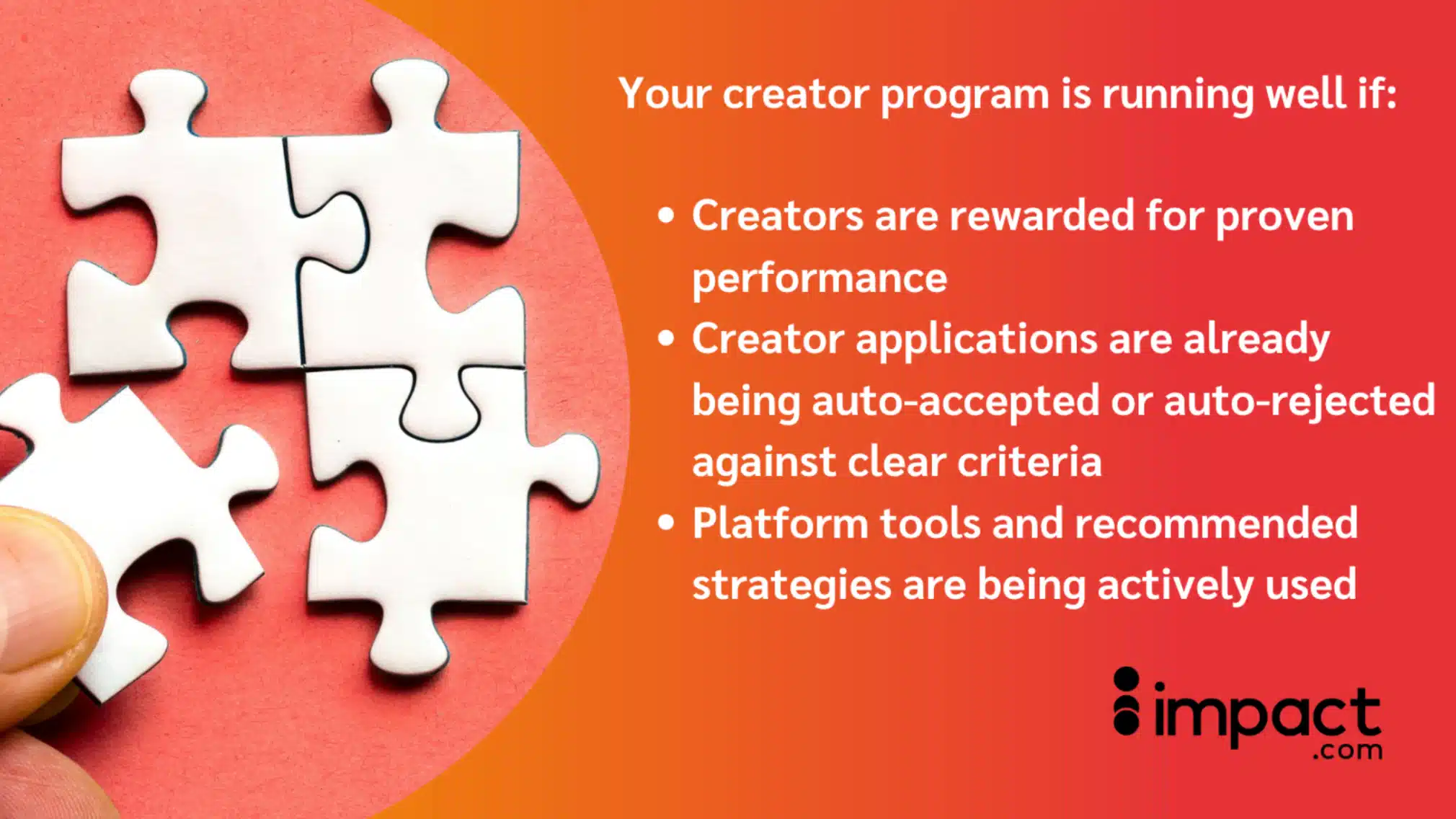
- Creators are rewarded for proven performance, a bonus or higher commission at a defined milestone, because the program treats partnership as an investment, not a one-off transaction.
- Applications are already being auto-accepted or auto-rejected against clear criteria, rather than manually reviewed one by one, regardless of who’s running that process.
- Platform tools and recommended strategies are being actively used, not worked around, whether that’s your brand’s team or a managed-services partner using them.

How to run an influencer marketing campaign: Why most brands fail before they start
Most brands recruit creators before the systems underneath the program are worth building on. This guide covers the gold standards impact.com’s creator team uses to build performance programs that compound over time.
FAQs
The difference between a self-serve influencer marketing platform and a managed services model is the following: A self-serve platform gives a brand’s team direct control over sourcing, vetting, contracting, and reporting. A managed services model pairs that same platform with a human team that handles specific functions on the brand’s behalf, typically starting with manual vetting to prove judgment, then phasing into automation as trust builds. The platform underneath can be identical. The difference is who’s operating it day-to-day.
The clearest sign that an in-house team has outgrown its ability to manage an influencer program is creators sitting in an unreviewed application queue for more than a few days, contracts stalling for lack of time to negotiate terms, and a team spending most of its week on manual admin instead of recruiting or nurturing relationships.
A hybrid influencer marketing model isn’t necessarily cheaper than fully outsourcing, and there’s no universal verdict. Costs depend on program size, maturity, and how well a brand has segmented its existing budget across social, affiliate, and paid teams before making the comparison. What consistently trips brands up is comparing an agency retainer against a single internal salary, which leaves out software costs, negotiating power, and the bandwidth ceiling one hire hits quickly. The more useful question is whether your budget math is measuring the right thing, not which model is cheaper.
In a hybrid influencer marketing model, strategy, final KPI ownership, and top-tier creator relationships typically stay in-house, because leadership alignment and brand voice are hardest to delegate cleanly. Repetitive or specialized execution, like configuring vetting automation, drafting commission templates, or building compliance workflows, typically moves to a managed services partner. The specific split varies by brand. What matters is that it’s written down as a RACI and revisited as the program grows, rather than assumed and left unchecked.
The model matters less than what happens after you pick one
The decision you make this week, in-house, managed services, or hybrid, will matter far less than whether you’re still asking the ownership questions six months from now. Model choice is a single moment. Staying on top of who owns what is an ongoing discipline, and it’s the second one that decides whether your program compounds or stalls.
That discipline gets tested for real the first time something doesn’t go to plan: a creator relationship goes sideways, a budget gets questioned, or the program scales faster than anyone prepared for. None of that reveals whether you picked the right model. It reveals whether ownership was ever clear to begin with.
Here’s where to start today:
- Put your RACI in writing this week, even a rough first pass, for whichever model you’re running today.
- Set a recurring cadence, monthly or quarterly, to revisit that map as your program changes, not only when something breaks.
- Bring this framework into your next budget conversation. It’s the ownership gap leadership needs to see, not just the price tag.
- Stay in regular, non-transactional contact with your top-performing creators between campaigns. Crankshaw has found the top 10% to 30% of creators in most programs drive the majority of a program’s revenue, and consistent contact, not just outreach when a campaign needs something, is what keeps them from drifting to a competitor.
Taylor’s closing point is the one worth carrying forward longer than any framework. “Creators are human, brands are human behind the email,” she said, “and that human connection is what keeps the success going.” Whatever model you run, that’s the part that no amount of automation can replace.
Discover more resources here:
- How to find influencers at scale: Why speed and automation are the keys to building a thriving creator program [blog]
- The Partnership Economy podcast: Rethinking creator strategy with Mal Chia of Ecom Nation
- Building your influencer portfolio: A strategic framework for scaling brands [ebook]
- From campaign budgets to operating systems: How to build a brand-owned influencer ecosystem [blog]