

Consumers weren’t just searching for ‘glasses’ anymore. They were asking AI assistants nuanced questions about eyewear and eye health—such as which frames suit a narrow face or which lens coatings help with screen fatigue. The AI mirrored them, synthesizing answers by drawing on sources it considered authoritative. One source that appeared repeatedly in these AI-generated eyewear answers is Fox News.
That’s when Zenni Optical made a choice. It could try to optimize its own site to beat a media giant in AI results. Instead, it recognized the real opportunity and formed a partnership with the trusted source AI. Zenni built the kind of authority the algorithm had no choice but to reflect.
If you’re figuring out how to improve brand visibility in AI search engines, that’s the lesson. Not a new metadata strategy. Not an AI optimization package. The brands winning in AI search are building the kind of specific, citable, human-first authority that the system is designed to surface.
According to David Doty’s Forbes article “AI Is Now Marketing’s Gatekeeper”, AI models now control what buyers discover about your brand. You cannot trick them with standard SEO. You have to influence the sources they already trust. Zenni figured that out pretty fast.
The AI optimization trap: Why chasing the algorithm is a losing game
The rush to master AI search has led most of the industry away from building real authority and straight into a familiar optimization trap. The industry response to AI search has largely been the same as it was to every previous algorithm shift: find the new rules, reverse-engineer them, and exploit them before everyone else does. Agencies are selling “AI optimization” packages. Blogs are publishing AI-specific keyword tactics. And most of it is solving the wrong problem.

“The biggest elephant in the room is that AI is quietly becoming the new storefront, and most brands have no idea how they appear in AI-generated answers.”
– Cristy Garcia, CMO of impact.com, Econsultancy report on AI and the customer experience
Garcia’s observation shows that most brands have no idea how they appear in AI-generated answers right now. Brands that find out first are the ones positioned to act.
Traditional SEO had a learnable rulebook of backlinks, keyword density, and domain authority. These were signals you could study, reverse-engineer, and exploit. AI search doesn’t work that way. Rather than ranking pages against each other, it synthesizes a consensus from the sources the web already treats as authoritative on a given topic. That consensus is built from what other people have said, cited, and linked to about your brand, not from what your own pages say about themselves. No amount of on-page optimization changes what the rest of the web thinks of you.
The stakes are higher than search rankings. Agentic AI tools are beginning to compress the customer journey into a single step, with Google’s rollout of agentic shopping allowing AI to recommend and complete purchases directly on behalf of users. A brand absent from the AI’s answer at the discovery stage doesn’t lose a click. It loses the sale.
Instead of asking how to optimize for AI, ask what AI actually rewards. The answer is consistent across all models and categories. It’s evidence that real humans find your brand credible, citable, and worth referencing. Build that, and the algorithm has no choice but to reflect it back.
How AI actually decides: The three signals of human trust
To build the kind of authority AI is forced to reflect, you first need to understand the signals it uses to recognize human trust in the first place. Brian Stempeck—CEO of Evertune AI—explains on The Partnership Economy Podcast how AI models now compress the entire research phase into a single summary.

“The consumer’s experience goes from ‘I went to Google, I read some other websites, I consumed a bunch of content to make a decision’—instead, that’s all condensed and summarized inside the AI model.”
– Brian Stempeck, CEO and co-founder of Evertune AI
Instead of sending users down a list of links to evaluate, AI forms a conclusion on their behalf, drawing from a wide network of sources it has already determined are credible. Three signals shape AI’s credibility judgments more than any others.
Signal 1: Authority via citation
AI learns what’s trustworthy by tracking what content gets referenced, linked to, and repeated across credible sources. A citation is the digital equivalent of a word-of-mouth recommendation, and AI counts them.
Building that citation footprint requires showing up across multiple content types, not just your own site. As Stempeck explained on the podcast, “In AI search, you have to pull more levers to train the models. You have to use a combination of content on your own website, PR sites, earned media, commerce, and sponsored content. It’s not like you put out one blog post or one keyword, and you change the model’s mind overnight. It takes a larger effort.”
He went further to map the specific buckets that drive AI citation:
“It comes down to owned media… [Earned] media with PR and independent content creators. And then sponsored content… [Also] social media and community places like Reddit. Those are the big four buckets to look at when you think about the type of content that’s getting into the AI models.”
– Brian Stempeck, CEO and co-founder of Evertune AI
The four content buckets that feed AI models:
- Owned media: your website, product pages, and blog content
- Earned media: PR coverage, journalist mentions, independent creator content
- Sponsored content: affiliate, commerce, retail, and paid content partnerships
- Community content: Reddit, forums, and social platforms

Source: A feature on a publisher blog, such as Money Under 30, is a great example of sponsored content.
Showing up across all four is what builds the citation footprint AI reads as authority. A brand visible only on its own website has one vote. A brand cited across owned content, earned coverage, affiliate reviews, and community forums has hundreds. This is not about gaming a search engine. It’s about earning a human consensus that the AI is built to reflect.
Signal 2: Expertise via specificity
AI rewards depth. Broad, surface-level overviews are treated as generic, blending into the background alongside everything else that loosely covers the same topic. Specific, detailed answers to narrow questions get treated as expertise.
This matters because users are asking AI more detailed questions than they ever asked Google. Stempeck notes on the podcast that people willingly share deeper context because AI platforms invite long conversations rather than quick searches.
“The average person on Google spends five or 10 seconds there. In AI, it’s more like six or seven minutes; it’s more of a conversation. People give a lot more detail on what they’re asking because they know they get good detail in response.”
– Brian Stempeck, CEO and co-founder of Evertune AI
Longer, more detailed user queries mean AI is searching for longer, more detailed answers. Content that thoroughly solves a specific problem—with examples, data, and nuance—creates a signal of expertise that AI is built to recognize and surface. Generic content optimized for a broad keyword doesn’t compete with a piece that actually answers what someone asked.
Signal 3: Credibility via association
AI reads more than what you publish. It reads who you publish alongside, who references you, and who you’re associated with. Featured expert voices, co-created content, and partner citations all transfer credibility through association.
The reason brand-owned content loses in AI answers isn’t a formatting problem. AI is specifically designed to distrust it. The sources AI reaches for—affiliate reviews, creator tutorials, community comparisons—share one quality brand content almost never has. They’re written by people with no stake in the sale.
That independence is the signal. A creator who notes that a product runs small, or that the return policy is frustrating, is doing exactly what AI is looking for. Polished messaging that presents only the upside isn’t credible to a system built to synthesize human consensus.

Dave Yovanno, CEO of impact.com, put it plainly on The Partnership Economy Podcast: “What is driving these LLM results is the affiliate and creator-style content. It’s the content from the community—because that’s the truth.”
That’s the reframe for your partnerships program. Your affiliates and creators aren’t just a distribution channel. They’re producing the exact content category AI is designed to cite.
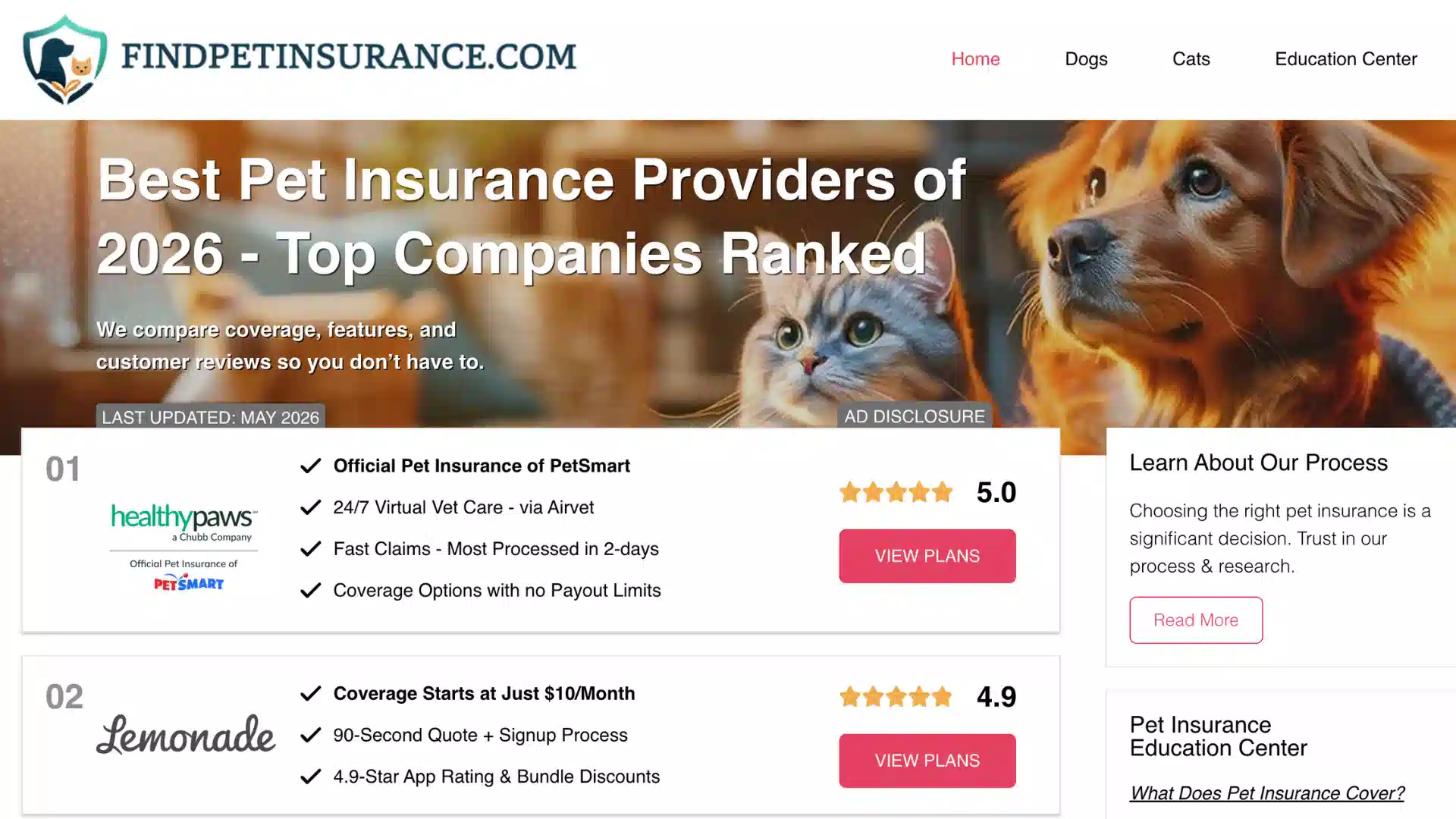
Source: Comparison sites such as FindPetInsurance.com earn powerful citations for your brand.
That credibility is already at scale. According to impact.com’s 2025 Global State of Affiliate Marketing report, almost every brand (97%), creator (96%), and publisher (87%) has integrated AI into their work. Your partners are already sophisticated, AI-enabled players. This means their authority is available to borrow if you build the relationships that make it possible.
Three ways to win AI by focusing on humans
The path to winning in AI search isn’t about chasing the algorithm but about deliberately building human trust through three core strategies. Citation, specificity, and association are not abstract ranking factors. They’re measurable evidence of human trust in your content strategy, whether it generates it or not. Each of the three strategies below builds one or more of those signals directly, without requiring you to think about the algorithm at all.
1. Become the primary source
The most powerful citation is one that points back to you because no one else has the data. When you publish something genuinely original—a proprietary study, named framework, or a data-backed case study—you create a source that others have to reference. Which means AI has to reference it too.
In the same podcast interview, Stempeck explained that smart companies are already producing content much faster to avoid being left behind.
“That’s one thing we’ve seen across almost every brand we’ve worked with. They’re doing more on their own side, accelerating how much they’re doing. This isn’t a space that’s going to wait around for them. And so I think increasing that content velocity is the next base.”
– Brian Stempeck, CEO and co-founder of Evertune AI
Brands that establish primary source status early will be the ones AI reaches for by default when questions come in. Three content types consistently earn citations in AI models:
| Type of primary source | Actionable ideas | Why AI values it |
| Original research | Survey your audience on a trending topic. Publish the results under a named report (e.g., “The 2026 State of X Report”). | Creates brand-new, citable statistics that link directly back to your brand. |
| Named framework | Develop a unique methodology for a common problem your audience faces. Give it a memorable name | Creates an ownable concept that others reference by name. It accumulates citations across every article and an AI answer that picks it up. |
| In-depth case study | Go beyond the testimonial. Document the specific process, timeline, and data behind a customer’s result. | Provides evidence-based narrative that functions as a unique proof point no competitor can replicate. |
Proprietary data is the strongest version of this. A statistic from your own research carries your brand name into every article, podcast, and AI answer that cites it.
2. Answer a niche question better than anyone
The impulse to cover broad topics at scale is understandable. But in AI search, breadth is a liability. AI models are looking for the single most authoritative answer to whatever a user asks. A piece of content that definitively solves one specific problem beats ten pieces that loosely address a general topic.
The standard isn’t “slightly better than what’s out there.” It’s the piece that makes every other piece feel incomplete. AI infers human-centric utility as a quality signal — so the more completely your content solves the problem, the stronger the citation case.
Finding the right niche questions to own starts with knowing where your audience is already struggling:
| Strategy | Where to look | What to look for |
| Community mining | e.g., Reddit, Quora, industry forums. | Questions with high engagement but no single, clear “best” answer. |
| Internal Knowledge Audit | e.g., Customer service tickets, sales call notes. | The same questions your team has to answer repeatedly on a 1-on-1 basis. |
| AI gap analysis | Type customer questions directly into the AI search | Topics where AI gives a vague or unsatisfying answer, signaling an authority vacuum |
When you find a question where the best available content is shallow, that’s your opening. One thorough, human-first piece that actually answers it can become the resource AI reaches for every time that question gets asked. The depth that serves a human reader and the depth that earns an AI citation are the same thing.
3. Borrow credibility at scale
Building authority through original content and deep expertise takes time. Borrowing credibility through your partner network can move it faster. When established voices reference, co-create with, and recommend your brand, AI systems log each of those endorsements as evidence of trust.
Expert roundups, Q&As with respected practitioners, and co-created content with affiliate partners all work through the same mechanism. They lend credibility to your brand by associating it with recognized names, and AI reads that association as a credibility signal and weights it accordingly.
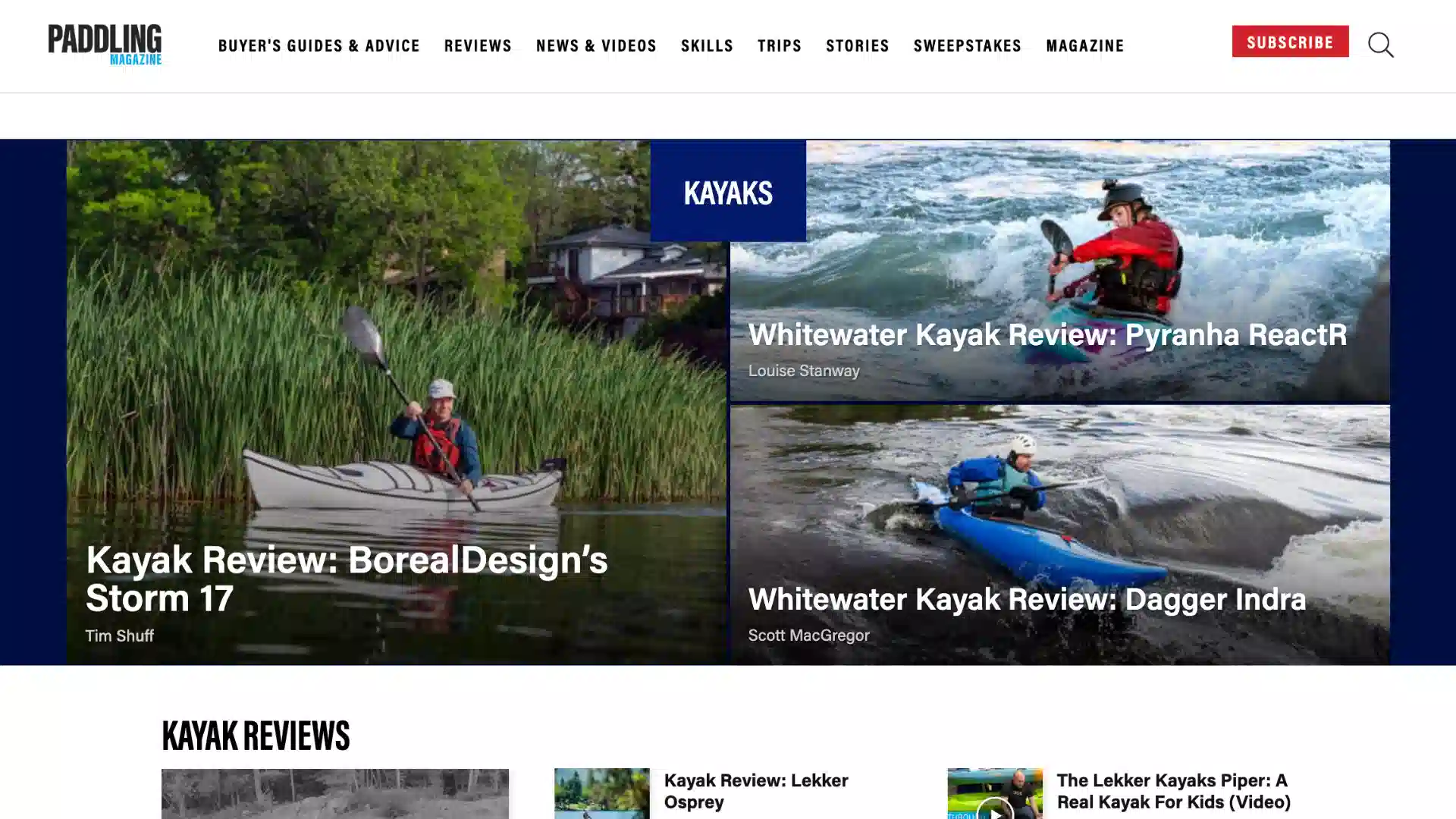
Source: Affiliate partners like Paddling Magazine give your brand credibility that AI easily picks up.
As a Street Fight analysis of AI search influence found, AI search systems are trained on trusted commerce content, reviews, comparisons, expert recommendations, and much of it is produced by affiliate publishers and creators. Brands can collaborate with those partners directly, closing visibility gaps that traditional SEO cannot address.
Your partnership program, run well, is the most scalable engine for this. Quality affiliate partners are trusted niche experts with audiences that already believe them. Their authentic content, detailed review, comparison guide, and tutorial function serve as independent citations that AI recognizes as a vote of confidence.
According to impact.com’s 2025 Global State of Affiliate Marketing report, publishers lead AI adoption for content creation and optimization at 41%, and 32% identify it as a top industry transformation. This is evidence that your partners are already producing the kind of AI-citation-worthy content your brand needs more of.
The most effective version of this strategy is to arm your best partners with your best content:
- Give them access to the proprietary data you created in strategy one
- Brief them on the niche questions you’re answering in strategy two
- Treat them as co-creators, not just distribution channels
Partners equipped with exclusive insights create more authoritative content than partners left to find their own angle, and the credibility signal AI sees on both sides grows accordingly. You are creating the trusted and human-led conversations that the algorithm has no choice but to overhear.
How to find the affiliate partners AI already trusts
The most direct path to AI visibility through partners is to identify who AI is already citing in your category, then activate those voices directly.
| Strategy | How it works | Why it’s effective for AI |
| Manual AI Query Analysis | Enter customer questions into AI search to see which partners, publications, and creators are cited in the answers. | Directly reveals partners’ AI models already recognize as trustworthy for your topics. |
| Automated Partner Discovery | Use tools like Partner Connect to identify publishers and creators influencing AI answers in your market. | Provides data-driven intelligence to find and activate partners with proven authority at scale. |
| Competitive gap analysis | Ask AI questions about your competitors’ categories and note which sources appear. | Surfaces partners who are already influential in your space but not yet working with your brand. |
Frequently asked questions
The strategies that improve brand visibility in AI search engines are fundamentally different from traditional SEO tactics. AI systems do not rank pages. They synthesize answers from the sources they consider most credible. Your brand visibility in AI search is determined by your citation footprint across the web. This means AI looks at how often trusted and independent sources reference your content. It looks at what third-party creators and publishers say about your products. It also checks if you are consistently associated with recognized experts in your field.
Three strategies reliably build this footprint. The first is becoming a primary source. You do this by publishing original research and named frameworks or in-depth case studies that others must cite. The second strategy is answering niche questions better than anyone else. Your content must be specific enough to serve a human reader completely. The third strategy is borrowing credibility at scale. You build this through partner and affiliate relationships with voices the AI already trusts. You do not need to understand how an algorithm works for any of these strategies. They all require you to create genuine value for a human audience.
Community content and reviews improve brand visibility in AI search. Forum discussions, creator tutorials, and affiliate comparisons also help. AI systems are specifically designed to trust this type of content. AI draws from independent sources rather than brand-owned pages. These outside sources reflect authentic human consensus instead of paid messaging.
According to the 2025 Global State of Affiliate Marketing report by impact.com, 87 percent of publishers have integrated AI into their work. The data shows 41 percent use it specifically for content creation and optimization. Your affiliate partners and influencer creators are already producing AI-optimized content at scale. This content acts as a credibility signal when it references your brand accurately and positively. AI already cites specific community voices in your category. Building relationships with them through your partnership program is crucial. This is one of the most direct routes to improving offsite content for AI search visibility.
Three factors influence brand visibility in generative AI search results more than any others. The first is citation authority. This measures how often credible third-party sources reference your brand, content, or data. The second is content specificity. Your owned and earned content must provide deep and detailed answers to the exact questions your audience asks. AI simply treats broad overviews as generic. The third factor is association credibility. This is based on the authority of the experts, partners, and creators mentioned alongside your brand.
Generative AI search results are built from human trust signals instead of technical optimization. You need to invest in building real authority through proprietary research, niche expertise, and strong partner relationships. This approach creates a citation footprint that AI is designed to reflect. Optimization tricks will build nothing that lasts.
Your new strategy: Stop chasing, start leading
Every dollar and hour your team spends on AI optimization tricks—adjusting metadata to game a black box, chasing ranking factors that shift with each model update—is time not spent building something permanent. Primary source content, definitive niche answers, and trusted partner relationships appreciate in value over time. Algorithm hacks don’t.
As impact.com’s 2025 State of Affiliate Marketing report shows, 97% of brands already use AI in their affiliate strategy—but most deploy only 2 or 3 use cases. The tools are in hand. The strategic depth isn’t there yet. This creates a massive opening for content directors and brand strategists. Brands still treating AI as an automation layer are losing ground on every question their customers ask right now. The leaders who shift that thinking first and point their programs at citation, specificity, and partner credibility will be the ones AI reaches for by default.
Your next content planning session is the right place to start. Look at your calendar through the lens of the three strategies:
- What is your next primary source project? The data or framework that forces AI to cite you.
- What niche question will you answer so completely that nothing else competes?
- Which partners, already trusted by AI, can you activate or equip this quarter?
The brands building those answers right now won’t need to optimize for AI. AI will find them because the humans they’re serving already did.
Further reading
- The Answer Era: AI is changing how brands get found—and partnerships are the strategy (blog)
- Your partnership program is driving AI-influenced sales—your attribution model just can’t prove it (blog)
- Why offsite content increases brand visibility in AI search and overview (blog)
- How to find affiliate marketing partners at scale through AI-powered discovery (blog)
- The unignorable content checklist: Five steps to a human-first AI overview content strategy for affiliate review (blog)
- The end of traditional advertising: How human connection is the new currency in marketing (blog)
- Affiliate marketing: How to give your businesses the strategic edge (blog)
- Why your AI investment is stalling your creator program (blog)