

The 2026 Super Bowl marked the arrival of the AI-first consumer. According to Forbes, 23% of national ad spots were linked to AI innovations.
When a consumer opens ChatGPT and types “best standing desk for home office use,” they get a single, synthesized recommendation pulled from sources the AI model trusts. This recommendation shapes the user’s decision before they’ve interacted directly with your brand.
As Dave Yovanno, CEO of impact.com, noted in Forbes, “The path to purchase is moving inside the answer itself, compressing what used to be multiple clicks into a single response.” This shift means your brand can no longer rely on traditional search visibility. To compete, you must influence the aggregated authority that large language models (LLMs) rely on through strategic and trusted partnerships that AI will cite.
This article is your brand’s roadmap for how to track brand mentions in AI search, influence synthesized recommendations, and build a partnership ecosystem.
How do AI answers use aggregated authority to curate brand mentions?
Because LLMs prioritize third-party consensus over your brand’s content, partnerships have become the primary visibility signal for any marketing strategy.
Yovanno’s conversation with Forbes revealed that LLMs aggregate authority from trusted voices already talking about your category, adding, “LLMs don’t invent authority; they aggregate it. They surface what credible creators, publishers, and communities are already saying.”
This means your brand must understand how it appears in AI-generated responses and which voices are shaping them. According to the Wall Street Journal, AI-driven traffic to 20 major retailers—from Best Buy to Etsy—surged nearly eight times in a single year. This proves that discovery is migrating into AI answers, and the brands woven into trusted third-party content are the ones getting found.
Third-party content carries weight because of how AI handles subjective queries. When someone asks “what’s the best SUV for a family of five?” the model resolves it by distilling a broad web of opinions across editor reviews, creator recommendations, and publisher comparisons, then surfaces the brand that appears most consistently across credible sources. Your owned content can’t manufacture that consensus.
Human presence is a core part of what makes a source credible. An editor who physically tested a mattress carries a categorically different signal than brand-controlled copy.

“LLMs don’t invent authority; they aggregate it. They surface what credible creators, publishers, and communities are already saying.”
– Dave Yovanno, CEO of impact.com
The actionable framework: How to build a partnership ecosystem for generative engine optimization (GEO)
As AI engines compress the customer’s path to purchase, your brand must shift its strategy from influencing web traffic to building a partnership ecosystem that acts as the primary authority source for LLM citations.
Levi Pillay, Product Marketing Manager at impact.com, explains that brands need to build consistent and credible signals across the web. He highlights a multi-source strategy to achieve AI citation, adding, “Instead of relying on your own site to do all the work, you want multiple trusted sources reinforcing the same idea about your brand, what you’re good at, and when you’re the right choice.” This is what AI systems pick up on. Not a single piece of content, but patterns across many sources.
Your partnership ecosystem determines whether AI cites your brand or a competitor—and building it deliberately is no longer optional.
According to impact.com’s Global State of Affiliate Marketing 2025 research report, 97% of brands have already integrated AI into their affiliate strategy. The brands pulling ahead aren’t just using AI to manage programs. Many are already using partner ecosystems to feed the authority signals AI models depend on.

“Instead of relying on your own site to do all the work, you want multiple trusted sources reinforcing the same idea about your brand, what you’re good at, and when you’re the right choice. This is what AI systems pick up on. Not a single piece of content, but patterns across many sources.”
– Levi Pillay, Product Marketing Manager at impact.com
The table below breaks down how you can deploy each partnership type to influence AI citations of your brand.
| How to drive AI citations and generative engine optimization through partnerships | ||
|---|---|---|
| Partnership type | How they influence AI answers | Brand strategy and benefit |
| Mass media publishers (e.g., CNN Underscored) | Provide high-authority seed data for retrieval-augmented generation (RAG) systems. | Focus on top-of-funnel authority. AI models treat these as truth sources for broad category queries. |
| Niche and vertical publishers | Establish category-specific authority and local relevance that AI models often lack. | Bridge the authority gap. Use these to dominate long-tail, expert-level queries for AI systems that require granular detail. |
| Independent creators such as YouTubers | Provide human presence signals, for example hands-on durability tests that AI uses to filter out synthetic content. | Create proof of life for your brand. Use video and first-person reviews to give AI the authentic data it needs to recommend your product. |
| Affiliate and review aggregators | Generate the consensus signal by repeating brand benefits across multiple independent domains. | Drive recommendation probability. The more review sites that agree on a product’s value, the higher the AI’s confidence in citing it. |
| Community and social partners (e.g., Reddit, niche forums) | Influence the sentiment layer of AI models, which ingest community discussions to determine brand reputation. | Manage brand sentiment. Engaging with community-led voices ensures AI doesn’t label your brand as low quality based on outdated threads. |
| Data and technology partners | Direct data licensing or API integrations allow your brand to bypass crawling and feed information directly into models. | Future-proof your presence. Building direct product finders or entering licensing agreements ensures your most accurate data is the foundation of the AI’s answer. |
Building your partnership portfolio matters as much as managing the individual partnerships. According to impact.com’s Global State of Affiliate Marketing 2025, brands now collaborate with an average of three to four different partner types. This strategy touches every stage of the customer’s journey and increases your brand’s chances of getting cited by AI.
High-performing programs go wider deliberately, covering the full spectrum from mass media authority to community sentiment. In an AI-driven discovery environment, breadth isn’t just good partnership strategy—it’s how you build the multi-source consensus an LLM needs to recommend your brand with confidence.

Building your influencer portfolio: A strategic framework for scaling brands
This guide provides a tactical roadmap to move beyond vanity metrics and focus on actionable ROI formulas that connect creator activity directly to revenue.
How do you brief partners to appear in AI overviews and citations?
Getting mentioned by a partner isn’t enough anymore. To influence AI-generated answers, your partners need to produce the kind of high-density, specific content that LLMs prioritize when generating responses.
That requires a new brief focused on content quality over quantity.
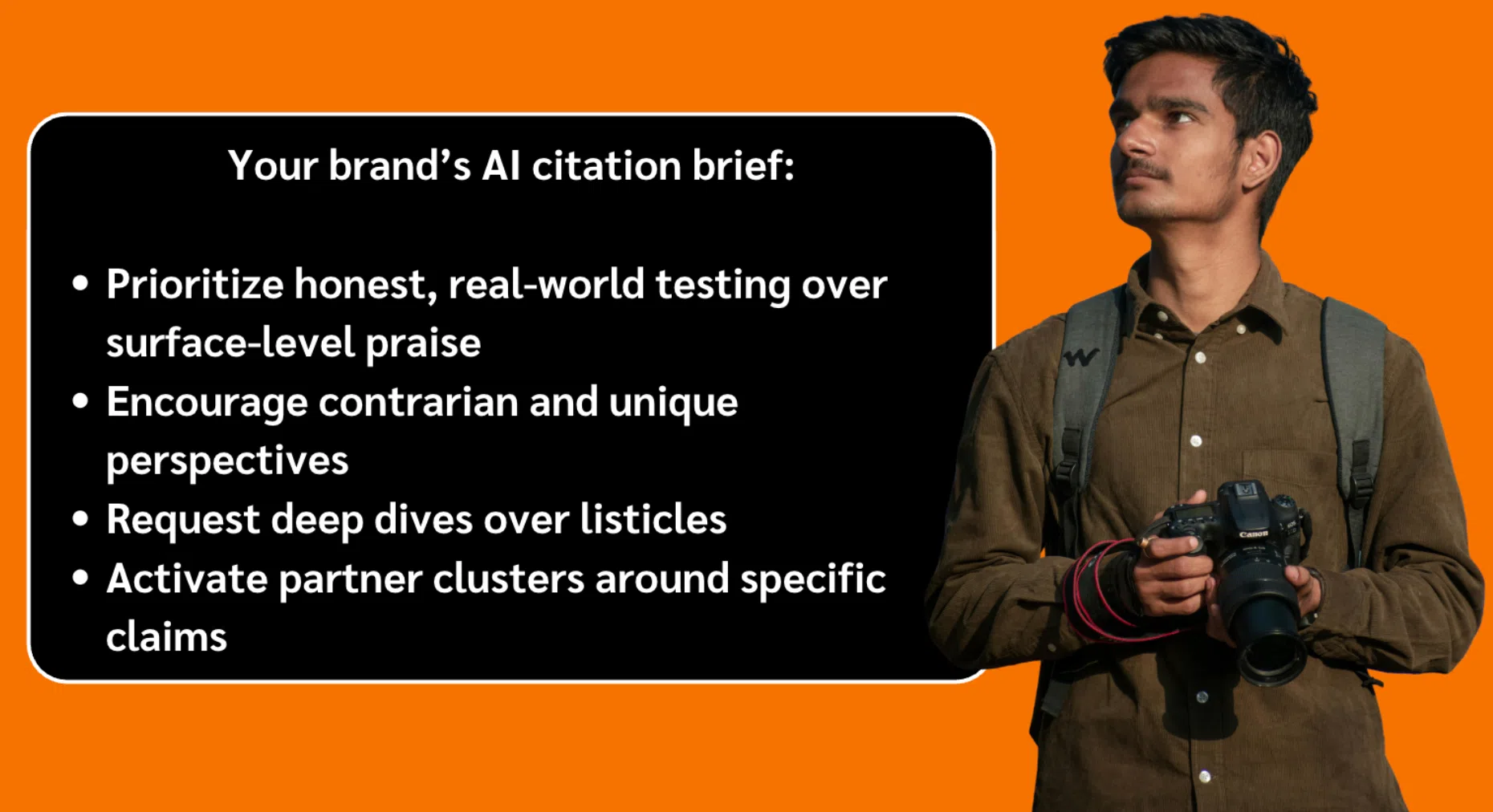
Prioritize honest, real-world testing over surface-level praise
AI systems cite content that demonstrates genuine, hands-on experience. Even if that includes negatives about your product or service. Brief your partners to document what they didn’t like alongside what they did.
An honest review of a running shoe that highlights the narrow toe box alongside the superior cushioning is far more citable than a generic endorsement. Authenticity is a ranking signal.
Encourage contrarian and unique perspectives
Because LLMs aggregate consensus, they actively look for unique viewpoints to construct a balanced answer. A partner who argues your standing desk is ideal for tall users but not for shared workspaces gives the model something specific to cite.
Generic summaries get filtered out. Precise, even contrarian, takes get surfaced.
Request deep dives over listicles
AI engines are hungry for high-density information. A 2,000-word article that includes technical specs, dimensions, setup time, and real usage scenarios feeds the model far more citable data than a “Top 10 desks under $500” roundup.
When briefing partners, ask for specific numbers, how-to guides, and product comparisons that go beyond what your own product page already says.
Activate partner clusters around specific claims
Pillay observed that AI systems respond to consistency over volume, urging brands to focus on a “handful of highly credible, relevant sources” all reinforcing the same positioning. He adds a critical nuance: “On the other hand, a large number of low-quality or inconsistent mentions won’t have the same impact.”
Identify the product claims or features where your brand is underrepresented in AI answers, then activate a cluster of credible partners simultaneously to address that specific attribute.
When multiple independent sources reinforce the same fact about your brand, the model treats it as verified. That’s the consensus signal that moves you from absent to cited.
How to track brand mentions in AI search
Influencing AI authority through partnerships only works if you know which partnerships are actually moving your citations—and which are producing noise. Tracking isn’t a separate discipline, it’s the feedback loop that tells you whether your ecosystem is working.
Adopt a share of model as your most important metric
Share of voice tells you how often your brand appeared relative to competitors across traditional media. Share of model (SoM) measures how often your brand appears as the recommended answer across AI-generated responses.
In 2026, SoM is the metric that actually reflects discovery. Traditional SEO rewarded presence. AI rewards consensus for the same brand, cited by independent authoritative sources, again and again.
Diagnose where your citations are coming from
LLMs draw from thousands of unique URLs when constructing an answer, from legacy media like Runner’s World to niche YouTube reviews to affiliate comparison sites. Knowing which sources are driving your brand’s AI visibility tells you exactly where to invest and where you’re missing.
impact.com’s partnership with Evertune does precisely this, giving brands the ability to identify which publishers and creators are feeding AI recommendations and which authoritative voices in their category aren’t mentioning them at all.
Pillay explains how your brand can track mentions across different AI tools. “Most teams start by identifying a set of important queries and checking how their brand shows up across different AI tools,” he said. “Alongside that, it’s helpful to track brand mentions more broadly across publisher content, since that’s often what feeds into AI responses.”
This visibility allows your team to move beyond passive observation and begin actively engineering the multi-source consensus required to trigger high-confidence AI citations.
Audit the consistency of your consensus signal
Tracking individual citations is only part of the picture. The more powerful diagnostic is whether your partners are all saying the same thing.
When a CNN Underscored review and a niche YouTube durability test independently arrive at the same conclusion about your product, the model treats that alignment as a verified fact.
Inconsistency across sources, on the other hand, reduces the AI’s confidence in citing your brand at all. Your tracking should surface where that alignment exists and where it breaks down.

The Answer Era: AI is changing how brands get found—and partnerships are the strategy
Learn more about the shift from the search era to the answer era in this blog.
Monitor sentiment before it becomes a citation problem
AI models also ingest sentiment. A luxury brand can run a sophisticated partnership program and find that AI systems label its products as low quality because of outdated community threads or unaddressed negative reviews from two years ago.
Tracking sentiment across the full partner ecosystem, including community and social sources, is what prevents these problems from compounding.
impact.com’s AI-powered Social Listening tools surface what creators and communities say about your brand in real time, giving your team the signal it needs to re-brief partners and correct the record before the model hardens its view.
Cristy Garcia, Chief Marketing Officer at impact.com, explained to Econsultancy that many brands are still not using AI to its full capability when it comes to measuring or managing their authority, explaining, “The industry talks a lot about AI disruption, but the uncomfortable truth is that very few teams are measuring or managing their brand’s authority in this new discovery environment.”
The brands that close that gap now build a compounding advantage. Every citation earned, every consensus signal strengthened, and every sentiment problem corrected makes the next AI answer more likely to include your brand.
Garcia warns that the window is narrowing: “By the end of 2026, AI-generated answers will influence more purchase decisions than traditional search results.” Brands that don’t understand how they show up in AI-powered discovery will lose to competitors.

“By the end of 2026, AI-generated answers will influence more purchase decisions than traditional search results.”
– Cristy Garcia, Chief Marketing Officer at impact.com
How to conduct an AI discovery audit: A 6-step checklist for tracking brand citations
Follow this six-step checklist to future-proof your brand as AI dominates the first step in the customer journey.
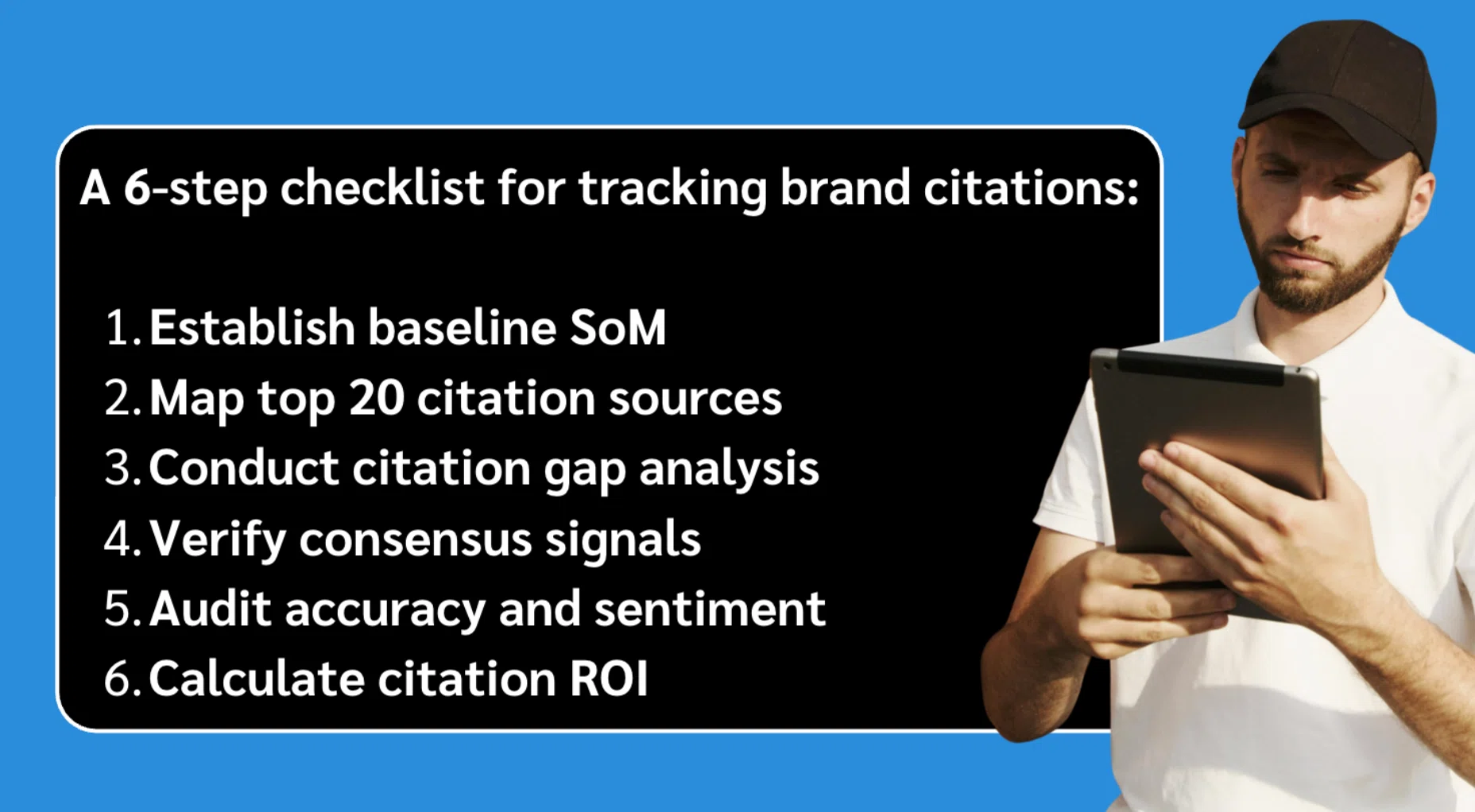
| 6-step checklist for tracking brand citations in AI answers | ||
|---|---|---|
| Audit step | Action and methodology | Strategic outcome |
| 1. Establish baseline SoM | Use tools like Evertune to run thousands of category-specific prompts across ChatGPT, Gemini, and Perplexity. | Identifies your starting SoM and current visibility vs competitors . |
| 2. Map top 20 citation sources | Trace the specific URLs LLMs use when recommending your brand. | Determines if your visibility is driven by intentional partners or random, unmanaged sources. |
| 3. Conduct citation gap analysis | Identify publishers and creators citing your competitors but ignoring you. | Surface high-priority partnership targets to close authority gaps. |
| 4. Verify consensus signals | Check for consistency across independent sources (e.g., a CNN review vs. a YouTube deep dive). | Triggers higher AI confidence, while inconsistency reduces the probability of a citation. |
| 5. Audit accuracy and sentiment | Use tracking data to find incorrect pricing, discontinued products, or low-quality sentiment from old community threads. | Allows targeted rebriefing of partners to update the content the AI is actively sourcing. |
| 6. Calculate citation ROI | Measure how specific partnership campaigns shifted your total SoM over time. | Moves beyond affiliate revenue to capture the compounding value of AI-influenced discovery.A creator whose content drives three new high-confidence AI citations is delivering compounding value that a last-click attribution model will never capture. |
FAQs
Tracking brand mentions in AI search requires a fundamentally different approach than traditional SERP monitoring. Instead of tracking keyword rankings and click-through rates, brands need to run structured prompts across multiple LLMs, map the URLs those models cite, and measure how often its brand appears as the recommended answer. Tools like Evertune automate this at scale, giving brands visibility into which sources are driving AI citations and where gaps exist.
Strategic partnerships directly impact brand mentions in AI-generated answers because LLMs don’t generate authority. They aggregate it from trusted third-party sources. When your partners, including publishers, creators, and review aggregators, consistently produce credible, high-density content about your brand, they build the consensus signal that tells the model your brand is the verified answer. More high-quality partnerships producing consistent signals means more citations.
When monitoring brand visibility across LLMs, share of model (SoM) is the primary KPI: how often your brand appears as the recommended answer across AI-generated responses. Beyond that, content managers should track citation source quality, consensus signal consistency across partners, sentiment accuracy, and how specific partnership campaigns shift SoM over time.
Tracking AI search citations is one of the most effective ways to identify high-value partnership opportunities for generative engine optimization (GEO). Citation gap analysis, mapping which publishers and creators are citing your competitors but not you, surfaces your highest-priority partnership targets. The sources already trusted by AI systems in your category are exactly the partners you need relationships with.
The consensus signal from partner sites directly influences how confidently an AI mentions a specific brand. AI models weigh consistency across independent sources when determining whether to recommend a brand.
When multiple credible, unrelated sources, such as a legacy media review, a niche YouTube test, and an affiliate comparison site, all reinforce the same claim, the model treats it as a verified fact and cites it with higher confidence. A single mention from one source, however authoritative, doesn’t produce the same effect.
How to shift from traffic acquisition to citation mastery
If your brand is not present in your partners’ content, you don’t exist in the AI’s answer. That’s not hyperbole—it’s how LLMs work.
Here are three directives to act on now:
- Establish a dedicated content authority budget. Garcia predicted in Econsultancy that by 2027, every major brand will have one. The brands that build it in 2026 will own the citations their competitors are still trying to earn.
- Implement a unified insight-to-action workflow. Use Evertune to identify where your brand is missing in AI search, then use impact.com to activate the partners needed to close those gaps.
- Operationalize the citation brief. Re-brief your top partners to move away from generic listicles toward deep-dive, hands-on content. Your partners are your brand’s primary training data for the AI era.
Check out more resources here:
- The Answer Era: AI is changing how brands get found—and partnerships are the strategy [blog]
- The Partnership Economy podcast: Optimizing for AI answers with Brian Stempeck of Evertune
- The marketer’s guide to AI-powered creator campaigns: A technology-agnostic framework [blog]
- Reimagining performance marketing: Partnerships, creators, and AI [webinar]
- AI-powered sentiment that drives real results [one sheet]
- Your partnership program is driving AI-influenced sales—your attribution model just can’t prove it [blog]