

According to impact.com’s new report, Where APAC travel brands are investing for growth,
more than 4 in 5 Australian travellers say they’d book based on an influencer’s recommendation, yet fewer than 1 in 5 did so in the past year. The truth is, travel brands haven’t built the affiliate travel marketing and partnership systems to turn that outsider trust into actual conversion. Instead, they’re putting the bulk of their budget into digital ads that only 18 percent of those same Australians trust.
The disconnect is clear: brands are spending the most on the channel travellers trust least, and underinvesting in the channel travellers are most ready to act on.
However, the findings from the APAC report show a significant shift towards performance-based channels–25% of travel brands are investing more in partnerships. Still, there are ample missed opportunities for brands to tap into partnership channels to reach all buying stages.
This analysis highlights the report’s key findings and provides actionable steps to help brands meet potential travellers where they’re actually searching.

APAC Travel Marketing Trends 2025: How Leading Travel Brands Are Driving Growth Beyond Traditional Advertising [Video]
Want a recap of this report? Check out this informative video.
Affiliate travel marketing trend 1: Trust matters more than price
While brands compete on price and visibility on low-trust platforms, customers make decisions based on an entirely different currency: reputation. Price still matters, but it’s no longer the first filter.
Before a traveller even considers the cost, they seek reassurance from sources they find credible. They rely on reviews, authentic recommendations, and brand reputation to decide which options are even worth comparing. If a brand feels untrustworthy, a good deal pushed through an ad or an OTA listing isn’t enough to convince them to book.
The data confirms this shift across the region. Reputation and positive online reviews consistently rank among the top factors influencing booking decisions in Australia, Singapore, and China. In China, 78% of travellers are likely to make a travel decision based on an influencer’s recommendation. Reputations of accommodations are universally valued— more than three-quarters of travellers across all three markets state that a property’s reputation directly influences where they choose to stay.

Source: impact.com’s Where APAC travel brands are investing for growth report
How to turn trust into bookings
The journey from consideration to conversion is filled with moments of doubt. A single click stands between a potential customer and a competitor. Winning bookings requires strategically weaving social proof directly into the full path to purchase. In this way, you turn credibility into your most powerful conversion tool.
A few focused actions can make a meaningful difference:
- Collect reviews where travellers already look
Encourage reviews on high-intent platforms like TripAdvisor, Google, and OTAs. These are often the first places travellers go to validate a brand. - Surface social proof across owned channels
Feature strong review scores, customer testimonials, and real traveller content on your website, landing pages, and booking flows. Then, reinforce trust in emails and retargeting ads. - Partner with creators your audience already trusts
Work with influencers and affiliate marketing travel bloggers who have credibility in your niche. Prioritize relevance and audience trust over reach alone.
- Invest in UGC that shows real experiences
Highlight authentic photos, videos, and stories from UGC content creators and their travel journeys. These real experiences build brand trust in a way polished ads rarely do.
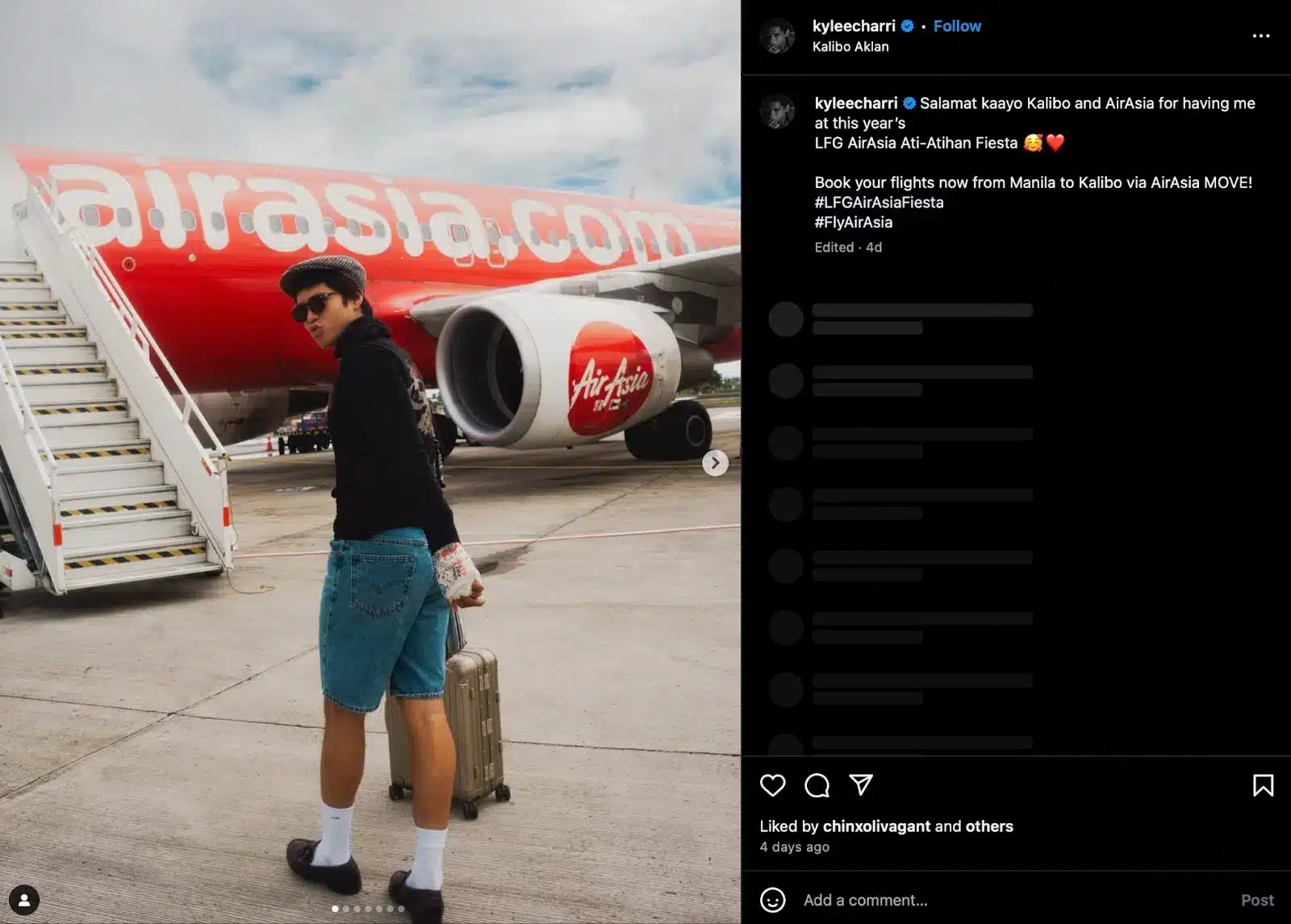
Fly AirAsia partners with influencer Kyle Echarri to promote their airline to his massive audience. Kyle shows himself actually using the service, thereby instilling consumer trust in the brand.
- Make trust part of your conversion strategy
Treat reputation as a core growth lever, not a brand metric. In trust-led travel markets, credibility gets you into the consideration stage and keeps you there.
Affiliate travel marketing trend 2: Brands back ads while travellers back recommendations
Trust in paid ads is low. Only 18% of travellers in Australia and 27% in Singapore say they trust ads for travel discovery. In contrast, travellers place far more trust in word of mouth and travel affiliate marketing channels. 59% of Chinese and 51% of Singaporean travellers use cashback and loyalty programs, and 46% of Australians use word-of-mouth recommendations when making travel decisions.
Interestingly, brands are investing in the very platforms consumers trust the least–digital advertising (2.06 out of 6) and OTAs (2.26 out of 6) rank as the top channels brands use for driving bookings.
This focus on ads creates a cycle of inefficient spending. Brands are paying a premium to capture last-click conversions from low-trust channels, failing to recognize that the customer’s decision was already shaped much earlier by a trusted source.
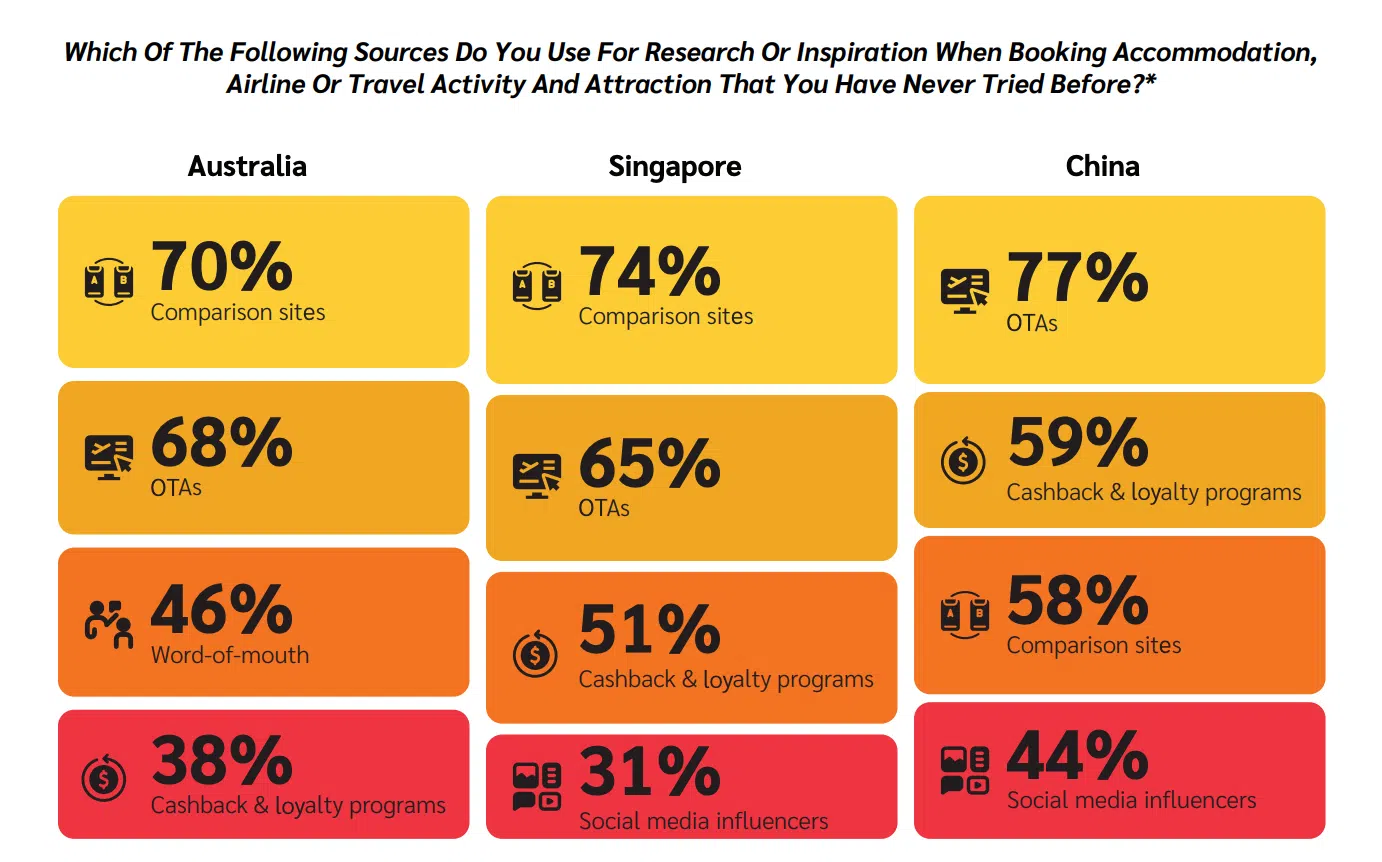
Source: impact.com’s Where APAC travel brands are investing for growth report
How to put trust-led travel affiliate marketing partnerships to work
Consumers are guided by authentic recommendations, not disruptive ads. Turning this insight into a scalable growth strategy requires a deliberate shift in execution. This means evolving your partnership efforts from a series of ad hoc campaigns into a formal, structured growth channel. By building a true partner ecosystem, you create a resilient and efficient engine that drives bookings and builds lasting trust.
- Set clear goals for partnerships
Tie your affiliate marketing for travel and creator programs to bookings, revenue, and customer acquisition, instead of only reach or impressions. - Build a formal partner program
Move beyond ad hoc collaborations. Create a structured affiliate and creator program with defined partner tiers, incentives, and performance metrics. - Prioritize partners that influence real decisions
Focus on comparison sites, loyalty and cashback platforms, and creators your audience already trusts. These partners shape where travellers actually book. - Rebalance spend toward trust-led channels
Test reallocating a portion of paid media budget into partnerships. Many brands see stronger efficiency when trust-based channels support discovery and conversion. - Review performance and scale what works
Track which partner types drive bookings and repeat customers. Double down on the relationships that deliver measurable impact.
Affiliate travel marketing trend 3: Travel brands build broader partner ecosystems
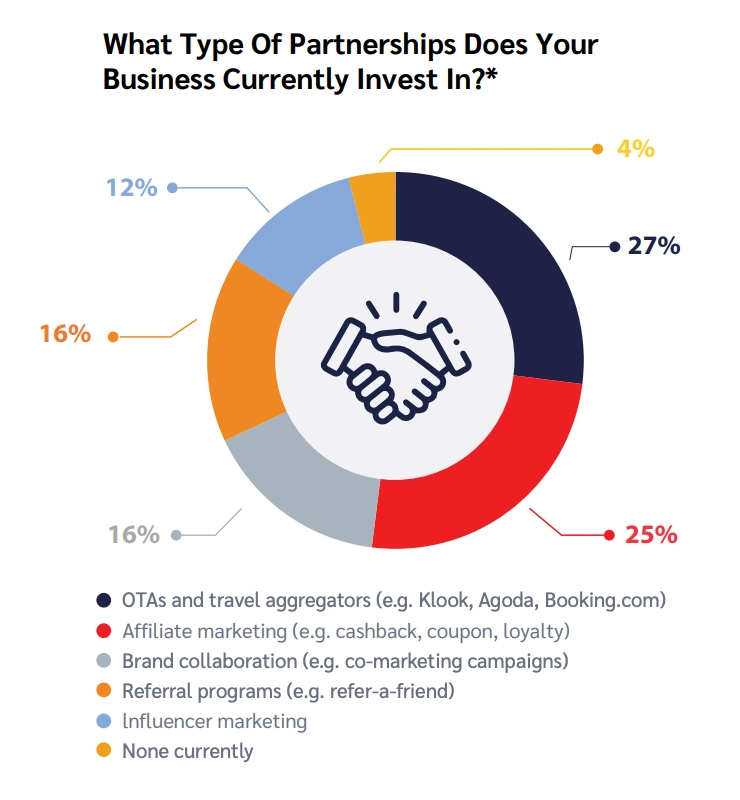
To break the cycle of inefficient spending, savvy APAC travel brands are beginning to shift budgets away from the channels customers trust the least. While OTAs and aggregators still receive the largest share of partnership investment at 27%, brands are spreading budget across affiliate marketing (25%), influencer marketing (16%), and brand collaborations (16%).
With OTA commission fees reaching up to 30%, many brands are reassessing how much value they get from aggregators. By investing more in performance-based partnerships, teams are finding a more flexible and efficient path to reach new audiences across the full buying journey.
Source: impact.com’s Where APAC travel brands are investing for growth report
How to build a higher-impact affiliate marketing for travel mix
Different partners do different jobs across the traveller journey. Here’s how to map your mix:
| Partner type | Funnel role | Example platforms | What it drives |
| Social media creators and influencers | Discovery | TikTok, Instagram, YouTube | Brand awareness, destination inspiration, first exposure to your brand. |
| Content and travel lifestyle publishers | Consideration | Travel Weekly Asia, Skift, niche travel blogs | Research validation, reputation building, SEO-driven traffic. |
| Comparison and review sites | Consideration to conversion | TripAdvisor, Google, Agoda, Kayak | Social proof at the moment of shortlisting; moves travellers from “maybe” to “who do I book with”. |
| Cashback, loyalty, and coupon platforms | Conversion | ShopBack, Fanli, loyalty program partners | Last-mile conversion for price-sensitive travellers already close to booking. |
| Brand-to-brand and non-traditional partners | Awareness and affinity | Lifestyle brands, finance partners, charities | New audience acquisition; values alignment for purpose-driven travellers. |
Affiliate travel marketing trend 4: Travel brands struggle with partnership attribution
As travel brands place greater focus on partnerships, they encounter a new and critical challenge: scaling complex partnerships. What starts with a few partners can quickly become dozens or even hundreds to manage. Tracking performance, managing payments, and proving impact becomes harder at scale. Many teams reach a point where manual workflows stop working.
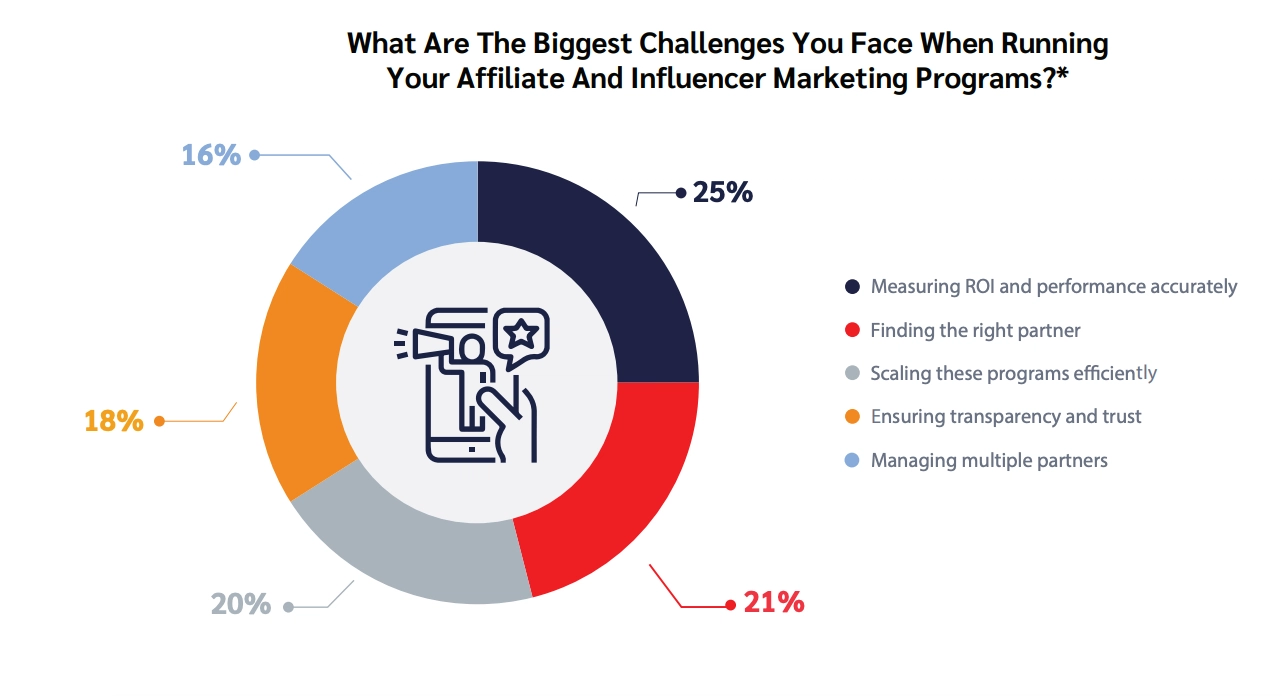
The data shows where brands are struggling. Currently, 25% of marketers say measuring ROI is the top challenge for partnership programs, while finding the right partners (21%) and scaling programs efficiently (20%) follow closely behind.
Source: impact.com’s Where APAC travel brands are investing for growth report
Measurement gaps remain a barrier to scale. Only 20% of brands track CAC and just 18% track AOV in affiliate programs, making it harder to prove true partner impact and optimize for profitable growth.
These challenges compound. When measurement is unclear, it becomes harder to justify investment. When programs rely on manual processes, growth slows, and errors increase.
Traditional attribution does not reflect how partnerships create value. Creators, publishers, and review platforms often influence travellers early in the journey. Their impact often shows up in awareness and consideration rather than last-click bookings. Without the right tracking, these partners are undervalued. Managing large partner networks without proper tools also limits how far programs can scale.
How to scale affiliate marketing for travel with the right technology
To reach the full potential of your program, you need technology that replaces manual effort with automated efficiency. A dedicated partnership management platform provides the foundation for managing and proving partner value, and creating a high-impact growth channel.
Here are a few practical steps:
- Automate tracking across partners
Move away from manual reporting. Use a platform that gives you consistent, reliable performance data across affiliates, creators, and publishers. - Simplify partner payments
Centralize payments to reduce operational overhead and avoid errors. This helps you scale your partner network without adding manual work. - Use data to prove ROI
Track performance beyond last click so you can show how partners influence discovery, consideration, and bookings. That way, it’s easier to defend partnership budget and scale what works. - Design for scale, not maintenance
Choose tools that support partner discovery, onboarding, and management as your program grows. Scaling partnerships should not require scaling headcount. - Look at proven examples for inspiration
Skyscanner increased bookings by 77% after consolidating more than 12,000 partners onto a single platform. The move helped the team scale faster, manage partners more efficiently, and diversify their partner mix while driving measurable growth.

Skyscanner increases travel bookings by 77% with impact.com
Learn how travel search engine Skyscanner increased bookings and revenue growth with impact.com.
Looking ahead to 2026 and beyond: Brands should shift focus to travel affiliate marketing and partnership growth
Despite high competition in the travel industry, brands continue to heavily invest in digital ads—the channel customers trust the least. The reality? Travellers make decisions based on reputation, authentic reviews, and trusted recommendations rather than ads. This begs the question, “why aren’t brands putting the most investment into partnership channels?”
The APAC travel brands that win the next five years of regional growth aren’t the ones with the biggest ad budgets, they’re the ones that will capitalize on the trust gap first. Implementing partnership marketing strategies allows brands to align spending with trusted channels and pay for voices that customers actually listen to.
However, manually managing different partnerships can lead to a lack of attribution and missed opportunities to maximize bookings. Using a partnership management platform like impact.com helps you successfully track partners and the value they bring to your partnership program.
Where APAC travel brands are investing for growth [Industry report]
Like what you just read? Then check out the full, detailed report
Want to learn more about taking your travel affiliate marketing program to the next level?
Check out these impact.com partnership resources:
- 6 affiliate marketing strategies borrowed from Travelstart’s success story [blog]
- APAC Travel Webinar: Riding the Wave with Influencer Marketing [webinar]
- How travel brands in Southeast Asia can expand reach and revenue with influencer marketing [blog]
- Southeast Asia travel marketing: Top 3 affiliate strategies to boost bookings [blog]
FAQs
Affiliate travel marketing is a performance-based strategy where travel brands pay a commission to partners, such as affiliate travel bloggers or influencers, for each booking they generate. These partners, known as affiliates, promote the brand using unique, trackable links within their content. When a customer clicks a link and makes a purchase, the technology attributes the sale back to the affiliate, who then earns a commission. This model is powerful because it allows travel brands to overcome ad distrust by leveraging authentic voices and only paying for confirmed sales, ensuring a high return on investment.
18% of Australian and 27% of Singaporean travellers trust paid ads for travel information. This requires a strategic shift away from paid media towards a diverse ecosystem of partners. Brands are already using more budget in partnerships— 25% of travel brands are investing more in affiliate marketing. Brands are also allocating their budgets across OTAs (27%), affiliate marketing (25%), and influencer marketing (16%). As these programs expand, the need for better technology becomes critical—25% of marketers report that measuring ROI is their single biggest challenge.
A good affiliate travel strategy starts with defining clear goals and understanding your customer’s path to purchase. This insight allows you to recruit a diverse network of partners, from content creators to loyalty sites, who can authentically reach your target audience. To drive success, you must empower them with competitive commission rates and the right marketing tools, like deep linking and high-quality creatives. Finally, consistently track performance data to optimize your approach, strengthen partner relationships, and ensure long-term, profitable growth.