

Picture a creator who did everything right. She built a fashion newsletter that reached 30,000 subscribers, posted consistently, and picked a platform with strong discovery tools. Her open rates were solid. Her affiliate revenue was not.
The problem wasn’t her reach—it was the brand partnerships underneath her content.
The products she promoted were easy to link to, but they weren’t a good fit for her audience. Readers opened her emails. They just didn’t act on her recommendations.
Affiliate marketing for bloggers can be a tricky way to earn money—creators often hit a wall at the early monetization stage. They optimize the distribution side, including the platform choice, posting cadence, subject lines, and treat the brand partnership as an afterthought.
To break through this monetization wall, creators must pair a thoughtful brand partnership strategy with a high-performing distribution channel, such as newsletters. The data makes a strong case for email marketing as the right vehicle for affiliate growth. According to EmailTooltester’s research article entitled “Social Media vs Email Marketing: Which One to Focus on in 2026?”, email achieves a conversion rate of 8% against social media’s 3%, and an ROI of 3,500% against social media’s 180%.
Litmus’ “The ROI of Email Marketing [Infographic]” puts average email marketing ROI at $36–$42 for every $1 spent––higher than paid ads, social media, and SEO. The reason for this success is that newsletter subscribers have to opt in. They chose to let you into their inbox, and that consent changes how they respond to recommendations.
But a high-converting channel like email only generates revenue if the brand partnerships within it are relevant to your audience. The platform is the revenue vehicle, while the brand partnership is the driving force.
Why newsletters outperform social media for affiliate conversions
The unique opt-in consent of a newsletter provides the direct, high-trust communication channel you need to sustain the brand partnerships that ultimately power your affiliate program.
But while newsletters are a great way to grow partnerships, most creators are measuring the wrong things—followers, likes, and impressions. Those numbers matter, but they’re an insufficient predictor of affiliate revenue.
Vanity metrics measure views. Conversion metrics measure action. Social media excels at the former. Newsletters are built for the latter.
Newsletter subscribers make an active choice to hear from you—no algorithm decided to surface your content that day, and no competing post bumped yours from the feed. Your email lands directly in their inbox because they asked for it. Opt-in consent creates a vastly different reader relationship than a social follow—and that difference shows up in the data.
According to EmailToolTester’s research comparing email marketing and social media performance, the gap is significant across every metric that matters for affiliate revenue:
| Metric | Social media | |
| Open/view rate | 15-25% | 2-4% (organic) |
| Click-through rate | 2.90% | 1.36% |
| Conversion rate | 8% | 3% |
| ROI | 3,500% | 180% |
EmailTooltester’s research article entitled “Social Media vs Email Marketing: Which One to Focus on in 2026?”
A social post reaches a fraction of your audience organically. The readers it does reach don’t ask for it. For affiliate marketing specifically, that trust differential is the whole game. Readers who trust your editorial voice are far more likely to act on a product recommendation than a follower who scrolled past your post between two other pieces of content.
If newsletters are the stronger vehicle, the next question is which newsletter platform best serves affiliate creators.
Beehiiv vs Substack affiliate marketing: which newsletter platform is built for revenue growth?
Whether you choose the advanced automation of beehiiv or the community-focused approach of Substack, the platform is merely the vehicle that moves your business forward. The real force of revenue growth is the brand partnerships featured in your content.
Both platforms can support affiliate revenue. They just approach it differently, and which one works for you depends less on features and more on where you are in your monetization journey.
Beehiiv: Built for creators who want to operationalize
Beehiiv is the more technically capable platform for affiliate marketing. Three features separate it from Substack for creators at the monetization stage:
- Audience segmentation. According to beehiiv, the platform lets you group subscribers by behavior and past engagement, so you’re sending high-ticket affiliate offers to your most active readers, not your entire list. Tyler Denk, CEO of beehiiv, has seen this tradeoff directly:

“For creators, whenever the incentives are tied to audience retention rather than content output, they pay attention to quality and bring the required consistency in storytelling. At beehiiv, we’ve worked with influencers on a per-post basis; however, this doesn’t guarantee trust, relationship-building, or repeated engagement. We wanted to create an ecosystem where creators are earning their checks by bringing an audience that matters to our brand.”
– Tyler Denk, CEO of beehiiv
- Conversion analytics. According to beehiiv, the platform includes click-through rates, A/B testing on link placements, and performance data that tells you what’s actually driving revenue—not just how many people opened the email.
- Pricing favors earners. Beehiiv notes that it charges a flat monthly fee ($0-$99/month) and takes 0% of subscription revenue. According to Substack, its platform is free to start, but it takes a 10% cut of all paid subscription income. As your revenue grows, the math shifts significantly in beehiiv’s favor.
Posts are SEO-indexed, automation is built in, and a native ad network gives creators a second revenue stream alongside affiliate links.
Beehiiv is the stronger choice for creators who have already built an engaged audience and want to treat affiliate revenue as a system, not a one-off.
Both beehiiv and Substack allow creators to effectively monetize branded content by directly tying it into their niche. For instance, fashion curator Vivian Rose uses her beehiiv newsletter called “The Girly GirlBlog” to blend aspirational fashion and beauty content with direct, highly targeted brand promotions.
Instead of using generic, disjointed ads, her newsletter features hand-picked edits that mirror the style and aesthetic that appeals to her audience. She thoughtfully connects her personal niche to her audience’s needs.
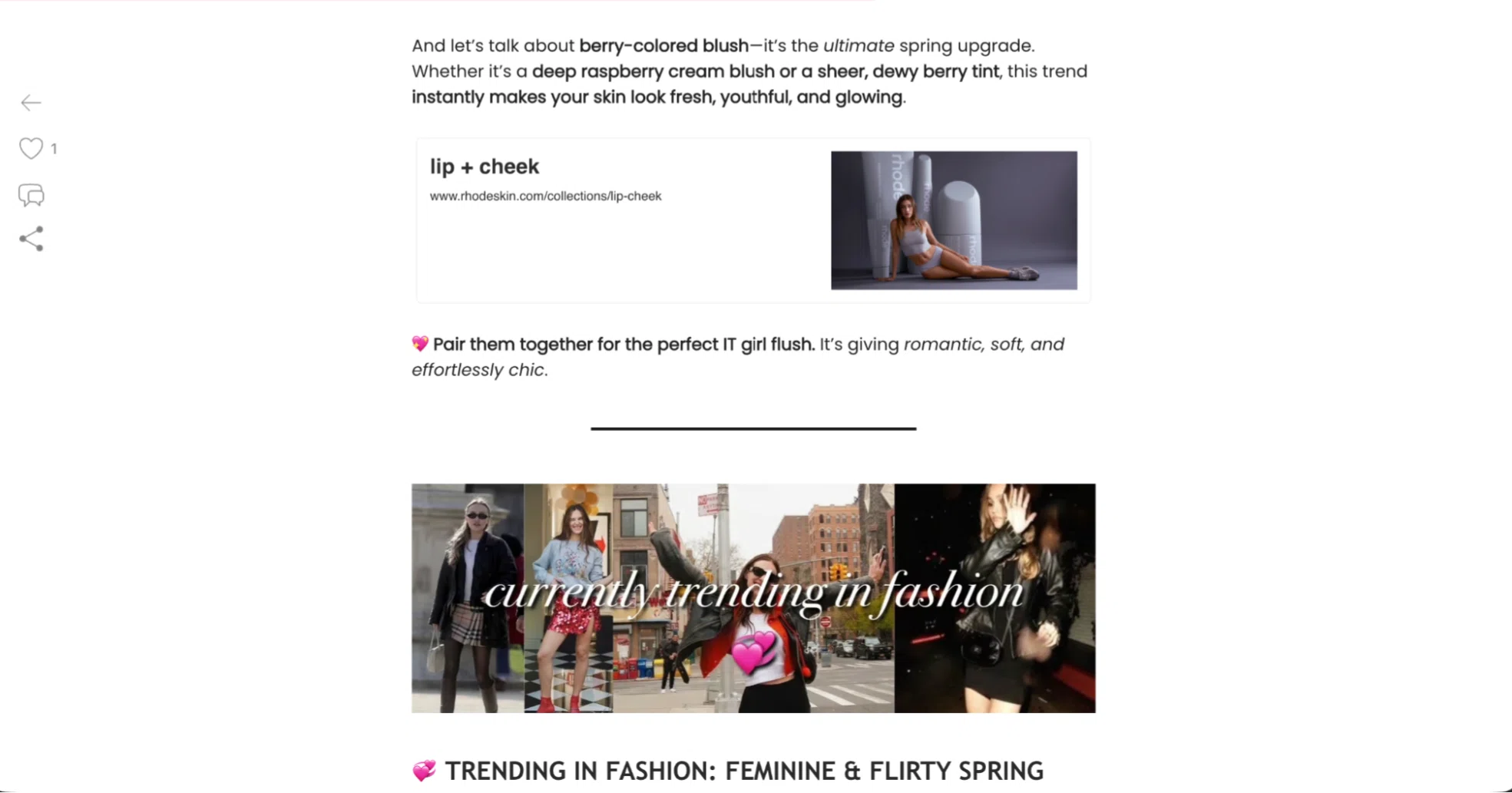
Vivian Rose’s beehiiv newsletter “The Girly GirlBlog” gives her personal recommendations for a lip and cheek color and ties in a related affiliate link in a neat little box.
Substack: built for trust and editorial depth
Substack’s advantages are structural rather than technical. The platform places greater importance on community building, making it ideal for creators who don’t yet have large followings.
- Discovery and growth. According to Substack, its Recommendations feature lets writers cross-promote each other during the subscriber sign-up flow—one of the most effective organic growth tools available to newsletter creators. According to Substack’s article entitled “Introducing Substack Notes”, Notes was launched in April 2023 and functions as a short-form social feed distributed algorithmically to non-subscribers, giving writers a built-in viral mechanism that beehiiv doesn’t replicate.
- Community. According to Substack, it has a chat and live video feed. These tools keep subscribers engaged beyond the inbox, building the kind of audience depth that makes affiliate recommendations land.
- Native ads. According to The Substack Post article entitled “A media future to believe in”, Substack introduced native ads in July 2025, following a $100 million funding round led by BOND and the Chernin Group. The use of native ads is a significant shift for a platform that had previously positioned itself as strictly ad-free. For creators without large paid subscriber bases, native ads open a new revenue path that doesn’t rely on affiliate links alone.
The trade-off is technical depth. Analytics are basic. Segmentation is limited to subscription, and there’s no A/B testing.
What Substack does offer is editorial credibility, and for affiliate marketing, that’s not a small thing. Take Emilia Petrarca’s Substack called Shop Rat. It integrates affiliate links across fashion and culture content read by 32,000 subscribers. The links work because Emilia’s editorial, not promotional voice, takes the lead. Readers act on her recommendations because she’s earned that trust through consistent writing, not because she optimized her link placement. To show her real and authentic thoughts, she often posts pictures of herself wearing the clothing she’s promoting.
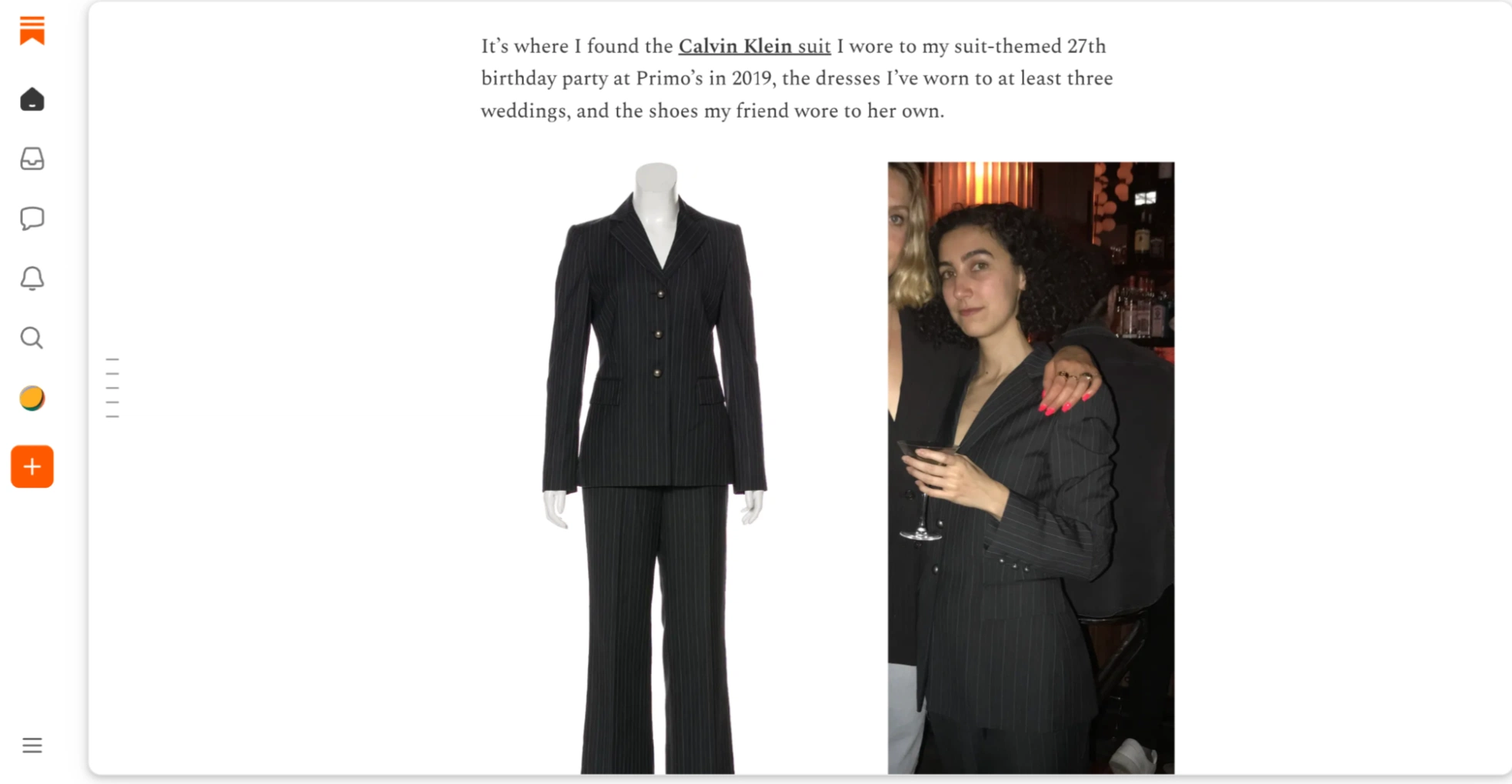
Emilia Petrarca’s Substack article called “What I’ve Learned from a Decade of Shopping The RealReal” shows her true feelings about a Calvin Klein suit she’s promoting.
Both Substack and beehiiv allow cross-platform use to build trust and engagement with audiences. Take Melanie Masarin, the founder of beverage brand Ghia. She uses ShopMy affiliate links woven into fashion content that reflects her genuine interests. The affiliate layer is secondary to the editorial layer—the link appears right at the end of the article. The editorial-first sequencing is exactly why it converts.
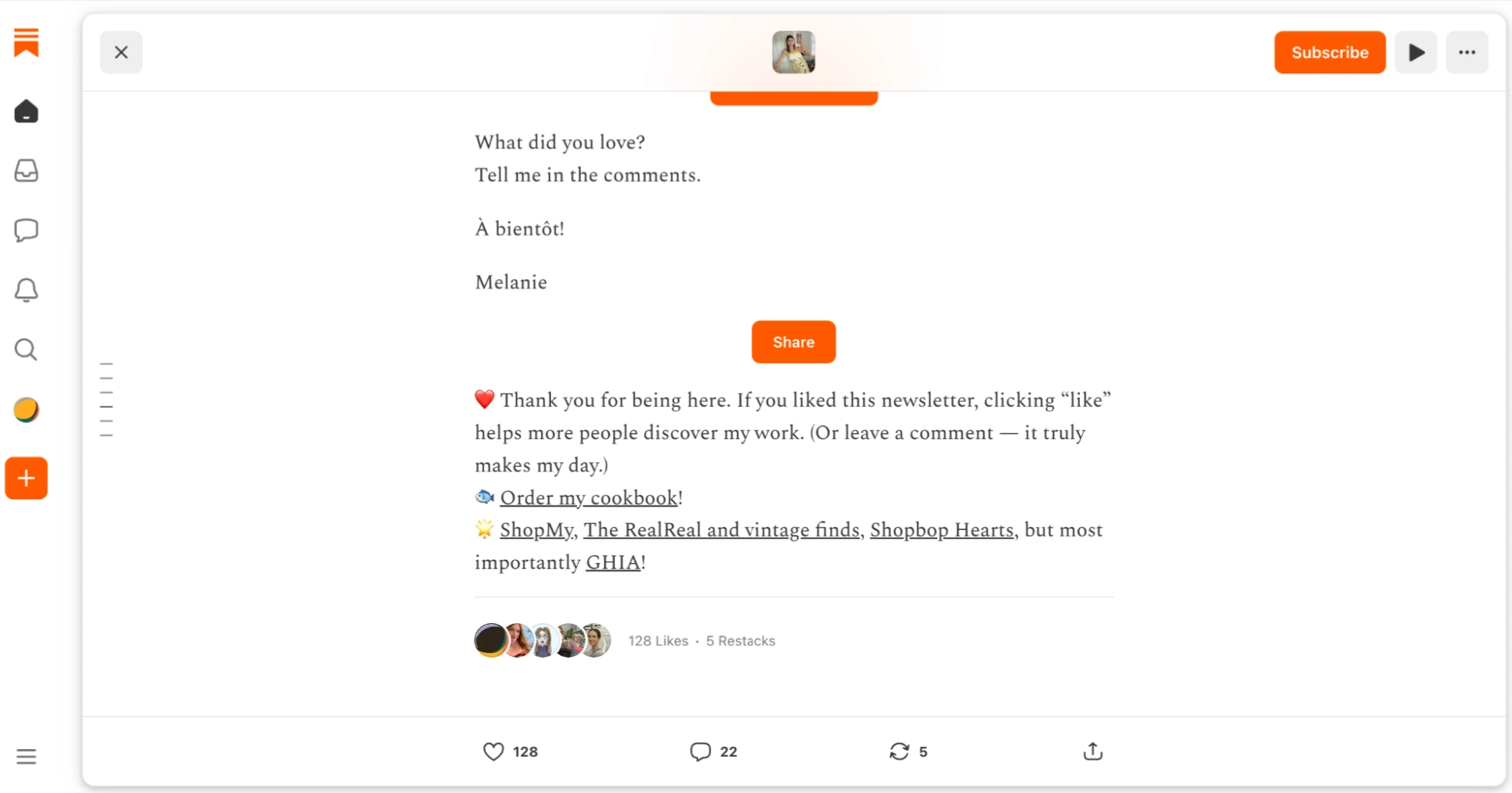
Melanie includes ShopMy links at the end of her “Night Shade” newsletters so readers have easy access to shop the items without getting interrupted while reading.
Affiliate policies: what both platforms allow
Neither platform prohibits affiliate links. But both limit content whose primary purpose is promotion. Beehiiv’s policy permits affiliate links when they’re incidental to content that delivers genuine value—not when affiliate revenue is the content’s reason for existing.
Substack’s guidelines draw the same line: the platform is built for editorial content, and publications that exist primarily to drive traffic or distribute offers risk removal.
The practical implication is straightforward. Editorial integrity isn’t a constraint to work around on either platform. Instead, it’s the mechanism that makes newsletter trust valuable in the first place.
On both platforms, link stuffing doesn’t just violate policy—it undermines the opt-in trust that makes newsletters outperform social media in the first place.
Substack vs. beehiiv: quick comparison
| Feature | beehiiv | Substack |
| Audience segmentation | Behavioral and engagement-based | Subscription tier only |
| Conversion analytics | Deep (CTR, A/B testing) | Basic (open rates, total clicks) |
| Pricing | Flat monthly fee, 0% revenue cut | Free to start, 10% cut of paid revenue |
| SEO-indexed posts | Yes | Limited |
| Community and discovery | Ad network, automation | Notes, Recommendations, Chat, live video |
The limitation neither beehiiv nor Substack solves
Choose beehiiv if you want the technical tools to scale affiliate revenue. Pick Substack if you’re prioritizing audience depth, editorial credibility, and community. Both are viable vehicles.
But neither platform gives you a way to find, vet, track, and manage the brand partnerships underneath your affiliate links. The platform determines how your content reaches readers. The brand partnership determines what you’re promoting, what you’re earning, and whether revenue compounds over time. Connecting with the right brands is the problem worth solving next.
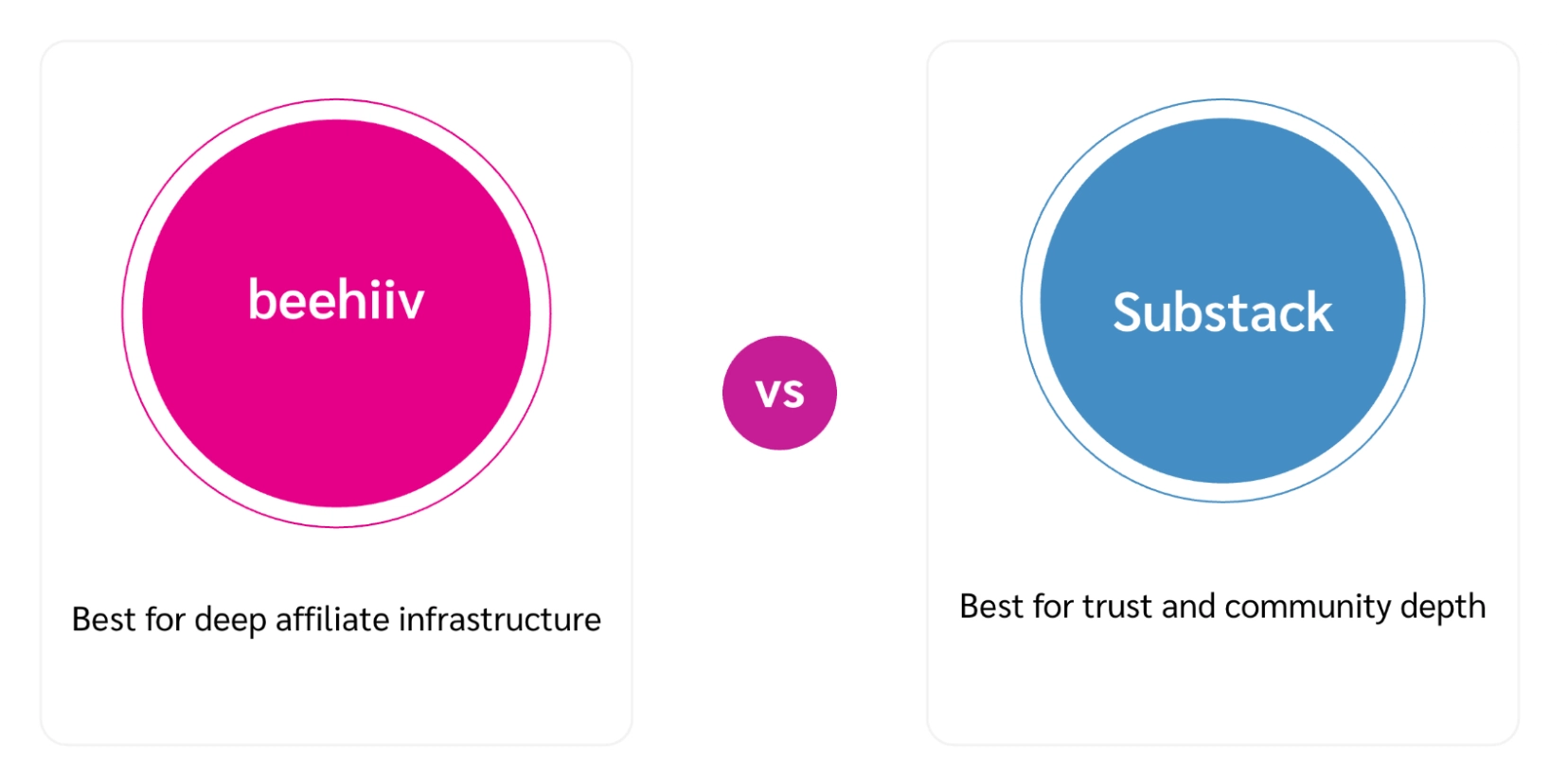
The strategy layer: why your brand partnership quality determines your revenue ceiling
The Substack vs. beehiiv debate is a distribution conversation. It matters, but it’s the wrong place to look if you want to understand why some creators generate consistent affiliate revenue, and others don’t.
Revenue is determined upstream, by the quality of the brand relationship underneath the content. Platform choice sets the vehicle. Brand partnership quality sets the ceiling.
How to find the right brands
The traditional affiliate model puts creators in a passive position: join a network, take what’s available, and hope something converts. Passivity is also what keeps affiliate revenue inconsistent. Without a deliberate process for finding and vetting brand partners, most creators end up promoting whatever is easiest to access, not what’s most relevant to their audience.
A well-structured recruitment strategy, powered by a partnership platform’s tools, connects you with partners who match your audience, niche, and goals. The results are a curated brand portfolio and more predictable revenue outcomes.
With the impact.com Brand Marketplace, creators aren’t blindly pulling links to distribute; they are actively sourcing high-quality links to power their revenue. Searching by niche, commission structure, and payout model means finding the brand fit that actually converts—not whatever happens to be available.
In the recruitment process, you need to forge genuine, long-term brand relationships—a partnership platform allows you to do that. Instead of waiting for inbound pitches or relying on a platform algorithm, you can use impact.com’s in-app messaging to directly contact brand managers and proactively pitch your value, negotiate rates, and align on creative vision. This direct, human-to-human communication lets you build strong brand partnerships that are the true driver of consistent, scalable income.
Advanced tracking and attribution: Track what actually converts
The second challenge after finding the right brand is proving your value to them. Newsletter attribution has a cross-device tracking gap that most creators don’t account for. A reader opens your email on their phone, clicks a link, and then buys on their laptop a few hours or days later. Without cross-device tracking, that conversion disappears. A platform like impact.com follows the customer journey across devices and sessions, so newsletter-driven conversions don’t fall through the cracks. Additionally, a creator-specific code tracks conversions without any cookie dependency, device use gap, or lost commission. When you’re making the case to a brand manager that your newsletter drives real revenue, the creator promo code is verifiable data. An open rate screenshot is not.
In an editorial newsletter where the writing is the product, clunky, tracking-heavy URLs can disrupt the reader’s experience and erode editorial trust. Using impact.com’s Deep Linking tool, creators can instantly generate clean, readable, and direct URLs that point straight to specific product pages rather than generic homepages. Clean, direct URLs keep the reading experience intact—the reader stays in the content, not the mechanics.
Platform choice matters less than most creators think. A beehiiv newsletter with misaligned brand partners will underperform a Substack one with a perfectly matched sponsor every time. The platform gets your content to readers. The brand partnership determines what you earn from it. Finding, tracking, and managing those partnerships through the right technology is what turns a newsletter with good readership into a business with predictable revenue.

Distribution gets you read. Brand partnerships get you paid.
The evidence shows that newsletters vastly outperform social media for affiliate conversions. However, the newsletter platform choice is important but secondary—brand partnership quality is the primary revenue driver. Newsletter platforms don’t determine what you earn—the brand partnerships underneath them do.
Distribution and partnership quality are two separate levers. Most creators spend their energy on the first and treat the second as an afterthought. They might join whatever network is easiest, promote any available brands, and wonder why revenue stays flat.
The most useful questions don’t revolve around which platform you should publish on. Your questions should be along the lines of:
- Which brands am I building direct relationships with?
- Are these relationships strongly aligned with my audience’s needs?
- Do I have the right tools to track and grow these partnerships over time?
Get these basics right, and the newsletter platform goes from being a passive promotional channel to a sustainable affiliate revenue stream.
Want to learn more about monetizing your content?
Check out these impact.com resources:
- A content creator’s guide to making money [2026] [blog]
- 12 highest-paying travel affiliate programs in 2026 (up to 40% commission) [blog]
- 14 high-paying beauty affiliate programs that you’ve never heard of (up to $50 per conversion) [blog]
- How to become a fitness influencer in 2026: 8 steps to landing brand deals [blog]
- 6 questions to consider when determining your content creator rates [blog
FAQs
The best platform for affiliate marketing for bloggers depends on where you are in your monetization journey. Beehiiv is better suited to creators who want technical systems: audience segmentation, conversion analytics, and SEO-indexed posts. Substack works better for writers prioritizing audience depth, editorial credibility, and community. What matters more than platform choice is the quality of your brand partnerships. A well-matched brand relationship will outperform a technically optimized newsletter promoting the wrong products every time.
The main difference between Substack and beehiiv for affiliate marketing comes down to technical tools vs. editorial depth. Beehiiv offers behavioral audience segmentation, A/B testing, detailed conversion analytics, and a flat monthly fee with no revenue cut. Substack’s strengths are editorial and social—its Recommendations feature drives organic subscriber growth, Notes gives writers algorithmic reach beyond their existing audience, and its community tools build reader relationships that make affiliate recommendations credible.
A partnership platform like impact.com helps bloggers earn more from affiliate marketing by solving two problems: finding the right brands and accurately tracking conversions. impact.com’s Brand Marketplace lets creators search and filter brand partners by niche, commission structure, and payout model. Creators can also contact brand managers directly rather than waiting for inbound opportunities. On the tracking side, cross-device attribution captures conversions across mobile and desktop. Promo code tracking resolves the cookie issue common in email environments, ensuring conversions are accurately attributed. These tools change affiliate marketing from a passive activity into a manageable business.