

The research-first buyer has changed the influencer marketing game
Something shifted in how people shop in 2025, and the data is hard to ignore.
According to impact.com’s 2025 Affiliate Benchmark Report—which analyzed 2,368 North American retail brands across the full calendar year—shoppers clicked through partner links 2 percent more than the year before.
But actually completed purchases 5 percent less often. Conversion rates fell 6 percent year-over-year. On the surface, that looks like weakening demand. It wasn’t.
Shoppers were simply researching harder, comparing more options, and waiting until they were genuinely confident before committing. Then consolidated into fewer, higher-value purchases.
Surprisingly, consumer spending fell just 1 percent despite far fewer transactions.
That shift changes who matters in your influencer program. A celebrity campaign can create a cultural moment. Gap’s collaboration with Troye Sivan genuinely brought a new generation back to the brand.
But cultural moments don’t answer the question a deliberate buyer is asking at 11 p.m.: Does this actually work for someone like me? For that, they turn to a creator they trust.
That’s the job nano- and micro-influencers were built for. And brands are starting to notice. OLIPOP built its entire creator program on $36 product samples and a 10 percent performance commission—and it now drives 12 percent of total sales at a 982 percent ROI.
This guide breaks down why smaller creators deliver outsized results and how to work with micro-influencers effectively.
The heart of community building: What is a nano- and micro-influencer?
Before diving into strategy, it helps to understand what makes these two creator tiers distinct—not just by follower count, but by the specific role they play in a buyer’s decision-making process.
Nano-influencers: Your community trust-builders
Nano-influencers typically have fewer than 15,000 followers. That sounds like a limitation. It’s actually their superpower.
These creators know their audience personally. They respond to every comment, answer DMs, and often have real-life relationships with their followers.
When a nano-influencer recommends something, it carries the weight of a friend’s opinion. Their content feels unscripted because it is. Their kitchens are lived in. Their reviews are honest, sometimes brutally so.
For a buyer who’s deep in research mode (comparing options, reading reviews, looking for a reason to commit) that kind of candid, personal endorsement is exactly what tips the scales. Nano-influencers don’t reach millions—they reach the right people, at the right moment, with the right level of trust.
What marketers should know:
- They make up 76 percent of Instagram’s influencer ecosystem
- They maintain the highest engagement rates of any tier, averaging 1.7–13 percent depending on the platform
- Best deployed for hyper-local campaigns, product seeding, and testing messaging before scaling
- Plan to work with a higher volume of nano-creators to build meaningful reach
Micro-influencers: Your niche experts
Micro-influencers fall in the 15,000-75,000 followers range. These creators have built audiences around specific topics, whether that’s budget travel, sustainable fashion, plant-based cooking, or vintage sneakers. Their followers show up because they trust that creator’s knowledge on a particular subject.
This is a meaningful distinction for the deliberate buyer. When someone is researching whether your product is right for them, they’re looking for an informed opinion from someone who understands their specific context.
A micro-influencer in the sustainable home niche hasn’t accumulated random followers. They’ve built an audience of people who actively seek eco-friendly alternatives and trust that creator to filter the good from the greenwashing. The creator is introducing your brand to a pre-qualified audience that already speaks the language of your category.
What marketers should know:
- They offer the best balance of professional-grade content and an authentic community feel
- Engagement rates range from 1.22–13 percent depending on platform and niche
- Best deployed for niche targeting, scalable programs, and education-first content that converts over time
- Focus on long-term ambassadorships rather than one-off posts—their authority compounds with repetition
How smaller creators build community
What both tiers share is something you can’t manufacture with a production budget: genuine two-way relationships with their audiences. They remember repeat commenters and ask their audience questions and actually respond. They share failures alongside wins, which creates the kind of vulnerability that builds real loyalty.
For your brand, this matters because you’re getting access to a trust infrastructure that took years to build. The creator’s audience is already engaged, already invested, and already predisposed to take their recommendations seriously. That’s a different starting point than an ad impression.
Quick comparison: Nano- vs micro-influencers
| Characteristic | Nano-influencer | Micro-influencer |
| Follower count | <15k | 15k-75k |
| Primary strength | Community trust | Niche expertise |
| Typical cost per post | $500-$2000 | $2000-8000 |
| Best for | Testing, authenticity, hyper-local campaigns | Balanced reach, niche targeting, scalable programs |
| Content style | Raw, unpolished, highly relatable | Polished but genuine |

The influencer portfolio approach: When to deploy micro-influencers vs macro-influencers vs celebrity partnerships
A sophisticated influencer strategy uses all tiers (celebrity, macro, and micro) for maximum ROI. This guide reveals the strategic framework for deploying each tier to achieve specific business objectives, from mass awareness to niche conversion.
5 undeniable reasons to partner with nano- and micro-influencers
The case for smaller creators isn’t just about affordability or engagement rates, though both are compelling. It’s about matching the right voice to the right moment in your buyer’s journey. Here’s why nano- and micro-influencers are built for the way people shop in 2026.
1. Their authenticity builds the trust that drives research-phase decisions
Your audience has developed a finely tuned radar for inauthenticity. Nano- and micro-influencers built their followings by being real. Their reviews are candid. Their recommendations come with context: How they actually use the product, what they’d change, and whether it’s worth the price.
When a creator has spent months or years sharing honest opinions with an audience that knows them, a brand recommendation carries genuine weight. It feels less like an ad and more like advice.
This matters most during the research phase, when a buyer is actively weighing whether to commit or walk away. A polished brand asset won’t answer their questions. A creator they trust will.
According to Influencer Marketing Hub’s 2025 Benchmark Report, marketers reported more success with micro-influencers than any other creator tier—not because they’re cheaper, but because their audiences actually believe them.
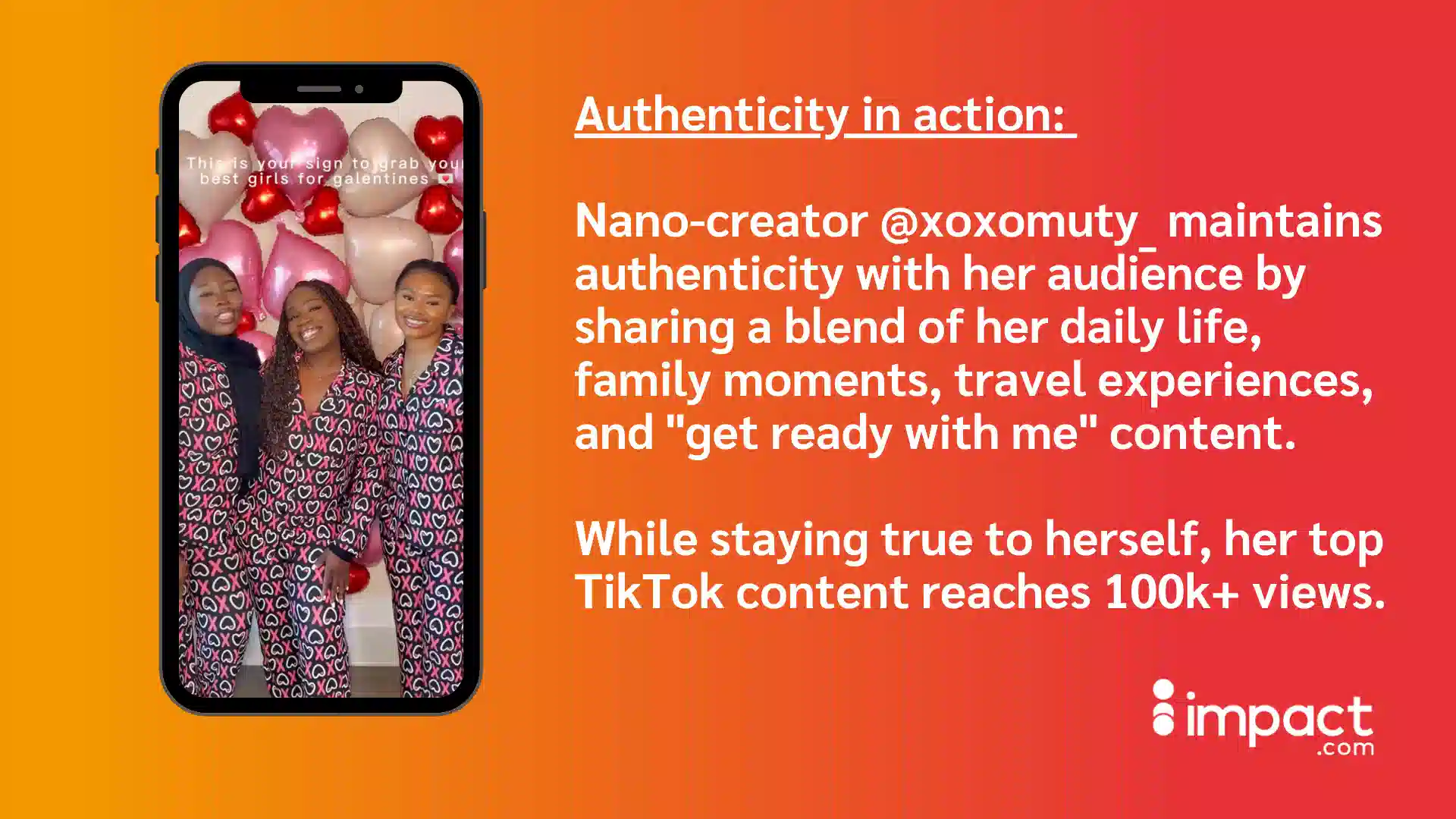
Authenticity in action: Nano-creator @xoxomuty maintains authenticity with her audience by sharing a blend of her daily life, family moments, travel experiences, and “get ready with me” content. While staying true to herself, her top TikTok content reaches 100k+ views—proof that genuine personality scales further than manufactured polish.
2. Their niche expertise answers the questions your buyer is actually asking
Would you rather reach one million people broadly, or 30,000 people who are actively looking for exactly what you sell?
Micro-influencers don’t accumulate random audiences. They build communities around specific expertise. Their followers show up specifically because they trust that creator’s judgment in that category. When a micro-influencer in the clean beauty space recommends your SPF moisturizer, they’re not introducing your brand to skeptics.
This is the “pre-qualified audience” advantage that broad reach campaigns simply can’t replicate. A celebrity endorsement tells millions of people your brand exists. A niche micro-influencer tells 25,000 highly relevant people your brand is worth their money. For a buyer doing serious research before committing, the second message is exponentially more valuable.
Nano-creators play a similar role at a more local or community level. Their niche is often their town, their life stage, or their very specific identity. Their followers see themselves in the creator beyond just engaging with topics of interest.
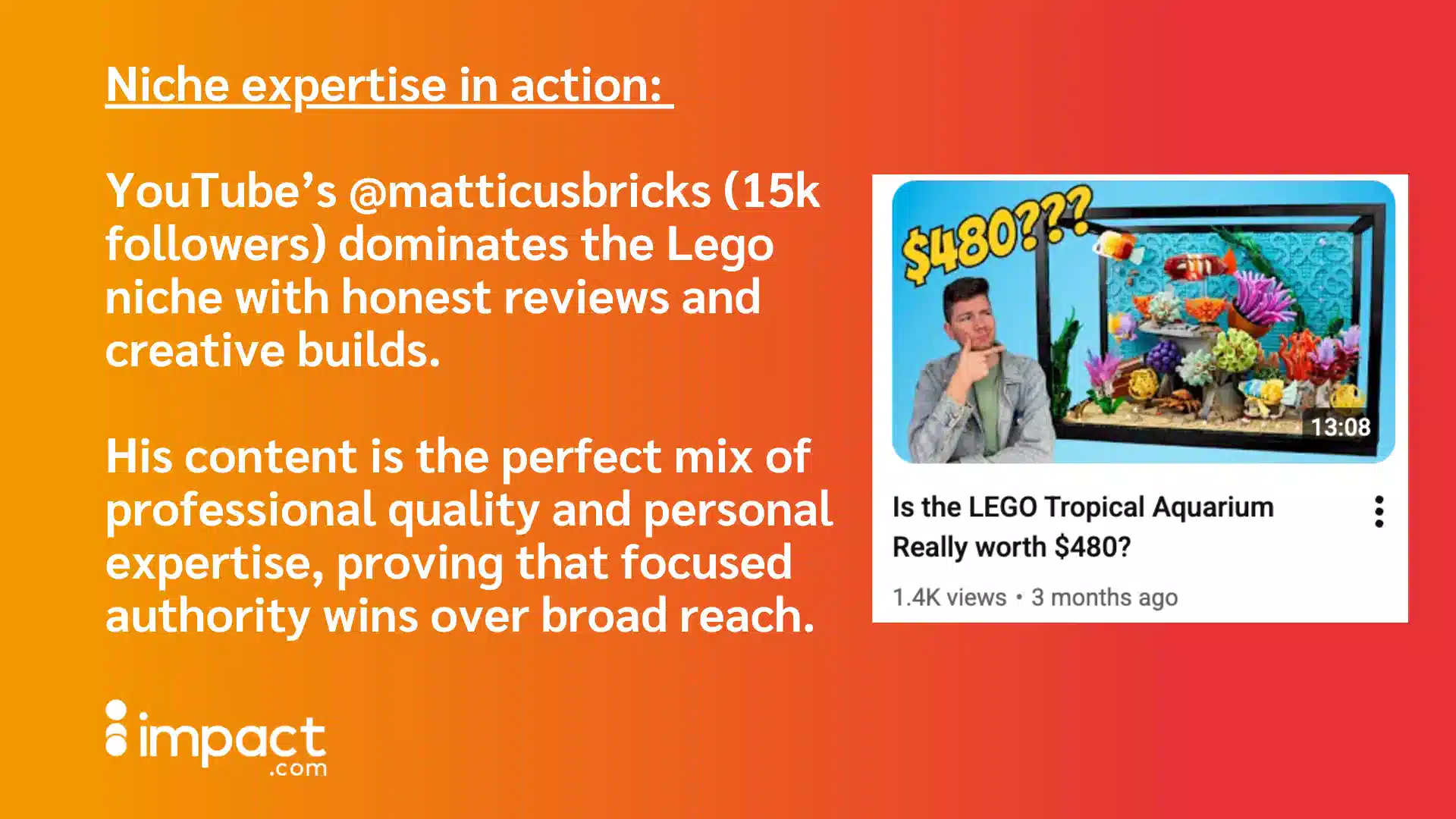
Niche expertise in action: @matticusbricks is the go-to Lego enthusiast for his 15k YouTube subscribers. By blending honest reviews with creative builds and convention vlogs, he offers exactly the kind of focused, trustworthy expertise that moves product in a specific community. His audience is here to buy, not just window-shop
3. Their engagement rates reflect real relationships, not passive audiences
Reach tells you how many people saw your content. Engagement tells you how many people cared. For brands investing in influencer marketing, that distinction is everything.
Nano- and micro-influencers consistently outperform larger creators on engagement precisely because their audiences are active participants.
According to Influencer Marketing Hub, nano-influencers average engagement rates of 1.7–13 percent depending on platform, and micro-influencers aren’t far behind at 1.22–13 percent. Macro-influencers and celebrities, by comparison, often see engagement rates below 1 percent as their audiences scale.
That’s because smaller creators have the time and bandwidth to maintain actual two-way conversations with their followers. They respond to comments. They answer DMs. They create content in response to what their audience asks for.
Getting someone to stop, save, comment, or click requires real connection, and that’s exactly what these creators have spent years building.
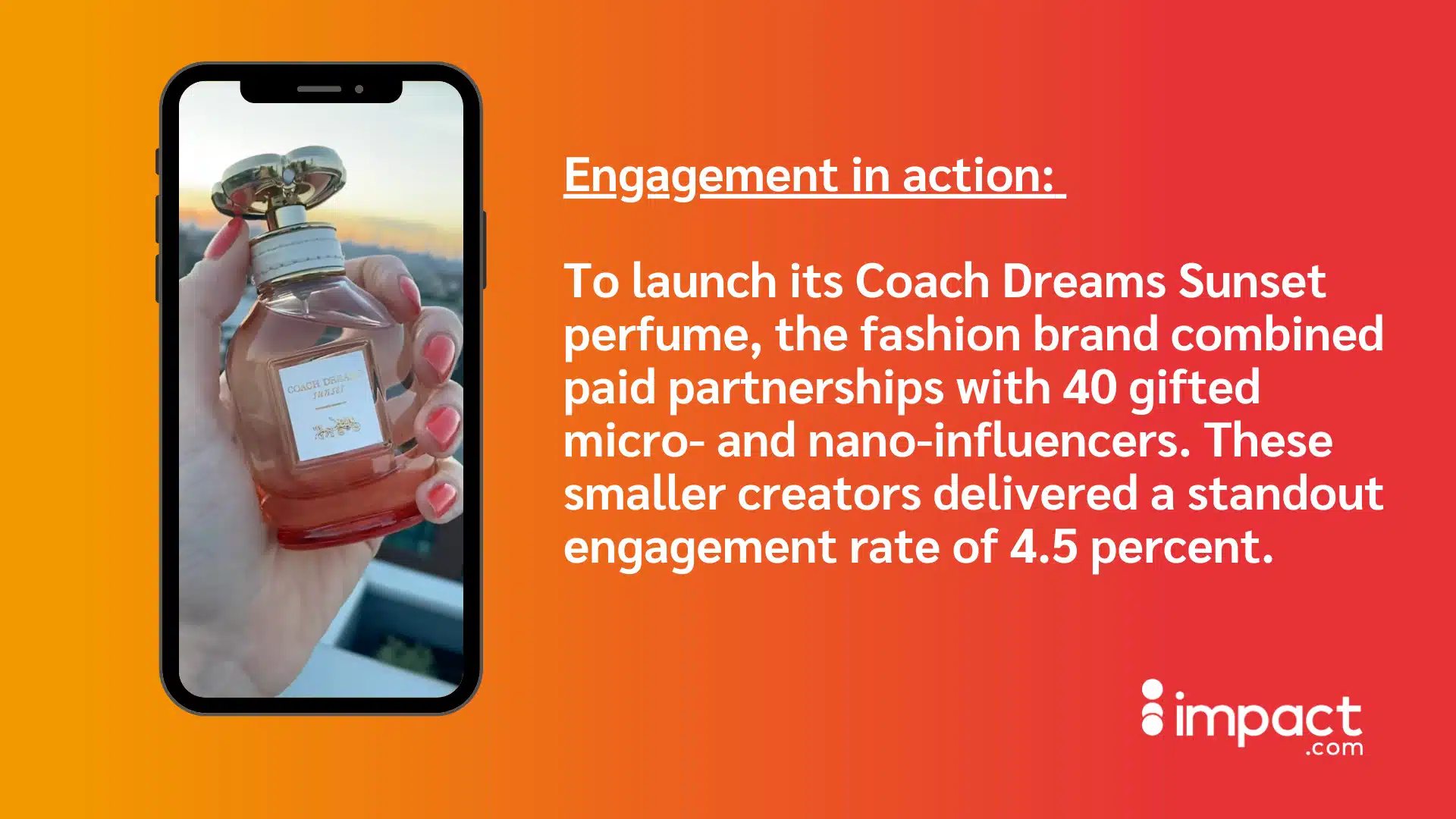
Engagement in action: To launch its Coach Dreams Sunset perfume, Coach combined paid partnerships with 40 gifted micro- and nano-influencers. Those smaller creators delivered a standout engagement rate of 4.5 percent—generating 2.3 million impressions and 211 pieces of authentic UGC for the brand to repurpose across paid and organic channels.
4. They drive conversions, not just awareness
This is where the narrative around micro-influencers often undersells them. They’re not just a cost-effective awareness play, like so many brands treat them. They operate as a performance channel. And when structured correctly, they can become one of your highest-ROI marketing investments.
According to impact.com’s convergence research, brands that combine affiliate strategies with influencer partnerships generate 46 percent higher affiliate-based sales than those using affiliates alone. For health and beauty categories, that lift scales to 178 percent. Smaller creators with trackable affiliate links and unique discount codes can prove exactly where conversions came from—which means they sit at the intersection of brand building and measurable performance marketing simultaneously.
The key is structure. When creators are genuine fans of your product and have skin in the game through commission, their content is more motivated. They’re actively driving their audience toward a purchase because it benefits them too.
OLIPOP understood this better than most. When the prebiotic soda brand launched its creator affiliate program in 2021, it wasn’t with a celebrity budget or a glossy campaign. It started with $36 product samples and a performance-based commission of 10 percent on sales generated.
What followed was a flood of creator applications from people who genuinely loved the product and wanted to share it. OLIPOP built a structure that rewarded it. No manufactured enthusiasm here.
Today, that creator community drives 12 percent of OLIPOP’s total sales and delivers a 982 percent ROI. No upfront fees. No celebrity retainers. Just brand affinity, creative freedom, and a compensation model tied directly to results.
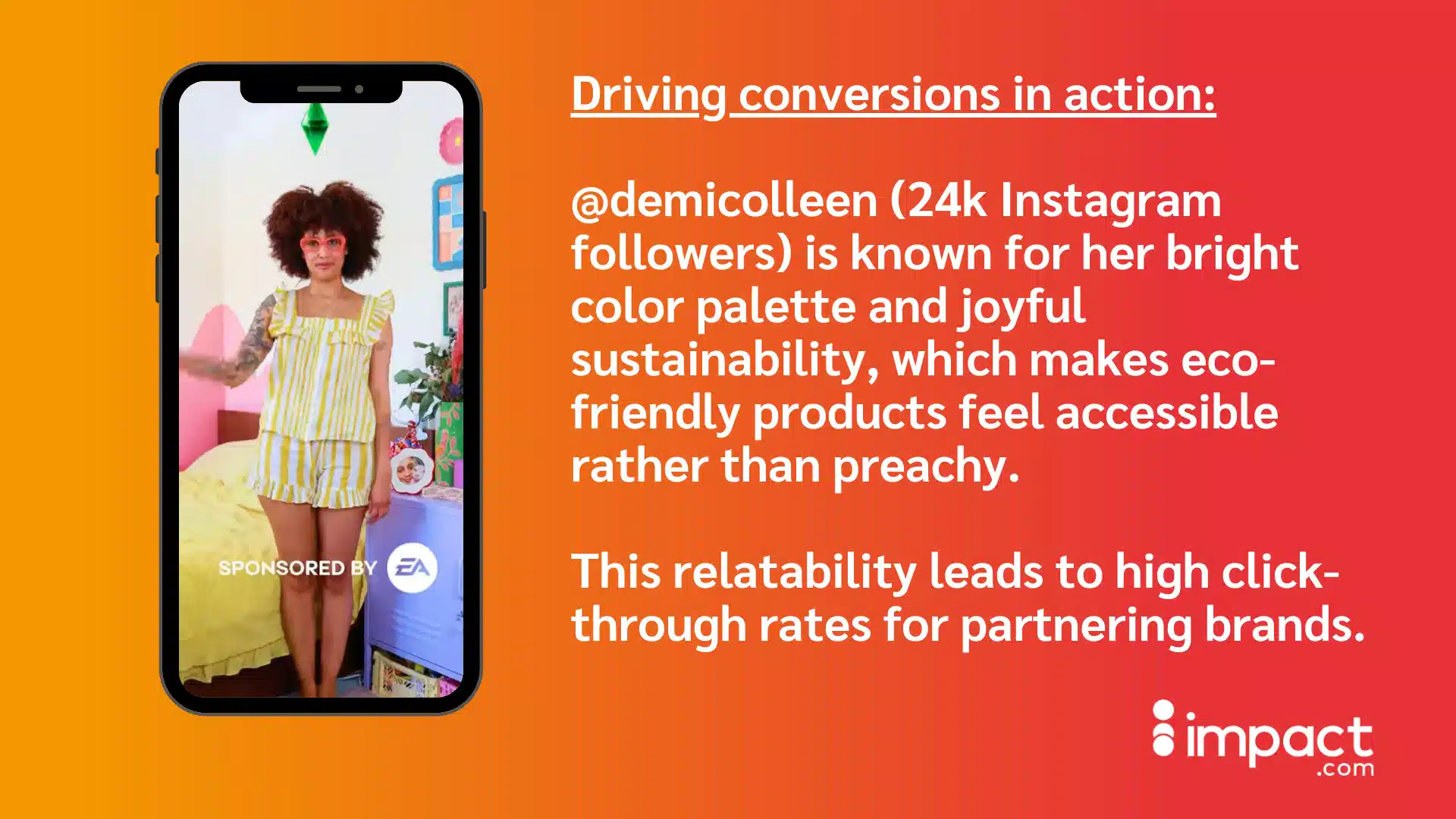
Conversions in action: @demicolleen (24k Instagram followers) focuses on the intersection of inclusivity and sustainability. Her colorful, joyful approach to eco-friendly living makes the products she recommends feel accessible rather than preachy—which translates directly into high click-through rates for partnering brands.
5. They offer budget efficiency that lets you test, learn, and scale
Macro-influencers and celebrities can charge anywhere from $15,000 to $49,000 per post, depending on the platform. At that price point, a single underperforming partnership poses real financial risk, and most brands can only afford to run a handful at a time.
Nano- and micro-influencer partnerships can start from as little as $500 per post. That cost structure changes how you can operate. Instead of betting your quarterly budget on one or two high-profile names, you can run campaigns across 20 or 30 niche creators simultaneously, test different audiences, compare messaging approaches, and identify what actually converts before scaling investment behind it.
And as OLIPOP demonstrated, you don’t always need to start with cash. For brands with strong product affinity, gifting combined with a performance commission can launch a creator program that pays for itself from day one.
Beyond the per-post savings, impact.com’s research shows that authentically created UGC results in 20–30 percent lower customer acquisition costs (CAC) compared to brand-generated assets. When you work with micro-influencers at scale, you’re building a content engine that lowers your CAC across every channel.
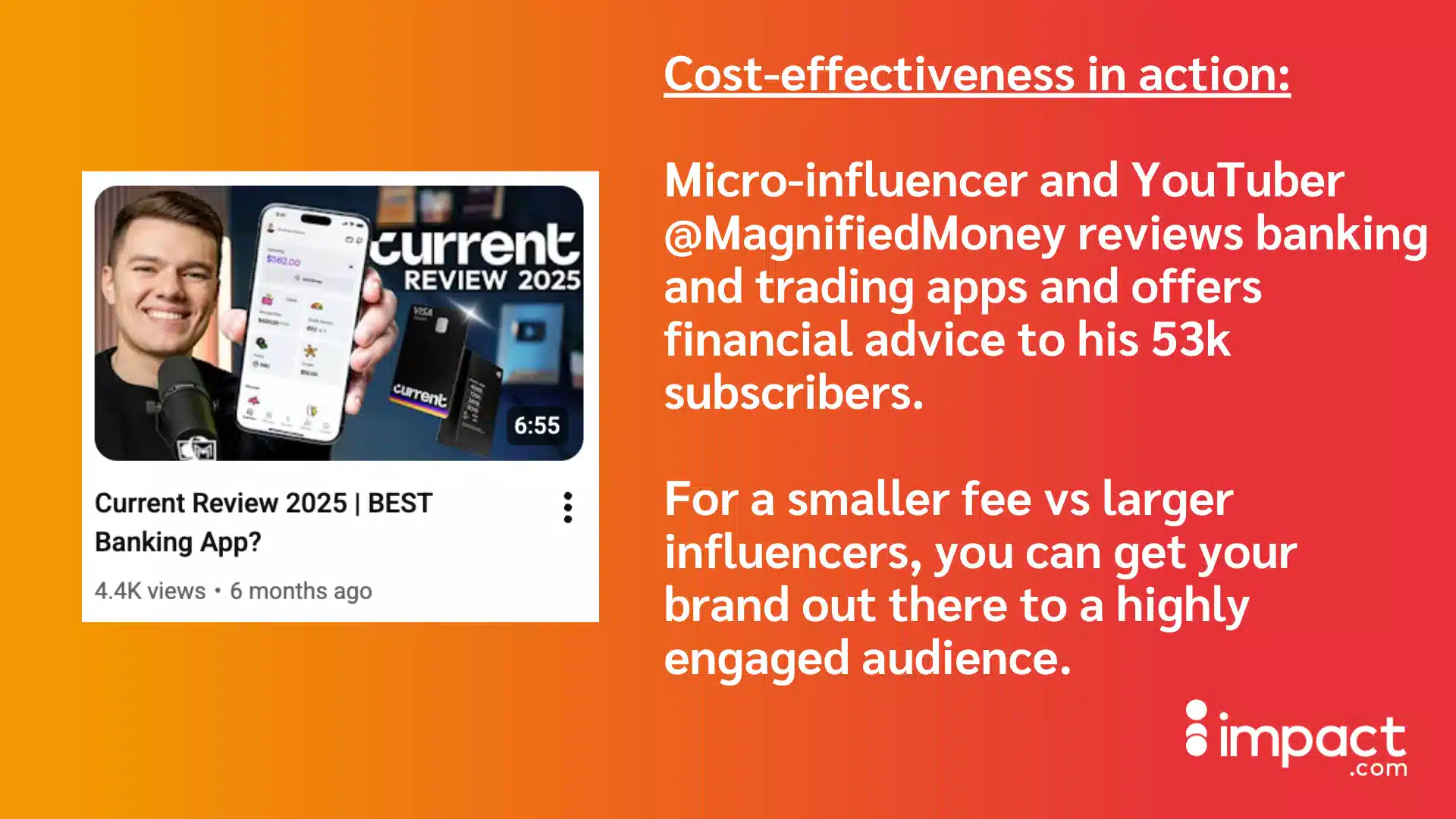
Budget efficiency in action: Micro-influencer and YouTuber @MagnifiedMoney reviews banking and trading apps for his 53k subscribers. For a fraction of what a macro-influencer would charge, brands can get in front of a highly engaged, financially minded audience actively researching the exact kinds of products being reviewed.

The modern customer journey: Understanding multi-touch discovery, research and purchase patterns
This report provides a clear roadmap for navigating your customer’s multi-touch journey, enabling you to develop an effective strategy that connects with consumers at the optimal time and place.
How to find micro-influencers
The best partners might already be in your community. Start by looking for hand-raisers in your own customer base, people who are already talking about your brand, your competitors, or your product category. These organic advocates can speak authentically because they genuinely use and care about products like yours.
Social Listening tools can help surface these creators, identifying influencers who mention your brand organically without being asked. A creator who spontaneously raves about your product will be far more compelling than someone who’s never heard of you.
As you scale, manual tracking fails. Influencer platforms become essential for managing high-volume partnerships that spreadsheets can’t handle.
The right tools allow you to:
- Filter with precision: Quickly find creators by follower count, niche, and engagement rate.
- Automate logistics: Handle contracting, payments, and tracking in one place.
- Focus on strategy: Shift your team’s time from tedious paperwork to building real creator relationships.
How to work with micro-influencers: Collaboration and strategy
You’ve found great creators. Now the real work begins: building partnerships that deliver for both sides.
Treat creators as creative directors, not distributors
The brands seeing the best results from micro-influencer marketing share one approach: they hand creators a goal, not a script.
It’s a natural instinct to want control over how your brand appears in someone else’s content. But over-briefing is one of the most common ways brands undermine the very thing that makes smaller creators valuable in the first place.
When a creator’s audience senses that every word was approved by a marketing team, the trust the creator spent years building evaporates instantly, and it takes your campaign results with it.
Resist the urge to prescribe every shot, talking point, and caption. Share your brand values, your campaign objectives, and any non-negotiables around claims or compliance. Then step back and let the creator translate those into content that actually resonates with their community.
They know their audience better than you do. A brief that says “show how this fits into your morning routine” will almost always outperform one that dictates exactly how to do it.
Long-term partnerships compound this effect significantly. When a creator mentions your brand once, their audience registers it as a sponsored post. That shift from “paid promotion” to “real endorsement” is where micro-influencer marketing earns its reputation for driving actual purchase decisions.
Measure what actually matters
One persistent myth about micro-influencer marketing is that it’s hard to measure. It isn’t if you set up tracking correctly from the start.
Unique discount codes, affiliate links, and UTM parameters connect creator content directly to conversions, giving you a clear line of sight from a specific post to a specific sale. This matters for two reasons: it tells you which partnerships are worth scaling, and it gives you the performance data to justify continued investment internally.
For a deeper breakdown of what to track and how to attribute results across a multi-touch creator program, see impact.com’s guide to measuring influencer marketing ROI.
Build compensation around performance
Smaller creators are generally more flexible with their compensation structures than their macro counterparts, and that flexibility is an opportunity to build partnerships that align incentives from day one.
The most common models are flat fees, product gifting, performance-based commissions, or hybrid combinations of all three.
Many brands start with a gifted product to test fit before committing to paid deals, which is exactly how OLIPOP launched its program. A $36 product sample was enough to attract creators who genuinely loved the brand, and a 10 percent commission on sales gave those creators real motivation to keep posting. The result wasn’t just authentic content. It was a financially sustainable program that scaled without ballooning costs.
Understanding creator financial realities makes for better partnerships. Many nano- and micro-creators have real upfront costs (equipment, editing software, time) and commission-only structures can create financial strain that quietly poisons the relationship.
Hybrid models that offer a modest base fee plus upside performance tend to yield the most motivated, sustainable partnerships. For detailed rate benchmarks by platform and tier, see impact.com’s breakdown of influencer compensation models.
FAQs
Micro-influencers typically have between 15,000 and 75,000 followers and have built their audiences around specific expertise or interests—sustainable living, personal finance, home cooking, fitness, and so on. Unlike macro-influencers or celebrities, they maintain close, conversational relationships with their followers, which results and significantly higher engagement rates.
Nano-influencers, the tier below micro, have fewer than 15,000 followers and often know their audience personally. Their recommendations carry the weight of a friend’s opinion because, in many cases, they literally are one. The defining difference isn’t follower count. It’s the depth of trust these creators have built with their followers, and the proximity of that audience to an actual purchase decision.
The benefits are both qualitative and measurable. On the qualitative side: higher content authenticity, stronger audience trust, and niche targeting that puts your brand in front of pre-qualified buyers rather than a broad, passive audience. On the measurable side: higher engagement rates than larger creator tiers, lower cost per partnership, and when structured with affiliate links and discount codes, direct attribution to conversions. Brands that combine influencer and affiliate strategies generate 46% higher affiliate-based sales than those using affiliates alone, according to impact.com’s research. For health and beauty categories, that lift scales to 178 percent. Perhaps most importantly, the budget efficiency of micro-influencer programs allows you to test across multiple niches simultaneously (something no macro or celebrity program can offer at equivalent cost.
Start with your own community before looking outward. Your best potential partners are often already in your customer base—people posting about your product or talking about your category without being asked. Social Listening tools can help surface these creators at scale. When evaluating potential partners, prioritize engagement rate and audience alignment over follower count. A creator with 18,000 highly engaged followers in your exact niche will almost always outperform one with 60,000 passive followers in a broader category.
Start with partner selection. A creator who already uses and genuinely likes products in your category doesn’t have to perform enthusiasm. From there, give them real creative freedom within clear guardrails. Share your goals and brand values, then trust them to execute in their own voice. The more you script, the more it shows.
Come prepared with clear deliverables, usage rights expectations, and a budget range. Creators negotiate more productively when they know exactly what’s being asked of them. Whatever structure you agree on, approach the conversation with genuine respect for the creator’s expertise. Trying to significantly undercut rates damages the relationship before it starts, and the best creators simply won’t work with brands that don’t value what they bring.
Several friction points consistently arise in micro-influencer programs, and most of them are solvable with the right systems and expectations in place.
Managing relationships at scale is the most common operational challenge. When you’re working with 20 or 30 creators simultaneously, manual tracking through spreadsheets quickly breaks down (contracts get missed, payments are delayed, and performance data is scattered). An influencer marketing platform that handles contracting, payments, and tracking in one place eliminates most of this friction and lets your team focus on the creative and relational side of the work.
Maintaining brand consistency across many creators is another real challenge. The solution isn’t tighter scripts, but better briefing. A well-constructed brief shares your brand values, campaign goals, visual guidelines, and any compliance non-negotiables clearly, while still leaving meaningful room for the creator’s voice. Creators who understand the guardrails but have freedom within them consistently produce better content than those handed a word-for-word script.
Ghosting and dropped partnerships are more common than brands like to admit, particularly among nano-creators who manage content creation alongside full-time jobs or other commitments. Setting clear timelines, checking in proactively, and building a buffer into your content calendar reduces the impact when a creator goes quiet. Long-term relationships also help. Creators who feel genuinely valued and fairly compensated are far less likely to disappear mid-campaign.
Finally, measurement and attribution remain a challenge for brands that don’t set up tracking from the start. Unique discount codes, affiliate links, and UTM parameters should be set up before any content goes live—not retrofitted afterward. Without them, you’re left with impressions and engagement data that’s hard to connect to actual business outcomes.
Building partnerships that last with nano- and micro-influencers
The brands winning with influencer marketing in 2026 aren’t the ones with the biggest celebrity budgets. They’re the ones who recognized early that the most valuable real estate in their customers’ journey isn’t a billboard or a homepage takeover—it’s a trusted recommendation from someone their customers actually know.
That trust isn’t something you can manufacture or buy outright. But you can find it, structure it, and build on it. Nano- and micro-influencers have already done the hard work of earning it. Your job is to give them the creative freedom, the right compensation model, and the long-term commitment to let it compound.
impact.com handles the operational side—discovery, contracting, tracking, and payment—so your team can stay focused on what actually drives results: building creator relationships that your competitors can’t replicate.
Check out more impact.com content here:
- Influencer marketing strategy: How to work with YouTube influencers in 2026 [blog]
- The Partnership Economy podcast: Authentic content that drives real results with micro-and-nano influencers
- The influencer portfolio approach: When to deploy micro-influencers vs macro-influencers vs celebrity partnerships [blog]
- Ultimate guide to influencer marketing [ebook]
- Influencer marketing trends 2026: 13 experts weigh in on the future of performance-driven growth [blog]