

A comparison site spends three years on an air fryer review: burn tests, a 200-use durability rating. When a shopper uses AI search to find which model suits a family of four, the answer draws on that testing and names one.
She never clicks through. She buys the air fryer straight from the retailer.
The retailer’s analytics show a sale, and the AI platform shows an engaged session. The review site’s affiliate dashboard shows nothing: no referral, no click, no commission.
If you run a comparison site or create content funded through affiliate and brand partnership income, that’s your dashboard. AI search is increasingly cutting that click out of the purchase entirely—a zero-click gap your monetization plan isn’t built for, even though the recommendation still runs on your content. It’s the exact scenario impact.com CEO Dave Yovanno and the “Creator Advantage” panel kept landing on at impact.com’s Partnerships Experience conference (iPX26) this year.
It’s time to get specific about which side of a new divide you’re going to land on. Quality content and cross-platform reach earn you the citation, but only negotiating compensation for that influence gets you paid for it.
Which side you’re on decides whether you monetize the Answer Era or spend years generating value someone else collects. The practitioners in this piece aren’t waiting for that deal to show up—they’re checking their own citation status and negotiating rate increases off it.
The citation already replaced the click, and your compensation model didn’t get the memo
The click was never the thing brands were actually paying for. It was a proxy: a stand-in for “this content influenced a purchase,” chosen because it was the easiest signal to track—not because it was the most accurate one.
That proxy is disappearing from a growing share of purchase journeys—even as your influence remains the same or even grows. The commission check isn’t coming.
AI traffic to US retail sites rose 393% year-over-year in the first quarter of 2026, according to Adobe. This is a wholesale shift toward answers rather than search results pages, and it’s accelerating.
At iPX26, Yovanno drew a distinction most brands haven’t fully internalized yet. “AI isn’t pulling from your brand website,” he said. “It’s not pulling from your paid media. It’s synthesizing what other people say about you: creator reviews, affiliate content, community discussion, and comparison articles. The content you don’t own.”
That’s your content he’s describing—all of the material the AI answer draws from instead of a brand’s own site.
Your content did the work. The current compensation system just isn’t built to see it.

“AI isn’t pulling from your brand website. It’s not pulling from your paid media. It’s synthesizing what other people say about you: creator reviews, affiliate content, community discussion, and comparison articles. The content you don’t own.”
— Dave Yovanno, CEO of impact.com
How to create the kind of content that actually earns an AI citations
Some content partners check their AI citation status and find they’re already being cited for a piece they didn’t think was their best work, while a stronger competitor goes unmentioned. The criteria aren’t what most people assume.
At iPX26’s “Creator Advantage” panel, Jake Leganski, Ray Duke, and Joshua van Aalst all land on the same formula, and it has nothing to do with generic AIO tricks.
Build content people actually trust
Quality comes first, and it builds in stages. Leganski frames it as a three-Cs progression:
- Content gets cited
- Citations create consensus
- Consensus wins the answer
Each step depends on the one before it. You can’t manufacture consensus without content that’s actually earning citations first.
“These AIs are giving recommendations based on consensus, but new technology comes out every year, so the AI doesn’t have consensus on the latest MacBook laptops within a month of them being launched,” said Van Aalst, the creator behind Just Josh. “Who has that? We do, because we got the laptop earlier and we tested it.”

“These AIs are giving recommendations based on consensus, but new technology comes out every year, so the AI doesn’t have consensus on the latest MacBook laptops within a month of them being launched. Who has that? We do, because we got the laptop earlier and we tested it.”
– Joshua van Aalst, creator of Just Josh
Duke, the creator behind Bulletproof Handyman, sums up what it takes to earn a citation as convergence plus quality. AI models want to see the same answer to a question coming from multiple trusted sources, but that doesn’t earn a citation on its own. Optimization is a layer on top of quality.
“You can do maximum AIO optimization—stuff all the keywords, have your chapter titles, have everything done just right—but if it’s a video nobody’s watching, and if you didn’t really put your heart into it, then AI is not going to care at all about that video,” Duke said.
AI models don’t have independent taste. They’re trained on the same signals humans already produce—watch time, comments, shares—so content that never earns real engagement gives the model nothing to point to as evidence of trust.
Syndicate content across platforms AI can crawl
Cross-platform syndication matters too, and it’s now a citation strategy as much as a distribution one.
Leganski, VP of Affiliate at Dreamday, ties that advantage directly to rate negotiation. “Let’s say I reached out to Ray for a campaign… he may charge a different rate depending on the platform. But when I think about the value proposition of Ray’s content, even if it is a social commerce campaign, if I’m also optimizing for AI search—cross-platform syndication makes a big difference,” he said.
The content still has to earn that value, though. Leganski points to the brief itself as the dividing line between content that blends in and that which draws attention from LLMs.
| Brief type | Example |
|---|---|
| Generic | “What are the top seven things a homeowner should take into account?” |
| Personalized | “I saved $15,000 by taking these seven things into account.” |
Leganski’s claim is backed by data: A 2024 study led by researchers from Princeton and Georgia Tech examined AI citation behavior and found that content built around specific stats and direct quotes was pulled into AI answers up to 28% more often than generic versions.
Real readers engage with specificity, and engagement is the exact signal AI models are trained to follow.
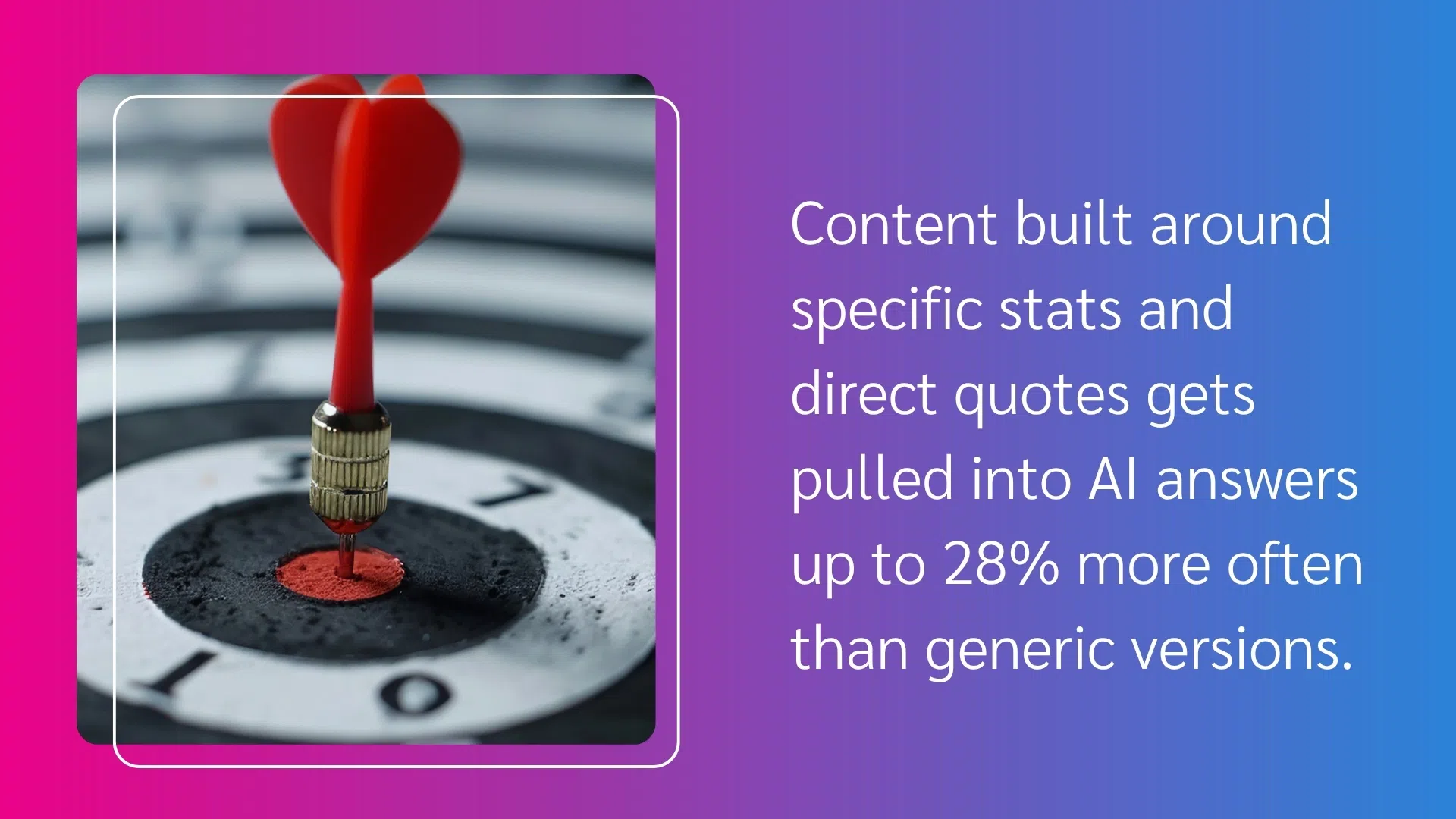
Source: GEO study
Know where AI sources its citations
According to Evertune’s analysis of the top 10,000 content sources behind major AI models, 40% of those sources contain affiliate links or are sponsored.
On impact.com’s The Partnership Economy podcast episode “Optimizing for AI answers,” Brian Stempeck, CEO and co-founder of Evertune, laid out the top four buckets that AI models actually source content from:
- Owned media: a brand’s own website and product pages.
- Earned media: PR coverage and independent journalism.
- Sponsored content: affiliate, commerce, and paid partnership content.
- Social and community content: forums, Reddit threads, and community discussion.
Sponsored and affiliate content is competing for the same citation as the other three buckets— which means it earns a spot fastest when it echoes what independent coverage and community discussion are already saying.
Build for quality and cross-platform reach, and check if your content aligns with the conversation already happening.
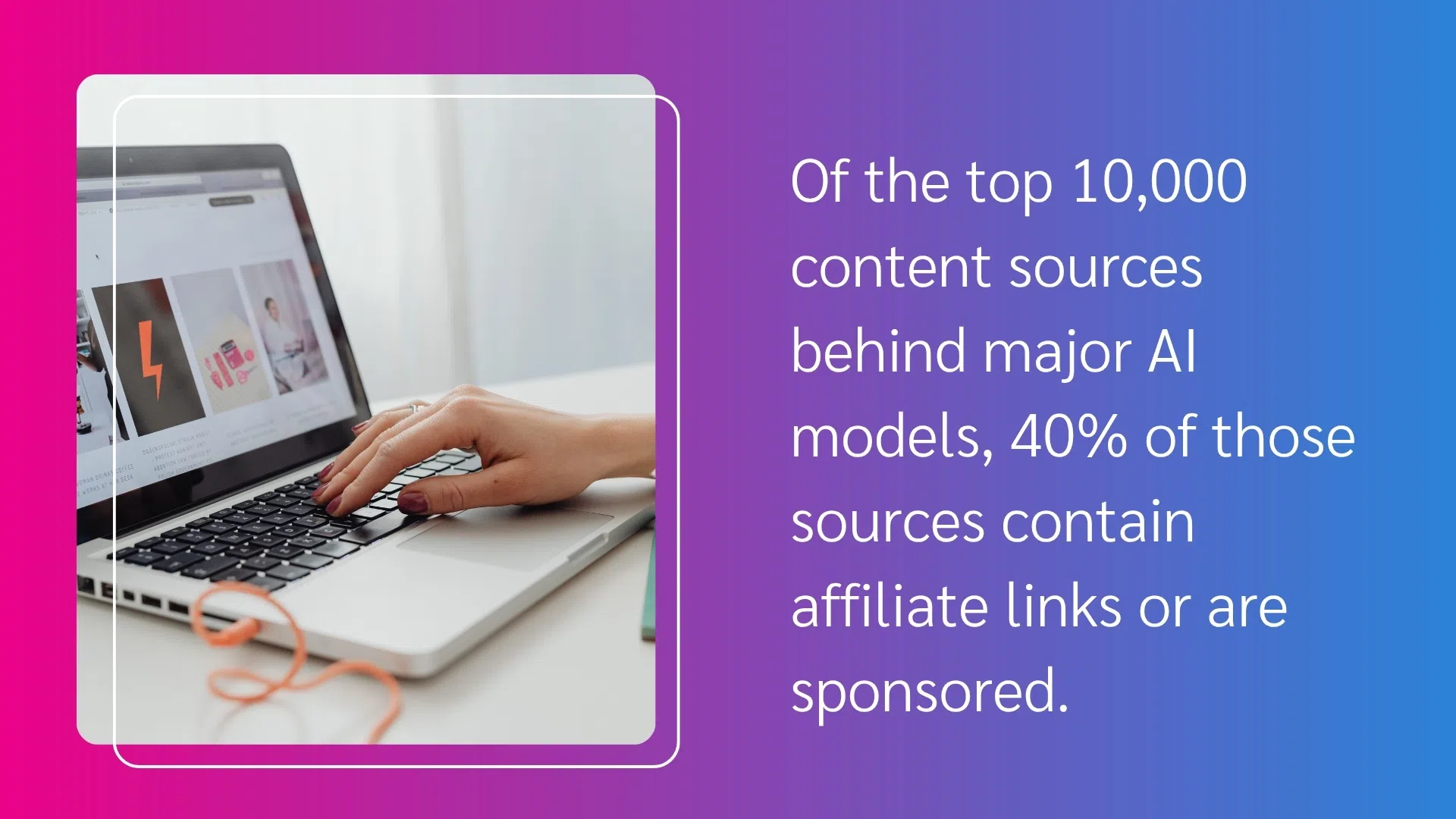
Source: Evertune
Integrating zero-click AI search into your monetization plan
Getting cited is only half of the equation. You also have to get paid for it.
Yovanno set the stakes, speaking directly to brands: “You can’t buy your way into AI answers, but you can partner your way in.”
He’s speaking to brands, but the same logic applies to you too. You’re the one brands need now to get in front of consumers, and that gives you leverage—but that leverage still has to become a monetization plan.
See where you’re already being measured
Citation-level measurement is starting to catch up to where click tracking has stood for years. It’s not perfect yet, and it’s not universal, but a citation can now be captured in some cases and folded into the attribution path alongside clicks and other signals.
Go back to the air fryer review site scenario. In this kind of citation tracking, the citation that powered the AI’s recommendation is logged as a step in the attribution path, with no click required to add it. The review stops being invisible in the data.
Duke’s already watching brands react to citation visibility. This capability isn’t standardized yet, but many companies are already measuring it independently. “I’m now having brands contact me with very rigid AIO instructions,” Duke said. “They’re trying to build the checklist first… before I’ve even come up with an actual campaign for them.”
You don’t need to wait on your platform to start documenting your own position.
Here’s one way to gather data for your brand conversation:
- Query ChatGPT, Perplexity, and Google AI Overviews for your branded terms and your category’s key terms.
- Screenshot what comes back.
- Repeat on a regular cadence, documenting what you can already see before a system does it for you.
Then take the next step and ask your platform and brand partners directly whether citation-level measurement is available to you today.
Yovanno named the standard to hold them to: “They need real attribution—links, codes, signals, storefronts. They need clear performance visibility. They also need real upside in what they drive. If you can’t give them those three things, they will find a brand that can.”
This capability exists in pockets—you just have to find out if you’re standing in one of them.
“Here’s what creators need from brands: They need real attribution—links, codes, signals, storefronts. They need clear performance visibility. They also need real upside in what they drive. If you can’t give them those three things, they will find a brand who can.”
— Dave Yovanno, CEO of impact.com
Negotiate to get paid for it
Measurement without a payout mechanism doesn’t close the gap—it just gives you better documentation of a problem you still can’t fix. The conversation with brand partners has to change from there.
“Being able to measure what those citations are and who is actually being cited by the LLMs is really how we then justify value and apply monetary justification to those experiences,” said Leganski. Bring that same measurement to your side of the table and use it to negotiate your own rate.

“Being able to measure what those citations are and who is actually being cited by the LLMs is really how we then justify value and apply monetary justification to those experiences.”
– Jake Leganski, VP of Affiliate at Dreamday
Some partnership platforms are starting to build compensation structures around exactly that: an emerging model, sometimes called pay-by-citation, in which payout triggers on citation-level influence rather than on clicks.
That immaturity cuts in your favor if you move now. Brands are still figuring out what to offer here, which means the content partners who ask for it first can shape what “standard” ends up being. Wait for the model to mature and you’re negotiating inside terms someone else already set.
The regulatory environment is tilting the same way: in June 2026, the UK’s Competition and Markets Authority ordered Google to properly attribute publisher content with clear links in AI-generated search results and to let publishers opt out of AI Overviews entirely.
Content partners can’t act on that ruling directly—it applies to Google in the UK, not to any single brand deal—but it takes away a brand’s easiest excuse for staying vague. “This isn’t trackable yet” gets harder to say once a regulator has ordered the biggest AI answer engine to make attribution visible by law.
Build for the citation, or watch someone else monetize it
The answer era is sorting content partners into two groups: those renegotiating their deals around citation-level influence, and those still waiting on a click that increasingly isn’t coming. That sorting is already underway.
Content partners who build genuinely citable, high-quality content and negotiate compensation models designed to capture that influence are the ones who monetize in this environment.
The ones who keep treating the click as the whole picture keep producing the citations AI answers run on, while brands and platforms collect the value it creates.
Discover more about how to enhance your publishing and creation strategy in The Answer Era:
- The unignorable content checklist: 5 steps to a human-first AI Overview content strategy for affiliate reviews [blog]
- How publishers and brands can tap into Reddit affiliate marketing to build strong community engagement [blog]
- Why Patagonia and Bark only partner with publishers who pass this values test [blog]
FAQs
A pay-by-citation compensation model is an emerging partnership structure in which a publisher or creator is paid when their content is cited as the source of an AI-generated answer, rather than only when a customer clicks a tracked link.
This model was created to close the gap left by CPA models, which have no mechanism to register a purchase when an AI answer influences it without producing a click.
Some partnership platforms are beginning to build measurement and payout capability around this model, though it isn’t yet a standardized industry practice. Publishers and creators should ask their platform and brand partners directly whether it’s available to them.
Publishers and creators can start by manually querying ChatGPT, Perplexity, and Google AI Overviews for their own branded and category terms and documenting what comes back, building a record of where their content is already being cited.
Beyond that manual step, some partnership platforms can now register a citation—content named as the source behind an AI-generated answer—as a trackable event in the attribution path alongside clicks.
Asking a partnership platform or brand partner directly whether citation-level measurement is available today is the fastest way to find out where that capability already exists.