

Introduction: The UPLIFT Desk story: Moving from content volume to strategic traffic
When Norman Scott, Affiliate Coordinator at UPLIFT Desk, took over the brand’s ambassador program, the baseline goal was to generate content volume. But as company priorities shifted toward site traffic in 2026, the program had to evolve, uncovering a structural bottleneck that had been invisible for months. Scott’s team was trapped in a manual, five-person internal approval chain that left prospective creator pitches frozen in spreadsheets for up to a week.
This operational friction reveals why mastering how to create a brand ambassador program requires an infrastructure mindset. Ambassador programs don’t fail from bad casting, they fail from bad systems.
By migrating from fragmented manual processes to automated platform tracking, UPLIFT Desk cut its creator vetting time, eliminated administrative backlogs, and empowered its team to focus on building genuine relationships with top performers who Scott said “live and breathe” the brand.
Grounded in expert insights from impact.com customer success managers and brands including UPLIFT Desk and Pink Lily, this guide is the operational blueprint for transitioning from a manual, relationship-by-relationship program to one that compounds.
The evolution: Moving from budget drainers to scalable assets
Without infrastructure to sustain it, even the most enthusiastic ambassador program stalls. The traditional model treats advocacy like a transaction.
Jake Cohen, Senior Customer Success Manager at impact.com, explained that many brands hand a partner a tracking link, ship a product, and hope they post, which “only keeps partners engaged for one or two posts”. Restarting recruitment from scratch every time a partner goes dormant drains both budget and momentum.
Cohen added, “Brands that set up a brand ambassador program without a solid foundation around how to run and communicate with their ambassadors often find it becomes unsustainable.” In other words, the problem isn’t the ambassadors. It’s the absence of systems to keep them engaged beyond that first post.
Pink Lily is a strong example of a modern approach to ambassador programs. The DTC women’s boutique uses automated newsletters to re-engage dormant partners, targeting ambassadors who haven’t driven a sale in 90 days.
Paige Brown, Customer Success Manager at impact.com highlighted the brands she’s worked (like Pink Lily) that use built-in automation tools to remove the manual workload for their team. She said, “Once your ambassador program is established, automation takes over the manual workload, allowing your team to manage the community hands-free.” For a team of two managing 800 inbound applications, that’s not a convenience—it’s the only way the program survives its own success.

“Once your ambassador program is established, automation takes over the manual workload, allowing your team to manage the community hands-free.”
– Paige Brown, Customer Success Manager, impact.com
| Comparison: Traditional vs modern scalable ambassador programs | ||
|---|---|---|
| Feature | Traditional self-serve program | Modern automated ambassador programs |
| Communication | Set it and forget it approach | Regular drip campaigns, incentives, and community building |
| Logistics | Manual tracking links, banking setup, and spreadsheets | Automated onboarding workflows and self-managed partner portals |
| Risk profile | High upfront flat rates with unproven vanity reach | Low-risk hybrid models (flat fee + performance commission) |
| Performance visibility | Siloed data and limited incrementality insights | Complete view of the full-funnel customer journey |
| Recruitment | Manual social media scrolling and manual vetting | Automated discovery via marketplaces, lookalikes, and Social Listening |
The readiness audit: How to create a brand ambassador program with a scalable foundation
Infrastructure doesn’t begin with software—it begins with internal alignment before your partners start promoting.
Too many brands treat ambassador programs as a low-risk experiment, dabbling with a handful of creators before pulling the budget when results don’t materialize overnight.
Alice DuBois, Senior Customer Success Manager at impact.com, has seen that pattern play out enough times to be direct about what it actually takes: “To build a program that actually scales, you have to fully commit to the testing phase with a dedicated budget and timeline. I recommend giving it nine months to a year to test a few different campaigns across different seasons.”

“To build a program that actually scales, you have to fully commit to the testing phase with a dedicated budget and timeline. I recommend giving it nine months to a year to test a few different campaigns across different seasons.”
– Alice DuBois, Senior Customer Success Manager at impact.com
DuBois added that launching ambassador campaigns during peak seasons can skew early results in either direction. These peak periods, like Black Friday, tell you almost nothing about your program’s long-term potential.
Before recruiting a single ambassador, run through the checklist below.
You’re ready to build a brand ambassador program if you can answer yes to all of the following:
- Leadership buy-in: Flat fees are available for testing, and stakeholders understand this is a long-term investment, not a quick-win channel.
- A realistic testing window: You can commit to a 9-to-12-month test. Basing your entire perception of ambassador marketing on a single busy period like Black Friday leads to false conclusions.
- Dedicated ownership: A specific person owns ambassador relationships. Setting it and forgetting it isn’t a strategy.
- An existing community: You have organic fans or loyal customers to tap into. Ambassadors amplify momentum—they don’t create it from scratch.
- Defined key performance indicators (KPIs) and ambassador profile: You’ve identified your target audience, the behaviors you want to incentivize, and whether you’re recruiting loyal customers, micro-creators, or both.
- A forward-looking content plan: You have a 6 to 12-month promotional calendar to keep ambassadors engaged and inspired well beyond their initial onboarding.
- Technology foundation: You can track incrementality and offline conversions via promo codes instead of spreadsheets.
The questions above aren’t gatekeeping—they’re infrastructure checks. Without those conditions in place, even the most authentic ambassadors can’t scale.
Which tools should you implement to automate your ambassador program?
The bottleneck isn’t creator enthusiasm—it’s the manual backend every brand eventually builds before realizing it doesn’t scale.
According to Scott, once UPLIFT Desk moved onto a dedicated platform, they saw a “significant cut in time” to vet creators, analyze data, and consolidate everything. The right stack removes the manual bottlenecks that cap growth and gives your team visibility into what’s actually driving revenue.
The table below maps out the automated infrastructure required at each stage of the partnership life cycle—and why it matters to your brand’s bottom line:
| Framework: The technical blueprint for automated ambassador programs | ||
|---|---|---|
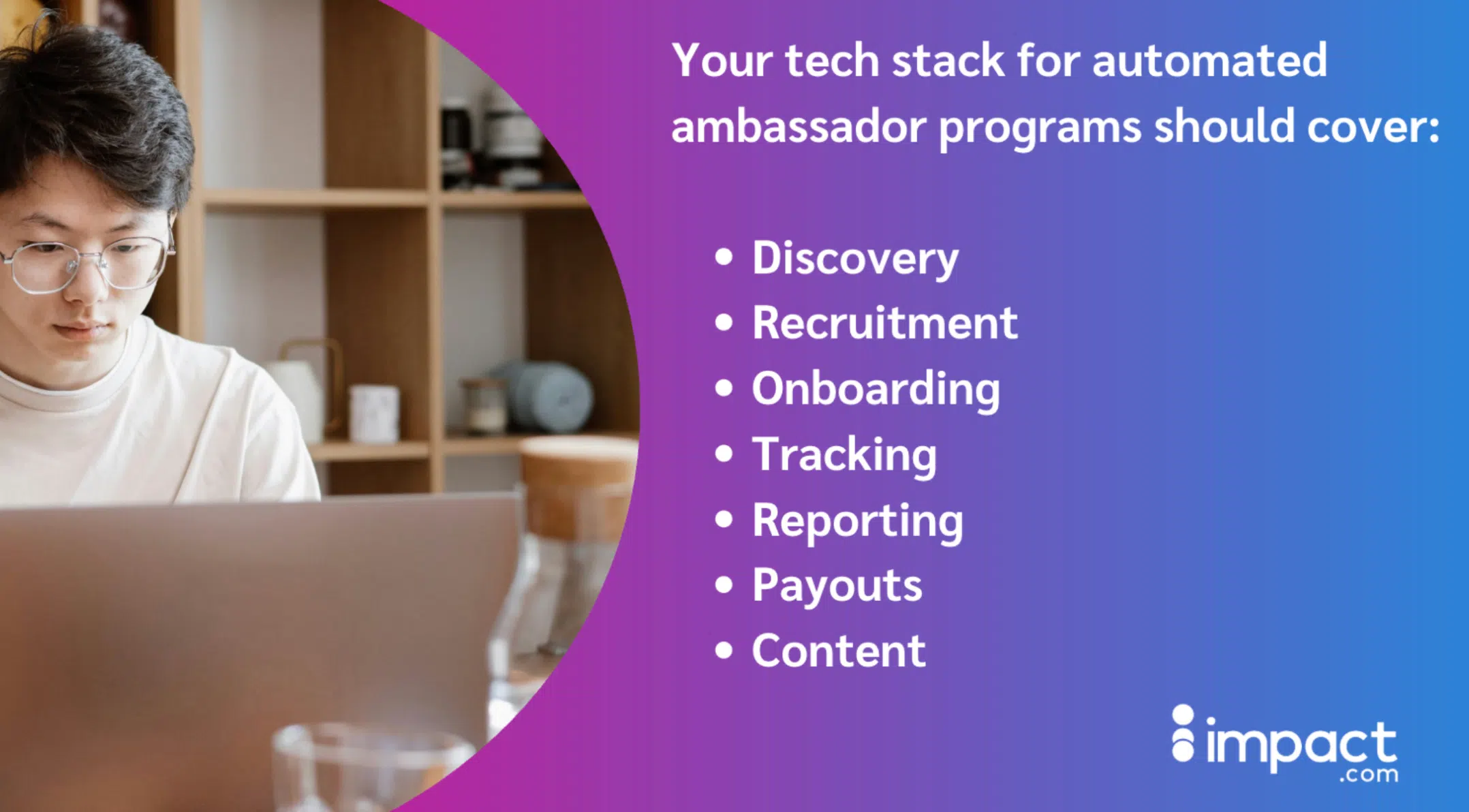
| Program stage | What the infrastructure enables | Why it matters |
| Discovery | Filter partners by niche, engagement rate, and audience demographics. Use creator lookalike tools to find untapped talent similar to top performers. Use Social Listening to identify fans already talking about your brand. | Surface warm leads with genuine brand affinity instead of cold outreach. |
| Recruitment | Built-in recruitment agents help you automate approval workflows and filter applications against preset criteria, auto-approving strong fits and flagging poor ones. | Eliminate the recruitment backlog that stagnates growth at scale. |
| Onboarding | Drip email sequences trigger at key moments: acceptance, first sale, and 30-day inactivity. | Keeps ambassadors informed and motivated from day one without manual follow-up. |
| Tracking | Promo code attribution captures offline and in-app conversions that click-based tracking misses. | Ensures ambassadors are credited across a three-to-six-month customer journey. |
| Reporting | Automated performance reports are sent to stakeholders’ inboxes on a set cadence. | Removes the need to manually log in and export data to prove program return on investment (ROI). |
| Payouts | Custom template terms automate commission structures, including elevated rates for new customer acquisition. | Executes hybrid compensation models without manual recalculation or error. |
| Content | A centralized user-generated content (UGC) library aggregates ambassador-created assets with usage rights tracked in-platform. | Builds a repurposable content pipeline for social, paid, and connected TV (CTV) channels. |
DuBois noted that one specific discovery tool consistently catches brands by surprise: the creator lookalike filter. “I always remind brands that they can take a competitor’s top ambassador handles, plug them in, and instantly surface similar creators to partner with,” DuBois said. “When they see how quickly they can uncover those highly relevant profiles, they are completely blown away”.
For brands struggling to find niche partners at scale, this kind of targeted discovery changes the recruitment conversation entirely.
Structuring compensation: Why hybrid models are the new standard
Compensation is where many ambassador programs break down. Pay only for performance and you lose the creators worth keeping. Offer only a flat fee and you remove the incentive to keep promoting after the first post.
DuBois explained where the industry stands in 2026: “It feels that it’s fully the expectation that flat fees are involved.” That shift matters for brands still operating on a gifting-only model. Creators invest real time and expertise into their content, and a flat fee signals you recognize that before asking for anything in return.
The hybrid model builds on that foundation. “Keeping partners engaged with your brand beyond the initial post to generate sales on a commission basis is a winning strategy,” DuBois added. A creator who earns a commission on their first post has a reason to keep talking about your brand weeks later.
For high-average-order-value (AOV) brands like UPLIFT Desk or a popular music store chain—categories where buyers research for months before committing—that compensation also needs to reflect the expertise required to move a buyer through a three-to-six-month research journey. As DuBois put it, “trust is at the crux of revenue.” A creator who feels like a transaction loses their audience, and that loss shows up directly in your conversion rate.
| Building the right compensation model into your ambassador program | |||
|---|---|---|---|
| Compensation model | Best for | Why it works | Trade-offs |
| Gifting only | Smaller brands or high-affinity partners. | Low upfront cost and builds genuine brand advocates. | Harder to scale with professional creators. |
| Flat fee | Influencer campaigns and top-tier talent. | Guarantees high-quality content and front-loaded effort. | Higher risk if not tied to performance. |
| Performance, i.e., cost-per-action (CPA) | Affiliate marketing and long-term ambassadors. | Directly aligns cost with revenue, low risk. | May fail to attract creators who need a guaranteed income. |
| Hybrid (flat fee + CPA) | Scalable brand ambassador programs. | Offers security and unlimited upside, keeps partners active and motivated to perform well. | Requires robust technology to manage complexity. |
The tiered partner roadmap: How to turn ambassadors into elite revenue drivers
Enthusiasm without a ladder stalls. A tiered roadmap gives ambassadors a reason to keep performing—and gives your program a mechanism to identify who’s worth investing in.
Pink Lily’s model is a practical blueprint. The brand segments its community into three tiers: Insider, VIP, and Loyalist. Brown explained that top-tier ambassadors earn a higher commission percentage, while entry-level partners receive product gifting and store credit. That mixed approach lets brands test new partners at lower risk before committing to elevated commissions.
For brands with a high AOV navigating a longer customer journey, Scott recommends layering performance bonuses at specific benchmarks to keep ambassadors motivated between conversions. UPLIFT Desk currently tests a sliding scale of three to seven percent per transaction with bonuses at set milestones.
As Scott put it, “The goal is to always be ahead of things so that we are always the number one partner that creators want to work with in our vertical.” To do this, create a structure where moving up the ladder through increased sales has a clear financial payoff.

“The goal is to always be ahead of things so that we are always the number one partner that creators want to work with in our vertical.”
– Norman Scott, Affiliate Coordinator, UPLIFT Desk
| How to structure ambassador tiers | |||
|---|---|---|---|
| Tier | Profile | Compensation | Goal |
| 1. Insider | New or unproven micro-influencers and loyal customers. | Product gifting + low CPA or store credit. | Test fit and content quality at low risk. |
| 2. VIP | Consistent performers with growing audience engagement. | Flat fee + mid-range CPA commission. | Reward consistency and deepen brand relationship. |
| 3. Loyalist | Top revenue drivers with proven conversion track record. | Higher CPA + performance bonuses at benchmarks. | Maximize output from your highest-value partners. |
The measurement pulse check: Interpreting metrics to stop the budget drain
Building a data-driven attribution loop is your final infrastructure requirement. Moving past surface-level metrics is the only way to prove your program is generating real revenue, not just activity.
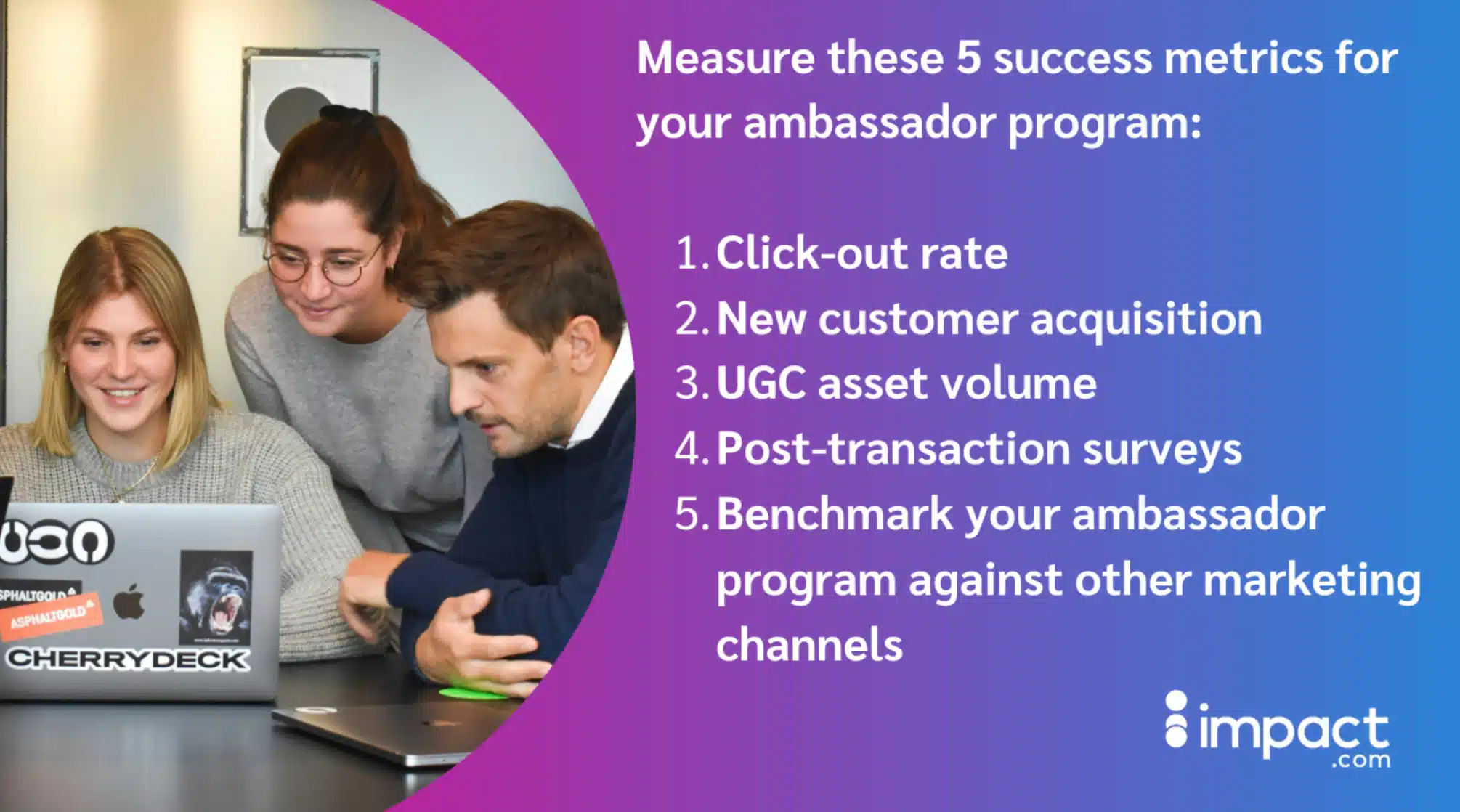
To stop the budget drain and protect your margins, modern partnership managers must look at data through five distinct, full-funnel strategic lenses.
Click-out rate as a signal for partner reinvestment
Start with interpreting the click-out rate as your audience engagement signal. DuBois flags it as an underused lead indicator, adding “Going toward where there is that click engagement has become a much bigger metric.” A high click-out rate signals genuine audience trust in the creator behind the content. When you see that signal from a specific ambassador, invest further in them.
New customer acquisition as the ultimate proof
For Pink Lily, new customer acquisition is the north star metric. Tracking whether ambassadors bring in net-new buyers rather than converting existing ones demonstrates incremental value to leadership and justifies continued budget.
UGC asset volume as a direct cost offset
Cohen emphasizes that building a community repository of UGC is a significant, yet frequently ignored financial win, adding “getting access and usage rights to people using your product or service is incredibly valuable.” A brand with 500 ambassador-created assets in a dashboard has a paid creative budget that never gets touched.

“Getting access and usage rights to people using your product or service is incredibly valuable. impact.com helps brands track their UGC libraries in one place and eliminate manual spreadsheets.”
– Jake Cohen, Senior Customer Success Manager, impact.com
Post-transaction surveys for the long game
Technical tracking links and standard cookies will never capture the true scope of extended buyer life cycles. Scott noted that because high-ticket standing desks carry a multi-month research phase, using post-checkout surveys (asking “Where did you hear about us?”) is the only way to catch long-term revenue that standard digital attribution completely misses.
Benchmark your ambassador program against other marketing channels
Granular attribution lets you compare cost per acquisition and return on ad spend (ROAS), demonstrating that ambassadors drive measurable revenue, not just brand awareness.
| What to measure based on your ambassador program goals | ||
|---|---|---|
| If your primary goal is… | Focus on these metrics | The strategic insight |
| Brand awareness | Impressions, clicks, and engagement rates. | High engagement confirms the advocate’s community trusts their story and the brand more than a generic ad. |
| Creative volume (UGC) | Number of assets in the UGC dashboard. | Building a proprietary library reduces the need for costly, high-production agency shoots. You can also group your top-performing content and use it to improve your strategy (i.e., top social channels, creators, messaging, etc.) |
| Direct revenue | Completed actions, sales, and conversion rate. | Proves the program is a low-risk, high-return engine for driving new customer acquisition. |
| Full-funnel growth | Click-to-conversion rate vs other channels. | Identifies top ambassadors ready to move from entry-level tiers into elite, high-performance programs. |
FAQs
Creating a brand ambassador program that drives revenue starts with four foundations:
- Identify your ideal ambassador profile and define the behaviors you want to incentivize
- Build tracking infrastructure before you recruit anyone
- Use a hybrid compensation model and automate onboarding and re-engagement workflows
- Give the program nine to 12 months before drawing conclusions
Starting a brand ambassador program without overextending your budget means beginning with what you already have:
- Identified customers and micro-influencers already talking about your brand organically
- Launched with a gifting-plus-commission hybrid rather than committing to flat fees across the board
- Started with an evergreen campaign before investing in high-stakes seasonal executions
The key indicators that a brand is ready to scale from manual to automated include several operational red flags. First, inbound applications exceed what your team can realistically review individually. Next, ambassador communication becomes inconsistent because there are simply not enough hours to manage relationships personally. Furthermore, you can no longer track whether your ambassadors are driving true new customer acquisition or cannibalizing existing demand. Finally, performance data lives across multiple spreadsheets with no single source of truth.
A hybrid model improves long-term relationships by giving advocates two reasons to stay engaged:
- A flat fee or gifting component covers their production time upfront, signaling that you value their expertise before they’ve driven a single sale
- A performance commission layered on top gives them a financial reason to keep promoting your brand beyond the initial post
Together, the two structures shift the dynamic from a one-off transaction to an ongoing partnership where both sides benefit as the program grows
The metrics that prove ambassador program success go beyond raw sales figures:
- Click-out rate: A high click-out rate from a social post to your site signals genuine audience trust in the creator, not just passive reach
- New customer acquisition rate: Tracks whether ambassadors are bringing in net-new buyers rather than converting existing ones, proving incremental value
- Conversion rate by ambassador: Identifies your highest-value partners and informs tiering and reinvestment decisions
- UGC asset volume: Measures the content pipeline your program generates as a cost offset against produced creative spend
- Program ROI vs other channels: Benchmarks your ambassador program against paid media to make the budget case to leadership
How to build a successful ambassador program that scales in 4 steps
The brands winning with ambassador programs in 2026 aren’t the ones with the biggest reach. They’re the ones who figured out how to build an infrastructure that builds trust.
That requires a mindset shift from high-cost reach to scalable trust. Automation isn’t a way to remove the human element from your program. It’s what protects your team’s bandwidth so the human element can go where it matters most—building real relationships with your most passionate advocates. When the administrative work runs itself, your energy goes toward the creators who genuinely move buyers.
Years after a creator first posted about UPLIFT Desk, a customer completed a purchase and noted in a post-transaction survey that they’d been following that creator for three years before purchasing. No click was ever tracked. No attribution model captured it. The relationship did the work. That’s the program worth building.
Your first four steps to building a scalable ambassador program:
- Start obvious. As Scott put it, “start where it seems kind of obvious.” Identify who is already talking about your brand and build your community from that core before branching into new niches.
- Talk to your community before you build for it. Cohen recommends interviewing a small group of potential ambassadors before finalizing your compensation model. What would drive them to keep promoting? Let those answers shape your incentive structure.
- Launch an evergreen campaign first. DuBois advises against launching during a high-stakes period like Black Friday. Start with an evergreen campaign to test the waters, learn who your best partners are, and build from there.
- Build your infrastructure before you scale your roster. Brown recommends identifying your ideal ambassador profile, defining your KPIs, and setting up your automation workflows before recruitment begins. The front-loading pays off once the program is up and running.
Read more content here:
- Why your 2026 search strategy depends on partnerships (and how to track the results) [blog]
- The Partnership Economy Podcast: Merging affiliate and creators w/ Jordan Carder of SharkNinja
- How to run an influencer marketing campaign: Why most brands fail before they start [blog]
- Building your influencer portfolio: A strategic framework for scaling brands [ebook]
- Why your AI investment is stalling your creator program — and what to fix first [blog]
- Influencer marketing trends 2026: 13 experts weigh in on the future of performance-driven growth [blog]