

Leading Australian nutrition brand Elite Supplements reached a ceiling many brands recognize—managing 50+ partners using manual spreadsheets that effectively became a full-time job. By shifting to an automated partnership platform with impact.com that turned their partners into a balanced program, the brand achieved 10+ return on ad spend (ROAS) month over month in just 12 months.
This story reveals exactly how to build an online community of influencers that functions as a predictable revenue engine.
The reason most programs plateau is simple: Scaling an online creator community isn’t a creative challenge, it’s an operational one that requires sophisticated data systems. To drive consistent return on investment (ROI), your brand must pivot from managing influencers to integrating them as an extension of your internal marketing operations team.
Pavankumar Kamat, Co-Founder at Panto AI, sees owned creator ecosystems like a serialized television show, adding that, “Commercials can be great in isolation. A series builds characters, arcs, and viewer habits, and those habits are the real asset.”
That serialized show can only exist when you build the infrastructure behind it. The brands running creator programs as a series of one-off commercials aren’t doing it because they prefer commercials. They’re doing it because they haven’t built the operational layer that lets the show run.
This guide breaks down four pieces of that operational work: infrastructure, integration, scaling, and incentives. Each section explains what to build and what to stop doing. The insights in this guide come from interviews with impact.com’s own customer success team and external practitioners—including newsletter platform founders, agency leads, and brand CMOs—who are running these programs right now.
How to build an online community with the right operational infrastructure
Before your brand can scale creativity, you must stabilize the technical foundation underneath it. Without a solid foundation, the work of managing creators expands faster than the revenue does.
Too often, an unstable foundation creates fragmented data. Paige Brown, Customer Success Manager at impact.com, sees brands run into this constantly, explaining: “If you’re only tracking it in-house and you’re just handing out promo codes, you can’t see if there’s maybe an affiliate partner that played a role in this conversion path as well, or if it’s truly just the ambassador.”
Without the right tools to track everything in one place, your brand has to juggle finding and managing affiliates, ambassadors, and influencers across multiple programs—which ultimately stunts growth.
When Brown talks about the “aha moment” brands have when they move to a single platform, the breakthrough is consistency: being able to monetize across those different programs and track incrementality across all of them in one platform. She added, “That’s an aha moment a lot of brands have. ‘If we can manage this all within one program, we don’t need to log on here and log on there and export reports.’”
Once everything is consolidated, you can start building your creator program from the ground up.
Building the technical layer of an influencer operating system
The fix for fragmented data is a single technical layer that handles every operational dimension of a creator program in one place. Tyler Denk, Co-Founder and CEO of beehiiv, named what that operating system actually requires: “Brands need to bring standardization while trying to build their creator army. You can’t have 50 creators with different contracts. Implementing a creator operating system (COS) is vital. This standardizes media library, payouts, content briefs, everything.”
Without that layer, every new creator adds to the manual workload. With it, the same team that managed 30 creators can manage 300.
The infrastructure layer has to belong to the brand. As Anthony LoCascio, Founder of Marketing Baristas, explains, “The ‘owned’ part of an owned ecosystem ultimately comes down to who controls the narrative when a platform changes its algorithm or a creator moves on.” He encourages brands to build the infrastructure so that the story lives in your brand’s channels (your site, your email list, your Google presence), not just in someone else’s feed.
Once data is consolidated and ownership is clear, attribution is the third component. Promo codes, custom UTMs, and tracking templates are how brands prove which partners actually drove the sale vs which ones got credit for one that would’ve happened anyway.
Volodymyr Lebedenko, Chief Marketing Officer at HostZealot, took this a step further: “Every creator should be treated like a channel tracked for content output, engagement quality, and revenue contribution.”
This operational precision is exactly what unlocks the hidden efficiency of your channels. According to impact.com and Cardlytics’ 2026 Consumer Spending Intelligence Report, influencer-driven transaction volume skyrocketed by 65% year over year (YoY). The real magic happens when creators are plugged into your marketing ecosystem as measurable growth assets, not external partners.
The influencer community infrastructure readiness checklist
| The influencer community readiness checklist | ||
|---|---|---|
| Component | Action item | Why it matters |
| Silo audit | Map your current partner ecosystem by centralizing all affiliate, influencer, and ambassador tools and legal agreements into a single source of truth. A partnership platform does this. | Eliminates overlapping costs and fragmented data. |
| Data ownership | Review contracts for first-party data and content rights. | Ensures your brand owns the relationship if platforms change. |
| Tracking setup | Implement custom UTMs and promo-code attribution from day one. | Necessary for proving ROI to leadership. |
| Automation | Set up automated recruitment workflows to auto-approve or reject inbound applications. | Saves hundreds of manual hours as the community scales. |
| Centralized reporting | Build one dashboard showing content output, engagement, and revenue per creator. | Treats every creator as a measurable channel rather than a line item. |
How to integrate influencers as a permanent extension of your internal marketing team
Once the infrastructure is established, creators stop being external vendors and become an arm of a high-efficiency marketing team. Getting to this stage requires deep product internalization, coordinated planning, and feedback loops that connect back to the business.
Deep product internalization transforms your partners into brand experts
The most measurable signal that integration is working is what happens to revision cycles. Dave Toby, Managing Director at Pathfinder Marketing started measuring how long it took retained creators to stop requiring revision rounds. According to Toby, “The drop-off happened consistently around the third month of engagement, where revision requests from our clients fell by roughly 43%. Right around that mark, creator content stopped reflecting brief compliance and started reflecting actual product familiarity.”
This 43% drop isn’t about saving hours for the creative team—it marks the moment the creator stops being a vendor and becomes a brand stakeholder who can be trusted with autonomous execution.
For brands operating without the proper infrastructure in place, that third month is where they accidentally throw away the value of their creator partnerships. They end the engagement and start over with someone cheaper, paying the onboarding cost a second time when the original creator was about to enter their highest-ROI phase.
Coordinated content planning helps you create a full-funnel strategy
Beyond measurement, coordinated content planning is the second integration move. Marin Cristian-Ovidiu, CEO of OnlineGames.IO, described how his team approaches it: “We plan content calendars with our creators. This coordination makes sure our brand voice appears without sounding like a corporate script. We map out themes for months at a time.”
The brand sets the calendar, the seasonal beats, the campaign moments, and the strategic themes. The creator owns voice, format, and execution. That separation is what protects authenticity at scale and what keeps the content from collapsing into 200 versions of the same post.
Building a sustainable feedback loop to improve your brand and program
The final piece of integration is the feedback loop. Lee Evans, Head of Marketing at Outbuild, named it as the largest unclaimed advantage in the category: “The best ecosystems are two-way. Creators should be feeding insights back into marketing, product, and even sales teams. That’s an untapped advantage most brands miss.”
This feedback loop transforms your creator community from a distribution channel into a high-velocity research and development asset. When product and sales teams act on creator insights regularly, your brand is running real-time research on its own product-market fit—without a single survey.
The influencer-to-team integration framework
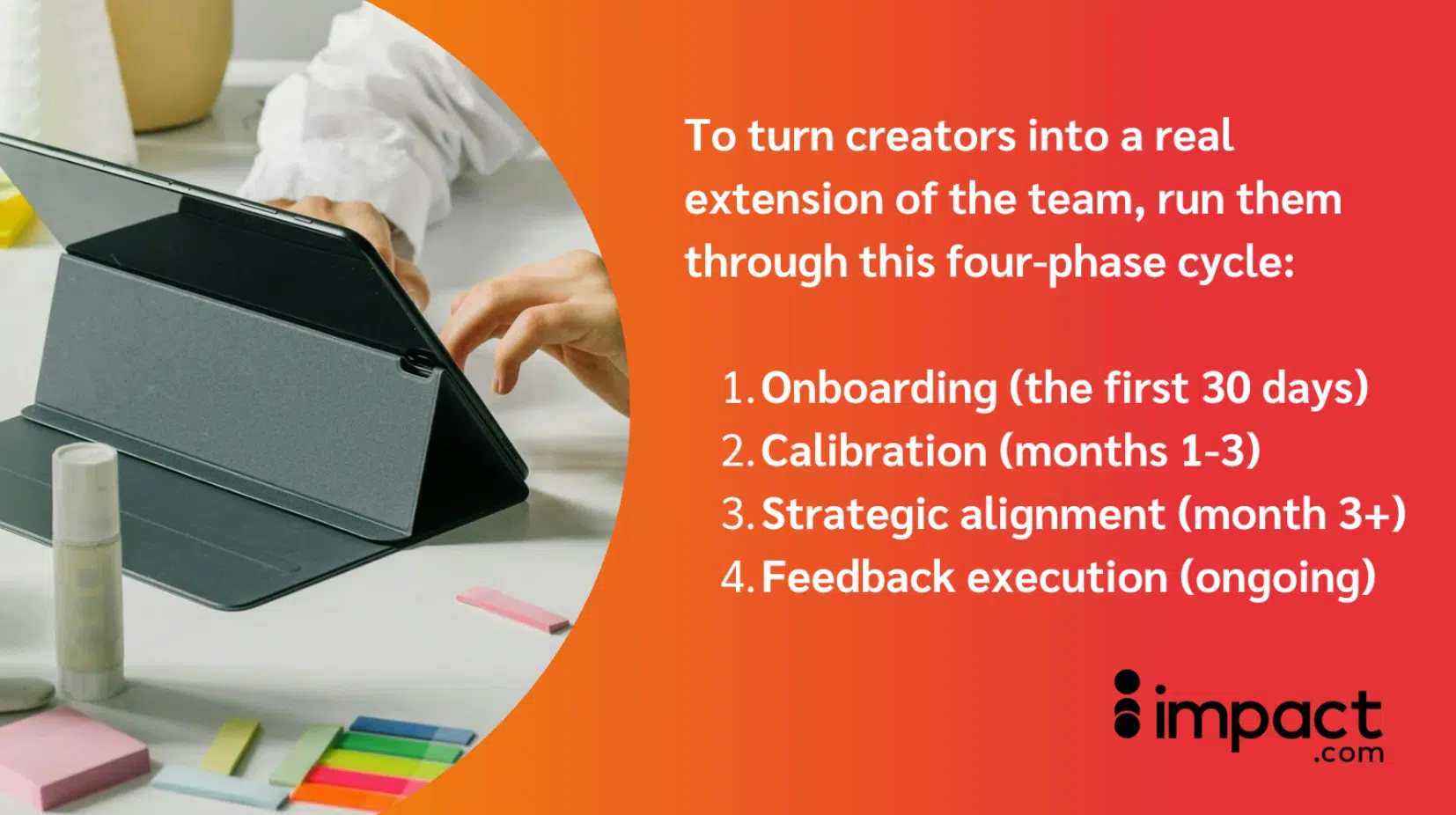
To turn creators into a real extension of the team, run them through this four-phase cycle:
- Onboarding (the first 30 days). Give new creators a content memory system. Include UGC libraries of past high-performers, brand mood boards, and walkthroughs of why specific pieces worked.
- Calibration (months one through three). Move from strict brief compliance to structured autonomy. Set non-negotiables on claims, brand positioning, and required talking points. Give creators room to use their voice on everything else.
- Strategic alignment (month three and beyond). Send a recurring creator newsletter with updated mood boards, seasonal trends, and upcoming product drops to keep active creators inspired around seasonal moments.
- Feedback execution (ongoing). Hold monthly listening sessions with the top-tier creators. Capture audience objections, recurring questions, and product requests, then route the insights to product, sales, and marketing. Close the loop by telling creators what changed because of their input.

How to run an influencer marketing campaign: Why most brands fail before they start
Read this guide to discover the gold standards impact.com’s expert creator team uses to build performance creator programs that compound over time.
How to scale your influencer program through community-led growth and partner tiering
Once creators are embedded in your operations—mapped into content lanes, plugged into attribution, and compensated for outcomes—the ecosystem begins to expand through peer-to-peer loops rather than brand-driven effort.
The networking effect: Influencer-to-influencer collaboration
Tom Bukevicius, CEO of Scube Marketing, lists community-led growth loops as one of the top infrastructure pieces most brands miss. He advises brands to “encourage creators to invite or collaborate with other creators, to turn your community into a self-expanding network.”
When two creators in a program co-create content, both get exposure to a new audience, and your brand gets two pieces of content for one production cycle. Built into the compensation structure, such as a small bonus when creator A drives a conversion through creator B’s content, this becomes a self-sustaining referral engine built on an existing network.
Creator referrals can work the same way as recruitment. When a brand makes it easy and rewards top creators for bringing in peers, the recruitment funnel stops being a manual outbound effort and becomes a community pipeline.
Standardize influencer content lanes to secure narrative consistency
Most creator programs eventually fragment because creators try to produce every kind of content, and the brand’s narrative gets lost. Evans sees the alternative play out at Outbuild: “Creators develop their own ‘lanes’ within your brand. Some become your educators, others your storytellers, others your proof points.” Over time, the audience starts to recognize these roles, which makes the overall narrative feel cohesive and ongoing rather than fragmented.
Alice DuBois, Senior Customer Success Manager at impact.com, points to a leading instrument retailer as a working example. The brand could partner with the biggest names in music, but it deliberately chooses not to.
DuBois said, “They actually choose to work with very niche ambassadors because there’s that increased authenticity lens to their content. Instead of partnering with a famous musician and just reaching a bunch of people, they have found that working with people who are very passionate about instruments, who operate at almost a savant level.” This ultimately brings the brand more value and revenue.
The lane is technical credibility, and the audience self-selects around it.
Actionable framework: The influencer role-based checklist
Use this taxonomy to assign specific roles during onboarding, ensuring your creator program covers the entire buyer’s journey. These clear parameters ensure your content investment is strategically distributed, removing the guesswork from community scaling.
| The influencer role framework: Structuring your online community for content diversity | |||
|---|---|---|---|
| Influencer lane | Strategic focus | Best for | Primary success metric |
| Educators | Explaining product mechanics, problem-solving, and the why behind the solution. | High-consideration purchases that require deep buyer research. | Save rate and average watch time: Signals the content is being kept for future reference. |
| Storytellers | Integrating the product into broader lifestyle narratives and cultural context. | Category-creating brands where entertainment and context outweigh specific features. | Shares and positive sentiment: Indicates that your brand is being woven into the audience’s identity. |
| Proof points | Documenting personal results and long-term outcomes (often over weeks or months). | Result-oriented products where the main conversion lever is peer validation. | Conversion rate (CVR): Directly measures the “this worked for them, it will work for me” factor. |
| Connectors | Introducing your brand to adjacent communities and facilitating peer-to-peer creator growth. | Ecosystem expansion and building brand authority in new communities. | Referral traffic and network growth: Tracks how effectively your brand enters new circles. |
Shifting incentives: How to turn your contractors into stakeholders
Scaling requires moving from a marketing expense mindset to an operational investment mindset where payment structures are designed to modify creator behavior. According to Cal Singh, Head of Marketing & Partnerships at Equipment Leasing Canada, when you pay creators by the post, they think by the post. But build incentives that reward outcomes, and they start behaving like part of the business.
The starting point is acknowledging where the market sits. DuBois has watched the expectation around flat fees harden in real time: “Six months to a year ago, we were still moving in that direction where that was becoming the expectation. Now it feels that it’s fully the expectation that flat fees are involved.”
Flat fees are the cost of entry, not a strategy. What flat fees can’t do is sustain engagement past delivery. DuBois described the long-term play: “You can pay however much for the post, but to keep them engaged with the brand beyond just that one post to generate sales on a commission basis is a really great strategy to keep ambassadors engaged.”
That dual structure—flat fee for production, commission for performance—is what motivates creators to keep working their content after the initial publish date.
Alexandra Dubakova, CMO at FreeTour.com, has seen the long-tail effect of this play out. Dubakova said, “Our highest-converting content last year was 6 to 9-month-old videos that creators kept engaging with in comments.” These partners constantly updated and re-shared content, and they only did this because they had a reason to care beyond the initial payment.
What hybrid compensation looks like in practice
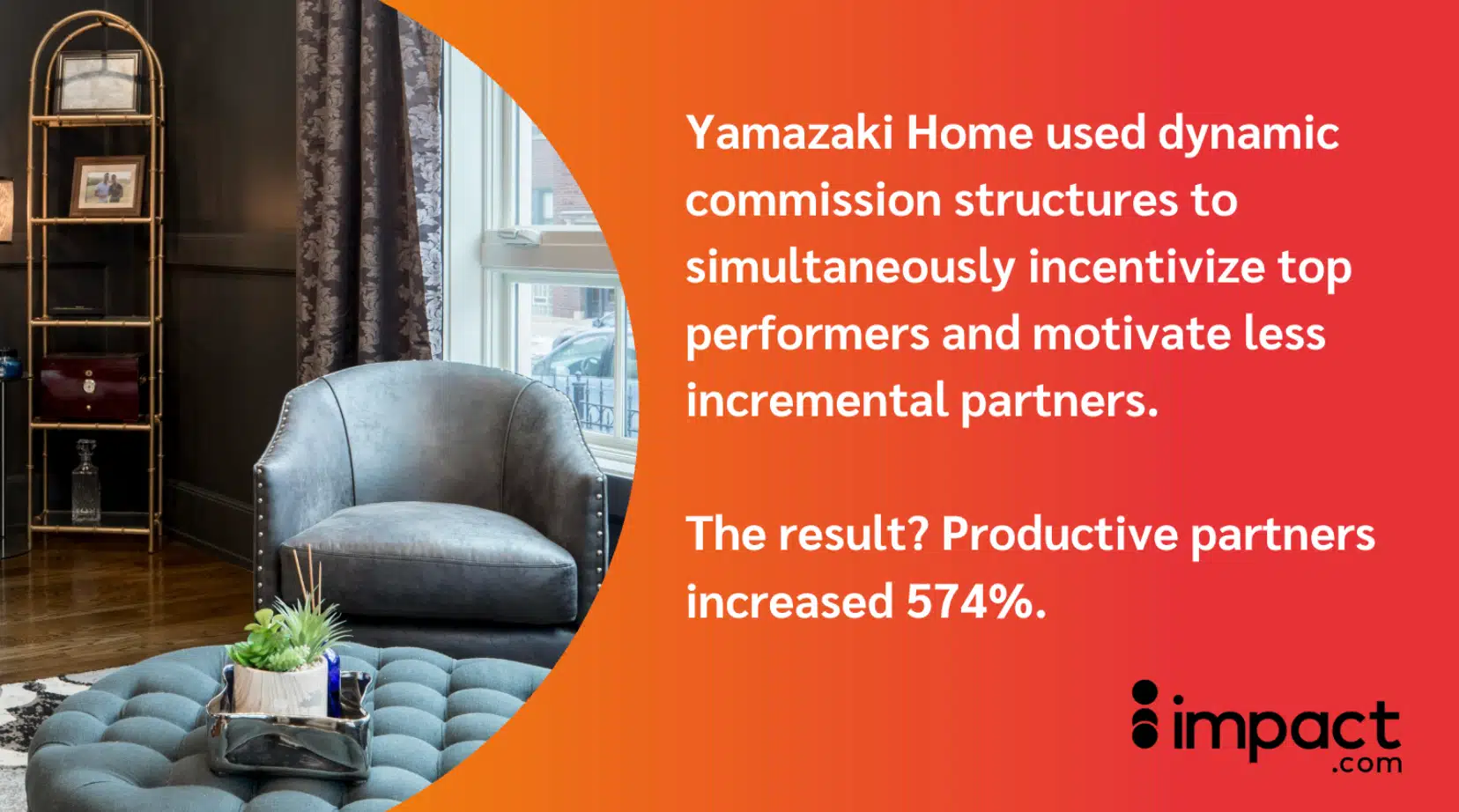
Yamazaki Home, working with the agency JEBCommerce on impact.com, designed economic logic into their tier structure: premium rates up to 18% for creators producing exceptional brand-aligned content, with a 7% baseline for less incremental partners.
The result? Productive affiliates increased by 574%, creating an active growth engine for the brand.
Singh explains why a compensation model like Yamazaki Home’s works: “The revenue sharing of building, first access to products, and credit of co-creation alters the relationship of creators to the brand in the long run.” That shift from contractor to stakeholder shows up in content quality—fewer revision rounds, longer publishing windows, and higher-converting evergreen posts.
According to Rafael Sarim Oezdemir, Head of Growth at EZContacts, the cleanest framework for organizing all of this is a tiered structure. Oezdemir explains, “Develop a tiered creator structure consisting of a small core of 10 to 20 brand advocates (top-tier), mid-tier of 50 to 100 people in the middle, and the last one of affiliates.”
A small core of deeply incentivized advocates keeps the brand voice coherent, a broad base of cost-per-action (CPA) affiliates drives volume, and the middle tier carries most of the conversion weight. The table below breaks this down.
Influencer incentive and perk matrix: from contractor to stakeholder
| The tiered incentive matrix: How to build an online community of influencers | ||||
|---|---|---|---|---|
| Community tier | Core mindset | Base compensation | Performance upside | Strategic perks |
| Core advocates (10-20 creators) | Stakeholder. Fully invested in brand growth and creative direction. | High-level flat fee or monthly retainer. | Revenue sharing, long-tail revenue participation, and co-creation credit. | First access to products, exclusive co-creation workshops, and early strategy visibility. |
| Strategic partners (50-100 creators) | Growth engine. Focused on a specific lane: education, storytelling, or proof. | Competitive flat fee per campaign or content piece. | Hybrid model: flat fee plus performance bonus or commission for conversions. | Cross-promotion incentives that reward creator A for driving conversions through creator B. |
| Scaled affiliates (100+ creators) | Amplifier. Driving high-volume reach and word-of-mouth. | Product gifting or store credit for initial testing. | Commission-only (CPA) or promo-code-based attribution. | Invitations into higher-tier community growth loops based on performance. |
Building your influencer portfolio: A strategic framework for scaling brands
Dive deeper into scaling your influencer program with this definitive guide.
FAQs
Transitioning from one-off influencer campaigns to a scalable creator community starts with consolidation. Audit every active partner program and centralize contracts, payouts, and data onto a single platform. Once a brand has a unified view of all partner activity, it can identify which creators are driving incremental revenue, which are duplicates across programs, and where to invest in deeper relationships.
The technical infrastructure required to build and track an online community of creators is a single platform that handles partner contracts, payouts, and reporting across affiliate, influencer, and ambassador programs. That platform needs an attribution layer with custom UTMs, promo codes, and tracking links assigned at the creator level from day one.
It should also feature a centralized media library and content rights management to enable the brand to reuse creator content across owned channels and automation for inbound applications, onboarding workflows, and recurring creator communications.
Incrementality is the metric that separates real revenue from credit-stealing. The basic move is to compare conversion behavior of customers exposed to creator content against a control group, isolating the lift creators actually produced. The more practical move is to track promo-code attribution, first-touch versus last-touch contribution, and customer lifetime value (CLV) by acquisition source. Creators driving high-CLV customers are worth more than creators driving high-volume one-time purchasers.
Contractor models pay flat fees for delivered content and end at the post. Stakeholder models pay a base that covers production cost, then layer on performance upside that compensates outcomes.
The difference shows up in long-tail content. A creator paid only at delivery has no economic reason to care if their video is still converting six months later. A creator with revenue share or commission has every reason to build evergreen content, repromote it, and recommend the brand inside their other partnerships.
Maintaining consistent brand storytelling across hundreds of creators requires three structural moves: defining the non-negotiables, assigning content lanes, and keeping creators connected through a shared content memory system. Start with the non-negotiables, such as claims, brand positioning, required talking points, and visual guardrails, and document them in a shared content memory system every creator can access. Then assign creators to clear content lanes, so each one knows their role in the broader narrative. Layer on a recurring brand newsletter with mood boards, product context, and seasonal direction.
Your brand’s first steps to creating an owned influencer ecosystem
The brands that compound creator revenue aren’t running better campaigns—they’re running a different kind of business. The campaign mindset caps growth at the budget cycle. The operational mindset compounds it.
To move from campaign spikes to a proprietary brand asset, start with these operational non-negotiables:
- Audit for silos. Map every fragmented affiliate, ambassador, and influencer program. Identify where they overlap, where attribution breaks, and which relationships could be consolidated onto a single platform.
- Establish data ownership. Get first-party data and content rights into every creator contract before scaling. Retrofitting agreements across a few hundred creators is a project most teams never finish.
- Commit to a 9-to-12-month testing window. DuBois was direct about the runway required: “I would give it nine months to a year to really test out a couple different campaigns, because seasonality can be so different.” Brands that benchmark a creator program against a paid-media quarter and pull funding when the numbers look soft never see the compounding curve start.
- Plan for continuous storytelling, not campaign sprints. Set up the calendars, the newsletters, and the content lanes that let creators evolve the brand narrative across months instead of resetting it every brief.
Discover more resources here:
- Why your 2026 search strategy depends on partnerships (and how to track the results) [blog]
- The Partnership Economy podcast: Navigating partnerships in the AI Age w/ Seth Hagerty of Best Buy
- Why your AI investment is stalling your creator program — and what to fix first [blog]
- impact.com X Cardlytics research report: Consumer spending intelligence report 2026
- Influencer marketing trends 2026: 13 experts weigh in on the future of performance-driven growth [blog]
- Building a successful influencer marketing program [worksheet]