

Google’s AI Overviews are changing how affiliate traffic works. Everything we’re seeing suggests most affiliates aren’t ready for what’s coming next.
Research from Pew Research Center found that click-through rates plummet to 8 percent when AI Overviews appear on search results, compared to 15 percent without them. That’s almost half the traffic gone.
At All Inclusive Marketing, we’re seeing this pattern play out across our partner network. One home goods affiliate watched their organic traffic drop 22 percent in Q2 2025. Their product roundup pages still ranked in the top three, but click-through rates fell nearly 40 percent.
The problem wasn’t that their content disappeared from search results. Google was pulling the answer directly into the Overview without linking back.
Pages built on easily summarized specs and surface-level comparisons get hit hardest. If your review can be fully understood without actually using the product, AI will summarize it. And when it does, rankings alone won’t save you.
This isn’t something you can fix with small SEO tweaks alone. It’s a human-first AI Overviews content strategy. It’s creating content that AI can’t easily replace: content so grounded in real testing, original proof, and expert judgment that AI systems cite it instead of summarizing it away.
That’s what we call “unignorable content,” and this article breaks down exactly how to create it in five steps.
How can an affiliate content strategy become ‘unignorable’ to AI systems?
Here’s the reality: AI Overviews thrive on easily summarized content. Specs, feature lists, surface-level comparisons. That’s exactly what they’re built to synthesize and serve up without sending a click.
The old playbook of publishing high-volume reviews built on scraped data? It’s done. AI does that faster and cheaper than any affiliate ever could.
What AI can’t do is create content that only exists because you did the work.
The definition of “unignorable”: Content nobody else can copy
“Unignorable” content offers something competitors can’t replicate without doing the same work you did.
In affiliate marketing, that might mean testing a mattress for 30 nights and documenting your sleep quality each day. Or, interviewing a product manager to understand design trade-offs that never make it into marketing materials. Avoid just listing specs that anyone can find on the manufacturer’s site.
If your review can be fully understood without touching the product or applying real judgment, it’s not unignorable. And in an AI-first search environment, that’s a problem.
The mindset shift: From affiliate marketer to source
When affiliates tell me they don’t have time for this level of effort, I’m blunt: Then AI is going to take your traffic.
It sounds harsh, but it’s the truth. Affiliates who treat content like a commodity are going to get replaced by commoditized AI answers. The ones who act more like product journalists or real experts in their field? They’re going to thrive.
This requires a mindset shift. Google still matters, but it’s no longer the only system looking at your content. You’re writing for answer engines. The goal isn’t to rank a page. It’s to become a source that AI systems learn from and reference when they generate responses.
Think about what that means practically:
- Stop optimizing for rankings alone and start creating content AI tools cite.
- Stop summarizing what already exists and start documenting what only you know.
- Stop chasing volume and start building authority through depth.
The affiliates making this shift are actively shaping how AI learns and how users discover products. That’s the real opportunity.
The difference isn’t subtle. Here’s the old model vs what works now:
| Traditional affiliate content strategy vs AI Overview content strategy | |
|---|---|
| Traditional affiliate content strategy | “Unignorable” AI Overview content strategy |
| Built for rankings and volume | Built for trust, depth, and defensibility |
| Relies on specs, features, and brand messaging | Anchored in first-hand testing and lived experience |
| Easy for AI to summarize and replace | Difficult to synthesize without losing value |
| Generic opinions and safe praise | Qualified judgement and clear point of view |
| Optimized primarily for Google SERPs | Designed for answer engine optimization (AEO) |
| Focuses on “best of” lists and comparisons | Focuses on real use cases and decision context |
| Avoids mentioning flaws | Transparently calls out limitations and trade-offs |
| One format reused across channels | Format matched intentionally to channel and intent |
| Measures success by traffic volume | Measures success by engagement, conversion quality, and citations |
| Competes for clicks | Becomes part of what AI systems surface during discovery |
Is there measurable ROI for a human-centric AI Overview content strategy?
When you raise the bar on effort, results show up fast in the performance metrics that actually matter.
Our team has been tracking this shift across our partner network for the past year. The pattern is consistent: affiliates who moved away from high-volume, surface-level reviews and invested in real testing and honest evaluation saw measurable improvement. Not just in traffic, but in conversion quality and engagement.
Here’s what that shift looks like across a handful of real partners:
B2B finance affiliate: 14 percent lift in qualified leads
One of our partners in the finance space completely revamped how they reviewed software products.
Instead of listing features anyone could find on a pricing page, they documented actual testing: screen recordings of the UI, walkthroughs of friction points, candid analysis of customer complaints pulled from G2 and Reddit.
The result? A 14 percent lift in qualified leads converting into sales opportunities. The volume didn’t spike, but the leads were noticeably more sales-ready.
Home goods affiliate: 18 percent traffic increase during AI Overviews expansion
Another partner added pros-and-cons tables to every product review and started showing their own real-world use of products on-site. In other words:
- Photos of items in their actual home, not stock imagery
- Honest takes on what worked and what didn’t
Traffic rose 18 percent in Q3 2025, even as AI Overviews became the mobile default and most affiliates were reporting declines.
B2B SaaS affiliates: Higher conversion rates with fewer reviews
We’ve seen several partners publish fewer reviews overall but go much deeper on each one.
They show real screenshots from inside the product, Q&As with founders about roadmap and design decisions, and honest takes on pricing and who the product isn’t right for.
The outcome? Meaningful conversion rate gains. Readers who clicked through were further along in their decision process and more likely to convert.
These examples reflect a broader story in affiliate marketing
According to impact.com’s State of Affiliate Marketing research, 73 percent of brands report increased revenue from affiliate programs over the past year. Affiliate marketing is clearly raising the bar.
These efforts compound because original evaluation attracts higher-intent readers, builds trust faster, and converts more reliably than high-volume, commodity content ever did. The AI era is demanding better content. It’s just a matter of how you look at things.
The unignorable content checklist: 5 steps to defend your affiliate traffic with a winning AI Overview content strategy
Understanding the mindset shift is one thing. Executing on it is another.
Unignorable content isn’t abstract or reserved for massive teams with unlimited resources. It’s built through specific choices:
- How you test products
- How you document proof
- How you apply expertise
- How honestly you evaluate what you review
The checklist below breaks that work down into clear, practical actions. Each item is designed to help you create content that AI can’t easily summarize, competitors can’t easily replicate, and buyers trust.
These are ranked by impact based on what we’ve seen work across our partner network at All Inclusive Marketing.
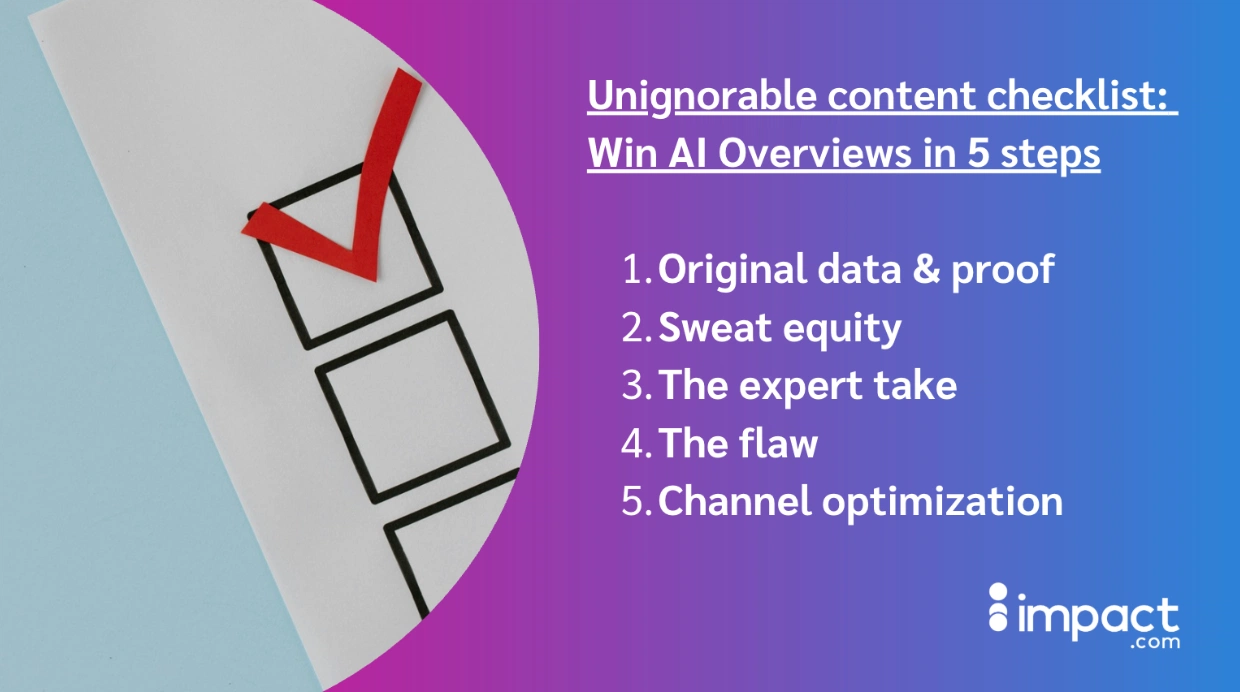
1. Original data and proof: Show what AI can’t invent
This is the number one priority. It’s one of the few things AI can’t convincingly fake or piece together from other sources.
Original data and proof are any assets you create while actually using the product: screenshots you took, videos you shot, test logs you documented, performance results you measured. It’s the content that only exists because you did the work.
Why it matters now
AI Overviews can remix opinions all day long. They can synthesize specs and surface-level comparisons from a dozen different sites. What they cannot do is fabricate first-hand evidence.
If your review relies only on words, AI can summarize it and serve it up without sending a click. But if it relies on proof like original photos, test data, or screen recordings, AI has to either cite you or skip the answer entirely.
That’s the difference between getting traffic and training the system that competes with you.
How to create original proof
The bar here isn’t high, but it is non-negotiable. You need to show, not just tell, that you used the product.
- Capture screenshots or original images while using it. If you’re using a digital product, show screenshots from inside your own account with real data, real workflows, and real UI elements you interacted with.
- Record short walkthroughs. A 60-second screen recording showing a key workflow or friction point is worth more than three paragraphs describing it. Users see it. AI can’t recreate it.
- Log performance over time, like before/after comparisons, usage metrics tracked across days or weeks, and results that only emerge through sustained use. This is the evidence that makes your review defensible.
- Show it in context. Don’t bury proof in an appendix or image gallery. Put it directly in the review where it supports your claims.
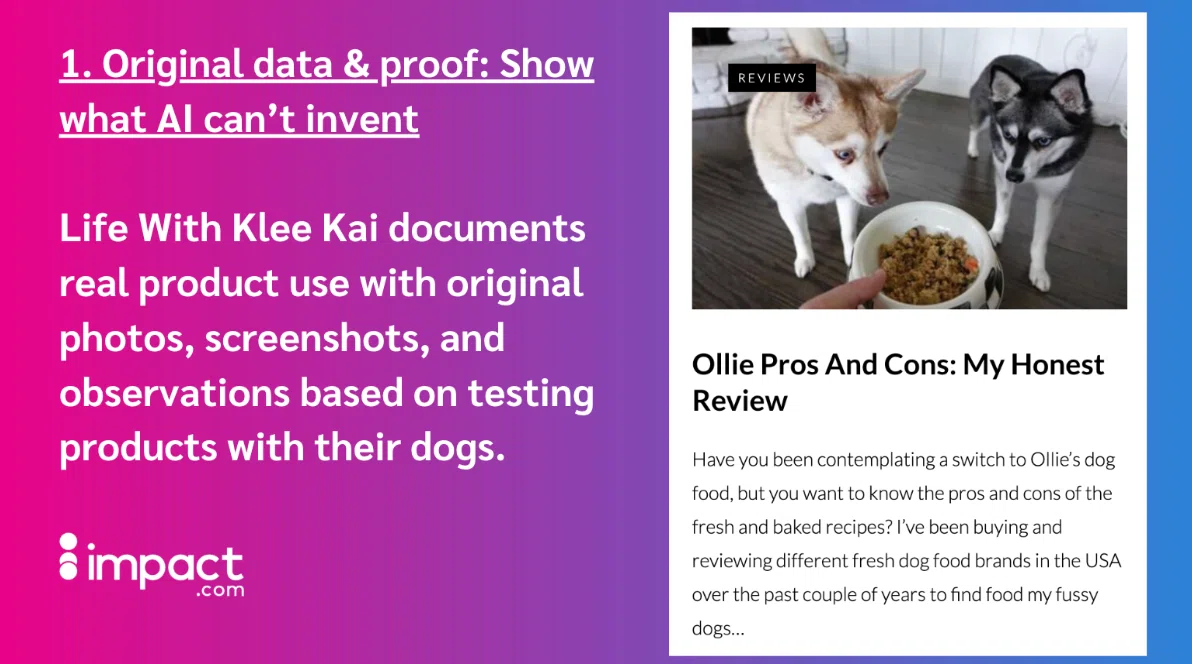
Life with Klee Kai: Documenting products in use
Kieran Beckles runs Life With Klee Kai, a pet product affiliate site. Instead of recycling product specs, he documents real product use with his dogs: original photos of them using the gear, screenshots of his purchase history, and observations based on weeks of testing.
That first-hand proof removes guesswork for buyers and delivers insights AI can’t fabricate. It’s why his content continues to perform even as AI summaries expand. And it’s why his reviews stand out in increasingly crowded search results where most affiliates still rely on the same recycled claims.
Over time, this type of evidence-rich content is more likely to be referenced by AI systems because it offers information that doesn’t exist anywhere else.
2. Sweat equity: Prove you used the product
Sweat equity ranks second because effort equals credibility. Both consumers and AI systems reward content where it’s obvious the creator actually used the product.
Sweat equity is visible effort that signals to readers you went beyond product research and actually lived with it. That might mean using it daily, paying for it yourself, or testing it long enough to experience both the value and the friction.
Why it matters now
AI Overviews thrive on second-hand summaries. Specs, feature lists, and recycled opinions are easy to synthesize. But lived experience breaks that loop.
When it’s clear you used the product, your content becomes harder to summarize and replace. The insights only emerge through real use: the small annoyances, the unexpected benefits, the moments where the product surprised you or let you down.
That’s what makes content unignorable.
How to show sweat equity
Use products for a meaningful period before reviewing them. The goal is to live with the product long enough to notice what only shows up over time.
- Document the timeline. “I’ve been using this for 30 days” or “After three months of daily use” immediately signals credibility. Even better: show the progression of what you thought in week one vs week four.
- Show purchase proof. A screenshot of your order confirmation or receipt removes any doubt that you actually bought it. This is especially powerful when you paid out of pocket rather than receiving a free sample.
- Call out the learning curve. Products that take time to learn or set up reveal their true value (or limitations) only after you’ve lived with them. Document that experience.
- Share the inconvenient truths. The small things that annoyed you. The feature that didn’t work as expected. The moment you almost returned it, but didn’t. This is the texture AI can’t generate.
Resident’s sweat equity strategy
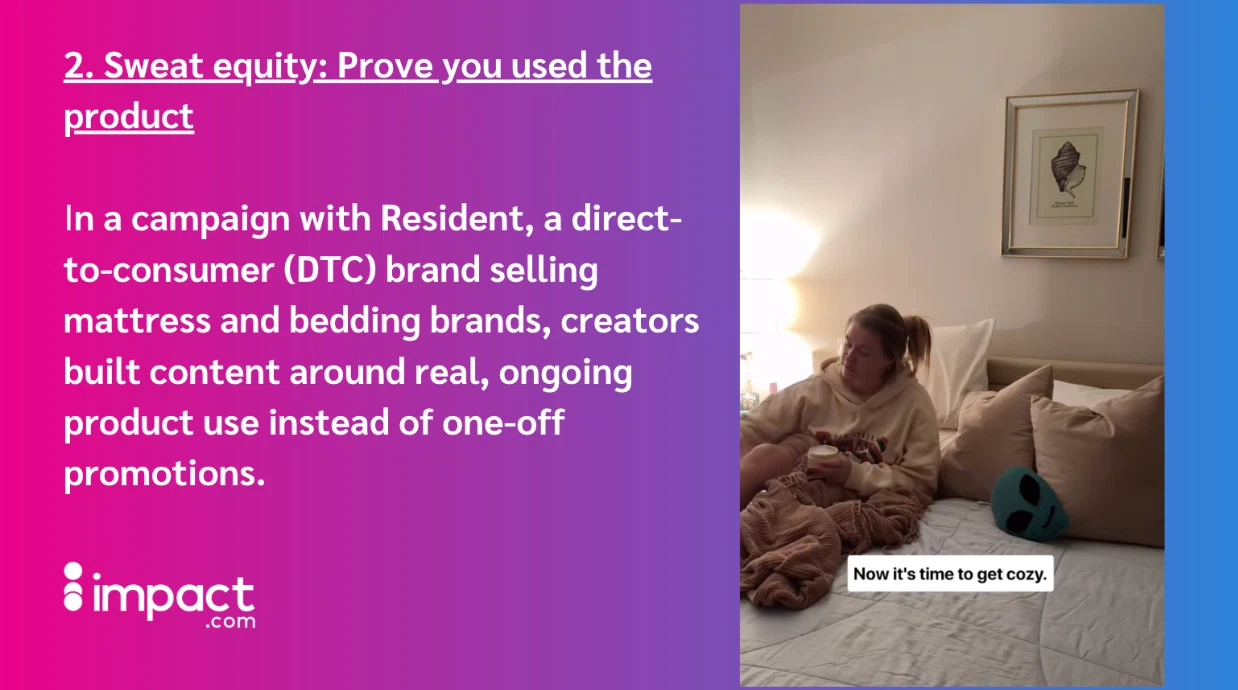
Resident, a DTC mattress and bedding brand, ran a creator campaign that demonstrates sweat equity done right.
Instead of one-off promotional posts, creators built content around real, ongoing product use. They documented setup, sleeping on the mattress over weeks, and the actual trade-offs they noticed.
One creator showed how the mattress felt different in summer vs winter. Another documented back pain improvement over 45 days.
That sweat equity made the content feel credible and evergreen. It answered questions AI summaries can’t touch and gave buyers the confidence to move forward. The approach doubled the value of each post for Resident.
3. The expert take: Explain why you use it
The expert take matters because it keeps people coming back. Whether it’s a product manager reviewing software or a home chef testing cookware, real expertise builds loyalty and makes your content worth citing.
An expert take explains why you use a product, not just what it does. It’s a qualified perspective rooted in real experience, problem-solving, and decision-making. It’s judgment that only comes from deep domain knowledge.
Why this matters now
Generic opinions are easy for AI to summarize and replace. “This product is great for beginners” or “Works well for most users” doesn’t require expertise. It’s the kind of statement AI can infer from aggregating dozens of reviews.
Experience-backed perspectives add context AI can’t infer on its own. Especially when you include trade-offs, areas for improvement, and real-world fit based on your knowledge of the space.
That’s what makes you a source instead of just another review.
How to provide an expert take
Anchor your reviews in qualified viewpoints. This doesn’t mean you need a PhD. You just need to demonstrate that you understand the product category deeply enough to make informed calls.
- Explain your decision-making. Why did you choose this product over alternatives? What factors mattered most? What did you prioritize and why? This reveals expertise more than any credential.
- Interview actual experts. If you’re not the domain expert, talk to someone who is.
- Compare based on experience. “After testing 15 email platforms over two years, here’s where this one fits” carries more weight than “This is a good email platform.”
- Articulate the use case fit. Who is this product actually right for? Who should skip it? Why? This level of specificity only comes from real understanding.
DC Rainmaker documents real-world performance
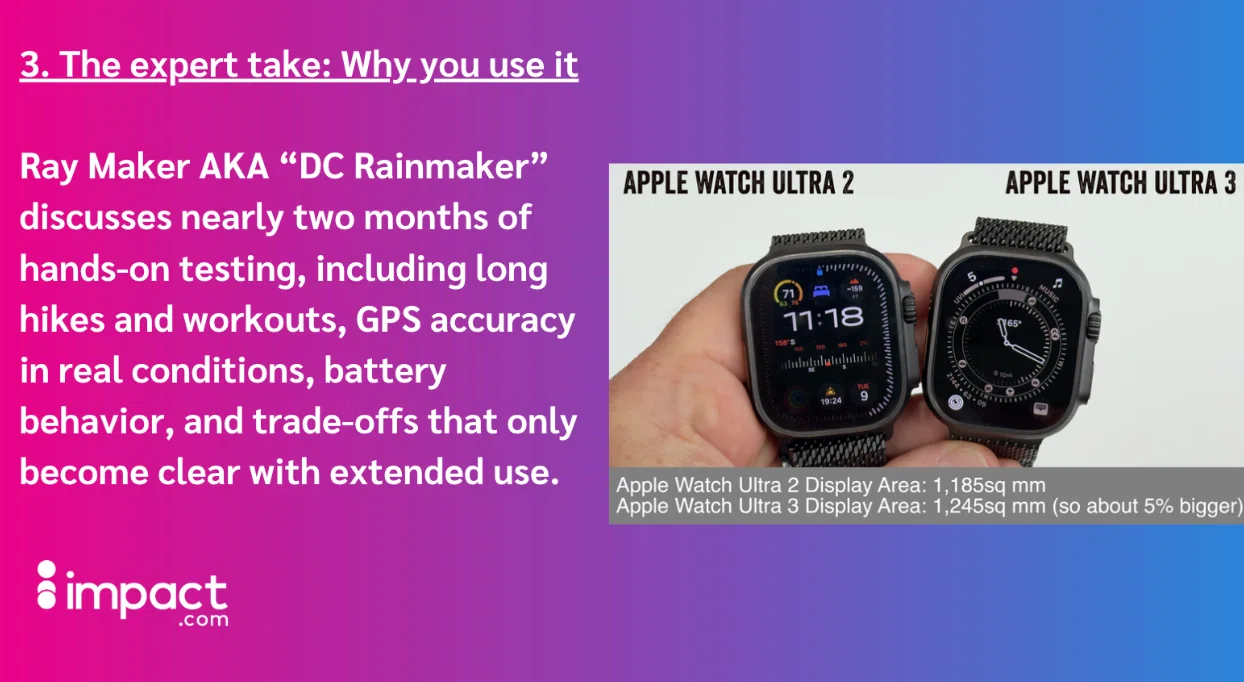
Ray Maker runs DCRainmaker.com, an affiliate review site for sports technology and physical gear. Instead of repeating specs, he spends weeks or months using products like GPS watches and bike computers in real conditions.
His reviews document real-world performance, limitations, and who each product is actually right for—all grounded in first-hand experience and clear judgment.
In this review, Maker discusses nearly two months of hands-on testing: long hikes and workouts, GPS accuracy in real conditions, battery behavior, and trade-offs that only become clear with extended use.
Expert-led content builds trust over time, not just on a single visit. Readers return because they learn something, not because they skimmed a summary.
When your site consistently offers context-rich, experience-backed insights, it begins to function as a learning source rather than just another page competing for attention.
4. The flaw: Say what AI reviews won’t
Addressing flaws means intentionally highlighting a product’s limitations. Present a clear, balanced view that helps buyers decide whether it’s right for them.
This is where a lot of affiliates hesitate. They worry that pointing out flaws will kill partnerships or hurt conversion rates.
We usually see the opposite.
Why this matters now
Trust is built through balance. AI-generated reviews tend to smooth over flaws in favor of safe, generic praise. When your content acknowledges trade-offs, it immediately signals independence and experience.
Buyers actively look for this, especially as AI summaries feel increasingly polished and sanitized. Gen Z and experienced purchasers have learned to spot marketing language instantly. They don’t trust perfection.
Balanced reviews reduce uncertainty, increase confidence, and help readers move forward with a decision. That clarity is what drives action, and it’s exactly what AI summaries tend to miss.
How to address flaws constructively
The key is framing. You’re not writing a hit piece. You’re helping someone make an informed decision.
- Use this simple structure: What the product does well, where it falls short, and who it’s still right for. This keeps criticism grounded, useful, and fair.
- Be specific about the limitation. “The mobile app is buggy” is more helpful than “It has some issues.” Name the problem clearly so buyers know what they’re getting into.
- Explain the impact. Does the flaw matter for most users? Is it a dealbreaker for certain use cases? Context makes the difference between a helpful callout and noise.
- Acknowledge when it’s not a flaw for everyone. “This laptop runs hot under heavy load, which matters if you’re doing video editing but won’t affect casual browsing.”
Pat Flynn’s ConvertKit review
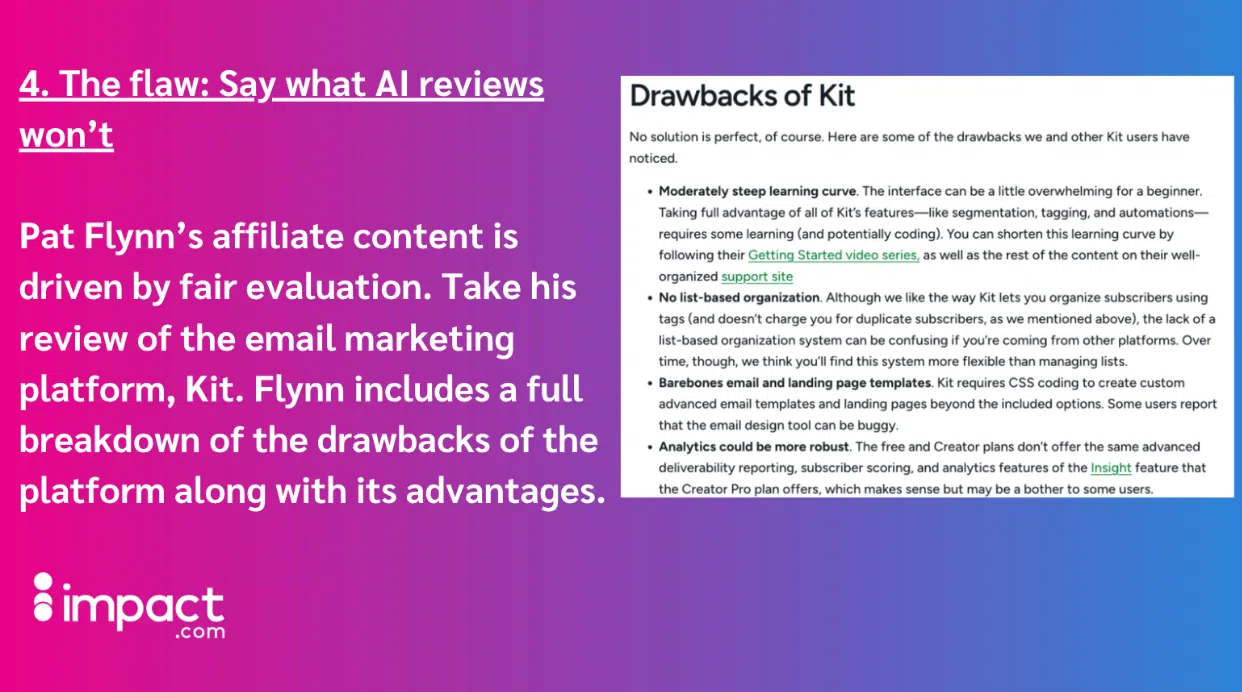
Pat Flynn runs Smart Passive Income, and his affiliate content is driven by fair evaluation instead of generic praise. He explains why he uses certain tools in the context of running real businesses, including pros and cons.
In his review of ConvertKit (now Kit), Flynn includes a full breakdown of the platform’s drawbacks alongside its advantages. He lists specific limitations: steep learning curve for beginners, no list-based organization, barebone email templates, analytics that could be more robust.
That honesty doesn’t hurt conversion. It builds it. Readers trust that if Pat’s willing to call out flaws, his praise is earned.
We’ve seen this play out with our own partners. A travel affiliate called out a booking platform’s buggy mobile app while highlighting what made the overall experience great. That honest post outperformed polished, brand-written reviews by 3x. The brand didn’t pull the partnership—they increased commissions.
Honest reviews rarely kill partnerships. In most cases, they strengthen them. Brands recognize that authenticity converts better than perfection.
5. Channel-aware optimization: Match depth to format
Channel-aware optimization is designing content for how and where people consume it. Instead of publishing the same asset everywhere, you align depth, format, and intent to the channel that serves it best.
This ranks fifth, not because it’s unimportant, but because it only matters after you’ve built content worth distributing. If your reviews aren’t valuable, optimizing them across channels just scales the problem.
Why this matters now
Valuable content performs best where it belongs. AI-driven discovery increasingly favors content that aligns with the user’s intent and the platform’s format.
When depth and delivery are mismatched, like publishing a 3,000-word caption to Instagram or a 30-second video explaining complex SaaS features, even strong insights get overlooked.
Format matters. Channel matters. Getting both right amplifies the work you’ve already done.
How to optimize by channel
The key is to reframe optimization. You don’t need to repurpose everything everywhere by default. Design for consumption.
- Long-form product reviews belong on YouTube where users expect depth and demonstration. Video lets you show the product in action, walk through UI, and document real usage in ways text can’t.
- Visual walkthroughs perform best on video-first platforms. TikTok, Instagram Reels, YouTube Shorts are built for showing, not telling. Quick product demos, unboxing with commentary, before/after comparisons.
- Deep comparisons and buying guides work as blog content where readers can skim, reference, and return. Support this with downloadable assets (comparison charts, checklists) for readers who want to go deeper.
- Quick takes and insights fit social platforms where the goal is to drive awareness and direct users to the full review elsewhere.
James Hoffmann’s strategic platform matching
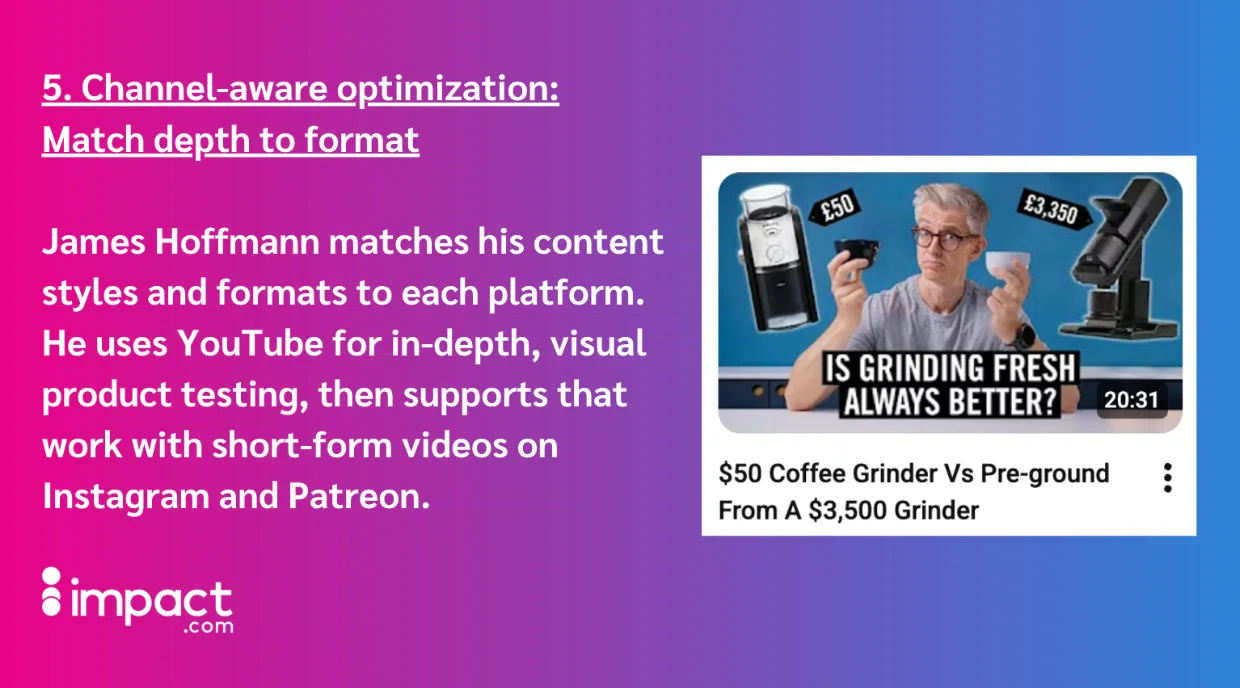
James Hoffmann is an affiliate who matches content format to each platform strategically. He uses YouTube for in-depth, visual product testing of coffee equipment: 20+ minute reviews showing grind quality, extraction, and real-world use.
Then he supports that work with short-form content on Instagram and Patreon. Each format serves a different intent.
The long-form YouTube content is where the expertise lives. The short-form content drives discovery and keeps his audience engaged between deep reviews. And his Patreon offers even more depth for people who want it.
Each format is intentional. Nothing feels repurposed or forced.
Content that’s matched to its channel is easier for AI tools to surface because it satisfies intent. At the same time, spreading unignorable content across the right formats reduces dependence on a single discovery channel, making your growth more resilient as search continues to evolve.
Where should you invest in 2026? Expertise over everything.
If you can only make one strategic bet for the next 18 months, here’s what I’d tell you:
Expertise. All day.
Diversifying channels can help, but if your content isn’t valuable, it won’t work anywhere. Spreading thin, interchangeable reviews across more platforms just accelerates how quickly they get summarized or ignored.
The affiliates holding up best right now are doing the opposite. They’re narrowing their focus, owning a specific niche, and going deeper than anyone else in that space. They treat content like a product, not a volume game.
That’s what turns a site into a source, and that’s the only position that matters in an AI-first discovery environment.
The shift from rankings to AI citations
At All Inclusive Marketing, we’re going all-in on AEO. That means making sure affiliate content is something AI tools like ChatGPT, Perplexity, and Google Gemini see as worth citing and learning from.
Ranking still matters, but it’s no longer the end goal. It’s to create content that AI systems reference when they generate responses.
That only happens when your work demonstrates real usage, original insight, and clear judgment. It doesn’t happen when your reviews repeat what already exists.
In practice, this means you’ll write fewer reviews but do them far better. You’ll invest more time in testing, documentation, expert context, and honest product evaluation.
Those pieces compound in value. Scale-driven strategies, like churning out high-volume reviews built on scraped data, erode fast in an AI-first world.
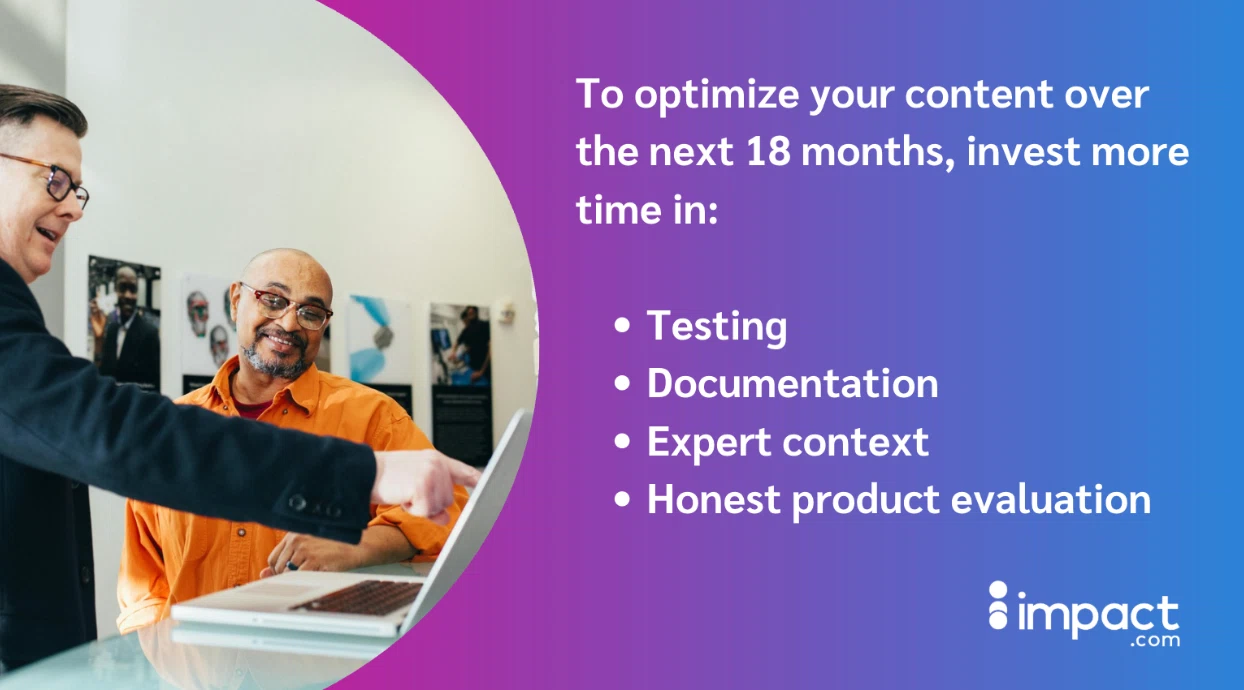
The three-part bet for a resilient AI Overview content strategy
Here’s what we’re seeing work:
- Own a niche. Don’t try to review everything in a category. Pick a corner you can dominate through depth and expertise. Become the go-to source for that specific thing.
- Go deep. One exceptional review is worth ten mediocre ones. AI summaries have made volume strategies obsolete. Depth is the new moat.
- Prove you used it. Show your work. Document real usage. Build proof that can’t be faked. This is the foundation everything else sits on.
That’s the bet that still pays, no matter what happens with the algorithms.
How do you know if your AI Overview strategy is working? Track these metrics.
When you invest more effort per piece, you need clear signals that your strategy is paying off.
The good news: Unignorable content leaves a different footprint than commodity reviews. And it shows up quickly if you know what to look for.
Here’s what we track with our partners at All Inclusive Marketing, and what you should be watching.
Traffic quality matters more than volume
This is the first place you’ll see movement, usually within 30 days.
Unignorable content should hold attention. Look for increases in:
- Time on page
- Deeper scroll depth
- Lower bounce rates
Even if overall sessions are flat or down, stronger engagement signals you’re attracting higher-intent readers that are more likely to convert.
We’ve seen affiliates lose 15 percent of their traffic but increase revenue because the traffic they kept was higher quality. That’s the shift you’re looking for.
AI citations are the new backlinks
Citations are becoming as important as SERP rankings—maybe more important.
Start monitoring whether AI tools are referencing your content. Check ChatGPT, Perplexity, Google’s AI Mode, and Gemini. Search for your brand name, look for your product explanations, watch for your specific phrasing showing up in AI-generated answers.
You won’t always get a click, but citations signal that large language models (LLMs) treat your content as a source. That’s the position you’re building toward.
Right now, tracking this is manual. Set a calendar reminder to check monthly. As tools improve, this will get easier to automate.
Conversion efficiency tells the real story
This is where unignorable content proves its value, and it often happens before traffic recovers.
Track affiliate click-through rates, conversion rates, and commission per visitor. Many of our partners see performance lift here first because clarity and trust reduce buyer hesitation.
Fewer clicks, but better ones. That’s the pattern. If your commission per visitor is rising even as traffic stays flat, you’re winning.
The 90-day view
This strategy compounds, but you’ll see early indicators within three months.
In the first 30 days, engagement should improve. Readers spend more time with deeper content, scroll further, and bounce less.
By 60 days, conversion quality rises. Your traffic converts at a higher rate because the people finding you are further along in their decision process.
At 90 days, you start seeing AI citations, repeat visitors, or ranking stability even as competitors lose ground.
If those three things are moving in the right direction, you’re on the right track. Unignorable content doesn’t always win fast. But when it works, it works in ways that are much harder for competitors to take away.
You’re not a marketer anymore…you’re a source
AI Overviews haven’t killed affiliate marketing. They’ve just raised the bar.
Thin, interchangeable reviews built for volume and clicks? Done. AI does that faster and cheaper than any affiliate ever could.
What works now is unignorable content: reviews rooted in real effort, original proof, and informed judgment. Content that can’t be summarized without losing value.
That’s the throughline of this entire checklist. And it’s the standard you need to hold yourself to if you want to stay relevant.
Here’s what this means in practice: You’re no longer just a marketer competing for clicks. You’re a source that AI systems learn from and users trust.
Your content doesn’t only influence individual buying decisions. It trains the systems shaping how products get discovered in the first place. AI learns from what you publish. Users decide what to trust based on the depth and honesty you demonstrate.
The affiliates who embrace this by testing products, documenting proof, applying real judgment, and publishing honest evaluations aren’t just surviving the AI era. They’re defining it.
They’re the ones AI tools cite. The ones buyers click through to read. The ones building sustainable businesses while competitors watch their traffic evaporate.
What’s next for you
If you’re ready to adopt this strategy, you need the right tools and partnerships to make it work.
impact.com’s platform helps brands and affiliates track performance, manage partnerships, and scale what’s working. All Inclusive Marketing specializes in building affiliate programs that prioritize quality over volume—exactly the approach this moment demands.
Request a demo with impact.com and schedule a meeting with All Inclusive Marketing to start building an unignorable content strategy today.
Check out more content here:
- The ultimate guide to B2B SaaS affiliate marketing [blog]
- Black Friday 2025 spending trends: Shoppers researched for weeks, but spent 31% in one day [research]
- Breaking Marketing Silos with Yulia Shilkina [podcast]
- The ROI of long-term creator partnerships vs one-off campaigns [blog]
- Influencer marketing trends 2026: 13 experts weigh in on the future of performance-driven growth [blog]
FAQs
Unignorable content is affiliate content that can’t be easily summarized, scraped, or replaced by AI. It’s built on real product use, original proof, and expert judgment instead of recycled specs or surface-level opinions.
This matters because AI Overviews pull answers directly into search results, often without sending clicks back to publishers. Content that’s easy to summarize is the first to lose traffic. Unignorable content holds up because it offers something AI can’t recreate: lived experience, context, and credibility.
The fastest way to humanize affiliate content is to focus on effort, proof, and judgment.
First, use the product and show it. Document real usage with screenshots, photos, or videos so readers can see what the product is actually like in practice.
Second, add original insight. Explain why you chose the product, what surprised you, and where it fell short. Generic opinions are easy for AI to replace.
Third, be honest about trade-offs. Balanced reviews build trust and answer the questions AI summaries tend to skip.
Adding sweat equity and original proof makes affiliate content superior because it introduces information AI can’t invent or infer.
AI-generated summaries rely on second-hand data, patterns, and existing opinions. Sweat equity shows that you used the product long enough to experience real benefits, friction, and edge cases.
Original proof, like screenshots or test results, removes guesswork and gives buyers clarity that summaries can’t provide.
Together, they make content harder to replace, more trustworthy to readers, and more likely to be referenced by AI systems instead of summarized away.
Balanced reviews build trust. Buyers are skeptical of perfection, and AI-generated summaries tend to smooth over flaws. When affiliates clearly explain what a product does well, where it falls short, and who it’s still right for, readers feel more confident making a decision.
Brands often recognize this, too. Honest, constructive feedback typically leads to stronger credibility, better conversion rates, and longer-term partnerships, and not lost commissions. Pointing out flaws thoughtfully doesn’t hurt performance. It usually improves it.
The critical mindset shift is moving from writing for rankings to writing as a source.
In the answer engine era, success isn’t just about where your page ranks. It’s about whether AI systems see your content as credible enough to learn from and reference. That means focusing less on volume and optimization tricks, and more on real product use, original insight, and clear judgment.
Affiliates who make this shift stop competing to be summarized and start shaping the answers themselves.