

A flawed assumption sits at the heart of your affiliate marketing commission strategy. It’s the belief that if you match competitors’ pay rates, you’ll find success. In reality, it’s a path to mediocrity.
Just ask Semrush. The company ran a generous first-click affiliate program designed to build loyalty. But over time, that same program had reached a growth ceiling, as newer partners were unable to get credit for the sales they drove. Their strategy was working against them.
Pivotal change came when they looked past the market and focused on their own business goals. They replaced their old model with a new structure built for customer acquisition, offering partners:
- $10 per trial activation
- $200 per new sale
- Regular monetary incentives, quarterly performance bonuses, and bonuses for new promo content
In the impact.com and Semrush case study, the result was a 400% increase in new partner sign-ups within six months.”
Semrush’s experience demonstrates a critical lesson. The most profitable affiliate programs are not built by copying others. They’re built by ignoring them.
The shift is already happening. According to impact.com’s State of Affiliate Marketing Report, high-performing brands now use an average of 2-3 different compensation models, a practice that makes every payout an investment in profit, not just a cost of keeping up.
This guide gives you a four-phase framework to stop chasing what everyone else is doing and start building a commission structure that is undeniably, profitably your own.
The hidden dangers of chasing competitor rates
Copying competitor rates feels safe—and that’s what makes it dangerous. Here are the three biggest dangers of letting competitors dictate your commissions.
| Danger | What it does to your program | Why does it compound over time |
| You inherit their business model | You adopt their financial strategy without seeing their books. This risks setting payouts that are unprofitable for your specific margins, LTV, and CAC. | Paying for growth at a loss depletes your budget. This prevents you from investing in channels and partners that are actually profitable for your business. |
| You start a race to the bottom | It forces you to compete on commission rates—a metric anyone can copy. Your program’s focus shifts from creating value to simply outbidding rivals. | This erodes profit margins across the board and makes the channel less sustainable. Profitability becomes the first casualty in an endless bidding war. |
| You attract the wrong kind of partner | You attract mercenaries motivated only by the highest payout. They are loyal to the payment, not your brand, and will leave the moment a competitor offers more. | Your budget is spent on overpaying for low-intent traffic. This leaves you undervaluing true brand advocates who could have driven authentic, long-term growth. |
By building your strategy on your own financial foundation, you sidestep these dangers and guarantee every dollar you spend is a calculated investment in your profitable growth.
The four-phase implementation plan for a profit-first commission strategy
So, how do you escape the race to the bottom and build a commission strategy that actually drives profitable growth? You stop looking outward and start looking inward.
Instead of reacting to the market, you take control by building a framework rooted in your own business economics. The following four-phase plan is a repeatable, eight-week roadmap designed to do exactly that.
The four phases move from financial analysis to a dynamic, multi-layered commission structure—built for profit, designed to attract partners worth keeping.
Phase 1: Foundation and financial analysis (Weeks 1–2)
The first step to building a profit-driven strategy is shifting focus from the external market to your own business economics.
The goal of this phase is to establish the strategic and financial guardrails for your affiliate marketing commission strategy. Completing this analysis first means every decision in the phases that follow is grounded in profitability, not reactive market-chasing.
Step 1: Define your primary objective
This first step sets your own course. Before you can design a commission, you must pick one specific affiliate program goal it will serve. This is a question that looking at competitor rates can never answer for you

Your program can’t chase everything at once. Choose one primary objective to act as your North Star. This choice will dictate which partner actions you value most and how you reward them.
| Primary objective | How it shapes your commission structure |
| New acquisition cost | Rewards new customer acquisition with a premium commission rate or a flat bounty. |
| Increase average order value (AOV) | Ties commission rates directly to order value, using tiers to incentivize and reward larger carts. |
| Promote high-margin products | Isolates profitable items and assigns them a higher commission rate to focus partner effort where it matters most. |
By defining your own objective first, you change your commission strategy into a tool for achieving your goals.
Step 2: Conduct your financial analysis
With your objective set, this step produces the numbers that let you ignore the market with confidence. These calculations give you the financial guardrails that keep every commission tied to your own profitability.
Your financial analysis answers three core questions. The answers will form the foundation of your entire commission strategy.
| Metric | The core question it answers | Why it matters for your strategy |
| Customer acquisition cost (CAC) | “What’s our maximum affordable cost to get one new customer?” | Sets your absolute spending ceiling to prevent unprofitable payouts. |
| Customer lifetime value (LTV) | “What is the long-term profit from an average customer?” | Justifies higher payouts for partners who deliver high-value customers. |
| Product/category margins | “How much profit does each specific product generate?” | Let’s you offer higher rewards for high-margin products, maximizing profit on every sale. |
With those three inputs, you can calculate your commission ceiling. Wondering what this looks like in practice? Here’s the math:
- Your average CAC across all channels: $45
- Target share of acquisition budget for partnerships: 30%
- Target commission spend per order: $45 × 0.30 = $13.50
- Average order value (AOV): $120
- Commission rate ceiling: $13.50 ÷ $120 = 11.25%
* This means you can offer up to an 11 percent commission while maintaining your target acquisition economics.
If you already have a commission structure in place, note your current rates and benchmark them against this ceiling before moving on. You may find you’ve been paying above it for years.
Phase 2: Commission model design (Weeks 3–4)
With your financial guardrails in place from Phase 1, you can now move beyond the flat-rate models that characterize most competitor programs. Instead of defaulting to a standard number, you design a strategic incentive system tailored to your own economics. Evaluating each model against objective and profit limits keeps every payout tied to a specific, measurable outcome. [
Step 3: Select your foundational model
The difference is intentionality: you’re selecting the model that serves your objective and fits your guardrails—not settling for whatever the market is paying.

Below are the most common foundational models. Evaluate each one not on its popularity, but on how well it aligns with the primary objective you chose in Phase 1.
| Model | What it pays for | Best for |
| Cost Per Sale (CPS) | – A percentage or flat fee on completed purchases – Ties every payout directly to your own profitable revenue. | – Ecommerce, retail, DTC brands |
| Cost Per Lead (CPL) | A fixed amount for a qualified lead or sign-up – Ensures you only pay what a lead is worth to you, based on your LTV. | – B2B, SaaS, financial services, insurance |
| Cost Per Action (CPA) | A fixed amount for a defined action (app install, free trial, etc.) – Let’s you fund your specific business objective with a predictable, fixed cost. | – Mobile apps, subscription services |
Your choice is now deliberate and backed by your own data. You’re selecting the most effective financial tool for your specific goal. Once you have this foundational model in place, you’re ready to add layers of strategic incentives on top of it.
Step 4: Layer on performance incentives
The foundational model sets the floor. Performance incentives mark the point where a flat-rate competitor strategy ends, and yours begins. You begin rewarding the specific partner behaviors that align with your most important business goals.

These layers are what truly set your custom, profit-driven strategy apart from the flat, one-size-fits-all rates your competitors use.
| Incentive | What it does | Strategic purpose | Best for |
| Tiered structure | Commission rates increase as partners hit pre-defined performance targets (e.g., sales volume). | Rewards top performers and creates a powerful, built-in motivation to scale. | Rewarding value |
| New vs. returning bonuses | Offers a premium payout specifically for sales to new customers. | Directly funds customer base growth by paying more for the most valuable acquisition. | Acquiring new customers |
| Product-specific commission | Assigns a higher commission rate to specific high-margin products or categories. | Pushes sales of your most profitable items, maximizing the profit from every transaction. | Selling high-margin items |
| Performance bonuses | A temporary, time-bound reward for hitting a specific goal (e.g., a sales contest or product launch). | Creates urgency and mobilizes partners around a single, high-priority campaign. | Product launches, seasonal pushes, and contests |
| Hybrid commission structure | Combines two different models (e.g., a base CPS rate + a flat bounty for a new customer). | Rewards multiple valuable outcomes within a single conversion, offering ultimate flexibility. | Rewarding multiple behaviors |
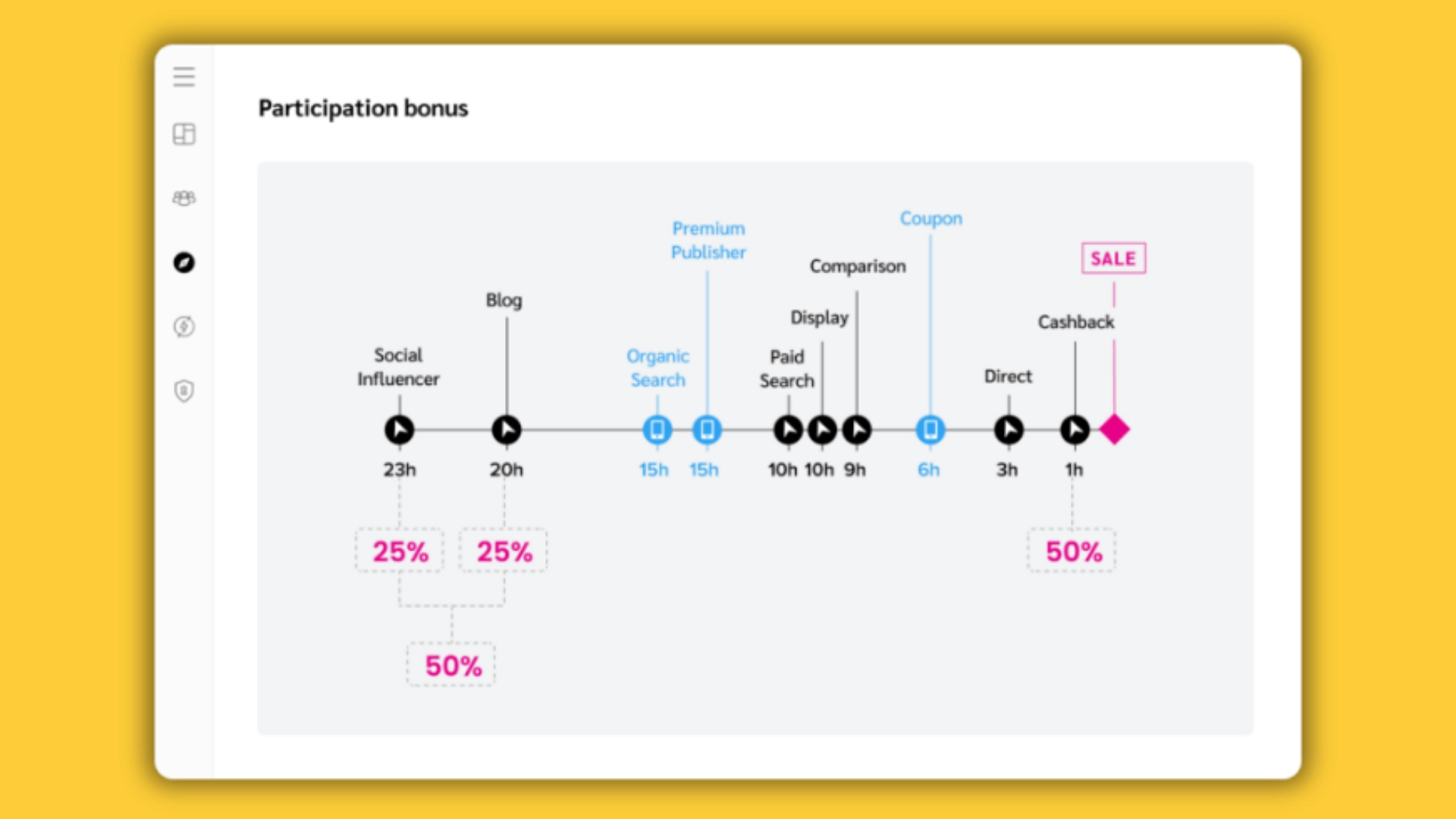
Performance bonuses help you reward all contributions
One more thing: Define your exclusions. An effective commission structure also defines what you don’t pay for. Document your exclusions clearly before launch:
- Returns or cancellations within a defined window (typically 30–60 days)
- Internal or employee orders
- Suspected fraud or duplicate accounts
- Gift card purchases (if applicable)
Partners appreciate clarity. These guardrails also protect your margin from edge cases that add up quickly at scale.
Phase 3: Partner segmentation and customization (Week 5)
Paying every partner the same flat rate—the hallmark of a competitor-driven strategy—assumes all partners deliver the same value. That assumption is a liability. This phase moves from a single flat rate to a commission structure that reflects each partner’s actual contribution.
You align your best payouts with partners who bring new customers and drive your most profitable sales. This is how you stop reacting to the market and start setting your own terms.
Step 5: Group your partners by type
Different partner types contribute different values, and your commission structure should reflect that.
Start by organizing your partners into functional groups. The table below features the most common partner types to help you begin segmentation (discover the others).
| Partner type | Key contribution | Examples |
| Influencer and content creator | Generates authentic demand and storytelling | Social media personalities, podcasters, YouTubers, brand ambassadors |
| Content partner | Builds top-of-funnel awareness and trust | Editorial blogs, “how-to” guides, niche topic publications, and digital magazines |
| Customer referral program | High-trust, word-of-mouth validation | “Refer-a-friend” initiatives, evangelist programs, and existing happy customers |
| Loyalty and rewards programs | Increases customer LTV and repeat purchases | Cashback platforms, employee benefit portals, “points-for-purchase” sites |
| Review and comparison sites | Wins the final click with bottom-funnel analysis | Product review aggregators, price comparison engines, “best of” listicles |
| Deals and coupon sites | Closes the sale with a final incentive | Coupon code databases, promotional deal sites, and browser extensions |
By grouping your partners this way, you create a clear map of your partner landscape. It sets the stage to assign the custom, strategic commission rules you’ll build in the next step.
Step 6: Assign custom commission rules
This is where your profit-driven strategy moves from theory to action. With objectives, financials, and partner segments defined, you can assign commission rules that mean something.

Instead of applying a single, market-based rate to everyone, you can implement a dynamic set of rules that rewards each partner segment based on the specific value they deliver.
The table below offers a strategic starting point for assigning these rules, which you can tailor to your program’s specific needs.
| Partner type | Customer journey role | Your commission approach |
| Influencer and content creators | Top-of-funnel: Build desire | Reward storytelling with a base CPS + new customer bonus. |
| Content partners | Top-of-funnel: Educate and build trust | Offer a premium payout for new customers to reward acquisition. |
| Customer referral program | Full-funnel: High trust validation | Use a simple flat bounty or store credit for low-friction advocacy. |
| Loyalty and rewards program | Post-funnel: Drive retention | Provide a standard rate that protects LTV and encourages repeat buys. |
| Review and comparison sites | Bottom-of-funnel: Win the final click | Set a competitive, margin-aware CPS to profitably defend against rivals. |
| Deals and coupon sites | Bottom-of-funnel: Close the sale | Apply a standard, profitable base rate that efficiently rewards the conversion. |
By assigning rules this way, your commission structure is no longer just a cost center. It’s a strategic lever you can pull to drive specific, profitable outcomes across your entire program.
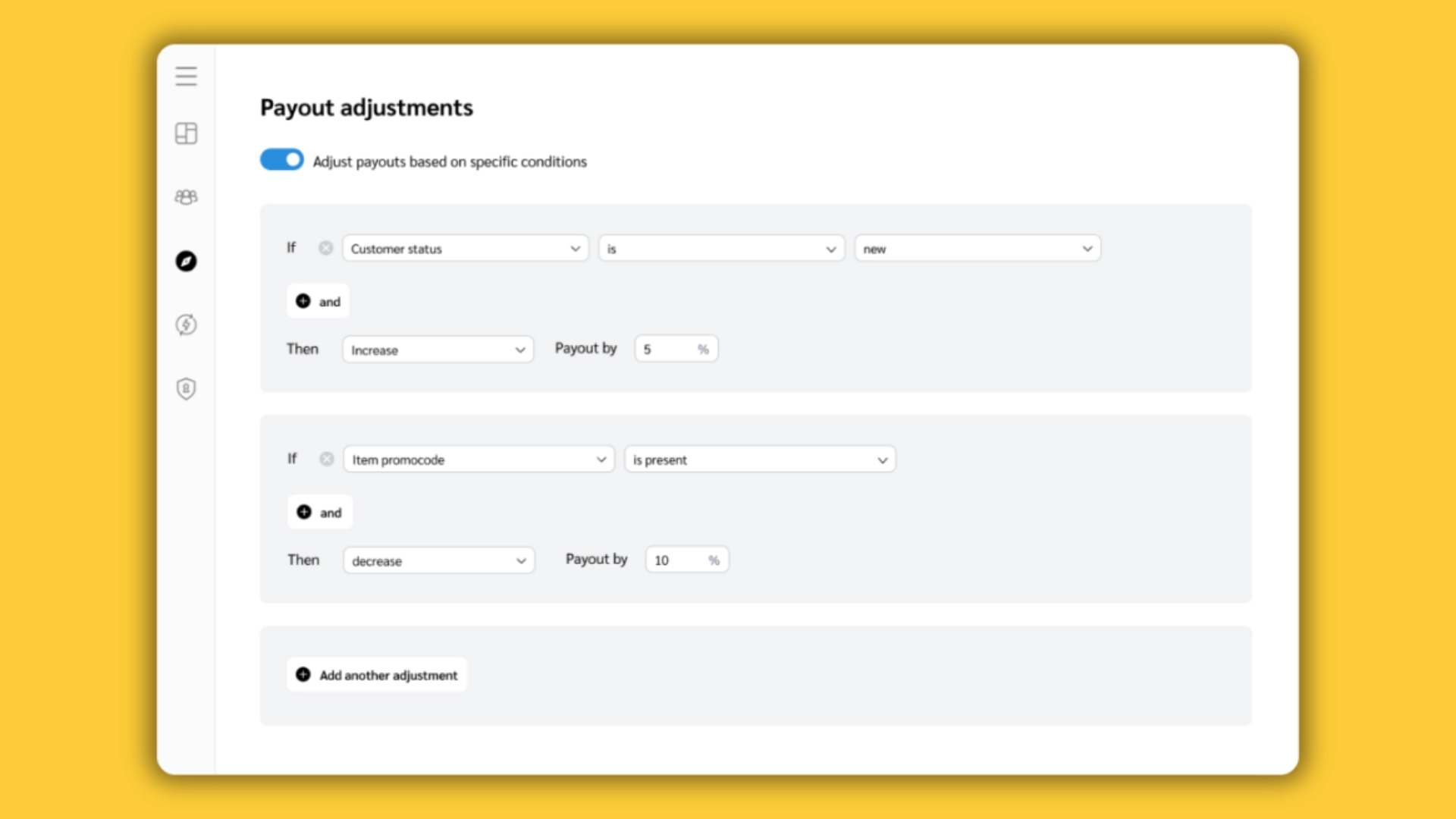
Dynamic Payouts allows you to align commission to value
Phase 4: Launch, communication, and iteration (Weeks 6–8)
Unlike a static rate that gets set and forgotten, your profit-driven structure requires a deliberate launch—clear partner communication, defined KPIs, and a 30-day monitoring window before you optimize.
It provides a framework for clearly communicating the “why” behind your custom payouts to partners. This phase also establishes a process to monitor performance, iterate, and prove the long-term value of building a commission model from your own economics.
Step 7: Create your partner communication plan
Your commission structure is a strategic tool and must be communicated with purpose. It’s a critical opportunity to get partner buy-in and motivate them to align with your goals. A well-executed communication plan builds trust and transforms your partners from passive participants into active, motivated players in your growth strategy.

Your communication goals differ slightly depending on your program’s status:
- For new programs: Set clear expectations. Frame your strategic model as a primary benefit that rewards high-value partners from day one.
- For existing programs: Manage change transparently. Focus on how the new structure better rewards partners for the valuable work they are already doing.
Your communication plan should be a comprehensive package that leaves no room for ambiguity. Use this checklist to cover all your bases:
- The strategic ‘why’: Clearly explain the goal of the new structure (e.g., “to better reward new customer acquisition”).
- The mechanics: Detail exactly how the new commissions work (e.g., tiers, bonuses, and base rates).
- Partner benefit: Explicitly state what’s in it for them (e.g., “higher earning potential for top performers”).
- Effective date: Announce the clear launch date for the new rates.
- Central source of truth: Provide a link to a one-sheeter or landing page with all the details.
- Q&A and support: Designate a clear point of contact for questions and feedback.
To help you put this plan into action, you can adapt the following email template for your announcement.
Subject: An update to your [Brand Name] commission structure
Hi [Partner Name],
We’re updating our affiliate marketing commission structure on [date] to better reward the results that matter most to our program.
Here’s what’s changing: (List your specific changes here—e.g., “New customers now earn a 15 percent commission, up from 10 percent”)
These changes are designed to reward partners driving real growth, and based on your recent performance, we think you’ll see the benefit directly.
Questions? Reply to this email or [link to FAQ page].
[Your name]
You can simplify this further with Email Workflows, which automatically send segmented messages to new content partners or trigger tier-based updates for loyalty partners.”. You can create a workflow that automatically sends a specific welcome email to new content partners explaining their bonus structure. Or, another workflow can manage tier-based updates for your loyalty partners. Automating your communication this way makes your dynamic strategy manageable and your messaging targeted and professional.
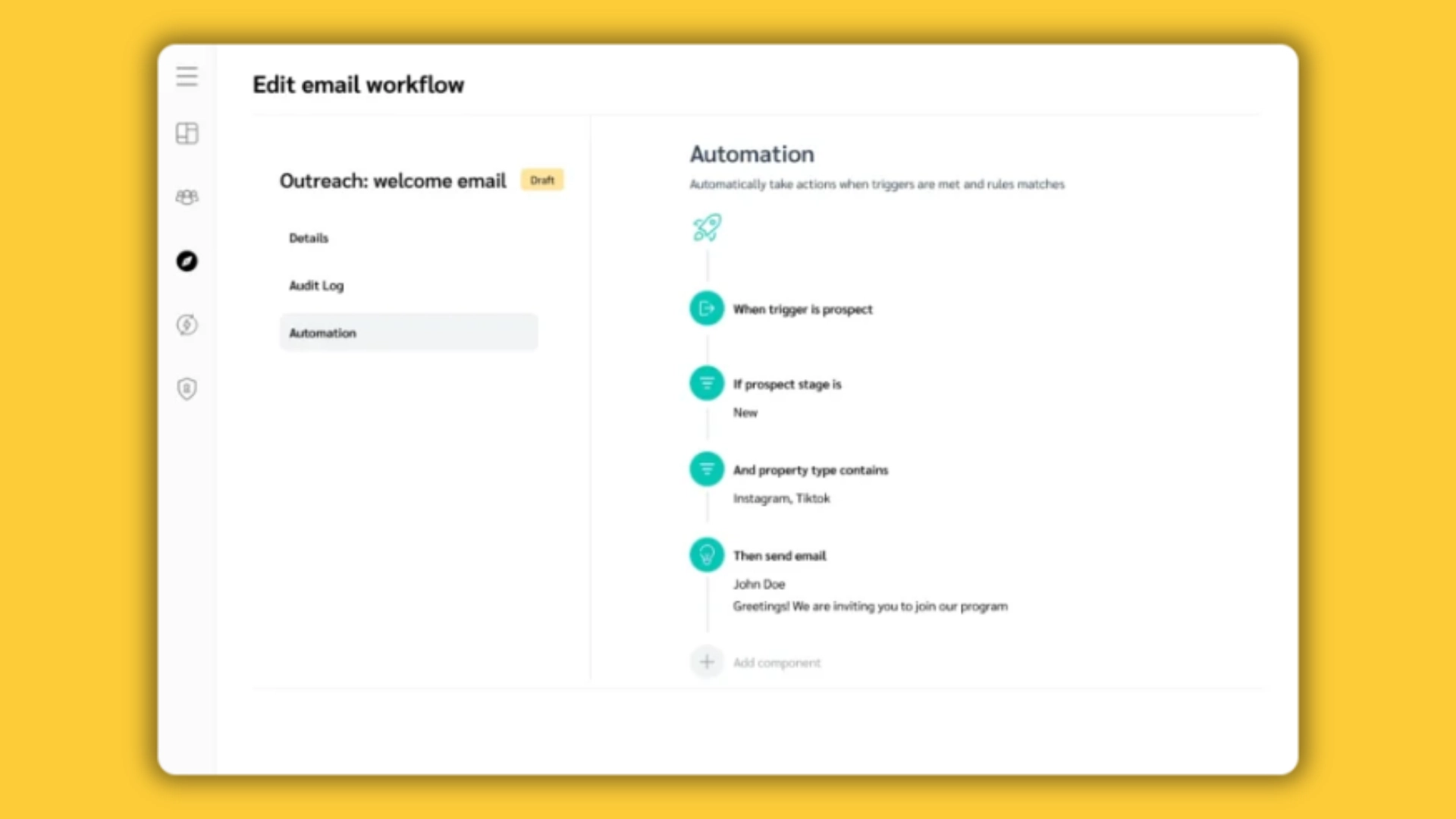
Email workflows automate communications with your partners by sending emails to specific partner segments.
Step 8: Go live and monitor performance
Your dynamic, profit-driven payout structure is now live. Unlike a static competitor rate that gets set and forgotten, your model is an agile system designed for continuous improvement.

The real strategic advantage comes from monitoring its performance. Use data from Performance Reports to validate your approach and make intelligent optimizations over time.
Your primary objective, which you defined in Phase 1, will determine exactly what you need to monitor. Use the table below as a guide to focus your analysis on the key performance indicators (KPIs) that align with your goal.
| Primary objective | Key metrics to monitor | The strategic question you’re answering |
| New customer acquisition | – New-to-File vs. Returning Customer Ratio – CAC per Partner/Channel. | Are my new customer bonuses actually driving efficient, profitable acquisitions? |
| Increase AOV | – Average Order Value – Performance Within Commission Tiers. | Are my tiered incentives successfully encouraging partners to drive larger basket sizes? |
| Promote high-margin products | – Sales volume of target SKUs – Profit margin per partner. | Are partners responding to product-specific commissions and promoting my most profitable items? |
Regularly reviewing these KPIs allows you to iterate with confidence. You can adjust tier thresholds, refine bonus structures, and double down on what works. This is all based on your own data, and not a guess about what the market is doing.
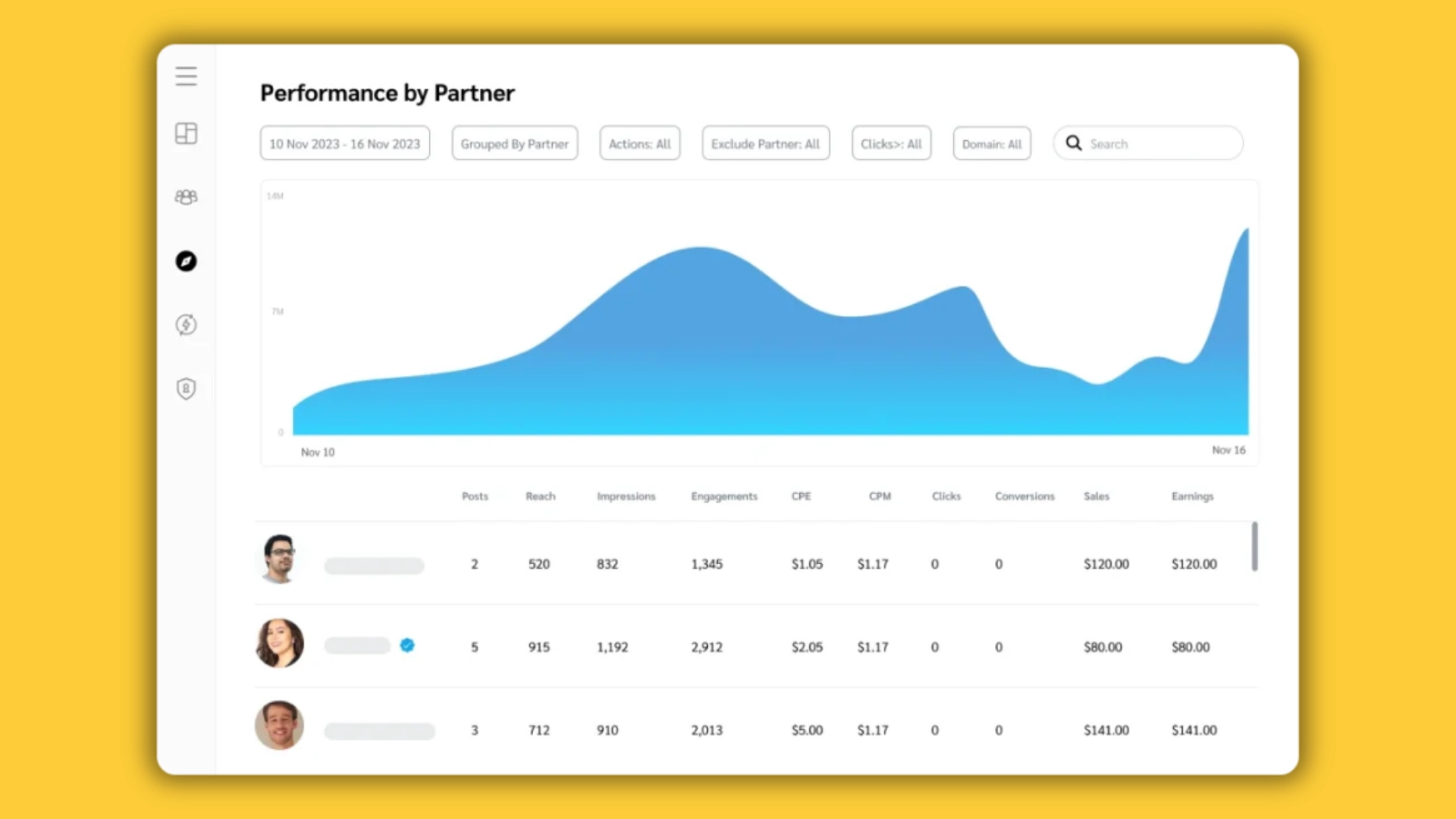
Performance reports validate your approach and help you make smarter commission decisions
Step 9: Schedule your first quarterly review
This final step truly separates a dynamic, managed strategy from a static, “set-it-and-forget-it” competitor rate. The quarterly review is your dedicated time to analyze performance, gather intelligence, and make informed adjustments based on data and real-world feedback. This process can be separated into an internal analysis and an external feedback loop

Internal review: Key questions to ask
First, use the performance data you’ve been monitoring to answer the hard questions about your strategy’s effectiveness.
- Did we achieve the primary objective set in Phase 1?
- Which partner segments over- or under-performed?
- Is our Customer Acquisition Cost (CAC) still within our profitable guardrails?
- Are any commission tiers proving unreachable or too easy for our partners?
Partner feedback: Engaging your top performers
Next, gather qualitative insights by speaking with a few of your top-tier partners. This shouldn’t be about negotiating rates but understanding their perspective on the structure itself.
Ask open-ended, strategic questions like:
- Is our commission structure clear about which outcomes we value most?
- How does our tiered or bonus structure influence your promotional planning?
- Are there any incentives, beyond a rate increase, that you find particularly motivating?
The insights from these conversations, combined with your data, allow you to iterate with confidence and build a stronger, more collaborative partnership program.
Your strategy in action: How a bespoke model delivered a 15x ROI
You’ve defined your financial guardrails and chosen your commission model. But what happens when you apply this thinking in the real world? Does it actually work?
Consider Yamazaki Home. It faced a stalled affiliate program and a backlog of nearly 600 pending partners. The conventional move would be to mass-approve them and set a standard, competitor-matched commission rate just to get things moving.
But they didn’t.
Instead of looking outward, they looked inward. Using end-to-end tracking, they gained a holistic view of the customer journey. This allowed them to identify their true top performers and uncovered that their budget was being misallocated.
They identified that low-value browser extensions were stealing commissions from the high-value content partners. These partners were actually introducing new customers to their brand.
This data gave them the confidence to stop paying for noise and start investing in performance. They established a baseline 7 percent CPA but layered incentives to reward true value, not just the last click.
Their flexible structure included:
- Premium rates: Offering commissions up to 18 percent for top-tier creators who produce exceptional work.
- Performance bonuses: Implementing bonuses for hitting specific sales targets to incentivize growth.
- Reduced payouts: Lowering compensation for low-impact partners who drove no tangible value.
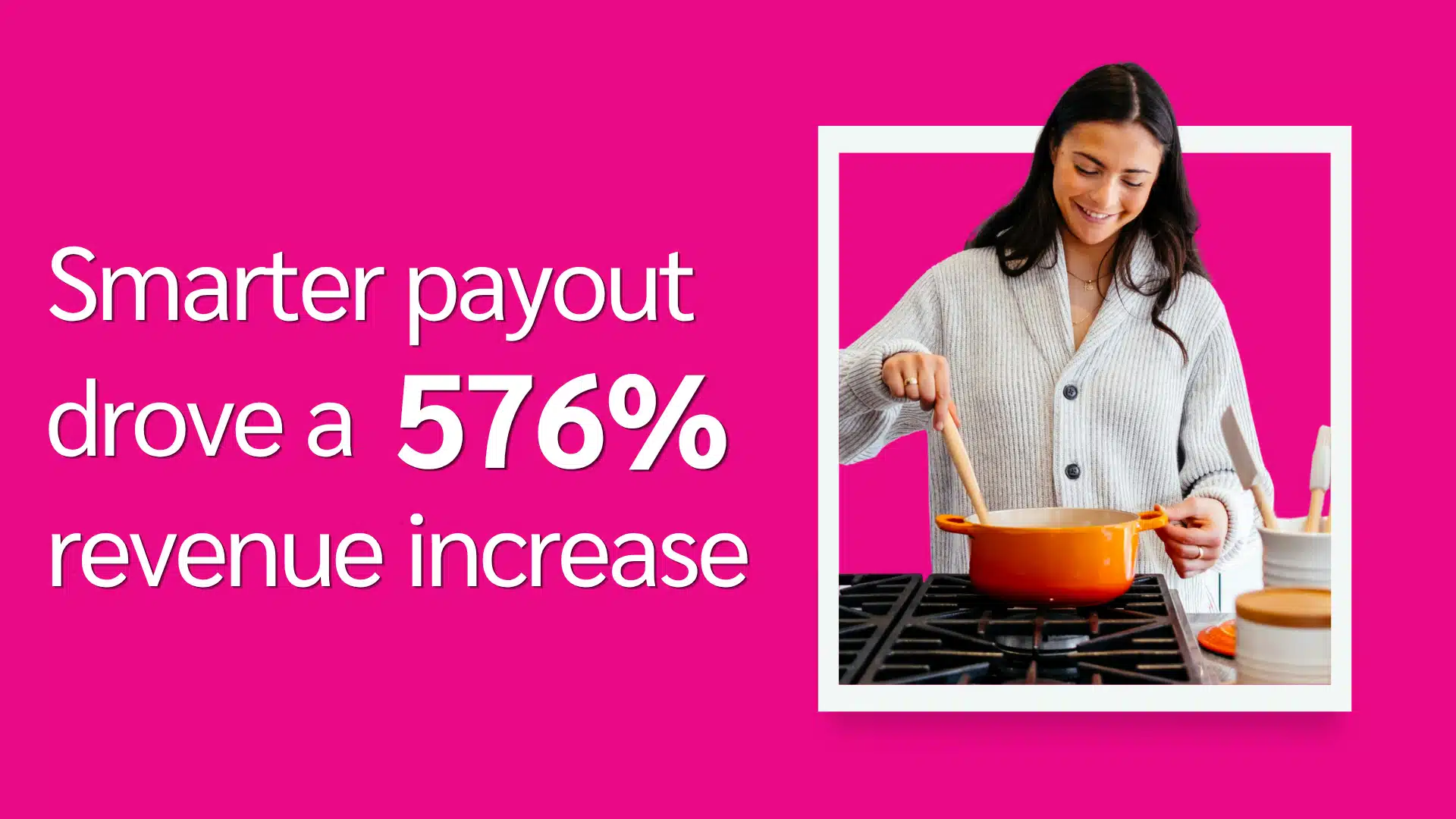
The result of ignoring competitors and reallocating budget based on their own data? According to impact.com’s Yamazaki case study, it drove a 576 percent increase in revenue and achieved a 15:1 return on investment in six months.
This is the power of a strategy built on your terms. You stop reacting to the market and start creating it. You turn your commission payouts from a defensive cost into an engine for pure profit.
Frequently asked questions
In affiliate marketing, commission is performance-based. When you approve a partner for your program, they receive a unique affiliate link that contains specific tracking parameters. The partner then places this link within their content. When a customer clicks that link, a tracking cookie is placed on their browser. This attributes their subsequent actions back to that partner for a set period, often called a “cookie window.” If the reader completes the desired action you’ve set—such as making a purchase—your affiliate platform records that event, attributes the conversion to the correct partner, and calculates the commission you owe. You then pay out these earned commissions to your partners on a regular, predetermined schedule.
The affiliate commission structure you should use depends entirely on your specific business goals. If your main objective is to drive direct sales, a Cost Per Sale (CPS) model that pays a percentage of revenue is a straightforward, low-risk choice. However, if you need to build a customer base for a product with a longer sales cycle, a Cost Per Lead (CPL) model that rewards partners for generating free trials or newsletter sign-ups might be more effective. The key is to select a baseline model that aligns with your financial guardrails and the primary action you want to drive. The most profitable programs rarely stop there. You should then layer performance incentives on top of your base model, such as tiered rewards for top performers or bonuses for promoting a new product. This motivates partners and steers them toward your most important business objectives.
Setting tiered affiliate marketing commissions to reward your top-performing partners involves creating a clear, performance-based structure with increasing rewards. First, you need to define what a “top performer” means for your program. This is typically based on a specific metric, such as total revenue generated or the number of sales closed over a set period. Once you have your metric, you create distinct performance thresholds or “tiers.” For example, you might set Tier 1 for partners generating up to $1,000 in monthly sales, Tier 2 for those between $1,001 and $5,000, and Tier 3 for anyone above that. Finally, you assign progressively higher commission rates or bonuses to each tier, so partners are financially motivated to move up through the levels. The key is to make this structure transparent so your partners always know what they need to do to earn more.
You should automate your commission payments. As your program grows beyond a few partners, manual payouts become a significant liability. They are not only time-consuming but also highly prone to human error. These mistakes and the payment delays they cause can quickly erode the trust you have with your partners. Using an affiliate or partnership automation platform solves this. It ensures every partner is paid accurately and on time, which builds loyalty. Automation also frees you from administrative work. This allows you to focus on high-value tasks, such as recruiting new partners and optimizing your program’s strategy.
Effective affiliate commission strategies are not about matching what your competitors are paying. Instead, the most successful strategies are built from the inside out, starting with your own financial realities. You begin by understanding your key business metrics, like your customer lifetime value (LTV), acquisition costs (CAC), and product margins. This foundation ensures every commission you pay is a direct investment in your profitability, not just a cost of doing business. On top of this financial base, you then layer on performance incentives. These can be bonuses for top performers or tiered rates that motivate partners to drive the specific outcomes that are most valuable to your growth.
Launch is just the starting line. Now you drive for profit.
By completing this framework, you’ve done more than just design a commission structure. You have fundamentally shifted from a reactive manager chasing market rates to a strategic leader who invests in line with your own financial truth.
You have traded the fragile tactic of copying competitors for a more durable position of building a program that is undeniably your own.
Your commission structure is your most powerful communication tool. It tells your partners what you value, where your brand is going, and how they can win with you.
And the work isn’t over. It has just reached a new level. Now, you lead your market not by offering the highest rate, but by offering the smartest one. This helps you turn your partnerships into a channel you can plan around, you always knew they could be.
You’re ready to build a program that’s undeniably yours. Continue building your strategic advantage with these impact.com resources.
- How to identify your affiliate program goal (worksheet)
- 5 effective affiliate commission structures: Models, examples, and benefits (blog)
- Building a profitable creator community: How OLIPOP’s hybrid commission approach drives 12% of sales (blog)
- How to pay content creators in 2025: 7 proven payment methods that drive results (blog)
- Partner marketing examples: 12 proven strategies to grow your brand in 2025 (blog)