

You’ve heard the advice to diversify your program across more types of affiliate publishers to spread the risk. What nobody tells you is that adding partners without changing how you measure and pay them just moves the same blind spot to a new place. PUMA found that out the hard way.
By 2023, one cashback partner accounted for 80% of PUMA’s total program revenue. The number wasn’t wrong—under last-click measurement, it was accurate. But it was also lying to them. PUMA’s team saw that one partner type was carrying the whole program, when really the measurement itself was hiding everyone else.
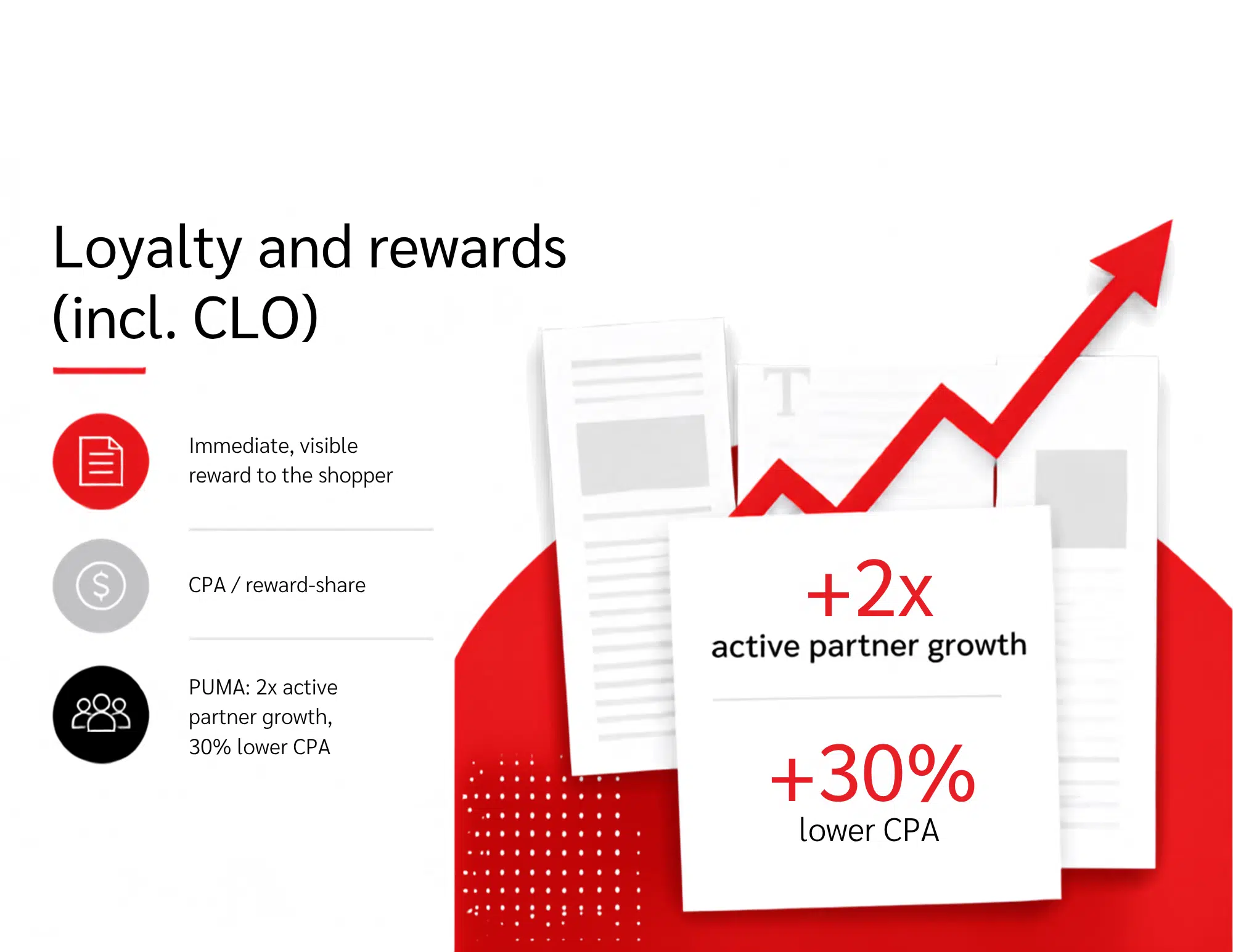
PUMA fixed it by measuring and paying its full mix—creators, retargeting partners, card-linked offers included—for what each actually did, not just who last touched the sale. Active partner growth doubled, and cost per acquisition (CPA) dropped 30%.
Too much publisher diversification advice stops at “don’t concentrate in one partner type,” but the real risk isn’t concentration—it’s measuring and paying every publisher type the same way. This method is exactly why PUMA’s cashback partner walked off with the credit in the first place. Add partner types without changing how you measure and pay them, and you haven’t diversified anything. You’ve just given the same blind spot more places to hide.
This article covers:
- Content and editorial
- Loyalty and rewards
- Networks and subnetworks
- Deal and coupon sites
- Social and creator partners
- Post-purchase commerce solutions
- How each model is priced
- Types of affiliate publishers at a glance
- Putting it into practice
- FAQ
Types of affiliate publishers at a glance
| Model | How it converts | Typical pricing | Proof point |
|---|---|---|---|
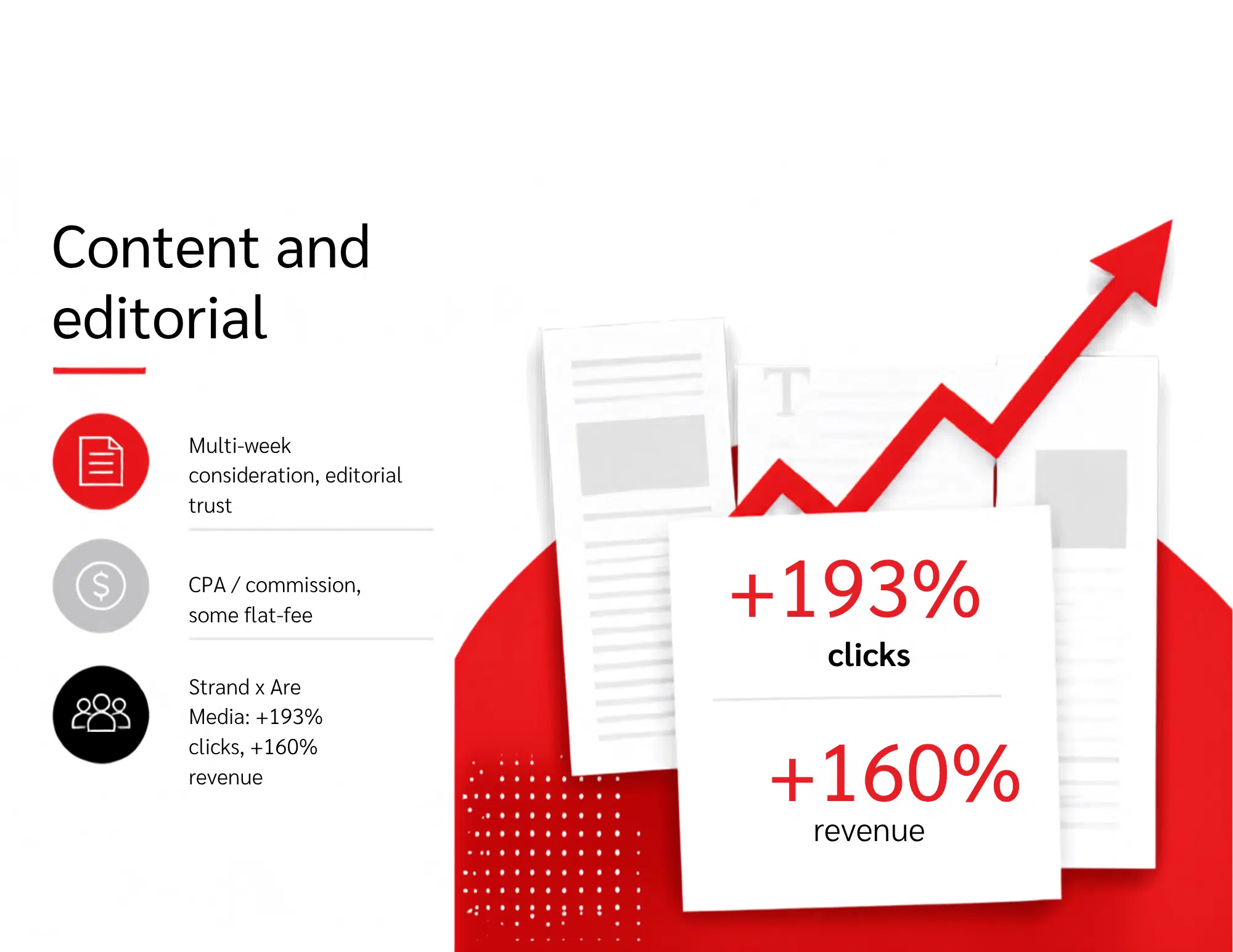
| Content and editorial | Multi-week consideration, editorial trust | CPA / commission, some flat-fee | Strand x Are Media: +193% clicks, +160% revenue |
| Loyalty and rewards (incl. CLO) | Immediate, visible reward to the shopper | CPA / reward-share | PUMA: 2x active partner growth, 30% lower CPA |
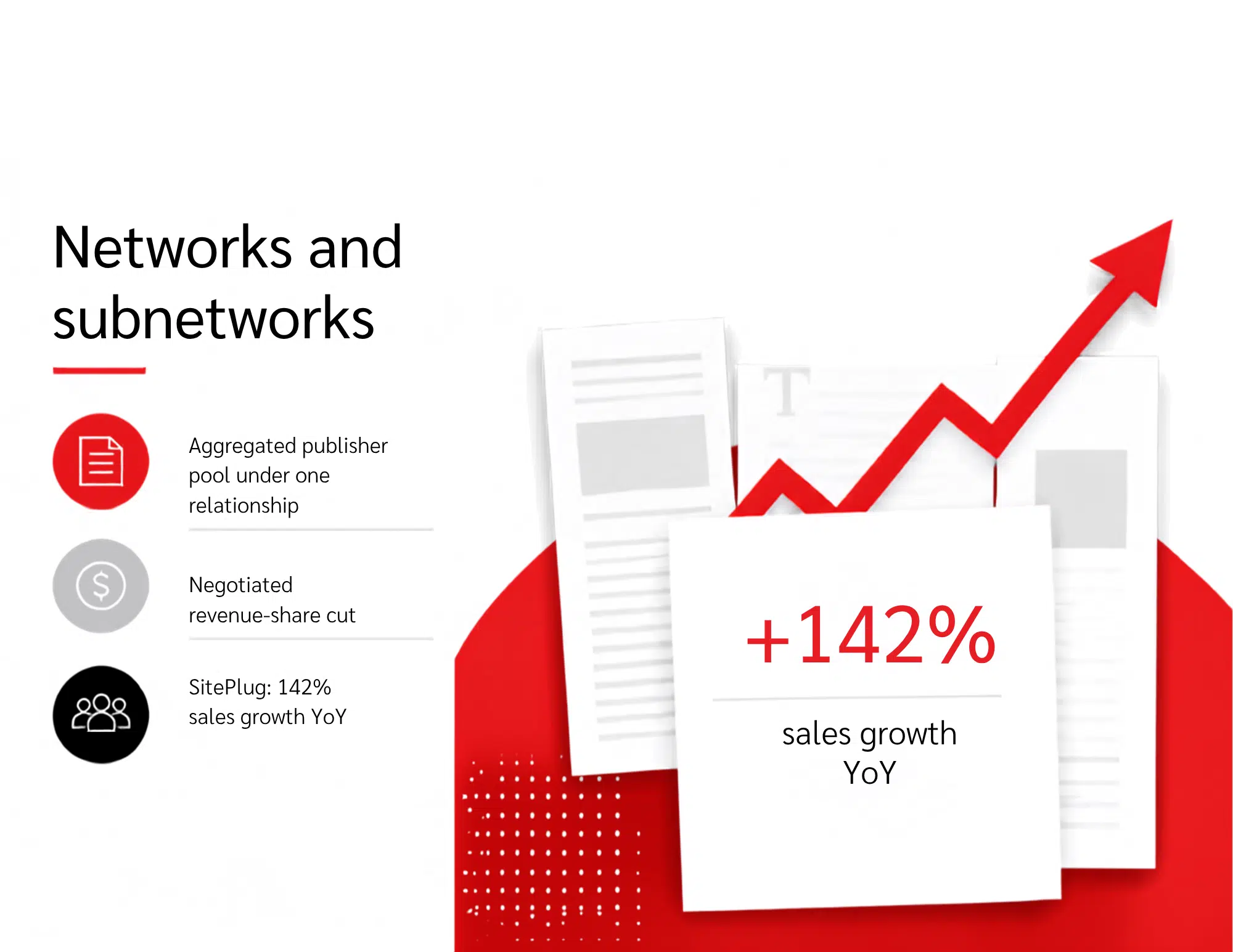
| Networks and subnetworks | Aggregated publisher pool under one relationship | Negotiated revenue-share cut | SitePlug: 142% sales growth YoY |
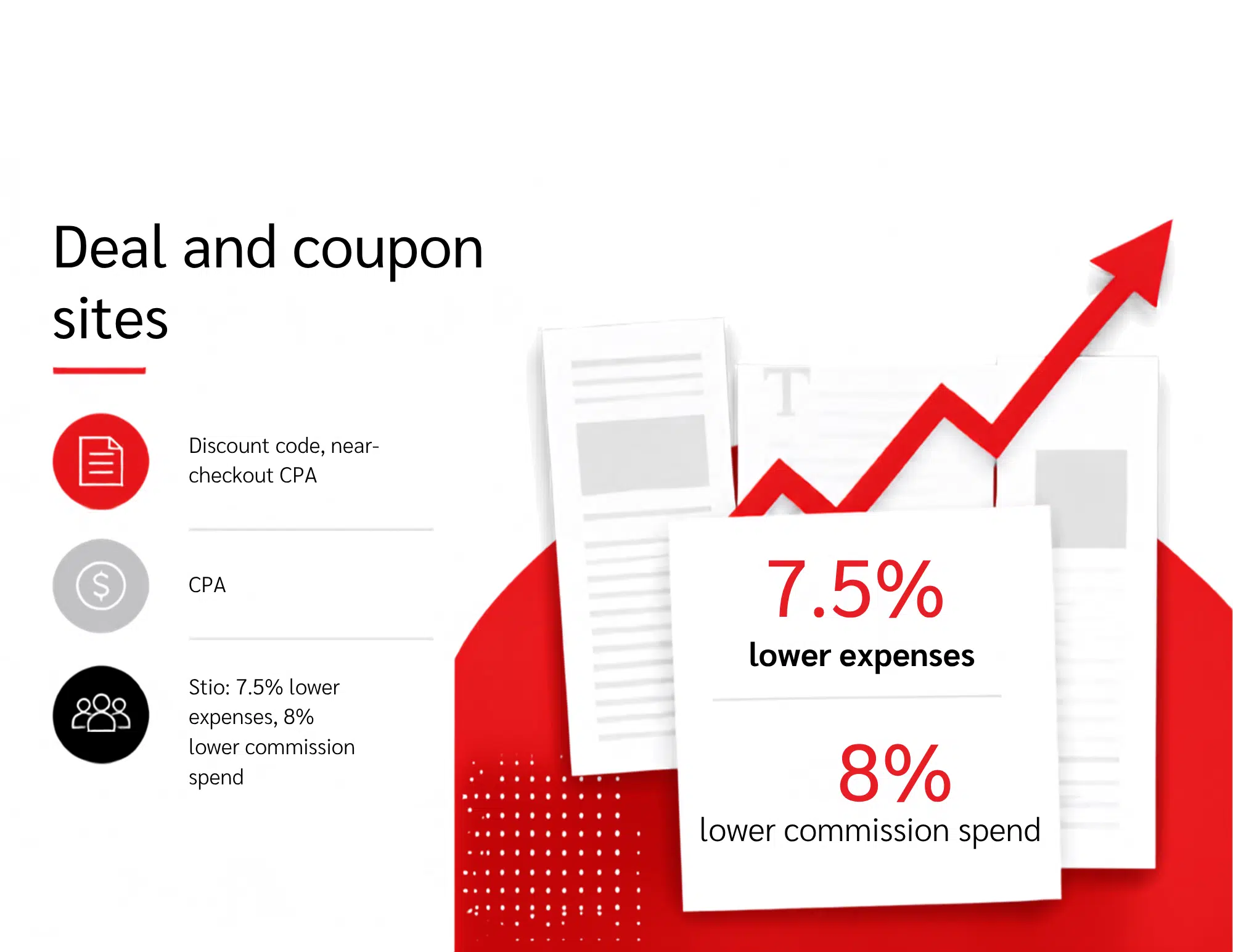
| Deal and coupon sites | Discount code, near-checkout | CPA | Stio: 7.5% lower expenses, 8% lower commission spend |
| Social and creator | Parasocial trust, content-first discovery | Hybrid flat-fee + commission | Sephora: 101% partner growth |
| Post-purchase commerce | Confirmed-purchase moment, at/after checkout | Performance-based | Total Beauty Network: new post-checkout revenue (Phase 1) |
Content and editorial
The short version: longer cookie windows and CPA-based pricing reward the influence editorial content actually has—not just the click it happens to catch last.
Content and editorial publishers earn trust the slow way—through in-depth reviews and buying guides that shape decisions weeks before a purchase. Their leverage isn’t a discount code. It’s credibility. That’s exactly why you need a longer cookie window for this partner type than you’d set for a transactional one. A shopper who reads a review on Tuesday and buys the following week should still credit the publisher who did the convincing.
How to price it
Price this model on commission or cost per action (CPA), calculated against the eventual sale. Some premium editorial partners are already pushing further: according to Digiday’s reporting on publisher commerce pricing, Wirecutter’s commerce team passed on cost-per-click (CPC) deals in favor of CPA, calculating that a typical CPC deal’s $3,000–$5,000 monthly payout wasn’t worth the effort of negotiating and running it directly. Expect more of your content partners to run the same math as CPC’s economics get scrutinized industry-wide.
Proof point: Strand x Are Media
Strand’s work with Are Media’s portfolio of lifestyle titles shows what happens when a program shifts its real budget toward this model rather than defaulting to transactional partners. Over a five-month partnership running from April through September 2025, the Strand x Are Media case study reported a 193% rise in clicks, an 89% increase in average order value, and a 160% increase in revenue.
A content publisher converting on a multi-week timeline looks unproductive under the same last-click lens that rewards a coupon site’s five-second assist. Measure it on the role it actually plays, driving qualified consideration rather than closing the sale, and it becomes one of your highest-leverage partner types instead of the hardest to justify in a budget review.
Loyalty and rewards
The short version: reward-share pricing works—until it’s the only lens you use to measure the whole reward family, cashback, and CLO included.
Loyalty and rewards are the widest family you’ll manage, spanning cashback sites that return a percentage of a purchase to the shopper, points-based loyalty platforms, and, increasingly, card-linked offers that skip tracking links altogether. What ties them together is the reward mechanism: the shopper gets something back, immediately and visibly, for buying through the partner.
How to price it
Price this family on cost-per-action, with cashback running a reward-share model: you and the partner split a percentage of the sale, and part of that share gets passed to the shopper as the incentive. That’s exactly the structure that made PUMA’s cashback partner so easy to over-reward under last-click measurement—every dollar of visible credit flowed to whoever stood closest to the transaction, regardless of who actually built the intent to buy.
Proof point: Better Beer
None of that makes cashback the wrong model. Better Beer’s cashback campaign ran a 25% incentive and saw an 83% sales surge—proof the model performs exactly as designed when built deliberately, not by default.
Card-linked offers: loyalty’s least-settled sub-segment
Vyond’s experience shows why that ambiguity shouldn’t stop a program from testing the model. After three years of declining affiliate revenue, Vyond partnered with Fidel, a card-linked offer provider built for business credit cards, to reach small businesses and solo entrepreneurs, a B2B audience most CLO providers don’t target. Fidel became Vyond’s top-performing partner at 22.5% of total partnership revenue, and the program grew 23.7% year-over-year.
Yours probably doesn’t have a clean home for CLOs yet either. That’s an industry-wide gap still being sorted out, not a reason to wait it out.
Networks and subnetworks
The short version: a subnetwork’s aggregate number hides who actually earned the sale — price that visibility gap in, don’t ignore it.
A subnetwork represents a pool of individual publishers to you under a single affiliate relationship. That’s the appeal: one relationship standing in for dozens or hundreds of smaller publishers you’d otherwise have to recruit, vet, and pay yourself. In exchange for a cut of the commission, a subnetwork typically handles:
- Onboarding individual sub-publishers into the pool
- Payments and reporting across the whole pool
- Recruitment and vetting you’d otherwise do yourself
Treating that aggregate number the same way you’d treat an individual publisher’s number is exactly the flattening this piece argues against—the sale happened somewhere inside that pool, and paying the pool as if it were one publisher tells you nothing about which one actually earned it.
Pricing and the visibility risk
You’ll negotiate pricing as a revenue-share cut, layered on top of whatever commission structure you already run with your sub-publishers. That layering is also the model’s core risk: you see what the subnetwork drove in aggregate without necessarily seeing which sub-publisher generated a given sale. Left unmanaged, that visibility gap is a documented vector for:
- Fraud that hides inside the aggregate number
- Brand-term ad hijacking by sub-publishers you can’t individually identify
- Paying full commission on a sale you can’t actually trace
That’s a genuine “know what you’re signing up for” consideration, not a reason to avoid the model.
Proof point: SitePlug
SitePlug is a working example of the aggregation model paying off at scale. By centralizing brand discovery and deep-link generation across a network of content, coupon, and domain-correction publishers, SitePlug grew brand partnerships 20% year-over-year, drove 142% sales growth year-over-year, and increased commissions 70% year-over-year—more than $35 million in sales for its brand partners.
Negotiate the revenue-share cut with the visibility gap priced in, and demand sub-publisher-level reporting wherever it’s available. A model built on aggregation only works if you can still see through it.
Deal and coupon sites
The short version: the model isn’t the risk — ungoverned coupon codes are.
Deal and coupon sites convert closer to checkout than any other model here. A shopper searching for a promo code seconds before completing a purchase is about as bottom-of-funnel as intent gets, which is also why short cookie windows will hurt this model more than they hurt your earlier-funnel partners: there’s rarely much gap between the click and the sale to begin with.
Pricing and governance
You’ll price this family almost entirely on cost-per-action. The real variable is governance. Leave it unmonitored, and:
- Coupon codes leak outside their intended channel
- Non-affiliate codes get credited as if they came through your program
- You end up paying commission on sales you never actually influenced
Proof point: Stio
Stio’s experience with Clique Affiliate makes the case for what active governance looks like in practice. Facing unrestricted coupon codes spreading to channels never meant to carry them, the team built a promo-code exception list to blacklist non-affiliate codes and used match-expression tools to make sure the codes still in circulation earned proper credit. The result: a 7.5% decrease in total expenses and an 8% reduction in commission expense.
The model isn’t the liability. An ungoverned version of it is. A deal and coupon partner converting at the bottom of your funnel is doing exactly the job it’s built for. If this model burns you, it’s because you never built Stio’s guardrails.
Social and creator partners
The short version: neither pure commission nor pure flat-fee prices what a creator partnership is actually worth — hybrid does.
Social and creator partners convert on trust that’s personal rather than editorial—an audience buying because someone they already follow said this product is worth it. That parasocial dynamic makes discovery, not conversion, this model’s real strength. Price it on pure commission and you’ll undervalue it the same way you undervalue content and editorial partners.
How to price it
Build this one as a hybrid: a flat sponsorship fee for the content, layered with a performance commission once tracking links or codes are in place. Rate benchmarks compiled by BrandsForCreators put nano-creator sponsorships as low as $50 a post and macro-creator rates at $25,000 or more—a spread wide enough that flat-fee-only or commission-only pricing will almost always undersell or overpay what the partnership is actually worth.
Proof point: Sephora
Sephora’s expansion from a traditionally affiliate-heavy mix into creator partnerships shows what that hybrid approach can do at scale: the program grew its partner base 101%.
Pay a creator purely on commission and you’re asking them to absorb all the discovery risk for none of the guaranteed return. Pay them purely flat, and you’ve killed their incentive to actually convert. The hybrid model exists because neither half of this job, discovery and conversion, is the whole job.
Post-purchase commerce solutions
The short version: the newest, smallest family in your mix — worth testing, not worth building your roadmap around yet.
Post-purchase commerce solutions monetize a moment every other model here treats as the finish line: the instant after a shopper confirms an order. Using confirmed purchase data rather than a tracked click, these partnerships surface additional offers on or after the confirmation page — distinct from retail media broadly, which typically operates pre-purchase. The family covers three sub-forms:
- Third-party confirmation-page offers
- First-party upsell and cross-sell
- Loyalty or subscription activation triggered by the completed purchase
How to price it
Price this one performance-based, tied to whatever the post-purchase offer converts. According to Rokt’s framing of post-purchase monetization, a completed transaction is a moment of high purchase intent, not a dead end—the logic every sub-form above is built on.
Proof point: Total Beauty Network
Total Beauty Network’s early work in this space illustrates the mechanic directly: monetizing the confirmation page itself with third-party offers generated measurable revenue from checkout flows that had previously been monetized only through the primary transaction.
Treat this as the newest, smallest family in your mix, because that’s what it is. Post-purchase commerce doesn’t have the multi-year track record content, loyalty, or coupon partnerships do. What it has is an early signal that a completed purchase isn’t the end of the value your customer can generate. Test it. Don’t build your roadmap around it yet.
How each model is priced
Every family above gets its own pricing logic in the sections that cover it. Here they are side by side, plus the mistake each one most commonly invites:
| Model | Pricing structure | What determines the rate | Common mistake to avoid |
|---|---|---|---|
| Content and editorial | CPA / commission, some flat-fee | Editorial reach, review depth, negotiating leverage | Paying on last-click and undervaluing multi-week influence |
| Loyalty and rewards (incl. CLO) | CPA / reward-share | Size of the reward passed to the shopper | Treating cashback and CLO as interchangeable when they convert differently |
| Networks and subnetworks | Negotiated revenue-share cut | Aggregate volume the subnetwork delivers | Pricing the cut without pricing in the visibility gap |
| Deal and coupon sites | CPA | Governance quality, not just conversion volume | Leaving codes unmonitored and paying for sales you didn’t influence |
| Social and creator | Hybrid flat-fee + commission | Follower tier, engagement, niche | Paying pure commission or pure flat fee instead of hybrid |
| Post-purchase commerce | Performance-based | What the post-purchase offer actually converts | Treating it like retail media instead of a distinct, newer channel |
Putting it into practice
Six publisher models. One question worth asking about each: are you measuring and paying this partner type according to what it actually does, or defaulting to whatever the rest of your program already uses?
Run that question against your own mix. A content publisher measured on last-click always looks underperforming, because last-click was never built to see multi-week influence. A coupon site left ungoverned always looks riskier than it needs to be, because the risk was never the model—it was the missing guardrails. A subnetwork’s aggregate numbers will always hide the sub-publisher who actually earned the sale, unless you ask for the reporting that surfaces it.
PUMA’s transformation didn’t come from finding new partners. It came from measuring the partners already in the program according to what each one actually did, and paying them accordingly. That’s the diversification work that actually moves your program forward. Before you add another partner type, ask: do you already know how you’ll measure and pay it, or are you planning to find out later?
Further reading
- How to choose a marketing attribution model for your affiliate program—the measurement logic behind why partner-type pay decisions and attribution model choice are the same underlying decision.
- impact.com customer success stories—browse the full library of customer results referenced throughout this piece.
FAQ
Affiliate publishers break down into six categories by how each engages a customer: content and editorial, loyalty and rewards (cashback and card-linked offers included), networks and subnetworks, deal and coupon sites, social and creator, and post-purchase commerce. Because each converts differently, none should be priced or measured the same way.
Payment structure should match how each publisher type contributes value. Content and editorial partners typically work on CPA or flat-fee arrangements, deal and coupon sites run on CPA tied to near-checkout conversions, and social and creator partners often combine a flat sponsorship fee with a performance commission. Paying every type the same way, regardless of role, skews revenue and measurement toward whichever model converts last.
A subnetwork is an aggregation layer that represents a pool of publishers to a brand under one affiliate relationship, handling onboarding, payments, and reporting for a cut of the commission. It lets a brand reach far more publishers than it could recruit individually, but reduces visibility into which sub-publisher drove a given sale—a documented fraud and brand-term hijacking vector worth actively monitoring.
A card-linked offer (CLO) triggers a reward automatically through a verified transaction on a shopper’s linked payment card, rather than a tracked link or cookie. CLOs don’t fit cleanly into most affiliate taxonomies yet—some file them under loyalty and rewards, others treat them as their own category—but they’re proving viable beyond consumer retail, including in B2B programs targeting small businesses and solopreneurs.
Affiliate marketing generally breaks into six publisher models, each engaging customers at a different point in the journey and needing its own approach to pricing and measurement: content and editorial, loyalty and rewards, networks and subnetworks, deal and coupon sites, social and creator, and post-purchase commerce. Treating all six as one category is what causes most programs to misjudge which partners actually drive growth.
“Affiliate” is often used as a catch-all in search behavior, but it technically describes one relationship type: a publisher earning commission on tracked, performance-based referrals. “Partner” is the broader umbrella, covering affiliates alongside creators, brand partners, ambassadors, and other relationship types that don’t fit the traditional affiliate structure. Treating every partner type as a standard affiliate is the one-size-fits-all measurement mistake this article argues against.