
Introduction: The two futures of AI-powered creator partnerships
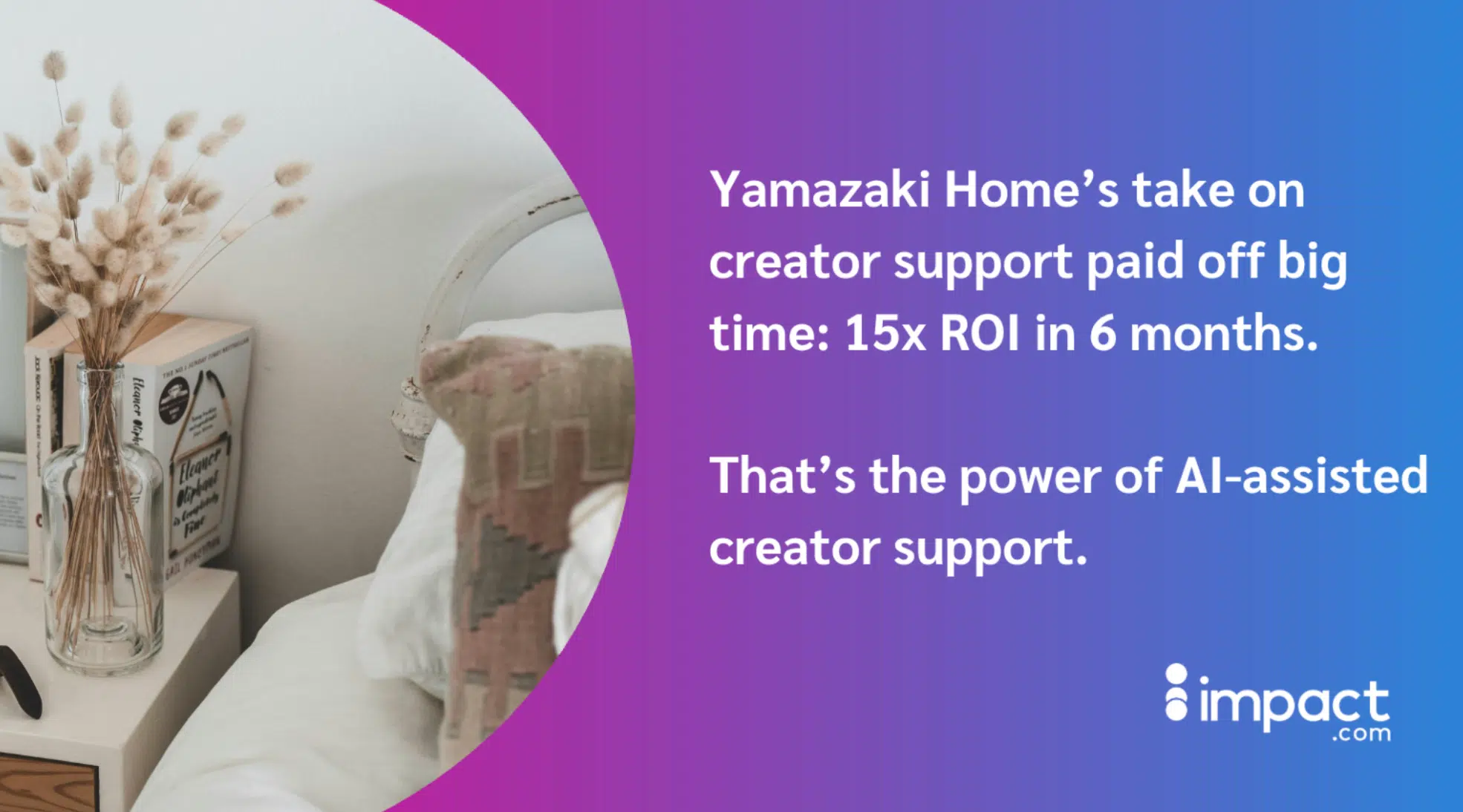
When JEBCommerce took over Yamazaki Home’s affiliate program, there were 597 pending partner applications gathering dust. By using impact.com’s AI-powered platform to evaluate partner alignment and automate vetting, they turned that backlog into a live, performing program. Six months later: 15x ROI, 576% revenue growth, active partner base increased by 252%.
Yamazaki Home won by prioritizing partner-facing AI tools over internal efficiency.
Brands that use AI exclusively to run their own programs more efficiently have unknowingly built the ceiling their programs will never break through. Because the focus is solely internal, their creator partners fall behind. That’s why their programs are stalling.
According to impact.com’s Global State of Affiliate Marketing report, 97% of brands now use AI in their creator programs. The report draws on responses from 818 marketers, 284 publishers, and 421 content creators across eight countries, more than 1,500 respondents. Most brands deploy just two to three use cases, with basic chatbots accounting for 35% of all AI use cases. The rest flows back into internal dashboards, fraud filters, and reporting tools. None of it reaches the creator.
When everyone has the same tools, how you build a successful influencer marketing campaign is the only thing that separates programs that grow from programs that plateau. To succeed, AI tools should shift from a self-serving brand model to a creator-support strategy. This guide draws on the Global State of Affiliate Marketing report throughout to show you where the gap is, why it’s costing you revenue, and how to close it.
How your brand is contributing to the creator monetization gap (and how to fix it)
Brands that optimize AI for internal efficiency and ignore creator needs watch their programs stall.
When creators can’t search-optimize their content or track which links are converting to sales or website traffic, your brand absorbs every missed click. Every high-intent audience member who never made it to checkout is a gap your program created.
impact.com’s Global State of Affiliate Marketing report found that only 15% of creators use AI for SEO and 18% for link tracking. In 2026, both are table stakes for capturing high-intent traffic — and when your creators skip them, that traffic doesn’t disappear. It lands with a competitor whose partners are better equipped.
Three creator challenges you can fix right now
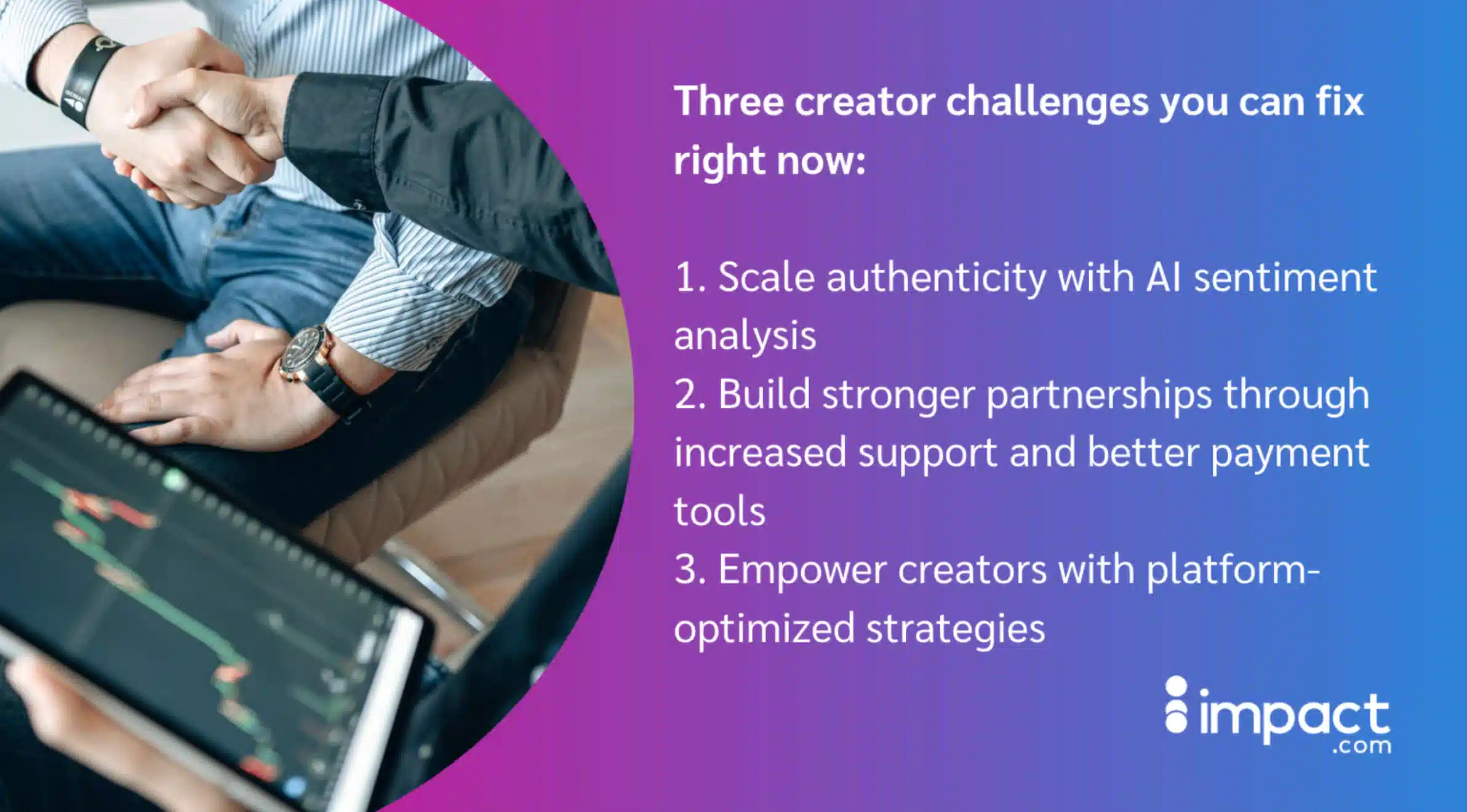
The same report identifies three friction points that creators name as top challenges. Each one has a direct, practical solution you can provide.
| 3 AI-powered solutions for the top creator challenges in 2026 | ||
|---|---|---|
| Creator challenge | % citing it | The fix |
| Maintaining authenticity while meeting brand requirements | 26% | Lead with the outcome, not a script. Use AI-powered sentiment analysis to identify content formats that resonate with each creator’s specific audience. |
| Finding long-term partners and responsive brand representatives | 25% | Assign dedicated points of contact with clear response-time expectations. Use customized payment tools to reduce administrative delays. |
| Managing technical complexity across multiple social media platforms | 22% | Share platform-specific performance data via dashboards. Automate metadata tagging so creators can focus on content, not taxonomy. |
Why prioritizing creator-centric AI tools gives your brand a competitive advantage
The brands pulling ahead have solved the root problem: They shifted from using AI tools solely for internal benefit to supporting creators.
Discovery tools don’t only help brands find creators. They help creators find their community, track their performance, and build the audience relationships that make them worth partnering with. A fitness influencer who can identify community peers and track content performance across platforms becomes a more powerful partner than one operating without that visibility. When your brand provides that infrastructure, you become the partner they don’t want to leave.
Creator-centric AI investment builds the kind of loyalty no competitor can replicate with a higher commission rate alone.
The AI-powered creator enablement framework
The table below maps six specific investments to the dual payoff they produce for creators and your brand.
| The AI-powered creator enablement framework | |||
|---|---|---|---|
| Solution | Why implement it? | How to implement it | The payoff |
| Briefs that build in creative freedom | Authentic content converts better. Restrictions = generic posts. | Lead with the outcome. Provide reference content and audience data, then let the creator own the execution. | Higher engagement rates, more authentic content, less creative friction. |
Partnership management workshops | Most creators were never taught how to get the most from an affiliate program. | Create short walkthroughs on tracking links, commission structures, and performance dashboards. Host monthly office hours. | Faster onboarding, fewer support requests, more capable partners. |
| Keyword intelligence sharing | Creators using AI for SEO dramatically outperform those who don’t, yet only 15% do it. | Share monthly keyword reports and trending search terms for your product category. Surface the queries your target audience is typing. | Higher organic search visibility, more website traffic, stronger content ROI. |
| Automated metadata tagging | Manual tagging across platforms drains creators’ time and results in inconsistent attribution data. | Use platform integrations to auto-populate UTM parameters and affiliate link metadata. Let the system handle taxonomy so creators can focus on content. | Cleaner attribution, accurate performance reporting, and reduced friction for creators. |
| Co-branded SEO playbooks | Most creators don’t have access to competitive SEO research. | Build quarterly playbooks with high-volume keywords, recommended content structures, and seasonal timing. Update them regularly. | Stronger search rankings for creator content and more high-intent traffic reaching your brand. |
| Attribution visibility for creators | When creators can’t see what’s converting, they stop improving. | Grant creator-level access to performance dashboards through advanced reporting tools so they can see the full picture of their own contribution. | Creators self improve. You get better performance without additional spend. |
Community building as a creator growth tool
Programs that grow past 100 active partners need infrastructure that scales with them — community tools, shared resources, and peer networks that reduce the management burden without sacrificing relationship quality. To move beyond a linear growth model, you must build the shared community infrastructure that allows creators to find, learn from, and amplify one another.
impact.com’s Global State of Affiliate Marketing report found that creator communities deliver five measurable benefits for your program:
| 5 data-led benefits that creator communities offer to brands | |||
|---|---|---|---|
| Benefit | What the data shows | Why it matters for your brand | How to support it |
| Organic amplification | 79% of creators say community helps them expand brand reach when sharing content. | Peer-to-peer amplification multiplies your content’s reach without additional ad spend. | Invest in tools that make amplification frictionless and seed your community forums with exclusive assets creators want to distribute. |
| Authenticity at scale | 77% of creators report that being part of a community produces more genuine, relatable content. | Authenticity is the top challenge for 26% of creators. Community gives them a space to move beyond generic scripts. | Use AI-powered sentiment analysis to identify which authentic formats are resonating, then share those insights back with the community. |
| Accelerated performance | 77% of creators say community lets them learn from their peers. | A creator who learns from peers develops faster. Peer learning is free professional development for your program. | Use Impact AI to identify your top-performing creators and invite them to lead monthly strategy sessions for the rest of your partner base. |
| Predictable retention | 75% of creators say community increases their loyalty to a brand. | Creators embedded in brand communities churn less. Reducing creator churn is one of the highest-ROI moves a partnership manager can make. | Recognize community contributions alongside sales. Reward creators who share best practices with early access to new products or higher commission tiers. |
| Real-time intelligence | 74% of creators say community helps brands gather deeper audience insights. | Community engagement generates organic intelligence you can use to sharpen briefs, identify new opportunities, and refine your product strategy. | Use Social Listening tools to monitor themes in your creator community and feed them directly into your next campaign brief. |

How brands can drive content conversion with creators [+5 steps to build communities]
Learn how to build communities where your brand and partners benefit with conversion-driven strategies.
How to get creators to align with your brand: Using AI to solve the growth paradox
The most persistent layer of your program’s growth ceiling is the growth paradox. This is the friction created when you use AI to enforce rigid internal alignment rather than enabling creators to scale.
Every resource AI consumes internally is a resource that never reaches your creators.
While you want to support more creators, the operational weight of managing a growing program absorbs the resources you’d need to do it. You can’t pour creator support into a program that’s leaking budget to fraud and drowning your team in manual compliance work.
Solving the internal scaling problem is what frees your team to actually support creators.
The growth barrier: How AI can boost scalability and tracking for influencer marketing programs
According to impact.com’s Global State of Affiliate Marketing report, 22% of brands cite managing program scalability as their top challenge. The math is unforgiving. A team of four to five people can effectively manage up to 100 active partners. Getting to 500 or more requires AI-powered automation to handle the repetitive management workload.
The same report revealed that 21% of brands are also blocked by technical tracking and analytics bottlenecks. That’s a deeper problem than it sounds. When attribution breaks, creators lose visibility into their performance. They can’t see what’s working. They stop improving. Your program data degrades exactly when you need it most.
Solving both delivers a dual benefit: your team gets time back, and your creators get the performance data they need to grow.
Why program protection is the foundation of a successful influencer marketing campaign in 2026
Every dollar lost to technical friction or fraud is a dollar taken away from the creators driving your actual growth.
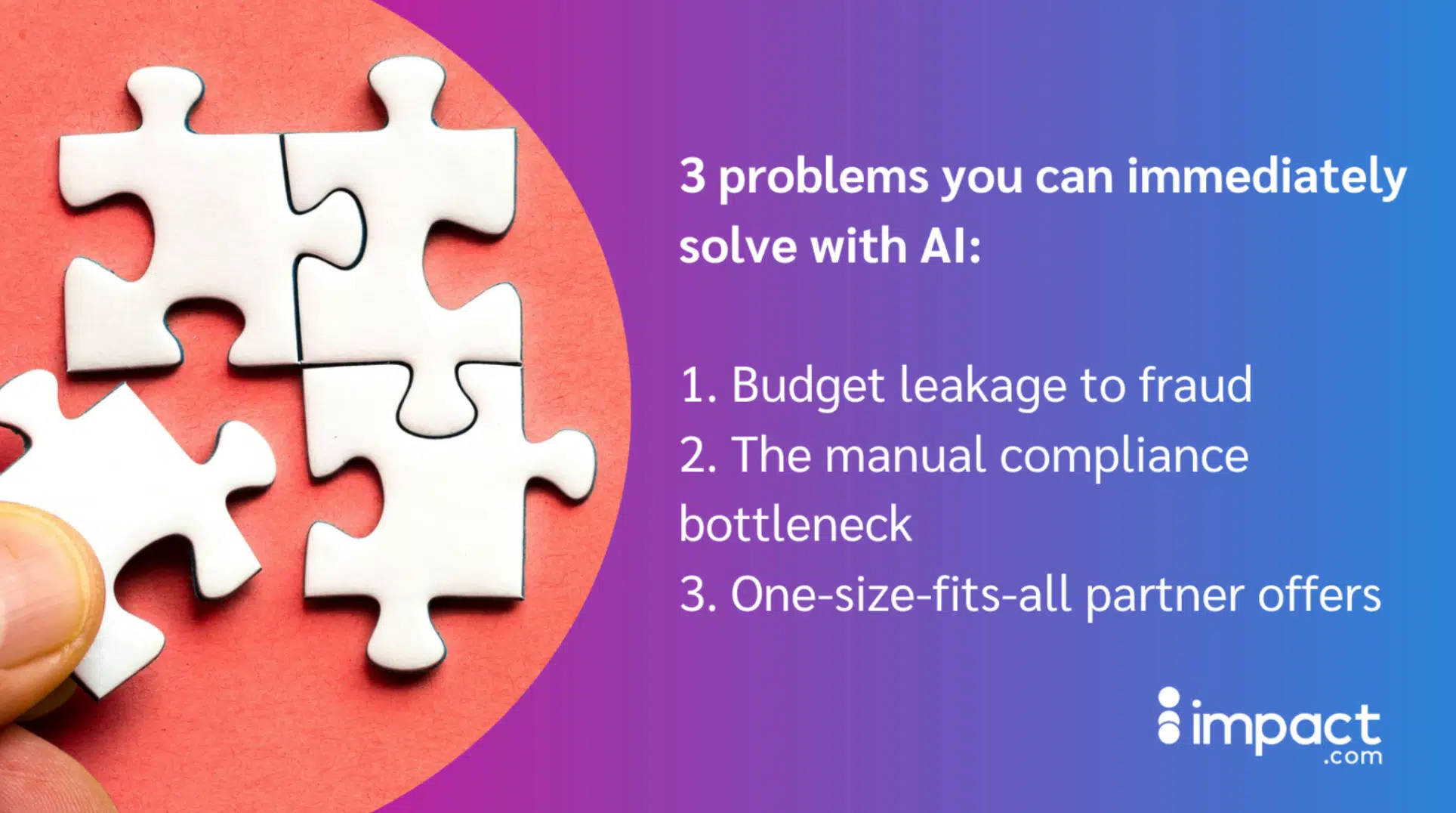
Problem #1: Budget leakage to fraud
Budget leaking to fraud is non-negotiable. It drains funds meant for creator incentives and community building.
The AI solution: Use automated fraud detection to identify click fraud and suspicious transactions in real-time. This protects the integrity of your payouts and ensures your budget is spent on genuine, high-performing partners.
Problem #2: The manual compliance bottleneck
Brand safety and disclosure requirements often become a manual oversight burden, preventing teams from managing more than a handful of partners.
The AI solution: Social Monitoring tools verify that creator content stays on-brand and that tracking links function correctly. They confirm disclosure requirements are met before content goes live. This removes the manual compliance burden from your team without sacrificing oversight.
Problem #3: One-size-fits-all partner offers
The same report showed that 31% of brands rank using AI tools to improve program management and personalize offers as their top growth opportunity, yet most still treat every creator the same, leading to churn.
The AI solution: Use AI to deploy personalized payment structures and campaign-specific payouts. By tailoring commission rates and rewards to the individual, you signal to your top creators that you view them as long-term business partners, not just transactional line items.

The 2026 guide to AI influencer marketing: Solving workflow friction and scaling authenticity
Learn about the real AI influencer marketing problems no one is talking about—and how to fix them.
How to optimize creator growth: The 2026 AI-powered influencer marketing strategy
Most programs stall because AI deployment stops at the brand’s own operations and never reaches the creators doing the work. The gap between brands that use AI for internal efficiency and brands that use it to build creator capability is growing.
Each row in the table below translates a specific friction point into an AI-powered response, with the tools that make it possible.
The brands acting on this framework now are the ones that will be hardest to displace in 2027.
| The 2026 standard: How AI-driven tools transform influencer discovery, monetization, and compliance | |||
|---|---|---|---|
| Program area | The old approach | The AI-powered approach | Business impact |
| Partner discovery | Manual application review. Keyword searches. Follower counts. | Impact AI surfaces new partners based on audience composition, content performance, and alignment signals. Find different types of influencers often missed by manual search. | Faster pipeline, higher partner-fit rates, access to engaged audiences that align with your brand. |
| Monetization and ROI | Flat commissions. No predictive insight. Revenue uncertainty for creators. | Forecasting and Anomaly Detection forecasts campaign performance and helps refine commission structures. ask impact answers data questions in plain language so you don’t need complex reports to understand what’s working. | Creators earn more predictably. Brands can reward long-term value (LTV) rather than last-click conversions alone. |
| Creative support | Vague briefs. No data to inform content decisions. | Sentiment analysis surfaces what topics, formats, and emotional tones resonate with each creator’s audience. Ask Impact helps brainstorm content angles and analyze top-performing posts. | More targeted content creation, stronger engagement rates, less wasted creative effort. |
| Security and compliance | Manual compliance checks. Reactive fraud response. Budget leakage. | Automated fraud detection flags suspicious activity in real time. Social Monitoring verifies on-brand content and functional tracking links before and after go-live. | Protected program integrity. Budget stays with high-performing, legitimate creators. |
| Partner recruitment at scale | Reactive, one-at-a-time recruitment from marketplace scrolling. | Find partners uses AI-powered matching to scale recruitment systematically. High-fit partners are identified continuously, not only when a slot opens up. | Reduced recruitment bottleneck, more consistent pipeline of aligned creators and publishers. |

Frequently asked questions
The questions below reflect what brand and agency teams ask most when rethinking how AI fits into their creator programs.
Start by shifting the question from how AI can improve your internal workflows to how it can better equip your creator partners. Use AI-powered discovery tools to identify aligned nano- and micro-influencers. Provide creators with SEO intelligence and attribution data they can act on. Automate compliance and fraud detection to protect program integrity. Deploy predictive analytics to personalize commission structures based on long-term value.
Programs that pair internal efficiency with external creator support consistently outperform those that don’t. The brands still winning are the ones who invest in both.
The creator monetization gap describes the earnings disparity between the top 1% of creators and the majority below them. Those creators have built real audiences but lack the technical tools to earn proportionally from them. Only 15% of creators use AI for SEO and 18% for link tracking, according to impact.com’s Global State of Affiliate Marketing in 2025 report. Both affect how much revenue they generate from affiliate programs. When creators underperform because they lack tools, the brand loses the high-intent traffic those creators could have delivered.
When brands give creators AI-powered keyword intelligence, performance dashboards, and automated metadata tools, creators produce content that ranks better and converts at higher rates. The ROI connection is direct. Better creator content means more high-intent website traffic, stronger engagement rates, and lower customer acquisition costs. Yamazaki Home saw 576% revenue growth in six months by treating creator activation as an AI-powered process rather than a manual one.
Self-service AI refers to tools deployed for internal brand operations: reporting dashboards, chatbots, fraud filters. Partner-first AI infrastructure extends those capabilities outward to creators and publishers. It gives them access to attribution data, SEO intelligence, platform performance insights, and community discovery tools. Both approaches have a place, but the brands building lasting competitive advantage are investing more heavily in the second.
The growth paradox is the tension between wanting to support more creators and lacking the operational capacity to do it. AI resolves this by automating the high-volume, low-judgment tasks: fraud detection, compliance monitoring, application vetting, and performance reporting. That frees your team for the relationship work that AI can’t replicate. A team of four to five people managing 100 partners can support 500 or more with the right AI infrastructure in place according to impact.com’s Global State of Affiliate Marketing in 2025 report. Solving scale isn’t a detour from creator support. It’s what makes creator support possible.
AI-powered discovery analyzes audience composition, content performance, engagement rate patterns, and sentiment signals to surface creators who match your brand’s specific audience and tone. Nano-influencers (>15k followers) and micro influencers (15-75k followers) often deliver stronger engagement rates because their audiences are tightly aligned. AI-powered matching makes finding them systematic rather than accidental.
How do you create a successful influencer marketing campaign using AI in 2026?
Start by shifting the question from how AI can improve your internal workflows to how it can better equip your creator partners. Use AI-powered discovery tools to identify aligned nano- and micro-influencers. Provide creators with SEO intelligence and attribution data they can act on. Automate compliance and fraud detection to protect program integrity. Deploy predictive analytics to personalize commission structures based on long-term value.
Programs that pair internal efficiency with external creator support consistently outperform those that don’t. The brands still winning are the ones who invest in both.
Why the new standard for influencer marketing success is partner-centric
The brands pulling ahead stopped treating AI as an internal efficiency tool and started using it to make their creators harder to poach.
97% of brands have a seat at the AI table. The ones who pull ahead will use that seat to serve their creators, not their own dashboards alone. Yamazaki Home’s 597 pending applications didn’t become 576% revenue growth because the brand got a better analytics tool. It happened because the brand built a system that activated creators, gave them full performance visibility, and let AI handle the volume so the partnership team could focus on relationships.
Creators who get better tools from their brand partners stay longer, produce stronger content, and drive more revenue. That compounding effect is the closest thing to a durable competitive advantage in influencer marketing today.
The programs that win won’t be the one with the most sophisticated internal dashboards. It will be the one whose creators have the data, support, and tools to reach their full potential.
Start here: Audit how your current AI tools are deployed. If more than half point inward, at your dashboards, your reports, your fraud filters, you’ve found the gap. Then pick one creator friction point from this article and build the infrastructure to solve it. That single shift is what separates programs that plateau from programs that compound.
That’s how to create a successful influencer marketing campaign in 2026: build the infrastructure your creators need to succeed, and let their success drive yours.
Ready to close the creator monetization gap? See how impact.com helps brands build creator-first programs at scale.
Further reading:
- The 2026 guide to AI influencer marketing: Solving workflow friction and scaling authenticity — A deep dive into the tools and frameworks for fixing fragmented AI workflows in creator programs.
- The marketer’s guide to AI-powered creator campaigns: A technology-agnostic framework — A practical five-function framework covering discovery, planning, monitoring, optimization, and analysis for AI-powered creator campaigns.
- The unignorable content checklist: 5 steps to a human-first AI Overview content strategy for affiliate reviews — An expert-led guide on turning your content into the source AI quotes, boosting your AI Overview snippets.
- The creator payment playbook — A strategic guide to building modern, AI-powered commission structures that increase creator retention and loyalty.
- Authentic content that drives real results — An expert podcast exploration into how brands can move beyond generic scripts to foster genuine, high-performing creator partnerships.