

Selling a high-consideration, expensive product like a mattress on social media used to feel like a losing game. For a brand like Resident, influencer content could build awareness, but it rarely drove sales.
The company’s solution was to restructure the way they approached social. Resident built a social commerce strategy that used affiliate links to turn creator content into direct sales drivers, then repurposed those proven assets into a library that scaled impact across other performance channels.
According to an impact.com case study, Resident’s highly produced ads were scoring below break-even on return on ad spend (ROAS)—costing more than they returned. When the team switched to creator content, the same ads turned profitable. The only cost was a gifted mattress.
Resident’s story proves the point: social commerce isn’t a content problem—it’s a structural one.
Social commerce strategies fail when brands treat it as a content play. The brands turning social attention into predictable revenue have made three structural decisions—model, incentives, attribution—that most programs never get right.
This article will show you how to build your own. We’ll break down the framework that separates fleeting engagement from scalable revenue by focusing on the three foundational decisions every successful strategy gets right: your program model, your incentive structure, and your attribution method.
Social commerce vs. traditional influencer marketing
The fundamental difference between social commerce and traditional influencer marketing lies in their core purpose and structure.
Traditional influencer marketing is typically an awareness play focused on generating reach and engagement. These programs often pay creators with flat fees, treating their work like a media buy. Success is measured in content metrics like impressions, likes, and shares.
Social commerce is a performance-driven system designed to generate revenue. By enabling purchases directly through social platforms—via shoppable posts, integrated storefronts, or in-app checkouts—it links sales directly to performance.
One of the key benefits of this structure is that it shifts the focus from visibility to revenue. This transforms social commerce into a scalable growth channel instead of a marketing expense.
| Aspect | Social commerce | Traditional influencer marketing |
| Primary goal | Measurable revenue and sales | Brand awareness and audience engagement |
| Core compensation model for partners | Performance-based (commissions, sales-based) | Flat fees (per post, per campaign) |
| Key metrics | CAC, AOV, ROAS, conversion rate | Reach, impressions, likes, comments, shares |
| Time horizon | Long-term, “always-on” programs | Short-term, campaign-based |
| Financial risk | Lower, with costs tied to successful conversions | Higher, requiring upfront investment with no guaranteed sales |
The core pillars of a high-performing social commerce strategy
The success of social commerce programs isn’t determined by tactics alone—it depends on four structural pillars that work together to create a profitable system:
- Program design: You must select the types of social commerce that align with your specific business goals, dictating who leads the customer experience and where it happens.
- Incentive alignment: Designing compensation, commissions, and rewards that tie the costs of a social sale to the revenue it generates ensures profitability.
- Attribution clarity: This pillar is about implementing the right tracking and attribution models to get a clear view of what’s driving sales.
- Optimization: By regularly analyzing performance data, you can identify what works, refine your approach, and make informed decisions.

To launch its Creaseless Sunscreen Powder and encourage conversions, Tarte Cosmetics executed a coordinated push across various social commerce channels.
Designing your social commerce strategy: A 4-step guide to developing an aligned program
Now it’s time to turn theory into an action plan. These four steps force you to make the foundational structural decisions—model, incentives, measurement, and optimization—that ensure your program is built for revenue from day one.
Step 1. Select the right set of social commerce models
Your first big decision is picking the social commerce models that match your business goals.
There’s no single “best” option. The strongest strategies layer multiple models—from influencer-led social commerce to native shopping features—to guide customers through their journey. Relying on one approach can leave gaps and miss opportunities to capture intent at different stages.
The right choice depends on what you need your program to do. If you’re trying to lower customer acquisition costs (CAC), you’ll use a different model than if you’re trying to boost average order value (AOV).
How to pick best-fit models
Model selection looks straightforward at launch, but it gets harder as programs scale. The right combination shifts as your partner mix grows, platform algorithms change, and audience behavior evolves.
Most programs don’t fail because they picked the wrong model on day one. They fail because they never revisited the decision.
At scale, AI starts to earn its keep. It can catch when the mix that worked at 20 partners is quietly falling short at 200.
This decision matrix provides the strategic framework for aligning your goals with the right partners, channels, and tactics.
| If your primary goal is… | Who powers the strategy | Commerce channels | Supporting tactics |
| Lower CAC | Creators | Affiliate links, promo codes, links to branded storefronts | Product seeding, UGC amplification |
| Increase revenue from social activity | Brand and creators | In-app shops, shoppable video | Livestream shopping, sponsored content |
| Shorten the sales cycle | Creators | Livestream shopping, in-app checkout | Time-sensitive offers, Q&A sessions |
| Increase AOV | Brands | Product bundles on-site | Creator content showcasing bundle value |
| Drive repeat purchases and LTV | Brand community | Exclusive access, loyalty rewards, brand ambassador programs | Customer advocacy programs, community forums |
| Monetize organic engagement | Creators and brand community | Affiliate links in bio/comments | Turning top fans into affiliate partners |
| Reduce purchase hesitation | Creators and customers | Reviews, demos, testimonials | UGC, expert reviews, customer advocacy programs |
Step 2. Align your incentives with performance
Many programs get stuck on incentive structuring. They measure what’s easy (engagement) instead of what matters: revenue. Likes and shares feel productive, but they don’t prove business impact and can lead to spending on activities that never result in a sale.
How you spend money reflects your strategy. Think of an “incentive” as any cost that goes into making a sale through social—influencer commissions, ad spend, even your team’s salaries.
A real performance program tries to tie every cost to the revenue it generates, separating a scalable growth channel from a simple marketing expense.
When you align incentives with performance, you pay for results. This lowers your financial risk and ensures your program is built for profitable growth.

“Figuring out the right partners, how they align with what you’re doing, and how you align with what they’re doing is the key to a good initial relationship. But thinking about these as long-term partnerships requires asking the right questions on both sides. What do you need from me? What can I do for you to make our relationship better?”
– Todd Crawford, VP of Strategic Initiatives at impact.com
How to select incentives that drive the right actions
The math behind incentive structures gets complicated fast. A commission rate that works at your current volume might not hold up at twice the scale. Manually modeling what a rate change would mean across partners, each with different conversion profiles, isn’t realistic.
AI forecasting is useful here because it can predict the revenue impact of commission adjustments before you make them—and at a scale no spreadsheet can match.
This matrix breaks down the key variables to consider when choosing the right incentive model.
| Social commerce type | Primary incentive | What the cost represents | Scalability | How to maximize ROI |
| Affiliate marketing content | Commission (% of sale) | A direct cost of making a sale | High: costs grow as revenue grows | Fine-tune commission rates based on partner value, product margin, and customer type (new vs. returning). |
| Sponsored content | Flat fee + performance bonus | A payment for reach, with an extra kick for results | Medium: scaling requires more cash upfront | Tie bonuses to sales or leads, and put ad spend behind your top-performing creator content. |
| Livestream shopping | Host fee + commission | Payment for talent and production, plus a sales driver | Low: scales with your audience and host’s effectiveness | Use limited-time offers to create urgency and track sales that happen after the event. |
| In-app social commerce | Platform transaction fees | The cost of using the platform’s native checkout tools | Medium: scales with the platform’s audience | Keep your product catalog fresh and use creators to drive traffic to high-priority products. |
Step 3. Choose the right attribution model to measure revenue
Clean measurement is the glue that holds your strategy together. Without it, you’re just guessing.
But even brands that have attribution in place can fall into a common trap: tracking top-line revenue while ignoring the metrics that determine actual profitability.
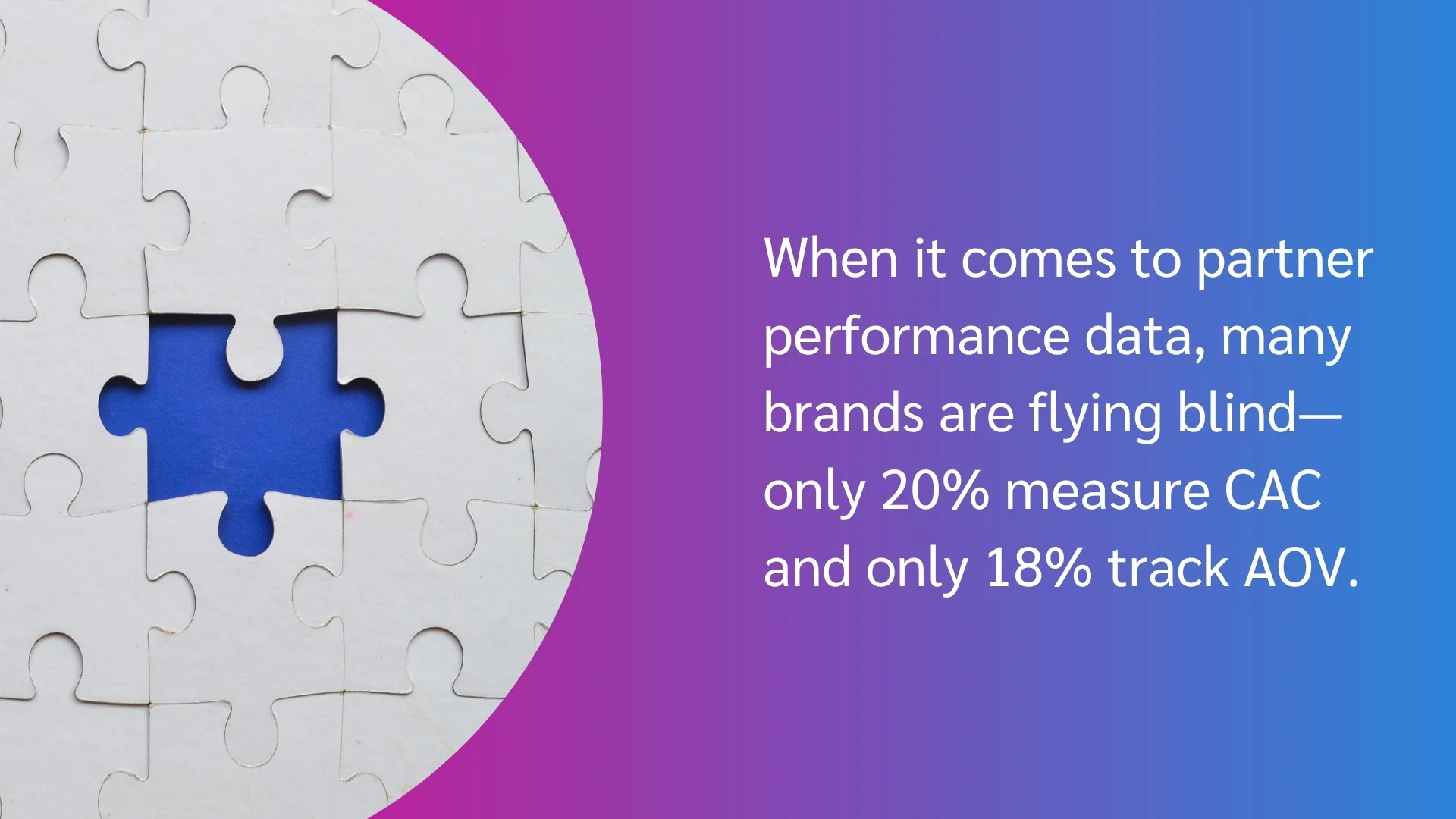
This is a blind spot for many marketing teams. According to impact.com’s 2025 Global State of Affiliate Marketing Report, most brands track sales volume, but only 20 percent measure CAC and a mere 18 percent track AOV.
This means that brands can’t distinguish between productive activity and profitable growth. A program might look successful because it’s driving thousands of sales, but if they’re all low-margin items from existing customers, it could actually be losing money.
Choosing the best-fit attribution model is how you avoid this. The right model gives you the clarity you need to improve your program and prove its value.
Source: impact.com’s 2025 Global State of Affiliate Marketing Report
How to measure what matters
This matrix explains the most common attribution models, providing a starting point for assigning credit as you scale your program.
While these models provide the foundational logic, AI-powered attribution moves beyond rules-based systems to answer the core question: “What is truly driving growth?” Instead of relying on simplistic rules like “last click,” the right AI approach analyzes every touchpoint in the customer journey to assign credit more accurately. It can even help you measure true incrementality by modeling what would have happened without a specific partner’s influence.
| Attribution model | How it’s used in social commerce | Strategic goal | Example | Common pitfall |
| First-click | Gives credit to the first social touchpoint. | Rewarding discovery. Identifies which creators and channels are best at introducing your brand to new customers. | Shopper sees a creator’s unboxing video on TikTok and clicks to your site, later purchasing through an email link. TikTok video gets credit. | Ignores mid-funnel content and closing touchpoints that helped secure the sale. |
| Last-click | Gives credit to the final social touchpoint, often tracked via an affiliate link or promo code. | Rewarding conversion. Pinpoints which partners and offers are most effective at closing the deal. | Customer sees several posts, then clicks an affiliate link in a creator’s Instagram bio and buys. Affiliate link click gets credit. | Undervalues awareness-building content that started the journey, often leading to over-investment in bottom-funnel partners. |
| Position-based (U-shaped) | Splits credit between the first touch and the last, with the rest spread in the middle. | Valuing openers and closers. Gives credit to both the creator who introduced the product and the partner who drove the final sale. | Buyer first sees your product in a creator’s post (40% credit), reads a blog review (20% credit), then buys using another creator’s promo code (40% credit). | Fixed 40/40/20 credit split may not reflect how much influence each touchpoint really had. |
| Time-decay | Gives more credit to touchpoints closer to the sale. | Capturing momentum. Best for short sales cycles or impulse buys where final interactions have the most impact on the purchase decision. | Someone sees a creator post on Monday (gets 10% credit), a retargeted UGC ad on Thursday (30% credit), and clicks a link from a live stream on Friday to buy (60% credit). | Undervalues top-of-funnel content that may have planted the seed for a later purchase. |
Step 4. Build a program optimization loop to refine and scale
A well-designed social commerce strategy creates its own feedback loop, providing the data needed to justify budget, prove value, and continuously improve.
For managers responsible for ROI, this gives them the foundation to:
- Build a narrative for leadership
- Show how the program performs against other channels
To build an effective optimization loop, you must consistently track a core set of metrics, understand the story they tell, and take action based on those insights.
“Knowing your data as well as you can, and being able to see it and slice and dice it from multiple perspectives, not only helps you do your job—it also helps you to defend the channel if you have management or anybody questioning it. You can champion it internally, because you have great data and you can clearly show opportunities.”
– Todd Crawford, VP of Strategic Initiatives at impact.com
Essential social commerce dashboard metrics
These are the metrics you can use to optimize your program:
- Customer Acquisition Cost (CAC): Total program spend / Number of new customers acquired. Are you acquiring customers profitably?
- Average Order Value (AOV): Total revenue / Number of orders. Are social customers spending more?
- Return on Ad Spend (ROAS): Revenue generated from paid promotion / Cost of paid promotion. Is your spend on creator content efficient?
- Conversion rate by partner/channel: (Conversions / Clicks) * 100. Which creators and channels are most effective at closing?
- SKU-level performance: Which specific products are selling best through social channels? What products should you promote more?
- New vs. returning customers by partner/channel: The ratio of new-to-file customers versus existing customers driven by each partner. Is this partner driving incremental growth, or are they converting customers who would have bought anyway?
How to interpret signals from your dashboard
A commerce automation platform can act as an intelligent guardian for your data, ensuring your source of truth stays reliable.
As you centralize tracking, you can more easily monitor for anomalies, flag tracking discrepancies, and even help stitch together complex customer journeys across different devices and platforms—adding a layer of intelligence that manual oversight can miss.
To build a solid data infrastructure, this matrix outlines the pros and cons of different tracking methods.
| Signal to watch for | Key metric | What it means | Recommended action |
| High traffic, low conversions | Conversion rate by partner | There’s a disconnect between the social creative and the checkout experience, causing friction. | Audit the user journey from top creators and optimize landing pages to match the specific offer in their content. |
| High sales volume, low profit | AOV | You’re effectively selling, but only finding success with low-value items that don’t maximize profitability. | Incentivize promoting higher-value products or bundles through commission bonuses. |
| A few tactics or partners drive all ROI | ROAS | You can see what a top-performing partner or tactic looks like for your brand. | Double down on these tactics/relationships and build a playbook for emulating this success. |
| Rising acquisition costs | CAC | Your program’s efficiency is declining, costing more to acquire each new customer. | Re-evaluate incentives or shift spend away from high-cost, low-conversion tactics/partners. |
| 80/20 product performance | SKU-level performance | A small handful of your products are driving the vast majority of social commerce sales, meaning you’ve found your “hero products” for this channel. | Double down on these winning products by featuring them more heavily in your overall social commerce strategy. |
| Low new customer rate | New vs. returning customers by partner | A high-volume tactic/partner is primarily converting existing customers, which can inflate your CAC. | Implement a tiered commission structure that pays a higher rate for new customers and a lower rate for returning ones. |
| Manual analysis isn’t scaling | All metrics | Your optimization loop is producing more data than your team can act on | Use AI-powered attribution tools to surface partner-level incrementality and flag anomalies—this is where AI adds lift. |
A thoughtful social commerce strategy lays the foundation for what’s next in marketing
As AI tools get better at predicting which partners and channels will perform, their recommendations will be trained on the performance data—like partner-level CAC and AOV— that only a disciplined social commerce strategy can produce.
At the same time, top creators will increasingly flock to brands that offer performance-based pay.
The future of commerce will be won by those who build a real commercial system—not just a thoughtful content calendar.
FAQs
You build a social commerce strategy by working through four decisions. Start by picking the models that fit your business goals, then align your incentives around performance so the program stays profitable as it grows.
From there, choose a clear attribution model so you can accurately measure revenue—not just activity.
Finally, build an optimization loop that lets you improve and scale continuously based on what the data tells you.
To choose the best social commerce channels for maximizing sales, go where your customers are. Look at the demographics and behavior on different platforms. Test a few promising channels with trackable links to see which ones drive actual sales—not just traffic—and then double down on what works.
The social commerce strategy that works best for launching a new product and boosting first-week sales is a two-phase strategy.
Before launch, seed your product with trusted creators to build social proof and anticipation.
During launch week, drive urgency with livestream shopping events and sponsored content that features time-sensitive offers (e.g., “15% off for 48 hours”). Pair this with direct affiliate links or promo codes to convert the buzz into immediate, measurable sales.
To build an effective social commerce strategy that scales, the most critical tool is a partnership commerce platform. For example, impact.com centralizes partner recruitment, contract management, performance tracking, and commission payouts in one place, giving you the attribution clarity you need to prove ROI.
While social platforms are where the sales happen, a partnership commerce platform provides the infrastructure to manage, measure, and scale what happens across all of them. It automates commission payouts, tracks performance across every partner, and surfaces the data—like CAC and AOV—that separates productive activity from profitable growth.