

Who is this guide for
If you’re running performance marketing programs—particularly affiliate partnerships, influencer campaigns, or commission-based collaborations—and dealing with:
- Suspicious traffic that drives clicks but no conversions
- Partners bidding on your branded keywords and claiming credit for organic sales
- Pressure to scale quickly while maintaining quality standards
- Limited time and budget to implement sophisticated fraud detection
This guide gives you a practical, phased framework you can implement starting today—whether you’re managing 10 partners or 1,000.
Performance marketing promises precision: pay only for results, track every dollar, scale what works. But when you’re managing partnerships—affiliates, influencers, and commission-based collaborators—that precision is under threat.
The reality: Whether you’re working with performance-based partners, quality concerns are widespread. A reported 23 percent of brands cite ensuring affiliate quality and performance as a major concern.
The problem isn’t the performance marketing model itself—it’s the growing threats undermining it:
- Bot traffic is skewing your performance data
- Partners are bidding on your brand keywords, competing with your own paid search
- Inappropriate ad placements are damaging your brand reputation
- Privacy updates (iOS 14.5+) and evolving cookie policies have disrupted traditional attribution models
Throwing more budget at high-commission partners won’t solve these underlying quality issues. The solution is a marketing quality assurance (QA) framework that protects your budget and brand integrity by ensuring every partner adheres to your standards.
This article breaks down that framework into three actionable phases you can implement, whether you’re just starting out or scaling an established program.
- The current landscape: Navigating quality challenges
- The partnership quality advantage: A strategic solution
- A practical framework for marketing quality assurance
- The quality assurance toolkit: Software for campaign accuracy
- PUMA’s quantifiable quality journey: Achieving 90 percent fraud reductions and 30 percent CPA savings
- The future outlook: the next frontier in partnership marketing
Quality assurance challenges in performance marketing
Performance marketing’s rapid growth has created a quality crisis: as programs scale, accountability often takes a backseat. This lack of control then triggers bot traffic, partner conflicts, brand safety violations, and compliance risks that directly undermine your ROI.
Recognizing these specific challenges is the first step toward protecting your budget and brand reputation.
Advanced bot traffic
Fraudulent activity in performance marketing is constantly evolving. Modern bots mimic human behavior by scrolling pages and hovering over links, making them hard to detect with standard filters. This makes them increasingly difficult to detect through standard filters.

What to watch for: Traffic may show excellent engagement (low bounce rate) but originate from the same few IP ranges using rotating device IDs. This is a tell-tale sign of a bot farm. A key red flag is traffic with instantaneous form fills and perfectly timed clicks at exact intervals.
Click farms and ad fraud
Sophisticated fraud tactics drain marketing budgets:
- Click farms: Operate in low-cost regions to generate thousands of fake conversions daily.
- Ad stacking: Layering multiple ads invisibly, making you pay for impressions the user never saw.
- Pixel stuffing: Shrinking tracking pixels to 1×1 dimensions to trigger unseen impression credits.
Lead stuffing
Partners submit fake sign-ups or use stolen emails to claim commissions for non-existent leads. The average invalid traffic rate for lead generation ranges from 8.5 percent to 25 percent, with extreme cases reaching 90 percent.

A sudden, non-historical volume of sign-ups is suspicious. Reviewing the data often reveals computer-generated names or bouncing email addresses, which are clear signs of automated submissions.
Financial verification is critical. As Danilo Coviello, Founding Partner, Espresso Translations, learned: “I saved my company $180K by identifying partners with fake ad impressions after reviewing invoices. They claimed $50K in monthly ad revenue but couldn’t provide receipts to prove it.” These verifications expose fraud before it drains your budget.
Brand safety risks
Even the strongest brand message fails—or worse, causes damage—if your ads appear in the wrong place. Contextual adjacency directly undermines brand integrity, demanding high selectivity regarding partner content placement.
The risk of inappropriate content placement
When your brand is seen next to controversial or inappropriate material, the damage is immediate. Your audience will associate your company’s values with the negative, low-quality, or harmful information you appear alongside. Ads appearing beside content about violence, misinformation, or other sensitive topics directly contradict your brand guidelines.
The importance of brand standards was highlighted in 2017 when AT&T, Verizon, and Johnson & Johnson pulled ads from YouTube after discovering that their ads had been placed alongside extremist content.
Low quality and unethical partners
Brand safety extends beyond controversial topics to the quality and ethics of the platforms promoting you.
Unethical partners: Some partners violate copyright, scrape content, or run low-value blogs filled with affiliate links solely to collect commissions. This gradually erodes brand credibility and damages the user experience.
The AI content flood: The rise of AI-generated content amplifies these risks. Partners now produce thousands of keyword-stuffed pages lacking genuine value. This flood of low-quality content weakens brand associations and wastes ad spend. For instance, in November 2024, NewsGuard identified 1,121 AI-generated misinformation sites, a massive increase from the previous year.

Cannibalization issues: Don’t compete against yourself
Cannibalization occurs when your partners claim credit for sales or traffic you would have earned organically or through your own marketing efforts. This results in you paying twice for a single customer action, directly eroding your profit margin.
Branded keyword bidding
This is the most common form of internal competition. When affiliate partners bid on your brand name in paid search, your internal paid search teams end up competing directly with them.
The cost: You pay an affiliate commission for traffic that was already explicitly searching for your brand. Recent analyses show that 31 percent to 43 percent of brands face these affiliate brand bidding violations.
Scenario: A customer searches for “Your Brand Name.” Both your internal ad and an affiliate’s ad appear. If the customer clicks the affiliate’s ad and buys, you pay the commission—a wasted commission for an already-decided customer.
Cookie stuffing and attribution abuse
Another serious form of cannibalization involves partners manipulating tracking to claim credit for organic sales.
Cookie stuffing: Partners place tracking cookies on users’ devices without a click on an ad or link. When the user later converts organically, the partner fraudulently claims the commission.
Last-click attribution: Many attribution models exacerbate this by giving commission to a partner who appears at the final touchpoint, even if they had no real influence on the purchase decision.
The fix: Carefully monitor branded search activity and use transparent attribution models to protect your budget from partners focused on claiming credit rather than driving new, incremental business.
Compliance requirements: The responsibility stays with you
When you work with partners, accountability never shifts. You remain legally responsible for everything your partners do in your name—especially when it comes to user data and advertising claims.
The high cost of non-compliance
Data privacy laws don’t mess around. Ignoring them and advertising regulations can lead to severe financial and reputational consequences for your brand.

Data privacy fines: When partners mishandle user data or make misleading claims, your brand remains legally responsible. Regulators levied over $2.2 billion in global GDPR fines in 2023, highlighting the serious consequences of inadequate quality control and compliance workflow management.
Deceptive advertising adds further risk. Some partners might promote unauthorized discounts, make false product claims, or use aggressive tactics that breach FTC regulations. Affiliate marketers have faced enforcement actions for false health claims, resulting in significant settlements. Brands connected to those affiliates faced reputational damage even without approving the messaging.
The need for consistent oversight
Managing partner relationships while maintaining compliance requires consistent oversight and adherence to your brand and social media policies.
Compliance accountability never shifts to partners; it remains with you. Without strong quality controls and clear workflows, you are essentially trusting your reputation and legal liability to partners who may not share your standards. A proactive quality assurance framework is the only way to safeguard your business from these very serious risks.
The partnership quality advantage: A strategic solution
Partnership-centric marketing offers a transparent alternative to the black-box nature of platform-based performance marketing. While platforms limit visibility into who promotes your products or how campaigns align with your brand standards, direct partner relationships provide clear expectations, ongoing visibility into partner practices, and better control over user experience—making quality and brand safety sustainable as you scale.
Transparency and accountability through direct relationships
When you know your partners directly, quality management becomes proactive rather than reactive. You’re communicating with the actual people representing your brand—the creators and stakeholders who shape how customers perceive you.
Direct communication delivers practical advantages:
- Clear alignment: Share brand guidelines, social media policies, and design standards directly, with immediate feedback when clarification is needed
- Audit capability: Review exactly how partners promote your products on their websites, verify traffic sources through firsthand walkthroughs, and ensure functionality meets your technical standards
- Performance transparency: When you tie partner compensation directly to verified conversions rather than vanity metrics, you naturally align incentives for mutual benefit

This performance-based model creates organic quality control. Partners who share in your outcomes naturally prioritize quality, making it easy to identify underperforming or non-compliant partners through transparent performance data. High-performing partners scale their efforts, while low-quality ones phase out, creating a self-correcting ecosystem that continually improves without the need for constant manual oversight.
Strategic vetting over volume
The process of choosing who promotes your brand is strategic, not random. A quality partnership is established by implementing a vetting framework before campaign launch.
Sustainable partnerships are built on alignment and integrity, which drive long-term growth. The criteria for success in these relationships go beyond traffic volume. Quality is established by focusing on partners who:
✅ Understand your market.
✅ Respect your brand standards and brand personality.
✅ Attract engaged audiences who are genuinely likely to convert.
Dario Markovic, Forbes Council, Entrepreneur Leadership Network, puts it well: “Look for alignment in values and audience. Even the most compliant partner can harm brand equity if there’s a mismatch.” This compatibility forms the foundation for partnerships that drive sustained growth, rather than short-lived traffic spikes.
What to evaluate before launch
Your vetting process should assess multiple factors to confirm the partner is a solid, strategic choice:
- Website review: Assess their overall website quality, content strategy, and design.
- Audience alignment: Analyze their audience demographics.
- Method confirmation: Confirm that their promotional methods align with your brand guidelines and deadlines.

“Before we bring on a partner, we build a ‘success scorecard’ that defines what a win looks like, what compliance standards must be met, and what partner behavior will make the relationship work. If someone can’t clearly explain their traffic sources or balks at sharing documentation, that’s our signal to walk away.”
– Sid Jashnani, CEO, Rekruuto
A practical framework for marketing quality assurance
Strategy is easy; execution is what separates high-performing programs from the rest. This three-phase framework scales with program maturity. It begins with foundational quality control and progresses toward automated protection at scale, ensuring marketing quality assurance remains consistent as your business grows.
Phase 1: Foundational quality control (the vetting layer)
This phase is your essential starting point. It focuses on manual, checklist-based steps to verify that new partners are compliant and aligned with your brand before they ever go live.
The primary objective is to prevent quality issues before they arise. You do this by thoroughly vetting partners during onboarding and establishing clear workflows, brand guidelines, and testing protocols from day one.
Tailoring Phase 1 to program maturity
| Maturity level | Focus area | Resource requirement | Key action |
| Foundational | Basic compliance, manual checks, and high-quality partners only. | Low-to-Moderate. Primarily requires team time for due diligence and a standardized checklist. | Focus on quality over volume. Limit partners to those with high Domain Rating (60+) and stable growth trends. |
| Advanced | Automated screening and high-volume partner recruitment. | Moderate-to-High. Requires platform investment (e.g., impact.com) for automated reviews. | Embed legal and creative review into automated onboarding flows. |
Partner vetting protocols: Your pre-launch checklist
Strong partnerships start with structured screening. A consistent vetting process filters out low-quality or high-risk affiliates before they go live.
Use this checklist to establish a reliable vetting workflow that supports marketing quality assurance:
| Partner vetting checklist | Informational goal |
| Review partner assets | Evaluate website quality, content strategy, design standards, brand tone, audience demographics, and promotional methods. |
| Interview and verify experience | Discuss traffic sources, promotional strategies, and prior performance. Verify past results through testimonials or references from other stakeholders. |
| Check data handling | Assess how they handle forms, lead capture, and user data to ensure compliance with privacy regulations. |
| Review attribution capabilities | Confirm their ability to support the latest attribution standards (e.g., specific tracking methods, privacy law compliance) given iOS 14.5+ changes |
| Confirm legitimacy | Verify site ownership through WHOIS or LinkedIn verification to prevent impersonation. |
| Assess content quality | Check for signs of excessive keyword stuffing or low-value, AI-generated content that offers no genuine insight. |
Setting up for success: Post-vetting best practices
Once a partner passes the initial screening, these practices help you formalize the relationship and set clear expectations:
- Set quality thresholds: Establish clear requirements for domain authority, organic traffic, and growth trends to maintain quality control.
- Streamline documentation: Use tools like impact.com to centralize reviews, documentation, and compliance records within a workflow, keeping all stakeholders aligned.
- Define brand bidding rules: Explicitly outline prohibited keywords (especially branded terms) and agree on clear penalties for competitive bidding violations.
- Mandate creative approval: Implement a mandatory review workflow for all creatives (ads, banners, landing pages) before they go live to ensure adherence to brand standards and claims.
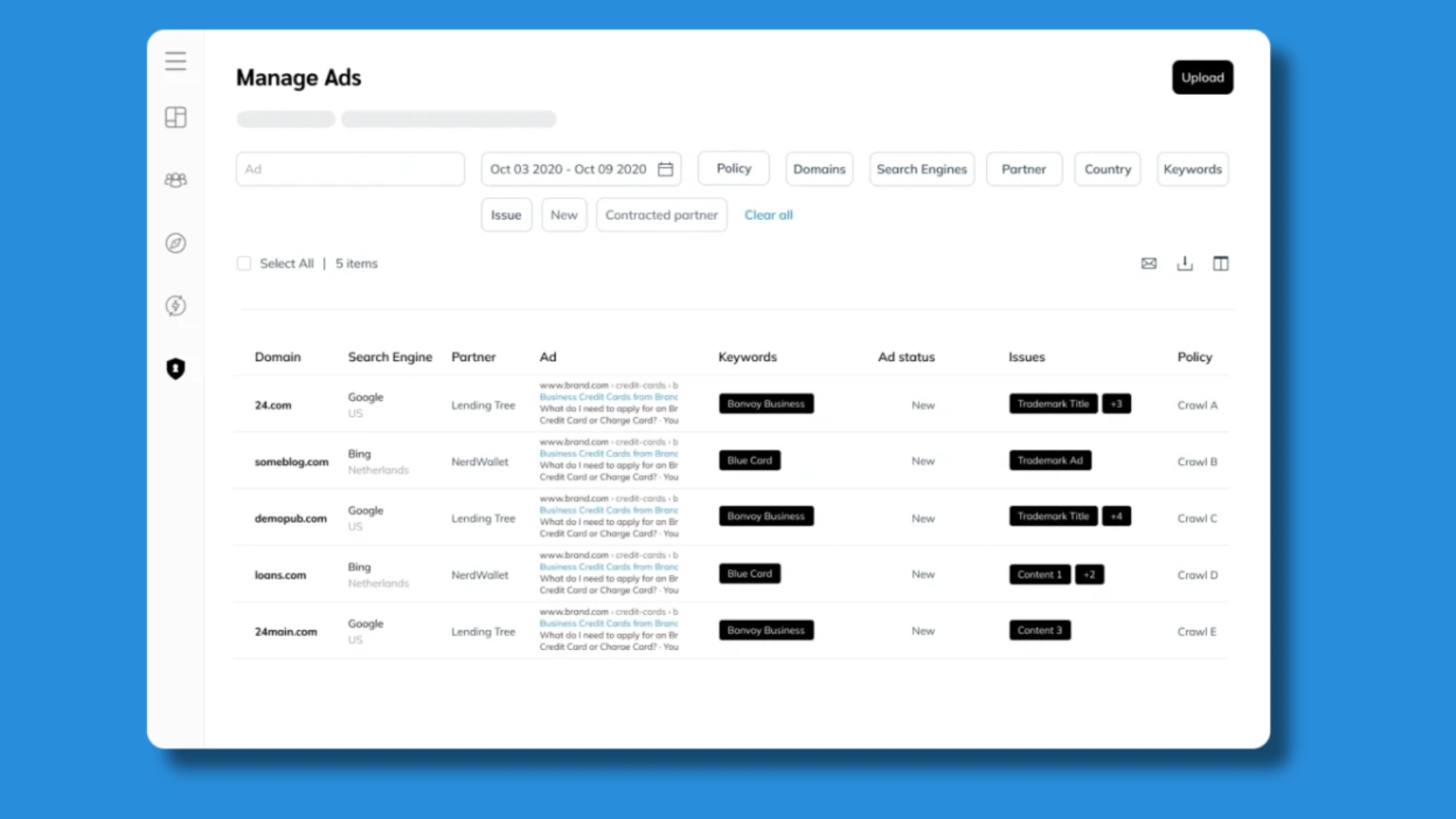
Host approved creatives and current offers in a central spot, such as impact.com
Transparency is key
Transparency is often the most effective way to distinguish credible partners from opportunists. Coviello shares a crucial insight:

“The biggest red flag is partners that pitch ‘proprietary traffic sources’ but don’t name any actual publishers or websites. I require them to have access to their traffic analytics dashboard in real time before any deal is signed. This level of transparency often immediately disqualifies partners.”
– Danilo Coviello, Founding Partner, Espresso Translations
Embedding transparency in the vetting process helps you identify trustworthy collaborators early, avoiding costly cleanup later and ensuring a positive experience for all stakeholders and creators.
Phase 2: Evolving quality control (the monitoring layer)
Once your partners are active, you shift from pre-launch screening to proactive monitoring to maintain a stable and functional program. The goal in this phase is to catch fraud or declining traffic quality before it significantly damages your budget or brand reputation.
Tailoring Phase 2 to program maturity
| Maturity level | Focus area | Resource requirement | Key actions |
| Foundational | Manual daily checks, anomaly detection using free tools (e.g., Google Analytics). | Low-to-Moderate. Primarily requires setting up custom dashboards and a daily team review time. | Set up custom Google Analytics dashboards to track the indicators below. Brad Jackson, Director of Operations, eCommerce Founder, recommends “monitoring metrics daily to detect issues at the earliest possible time”. |
| Advanced | Real-time automated alerts, predictive fraud scoring, and API-based detection. | High. Requires investment in a dedicated anti-fraud platform (e.g., Lunio, AppsFlyer) or a platform with Event Risk tools. | Build automated alerts for outliers instead of waiting for manual reporting cycles. |
Traffic quality monitoring: Your anomaly watchlist
Even reliable partners can experience “performance drift”. Continuous tracking provides real-time visibility into partner traffic and campaign performance. Focus on these indicators to maintain marketing quality assurance.
Instead of just looking at raw numbers, think of yourself as a detective monitoring patterns. The goal is to catch issues before they cause significant damage.
As Dorian Menard, Founder and Business Manager, Search Scope, advises: “A sudden spike or drop compared to a partner’s normal baseline is often more telling than the raw number itself.” He notes that daily checks should specifically include bounce rate anomalies, time-on-site variances, and conversion-to-click ratios.
Miguel Angel Gongora Meza, Founder and Director, Evolution Treks, echoes this, stating he checks click-to-conversion ratios daily and pairs it with time on site and bounce rate patterns. For example, an uptick of 5,000 clicks in an hour with an average time on site of 2 seconds should immediately flag low-quality traffic.

“I check click-to-conversion ratios daily. If a campaign generates 10,000 clicks but only 10 conversions, the traffic indicates it’s being pumped in without intent. If I see 5,000 clicks in an hour with an average time on site of 2 seconds, this flags low-quality or fraudulent traffic. I have dashboards that update hourly to react quickly.”
– Miguel Angel Gongora Meza, Founder and Director, Evolution Treks
Using rolling baselines enables your team to react quickly to deviations that automated dashboards might overlook, maintaining campaign efficiency, accountability, and optimal functionality while keeping all stakeholders informed.
Fraud detection scorecard: Key indicators to monitor
Use this watchlist to guide your team’s daily checks and maintain marketing quality assurance:
| Indicator to watch | What it reveals | Actionable insight |
| Bounce rate anomalies | A sudden, significant spike or drop compared to the partner’s normal baseline. | May indicate low-quality bot traffic that isn’t engaging with the page. |
| Time-on-site variances | A dramatic decrease in average time on page. | Low time suggests users (or bots) aren’t reading content, signaling disengaged traffic. |
| Conversion-to-Click ratio changes | An abnormal ratio, like too many clicks without conversions, or too many conversions from very few clicks. | The former suggests traffic quality issues; the latter might indicate cookie stuffing or technical errors. |
| Low-engagement session spikes | A sudden influx of sessions with high exit rates and no progress down the conversion path. | Investigate immediately for possible bot activity or poor contextual placement. |
| Irregular traffic alerts | Automated system flags for unusual activity patterns or abnormal conversion ratios. | Requires investigation to determine if the cause is fraud or a technical tracking issue. |
| IP/Device ID mismatch | Multiple unique device IDs are being assigned from the same exact single IP address or range. | Signals sophisticated automation (a botnet or script) using device fingerprinting to look human but operating from one source. |
| Geographic source discrepancy | Traffic spike from a country or region that is not a target market or a usual source for that specific partner. | Often indicates a click farm or proxy network is being used to mask the true location of the fraudulent activity. |
| Rapid Click-to-Conversion time | Conversions are happening in unnaturally short time frames (e.g., under 5 seconds from click to form submission). | Suggests automated form submission or script manipulation (bot traffic) rather than genuine human interaction. |
| Form field irregularities | Submissions using non-standard or suspicious characters in form fields, or a high number of submissions using the same few email domains (like burner accounts). | Points toward lead stuffing or automated sign-ups attempting to claim commission. |
By focusing on these deviations and patterns, you shift your monitoring from simple data collection to agile anomaly detection, preparing you for the next phase of automated defense.
Phase 3: Advanced quality control (the automation layer)
As programs scale, manual review alone can’t keep up. This final phase introduces automation and predictive analysis to safeguard campaigns efficiently. The goal is to create sophisticated workflows that protect your brand without increasing headcount or extending deadlines.
Tailoring Phase 3 to program maturity
| Maturity level | Focus area | Resource requirement | Key action for SMBs |
| Foundational | Utilizing basic automation within partner platforms (e.g., automated link generation, pre-approved creative libraries). | Moderate. | Focus on using pre-approved asset libraries and setting simple geo-fencing or IP blocking rules for high-risk regions. |
| Advanced | Full-stack compliance automation, behavioral analytics, and automated contract enforcement. | High. | Implement webhook-based alerts for instant notification on partner creative changes. |
Advanced fraud detection: Your tech toolkit
Fraud tactics are constantly evolving, meaning staying ahead requires layered detection that goes beyond basic checks. Automation transforms fraud detection from a reactive task into a continuous, filtering process.
The most effective strategy against sophisticated fraud is employing layered detection methods that target different stages of the fraudulent lifecycle.
Behavioral analytics and device fingerprinting
- How it works: This combines device information with analysis of how a user navigates (e.g., mouse movements, scroll speed).
- Why it matters: It detects anomalies that indicate automated bot traffic trying to look human.

“Flawed filters don’t work anymore. I have opted to use device fingerprinting layered with a behavioral study protocol for the most success. For instance, if asset conversion comes from the same IP range but shows up in a variety of device IDs, I flag it. I also utilize honeypot links, or hidden calls-to-action that aren’t visible to human users, or crawlers, but can be clicked by bots. If our partners’ traffic interacts with my honeypots, I can conclude without a doubt that there’s automation or click fraud happening.”
– Syed Irfan Ajmal, Marketing Manager at Trendline SEO
Honeypot links and hidden forms
- How it works: You deploy links or forms that are invisible to human users but instantly clicked by automated bots.
- Why it matters: It is a clear, definitive testing method for quality control; if the traffic interacts with it, you know automation is involved.
David Reynolds, Digital Marketer, SaaS Growth Specialist, WebP to PNGHero adds a tangible example: “I added a hidden pixel-tracked link buried deep in the footer… Within 48 hours, a partner’s traffic had dozens of clicks on it. That single decoy link gave me evidence to cut ties immediately.”
Timing analysis
- How it works: It monitors the speed and pattern of user actions (e.g., click-to-conversion time).
- Why it matters: It identifies automated click sequences and suspicious workflows that operate unnaturally fast for a human.
Coviello notes he checks timing sequencing and will flag automation if clicks are made at perfectly even intervals (e.g., every 10 seconds) across millions of clicks. This has helped “at least 35 percent, especially over a 6-month period.”
Blacklists and ID cross-checking
- How it works: New or high-risk affiliate IDs are cross-checked against lists of known problematic partners or flagged incidents.
- Why it matters: It provides a quick filter to find bad actors based on historical data.
Geo-fencing and IP blocking automation
- How it works: Automatically blocks or rejects clicks and traffic originating from known proxy servers, high-risk IPs, or regions not defined in the target agreement.
- Why it matters: It prevents traffic from click farms or regions where cash-on-delivery (COD) fraud is known to be high.
Applying these safeguards transforms fraud detection from a reactive task into an automated process that continuously filters low-quality traffic with minimal human intervention, protecting both user experience and business outcomes while meeting strict deadlines.
Compliance automation: The automated shield
Manual compliance reviews become impossible when overseeing hundreds of partners. Automation maintains consistency and frees your team to focus on content strategy and design innovation, rather than constant oversight, ensuring stakeholders meet deadlines without sacrificing quality.

You can build reliability into partnership management by automating these essential compliance and brand-safety tasks:
Onboarding enforcement: Embed compliance checklists directly into partner sign-up workflows. Menard recommends “automating compliance checklists through partner portals—forcing sign-off on updated brand rules before campaigns go live.” This enforces brand guidelines, social media policies, and brand standards from the start.
Real-time creative alerts: Use webhook systems to trigger instant alerts when partners upload new creatives or change a Call-to-Action (CTA). David Hunt, Chief Operating Officer, Versys Media, explains: “We use webhook systems to trigger alerts whenever a partner uploads new creative or changes a CTA. Automated UTM templates and naming conventions prevent invalid links from ever going live.” Meza achieved a 70 percent reduction in review time by setting automated crawlers to capture and verify live creative screenshots against stored brand guidelines.
Centralized feedback loop: Automate feedback on partner performance metrics (like lead quality score) back to the partner in real time. This enables partners to self-correct quickly, enhancing workflow efficiency and minimizing manual back-and-forth communication.

Partner reports give you access to detailed performance insights
Content scanning: Automate scans for prohibited terms, unapproved claims, or violations of social media policies and brand personality guidelines. This mitigates legal risk and avoids costly fines and reputational damage.
Automated incentive management: Use Dynamic Payout tiers based on real-time performance metrics (e.g., retention data). This automatically rewards top-tier quality partners and reduces payouts for low-quality ones, maintaining motivation and quality organically.
Brand monitoring: Apply monitoring for promo codes, web mentions, and paid search activity to find unauthorized usage. Coviello notes he organizes “automated brand monitoring, which scans over 50,000 websites a day for unauthorized logo usage or false claims regarding our partnership.” This protects brand guidelines and prevents cannibalization issues.
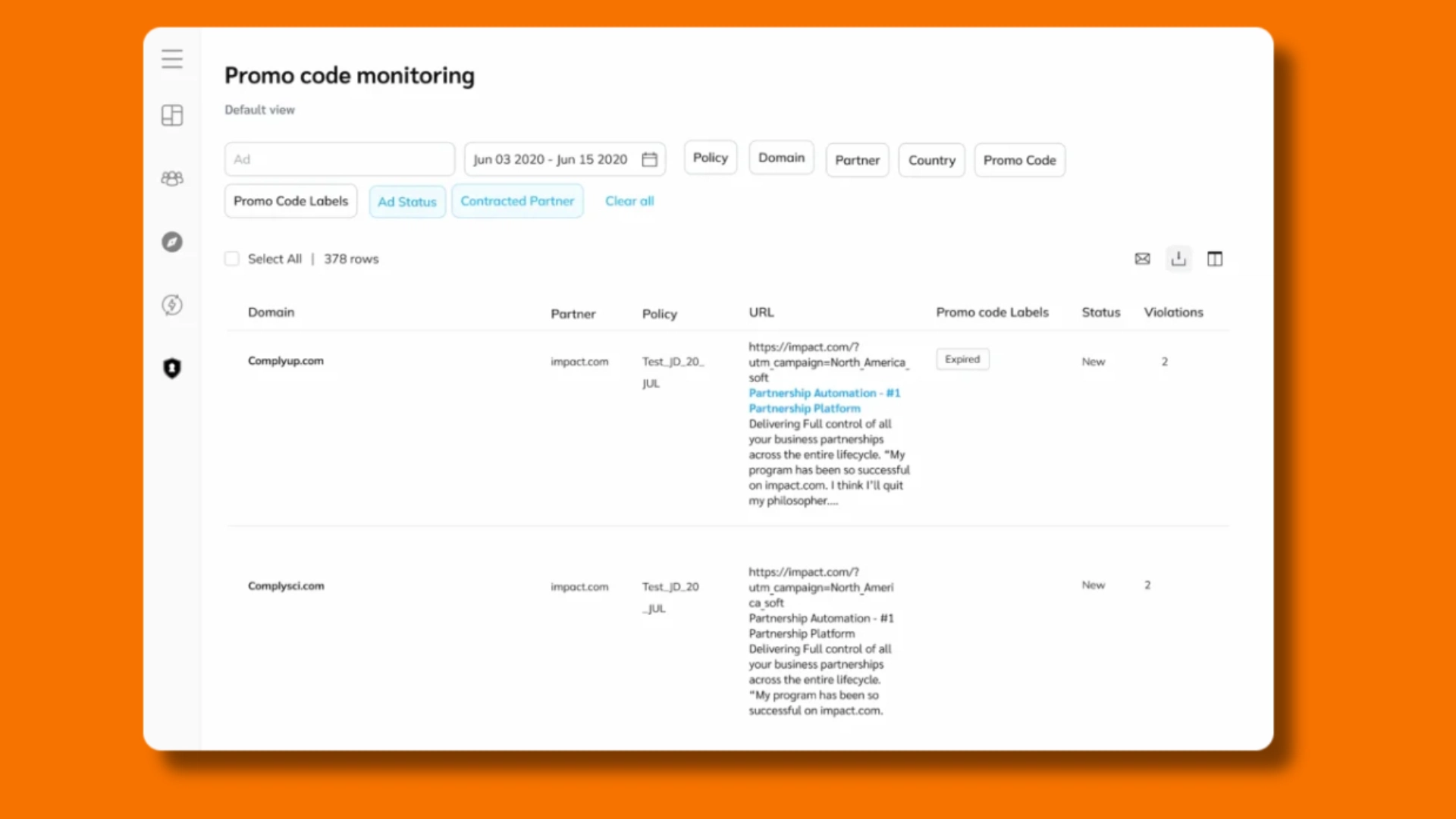
Promo Code Monitoring: Instantly track codes across regions to manage the risk of partners using unauthorized or expired offers, and easily take corrective action.
Embedding automation at the compliance layer is key to building reliability into partnership management. This step ensures you maintain your brand standards and enhances workflow efficiency as your program scales, ultimately keeping all stakeholders and creators aligned.
The quality assurance toolkit: Software for campaign accuracy
Technology defines how effectively quality assurance scales beyond manual review. The right tools strengthen accuracy, prevent fraud, and maintain compliance across your entire program while improving functionality and user experience. The wrong ones? They waste budget without measurable results.
Match tools to maturity
Before choosing quality control tools, assess your program’s maturity and resources. Not every team requires enterprise-grade automation immediately.
To find the right toolkit, start with a self-assessment:
- Maturity check: Are you managing a few high-value partners (Foundational) or hundreds/thousands (Advanced)? Your expected growth rate is key.
- Budget check: Do you require an SMB budget with cost-effective starting points, or can you justify enterprise software?
- Resource check: Does your team need ready-made solutions, or do you have dedicated analysts who can build custom dashboards?
Your answers guide your investment approach:
| Approach | Ideal for | Tradeoff |
| Do-it-yourself (DIY) | Foundational programs / SMBs with limited budgets. | Low-cost but resource-heavy; breaks down as volume grows. |
| Platform solutions | Evolving / Advanced programs managing large volumes. | Higher upfront cost, but automates detection and repays investment through efficiency and protection. |
The best strategy is to scale intentionally, layering automation only as your network and complexity grow, ensuring solutions maintain quality while respecting creator deadlines.
Essential software features for a quality assurance program
If you choose a platform solution, your Quality Assurance (QA) toolkit must support the entire partnership lifecycle, from vetting to compliance. The best platforms bundle key features that automate control and ensure accuracy.
Partner discovery and seamless onboarding
Top platforms automate partner discovery and standardize onboarding. Look for:
- Advanced discovery: Tools with robust filters and AI recommendations that search internal marketplaces and external search engines.
- Detailed profiles: Necessary information for informed vetting and collaboration decisions.
- Recruitment tools: Features like personalized bulk outreach and automated email workflows.

Each partner in the impact.com Marketplace has a detailed profile.
Accurate, reliable, and private tracking
Accuracy is core to performance. Demand technology that provides the most reliable tracking, ensuring you are not disrupted by evolving privacy standards:
- Best-in-class tracking: Solutions using robust APIs or a modern, ITP-compliant universal tag, more reliable than traditional pixel tracking.
- Cross-device identity: Uses an identity graph to link devices belonging to the same user, providing vital context for the path to purchase.
- Privacy assurance: Built around consumer privacy (GDPR/CCPA-compliant) with secure encryption like HMAC-SHA256 for Personally Identifiable Information (PII).

Future-proof your program with impact.com’s modern approach to tracking.
Continuous fraud and compliance control
Automation is essential for scale. Look for tools that proactively monitor quality:
- Advanced fraud detection: Protects spend from invalid, non-human events by monitoring clicks and conversions for suspicious activity.
- Violation monitoring: Automated checks for specific threats, such as managing risk around unauthorized promo codes or monitoring paid search to protect your trademarks.

Tools like Web Monitoring provide the visibility to track your promotions and the power to eliminate risks.
These advanced capabilities should be your benchmark when evaluating any quality assurance platform.
What are the best software tools for improving marketing quality assurance and campaign accuracy?
Selecting the right software depends on the size and maturity of your program. These four software categories represent distinct operational disciplines—tracking, fraud prevention, data integrity, and compliance—and should be evaluated based on the specific QA layer that needs to be fortified.

| Software tool | Description | Pro | Con |
| Partner/Affiliate Management Platform (e.g., impact.com) | Provides foundational attribution, real-time analytics, and operational partner management. | Essential for scalability and dynamic incentive management; offers robust, all-in-one control. | Can be expensive for smaller businesses and may have a steep learning curve. |
| Dedicated Anti-Fraud/IVT Software (e.g., Lunio) | Proactively detects and blocks fraudulent activity, bots, and click farms. | Maximizes ROI by ensuring spend reaches real customers, providing enhanced and faster detection. | High cost; often a low-transparency “black-box” solution requiring constant maintenance. |
| Data Integration and Governance (e.g., Adverity) | Cleans and harmonizes data from multiple ad platforms and sources for accuracy. | Enables a holistic 360-degree view, eliminating manual data transfers, and is essential for complex attribution. | Complex enterprise solutions that require a dedicated data analyst; high cost. |
| Compliance and Brand Monitoring (e.g., PerformLine) | Scans partner content to ensure adherence to brand guidelines and legal terms. | Mitigates legal risk and fines, simplifies audits, and provides real-time alerts for violations. | High upfront costs, require ongoing maintenance, and yield false positives are common. |
Evaluate each option based on your budget and which QA discipline needs the most immediate focus.
PUMA’s quality transformation: From manual chaos to automated precision
The challenge: PUMA’s affiliate program relied on spreadsheets and email chains, with 80 percent revenue dependency on a single partner and limited fraud visibility—especially problematic for cash-on-delivery (COD) fraud in Southeast Asia.
The solution: Implemented impact.com’s partnership management platform to centralize operations, deployed automated fraud protection (session cookies, click-through limits, Paid Search Monitoring), diversified their partner network, and introduced Dynamic Payouts to reward quality over volume.
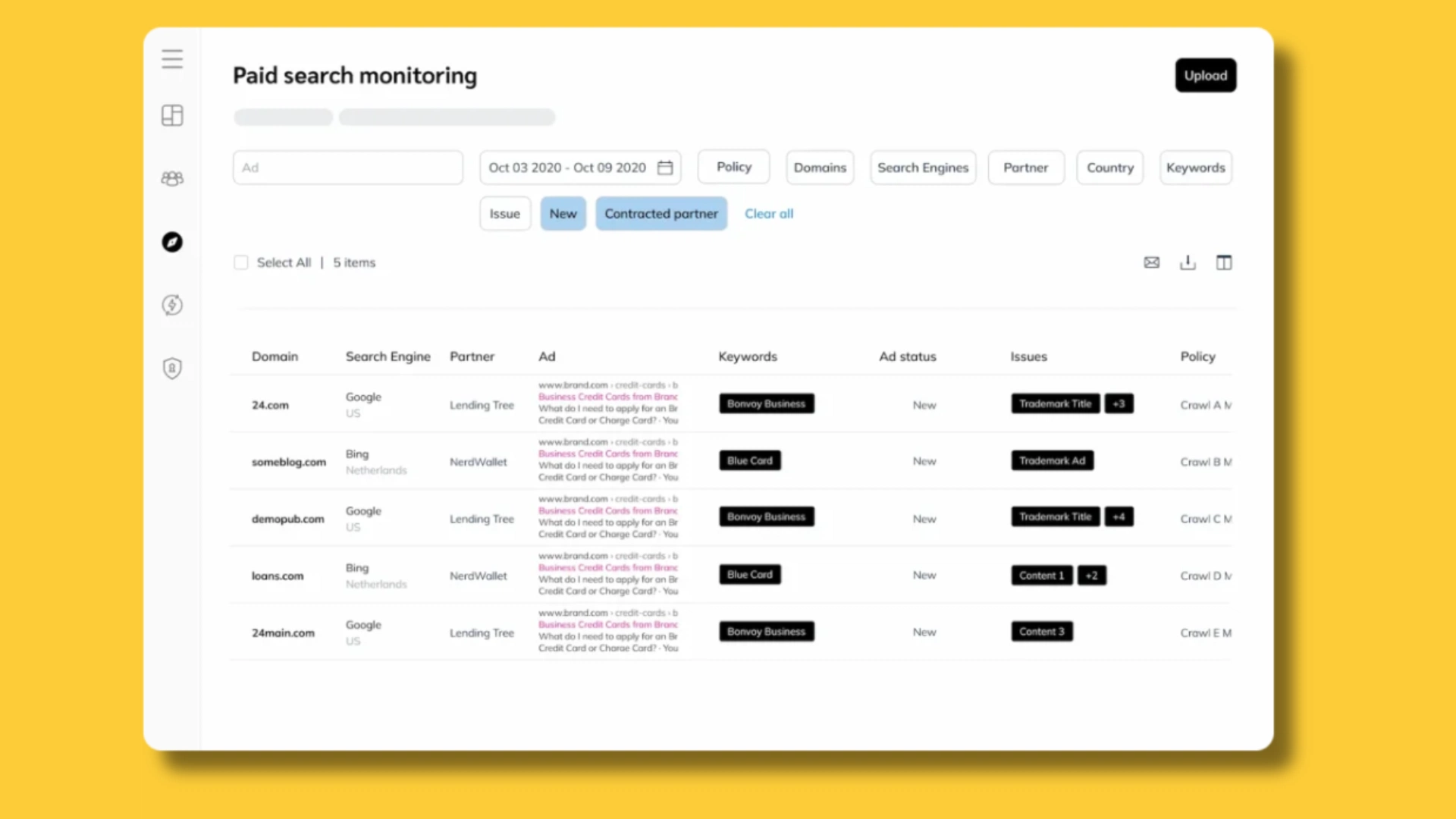
impact.com’s Paid Search Monitoring
The results:
- 90 percent reduction in COD-related fraud
- 30 percent decrease in Cost Per Acquisition (CPA)
- 2.5x increase in sales across Singapore, Malaysia, and the Philippines
- Doubled active partner base, eliminating concentration risk
These results confirm that marketing quality assurance functions as a powerful growth multiplier—protecting budgets while driving measurable performance gains.

PUMA slashes affiliate fraud by 90% (case study)
Discover how PUMA reduced fraud and doubled its partners using impact.com’s tools.
FAQs
QA in marketing refers to the processes and checks implemented to ensure campaigns, content, and partnerships align with your brand guidelines and deliver genuine value.
QA protects your budget, brand reputation, and legal standing. Without it, you risk:
- Paying for bot traffic that will never convert.
- Brand damage from inappropriate ad placements (contextual adjacency).
- Legal penalties if partners violate data privacy laws in your name.
QA is often skipped because teams face pressure to launch campaigns quickly and meet aggressive growth targets. Manual QA processes do not scale well and can be perceived as slowing down marketing velocity. Many marketers also lack the necessary technical tools or expertise for effective, large-scale QA.
A strong QA framework delivers multiple benefits:
- Higher ROI: By eliminating wasted spend on fraud and low-quality traffic.
- Stronger brand reputation: By controlling how and where your brand is promoted.
- Reduced legal risk Through effective compliance monitoring.
- Improved attribution accuracy: By filtering out illegitimate conversions.
The future outlook: the next frontier in partnership marketing
Marketing quality assurance is moving from reactive fraud detection to predictive prevention. AI and machine learning now identify risk patterns before campaigns launch, while blockchain technology promises immutable transaction records that make fraud immediately traceable.
As fraudsters adopt AI-generated content and sophisticated botnets, defenders are countering with equally advanced behavioral analytics and pattern recognition. Brands investing in these frameworks today gain a sustainable competitive advantage, while those waiting risk constant catch-up as fraud tactics evolve faster than manual processes can adapt.
- Dorian Menard, Founder and Business Manager, Search Scope
- Danilo Coviello, Founding Partner, Espresso Translations
- Miguel Angel Gongora Meza, Founder and Director, Evolution Treks
- Brad Jackson, Director of Operations, eCommerce Founder
- Syed Irfan Ajmal, Marketing Manager, Trendline SEO
- David Reynolds, Digital Marketer, SaaS Growth Specialist, WebP to PNGHero
- David Hunt, Chief Operating Officer, Versys Media
- Sid Jashnani, CEO, Rekruuto
- Dario Markovic, Forbes Council, Entrepreneur Leadership Network
Get more insights into developing your performance marketing strategies with automation and transparent partnerships.