

Fresh off a major direct-to-consumer (DTC) launch, a consumer electronics brand set an ambitious goal: drive 30% of new revenue through partnerships.
To get there, they went all in on influencer gifting. Inbound requests poured in, and creators lit up social feeds with fresh content.
But behind the scenes, the operational reality didn’t match the content output. The team was drowning in manual work, chasing down shipping addresses and managing one-off contracts. Worse, they couldn’t find the right creators. Instead of partnering with real tech enthusiasts, they worked with generic lifestyle influencers—missing their key target market.
With no tracking in place, it was impossible to prove whether any of that product investment generated a single sale.
The tactic is easy to start and hard to measure. But the brands that fail at influencer gifting aren’t executing poorly—they’re pursuing a strategy that was never right for their business in the first place.
The brands getting real results started with a clear goal that aligns with their business, then chose best-fit creators, strategic compensation models, and tracking methods that could prove ROI.
This guide walks through how to build that foundation, and how to know whether gifting is even the right fit for your brand.
Why most influencer gifting strategies underperform
When an influencer gifting program struggles, it’s easy to blame the execution. Products go out, but no one can tell if they drove a click, a visit, or a sale. What works for 10 creators becomes a logistical nightmare at 50.
However, these failures aren’t just operational problems. They’re symptoms of rolling out a gifting strategy that was never the right fit for the brand in the first place.
Product gifting isn’t the problem. The strategy and infrastructure around it (or the absence of both) is.
A few specific ways these programs tend to break down:
- Gifting to creators who aren’t a genuine brand fit, and writing off the cost when no one posts.
- Running campaigns around “awareness” without defining what success actually looks like.
- Getting buried in logistics like chasing addresses, tracking shipments, or following up manually.
- Using gifting as the only form of compensation.
- Having no way to connect gifting activity to traffic, conversions, or revenue.
Most of those problems stem from the same cause: brands treating gifting as a one-off gesture rather than a managed channel.
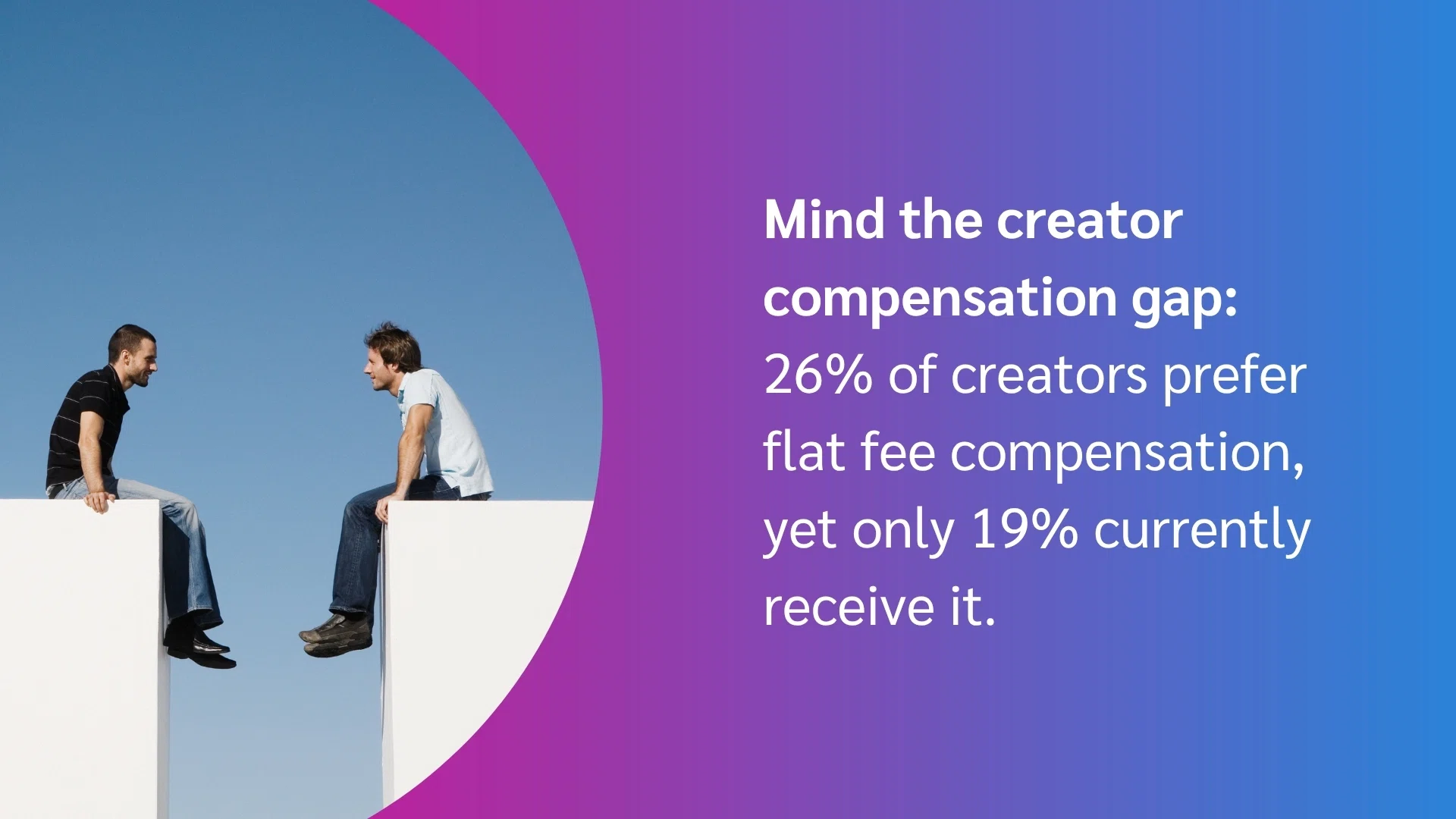
Source: impact.com’s Global State of Affiliate Marketing report
Before you build: Is product gifting the right fit for your brand’s goals?
Before you invest in a gifting program, pressure-test whether the conditions are in place for it to succeed. Some of the most common blockers aren’t always obvious, and even the best gifting strategy will fail if your foundational infrastructure isn’t ready.
“When brands assume content will come out of gifting and have no plan in place, gifting campaigns become a cost that many brands grow weary of over time,” says Jade Rice, Creator Solutions Manager at impact.com.
For example, if your brand sends hundreds of gifted products to creators but your website has a clunky checkout process, traffic will bounce before converting.
Similarly, giving away inventory without basic UTM tracking in place means you’ll have no way to measure if the campaign drove revenue.

“When brands assume content will come out of gifting and have no plan in place for follow up or a goal for a creator to strive for, gifting campaigns become a cost that many brands grow weary of over time.”
– Jade Rice, Creator Solutions Manager at impact.com
Getting clear on your readiness before you start saves both product and time. Some things matter more than others:
- Your product needs to be something a creator can experience and share
- Your website needs to convert the traffic they send
- You need at least basic tracking in place to connect gifting activity to real outcomes
Without those foundations, even a well-run gifting program will struggle to prove its value.
Framework: How to decide if product gifting is right for your brand
| Area | Ready to gift | Not ready yet |
| Product focus | You identified a specific “hero” product, new launch, or curated bundle you want to drive attention to | You have a large product catalog but no clear alignment on which items you want creators to highlight |
| Product fit | Your product is easy to experience, photograph, or demo | Your product requires significant context or education to appreciate |
| Audience clarity | You clearly defined a target audience and know exactly who your ideal buyer is | Your customer profile is vague, risking gifting to creators with mismatched audiences |
| Inventory readiness | You have sufficient stock of your focus products to gift and sell | You frequently face stockouts or supply chain delays that would limit your gifting ability and frustrate buyers |
| Customer journey | Your website converts well and offers a smooth path to purchase | High drop-off rates or a poor site experience will undercut creator-driven traffic |
| Monetization readiness | You have affiliate links, promo codes, or UTM tracking set up | You have no way to attribute sales or traffic |
| Profit margins | Your margins can absorb gifted product cost without eroding profitability | Gifting would eat into margins to a degree that’s hard to justify |
| Operational capacity | You have bandwidth to manage outreach, fulfillment, and follow-up | Your team is already stretched, and gifting would add unsustainable overhead |
| Tracking infrastructure | You can connect gifting activity to measurable outcomes | You’re relying on intuition to evaluate whether gifting is working |
Scoring considerations:
- If most of your answers land in the left column, you’re in a good position to build.
- If several land on the right, it’s best to address those gaps before you gift products.
Crafting a smart influencer gifting strategy: The 3 decisions you must make
Once you’ve confirmed that product gifting is a good fit for your brand, the next step is to build the program.
This is where strategy meets execution. Get these right, and the rest of the program has a foundation to build on. Skip them, and you’re back to the ad-hoc approach that makes gifting so hard to scale and measure.
By defining your goal, creator-vetting process, and compensation model upfront, you create the foundation for a measurable channel.
Decision 1: What’s the goal of your gifting program?
Brands that pass the qualification check still fail when they skip the goal-setting step. Without a defined objective, even a well-targeted creator list can’t tell you whether the program worked.
Knowing the goal of your gifting program will influence:
- The creators you target
- The products you send
- The metrics you track
- Your compensation structure
There are three goals most brands build their gifting programs around:
Goal 1. Content generation
You need high-quality, authentic product content for your own channels, ads, or website. Gifting is a cost-effective way to build that library without a production budget. This works especially well for brands with strong visual products and an immediate need for user generated content (UGC).
If your brand doesn’t have a single hero product, content generation gifting can reveal which items resonate best before you concentrate spend.
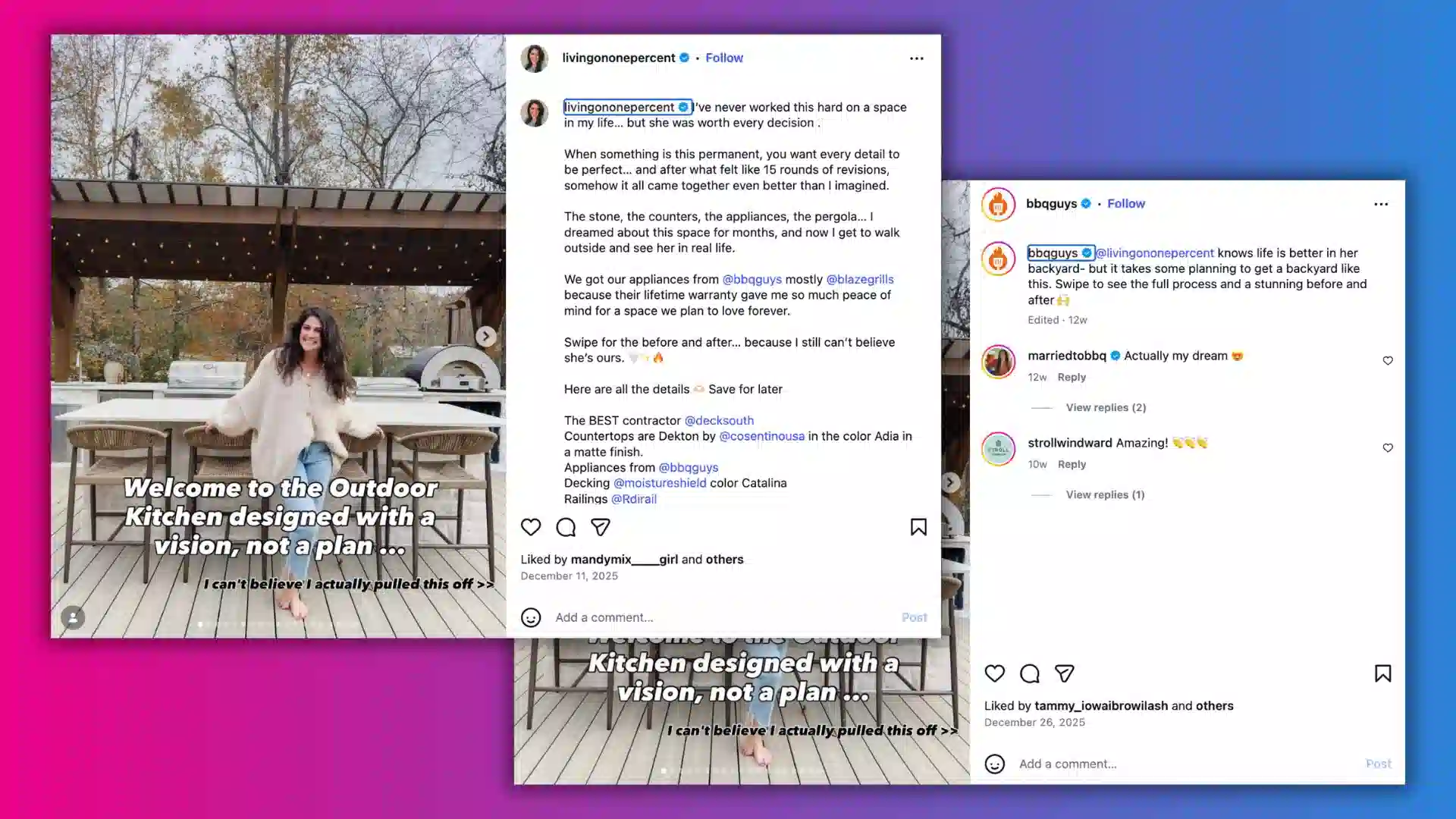
BBQGuys stretched the value of its partnership with Nicole Hamil by turning content from her gifted products into UGC.
Goal 2. Audience building and awareness
You’re entering a new market, launching a new product, or trying to reach a customer segment you don’t yet have access to. Gifting gets your product in front of relevant audiences through creators they already trust.
If you’re pre-DTC launch, this is often the right starting point. You can build awareness and creator relationships before tying your program directly to sales.
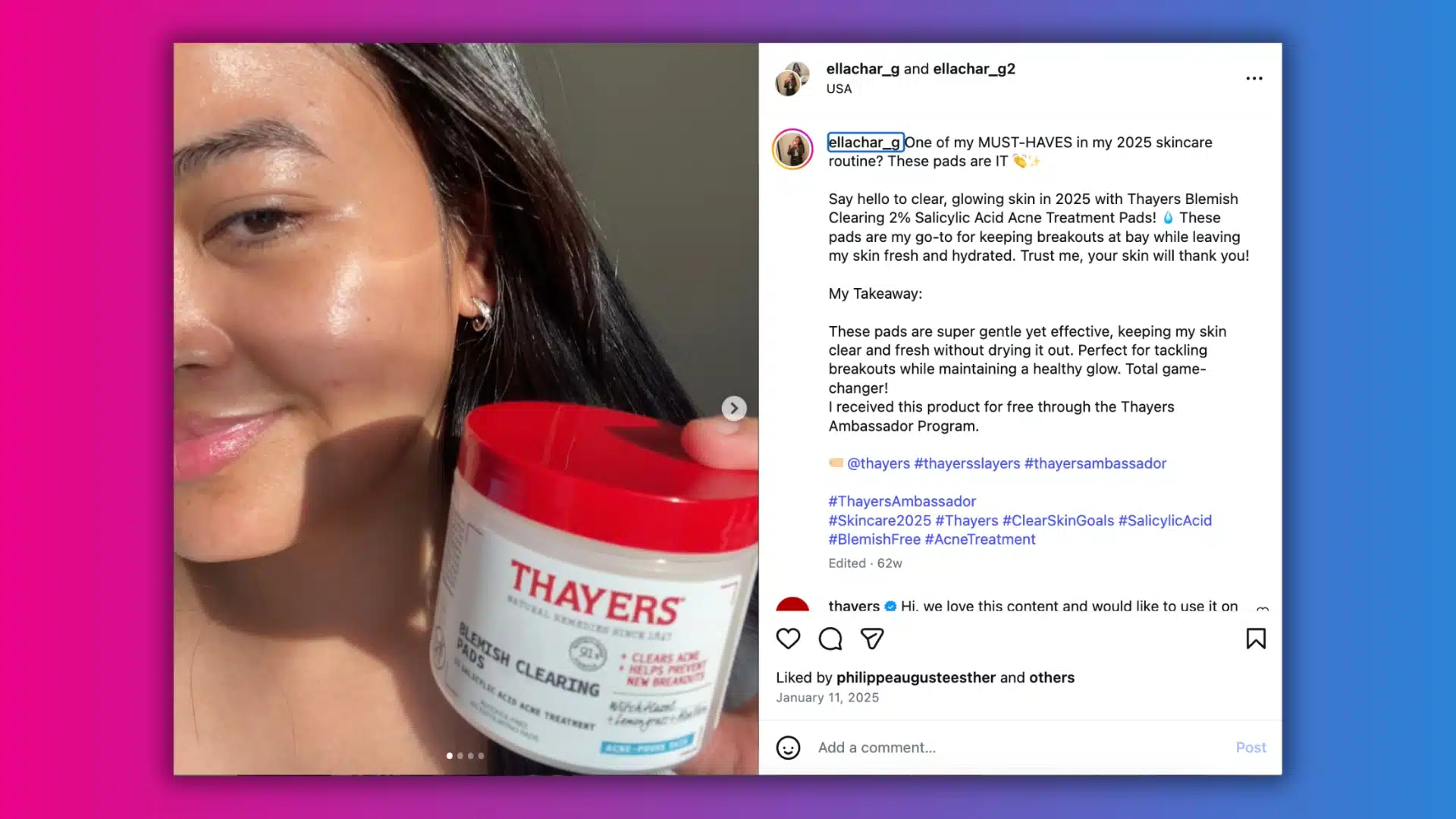
To raise pre-launch awareness, Thayers gifted their reformulated Blemish Clearing Pads to Rache.
Goal 3. Driving revenue
You want gifting to directly contribute to sales. This requires pairing gifted products with affiliate links or promo codes so you can track what converts. The goal here isn’t just one-off posts—it’s building an always-on creator channel where gifting feeds directly into affiliate revenue over time.
For higher-priced or luxury products, longer attribution windows may be necessary to measure the full return.
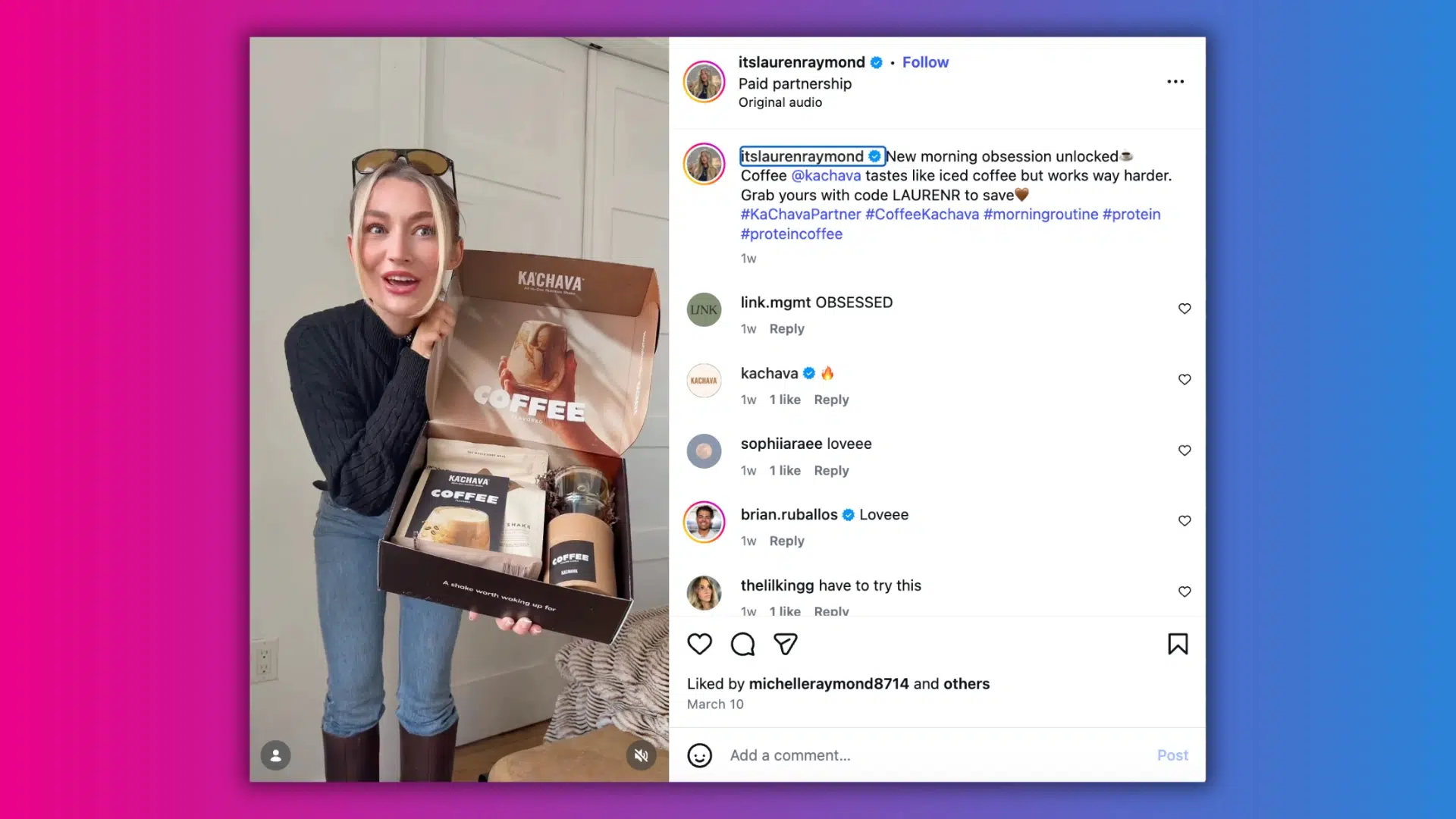
Ka’Chava drove sales by giving Lauren Raymond free product, a discount code, and an affiliate link for her bio.
At a glance: Choosing your primary product gifting goal
| Goal | Best for | What to measure |
| Content generation | Brands with strong visual products or limited content budgets | Volume and quality of UGC produced |
| Audience building | New product launches, new market entry | Reach, engagement, new followers |
| Driving revenue | Brands with tracked affiliate or promo infrastructure | Clicks, conversions, revenue attributed |
Decision 2: Which influencers should I send the product to?
Creator selection is where the strategy-vs.-execution problem resurfaces. A brand with the right product and the right infrastructure will still waste inventory on creators whose audiences were never going to buy.
But choosing the right partners is harder than it seems. Follower count doesn’t tell the whole story. You need a system to evaluate fit.
Without a structured vetting process, it’s easy to default to whoever raises their hand first or waste hours scrolling social media for the perfect partner.
That assessment gets even harder at scale. As your program grows, so does inbound interest from creators. In conversations with brands navigating this challenge, we found that even with access to a large talent pool, they often only shortlisted 10 to 20 creators who matched their needs.
The first step is establishing a scalable process for inbound and outbound influencer pipelines:
- For inbound requests: Instead of fielding pitches through DMs or your inbox, route all interest to a standardized application form or dedicated landing page.
- For proactive outreach: Use creator discovery and social listening tools to build targeted lists based on specific data points like audience demographics, engagement rates, and niche topics.
Before you send a single product, build a short vetting checklist and apply it consistently.
Decision 3: Should you only offer gifts as compensation?
Sending a free product doesn’t guarantee a post without a contract in place.
Your compensation strategy needs to match your goals and the caliber of the creator you’re working with:
- For nano and micro-influencers who are still building their audience and excited to try new brands, a well-chosen gift can be enough motivation to create.
- More established creators are running a business that needs predictable income, making product-only compensation a harder ask.
“When scaling a creator community, programs that invest in their creators are often more successful in the long term because they go the extra step to create a program that creators are excited to join.”
– Jade Rice, Creator Solutions Manager at impact.com
The impact.com report found that only 6% of influencers with 3-5 years of experience prefer product gifts as a compensation method. No matter what their experience level, 26% prefer flat-fee compensation and only 19% currently receive it.
That gap matters when you’re trying to build lasting creator relationships.
“Highly productive creators have become so educated in understanding the value they provide for brands. The most effective creators will always select brand partnerships that align with their personal brand and offer them a flat fee because of the guarantee of payment,” says Rice.
A successful strategy requires aligning your compensation model directly with:
- The behaviors you want to incentivize
- The tier of influencers you want to land
The most effective gifting programs treat compensation as something that evolves. A creator might start as a gift recipient, move to a hybrid model once they’ve posted consistently, and eventually become a long-term partner.
For example, impact.com’s case study with OLIPOP highlighted the brand’s hybrid model—gifted product plus a 10% commission—that drove 12% of total sales at 982% ROI.
That’s how gifting turns into a channel with compounding returns.
Quick reference: When to use gift-only vs. hybrid compensation
| Gift-only | Hybrid (gift + commission or fee) | |
| Best for | Nano and micro-creators, UGC collection, organic discovery | Mid-tier and macro-creators, guaranteed content, long-term partnerships |
| Content guarantee | No | Yes, when tied to deliverables |
| Product value (AOV) | High-value products serve as a strong standalone incentive | Lower-value items may need added financial incentives, but flexible enough to work for all AOV levels |
| Cost | Product cost only | Product cost plus commission or fee |

Rethinking how to use influencer gifting?
See how OLIPOP’s hybrid gifting compensation model drove 12% of sales with 982% ROI.
Scaling your product gifting workflow with automation
A well-designed gifting strategy is useless if the logistics don’t scale. Most brands discover this the hard way—the operational overhead of manual gifting is what forces programs back into ad-hoc territory.
According to Rice, “the biggest operational bottleneck is collecting all the names, addresses, and tracking information—trying to keep track of who has what, who has posted, and what’s been posted manually is a time-consuming process.” At 50 creators, that overhead becomes a full-time job.
This is a common frustration brands run into, and many teams cite it as the main reason they can’t scale gifting without adding headcount.
“The biggest operational bottleneck is collecting all the names, addresses, and tracking information—trying to keep track of who has what, who has posted, and what’s been posted manually is a time-consuming process.”
– Jade Rice, Creator Solutions Manager at impact.com
Automation changes that equation. What comes off your plate:
- Product selection and address collection are handled by the creator
- Orders fulfilled automatically through Shopify, with inventory updated in real time
- Data is secured, replacing risky spreadsheets full of personal creator addresses
- Optional approval steps so your team controls what gets sent
Platforms like impact.com provide the infrastructure to handle these workflows, allowing small teams to run programs that would otherwise need a dedicated coordinator and larger brands to scale without losing consistency.
Most importantly, automating these logistics frees you up to focus on the strategic decisions that actually make the program successful.
Proving the ROI of influencer gifting
The final version of the strategy-misfit problem is a measurement problem: brands that skip attribution setup from the start can’t prove their program is working, even when it is.
With the right infrastructure, gifting is as measurable as any other marketing tactic. The starting point is choosing the right attribution model and means of tracking. Unique promo codes, affiliate links, and UTM parameters connect creator activity to real outcomes.
They’re not perfect. You’ll need to establish a “good enough” attribution framework to start—such as using exclusive promo codes to clarify “muddied” channel data, or extending attribution windows for high-ticket items. But they give you enough signal to evaluate what’s working and compare gifting efficiency against paid media.
That comparison matters. A creator-driven sale that costs a fraction of a paid ad tells a very different story than one that doesn’t show up in your data at all.
What you track should also reflect where your business actually is. The brands that prove gifting ROI aren’t doing anything complicated. They define what success looks like for their current stage, set up tracking before the first product ships, and review performance consistently.
| Business stage | Focus metrics | Why they matter |
| Pre-launch or pre-DTC | Content output rate, content quality, engagement rate | You can’t track sales yet, so measure the asset value gifting creates |
| Early post-launch | Referral traffic, promo code usage, and affiliate link clicks | Establish the connection between creator activity and site behavior |
| Established program | Conversions, affiliate-driven revenue, CAC by creator | Evaluate gifting as a performance channel against other marketing spend |
Make influencer gifting work for your brand with a well-crafted strategy
Most gifting programs don’t fail because the strategy is wrong. They fail because there wasn’t a solid strategy in place.
What that looks like in practice will vary by brand. For some, gifting is a content engine. For others, it’s the entry point to a full creator affiliate program. The goal, the creators, the compensation model, and the tracking all look different depending on where you are.
Brands that treat gifting as a gesture will achieve inconsistent results. The ones treating it as a managed channel are the ones building creator relationships that compound and drive revenue they can actually defend.
The cost of skipping the qualification step goes beyond wasting product. You also waste months a program spends burning through inventory before arriving at the strategy it should have started with.
Find out more about building a profitable influencer marketing program:
- Creator marketing attribution models: The modern marketer’s guide (blog)
- The influencer portfolio approach: When to deploy micro-influencers vs macro-influencers vs celebrity partnerships (blog)
- The ROI of long-term creator partnerships vs one-off campaigns (blog)
FAQs
Influencer product seeding, also called product gifting, means sending free products to creators. Traditionally, this is done in hopes they’ll share them with their audience without a guaranteed deliverable. However, the product can also serve as a formal form of compensation in exchange for contracted content.
In “no strings attached” campaigns, the creator receives the product and decides whether to post. When it works, it generates authentic content and word-of-mouth exposure. When it doesn’t, the product cost is absorbed with nothing to show for it.
You can use influencer gifting to launch a new product and generate conversions by pairing gifted products with trackable tools like affiliate links, promo codes, or UTM parameters. That’s what connects creator activity to actual conversions rather than just impressions.
Creator fit matters too. Gifting to creators whose audiences match your target customer gives you a much better chance of driving purchase intent, not just reach.
For a new product launch, consider a hybrid model: gift the product to generate authentic content, and add a commission structure to incentivize creators to keep posting after the initial send.
To measure the ROI of influencer gifting versus paid influencer collaborations, start with the same metrics you’d use for any performance channel:
- Conversions
- Referral traffic
- Revenue attributed
- Customer acquisition cost (CAC)
To collect the data to compare gifting against paid collaborations on a like-for-like basis, you need:
- Unique promo codes
- Affiliate links
- UTM parameters
The key difference is cost structure. Gifting programs carry product and fulfillment costs. Paid collaborations carry fees and sometimes commission on top. When you can attribute revenue to both, you can evaluate which drives a lower CAC and higher return for your specific brand and creator mix.
The brands that benefit the most from influencer gifting campaigns typically sell visually compelling, easy-to-experience products. For example, categories where a creator can genuinely show the product in action include:
- Beauty
- Food and beverage
- Fashion
- Fitness
- Home goods
Beyond product type, a few conditions matter more than anything else: healthy margins that can absorb gifting costs, a website that converts the traffic creators send, and basic tracking infrastructure to connect gifting activity to real outcomes.
To set your program up for maximum ROI, define a clear goal before you send anything, vet creators for genuine brand fit rather than follower count, and have affiliate links or promo codes ready before the first product ships.
When using influencer gifting, the primary legal and disclosure rule in most markets, creators are required to disclose when they’ve received free products—even if no payment was made.
In the US, the FTC requires clear disclosure—something like #gifted or #ad placed where viewers can actually see it, not buried in a string of hashtags.
Requirements vary by country, so if you’re running gifting campaigns across multiple markets, it’s worth reviewing the rules for each region. The UK, Australia, and the EU all have their own guidelines.
As a brand, you’re not just responsible for your own compliance. Build disclosure requirements into your creator agreements and make expectations clear upfront.
Note: this isn’t legal advice. For guidance specific to your business, consult a legal professional familiar with advertising and influencer marketing regulations in your market.
To set a realistic budget for a revenue-driving influencer gifting program, start with your unit economics. What’s the cost of goods for the product you’re gifting? What are your margins? And what’s your current CAC from other channels? Those three numbers give you a baseline for what gifting needs to deliver to be worth it.
From there, factor in the full cost of running the program: product, shipping, fulfillment, and any platform or tool costs. If you’re running a hybrid model, add commission or flat fee costs on top.
A useful starting point is to treat gifting like any other acquisition channel. Set a target CAC, track performance against it, and adjust your creator mix and compensation model based on what the data tells you. The brands that scale gifting successfully don’t set a budget and hope for the best. They start small, measure rigorously, and grow spend as the returns justify it.
The most common mistake brands make with influencer gifting is going in without a strategy. Products go out to a broad pool of creators with no clear goal, no vetting process, and no tracking in place. When nothing posts or converts, there’s no data to explain why.
A few other mistakes that compound the problem:
- Prioritizing follower count over fit. A large audience that doesn’t match your customer won’t drive conversions regardless of how much content gets created.
- Relying on product-only compensation. For established creators, a free product isn’t enough motivation to post consistently. Without a commission or fee structure, content output drops.
- Skipping attribution setup. No affiliate links, promo codes, or UTM parameters means no way to connect gifting activity to revenue, making it impossible to optimize or justify the spend.
- Treating gifting as a one-off campaign. The brands that see compounding returns run gifting as an always-on program, not a seasonal burst.
Most of these mistakes share the same root cause: starting with execution before the strategy is in place.