
In 2024, OLIPOP had a problem most brands would envy. Hundreds of creators were applying to their program every week. The interest was there. The infrastructure to turn that interest into revenue wasn’t.
Once OLIPOP moved off manual workflows and onto a structured planning framework, the results were hard to argue with: a 982 percent average ROAS and creators driving 12 percent of total company sales.
That’s the pattern behind most high-performing influencer programs right now. The brands winning aren’t necessarily finding better creators than everyone else. They’ve built systems that make the right creator relationships scalable, trackable, and repeatable. According to impact.com’s Global State of Affiliate Marketing in 2025 report, social media influencers are growing faster in brand collaborations than any other partner type (which means the brands without that infrastructure are about to feel the gap).
This guide covers how to build an influencer marketing strategy across six phases, from setting objectives and attribution to discovery, campaign execution, and operational scaling.
The 6-phase influencer marketing strategy framework:
- Phase 1: Set the strategic blueprint (objectives, budget, attribution)
- Phase 2: Design your program architecture and Ideal Influencer Profile
- Phase 3: Build a repeatable discovery and vetting engine
- Phase 4: Run campaigns with a structure that supports creativity
- Phase 5: Measure what matters and optimize continuously
- Phase 6: Scale operations with the right team and technology
Each phase builds on the last. Together, they form a planning framework you can use to design, launch, and grow a measurable and repeatable influencer program.
Phase 1: Set the strategic blueprint (objectives, budget, attribution)
The biggest reason influencer programs stall isn’t a creator problem. It’s that the program was built backwards. Brands recruited creators first, then tried to figure out what success looked like, how to measure it, and whether the budget made sense. By that point, the infrastructure that would have made those answers easy to find simply doesn’t exist.
Phase 1 is where that infrastructure begins. Before you recruit a single creator, you need three things locked in: clear objectives tied to business outcomes, a budget structure that accounts for more than just creator fees, and an attribution model that’s live before anyone publishes. Get these right and everything that follows (vetting, compensation, measurement, scaling) operates with a level of clarity that’s impossible to retrofit later.
Strategic objectives: Decide what success actually means
Influencer marketing can support different goals at different stages of growth. What matters is being clear about what you’re trying to achieve now—and not trying to optimize for everything at once.
Most programs ladder up to one (or two) primary objectives:
- Brand awareness: Expand reach with new, relevant audiences through creator-led distribution.
- Consideration: Drive qualified traffic to product pages, collections, or educational content.
- Conversion: Generate trackable revenue directly from creator partnerships.
- Retention and loyalty: Use creators to reinforce brand affinity and repeat purchase behavior over time.
Your business stage dictates your influencer strategy focus:
- New markets prioritize reach and learning
- Established teams prioritize revenue efficiency and incremental sales
This focus also shapes creator evaluation. Judging discovery-driving partners solely on last-click revenue will undervalue their role earlier in the customer journey. Clear, upfront goal alignment ensures performance is assessed in context.
The budget allocation framework: Set guardrails early
A solid budget structure helps your influencer marketing program remain manageable as it scales.
A simple framework many teams use is to split budget across three areas.
| Creator budget allocation framework | |||
|---|---|---|---|
| Budget category | Allocation | What’s included | Strategic role |
| Creator compensation | 60–70% | Fees, commissions, performance bonuses, and usage rights. | The “engine” of the program; drives the core content and reach. |
| Tools and infrastructure | 10–15% | Platforms for management, tracking, payouts, and reporting. | Enables the program to scale beyond manual, time-intensive workflows. |
| Optimization and testing | 10–15% | Experimentation, creative testing, and performance-based incentives. | The “efficiency layer” where ROI improves through structured learning. |
Following this structure will help you avoid a common trap: building a creator roster without the measurement and optimization layer needed to prove return on investment (ROI).
Cecilia Hoff, Creator Consulting Manager at impact.com, notes that while this is the gold standard for creator-affiliate efforts, your business stage and funnel focus may require initial adjustments.
“Newer programs often invest more in testing initially to prove concepts like performance incentives,” says Hoff. A clear understanding of the performance funnel, or what Hoff calls “gathering proof points”, is key to supporting growth. This full picture allows leadership to justify and increase creator budgets.
Hoff also points out that teams with an upper-funnel purview—prioritizing brand awareness over direct conversion—may initially allocate less to testing since ROI is harder to prove in the early stages.

Attribution models: Choose how creators get credit
Attribution is one of the most important strategic decisions you’ll make. It defines:
- How to reward creators
- How to evaluate performance
- How stakeholders perceive your program
Common models include:
- Last-click attribution: Simple to implement, but often undervalues creators who influence discovery earlier in the journey.
- Multi-touch attribution: Distributes credit across multiple touchpoints, offering a more realistic view of how influencer content supports conversion.
- Hybrid approaches: Combine last-click revenue tracking with assist metrics, engagement data, and content-level performance signals.
The best attribution model depends on your goals. Last-click may suffice for direct sales, but multi-touch is crucial for programs supporting discovery and consideration. Establish your model upfront to align expectations before creators publish.

The modern customer journey: Understanding multi-touch discovery, research and purchase patterns
Learn how to capture the full value of creator-led discovery across fragmented touchpoints in this research report.
Set up tracking before you launch
Attribution only works if tracking is in place from day one.
To set up tracking, follow these steps:
- Assign unique links or promo codes to creators
- Define how you’ll attribute conversions across devices
- Establish baseline performance benchmarks
- Align internal reporting on what success looks like
Plan for multi-objective measurement and cross-device journeys
Influencer marketing rarely fits neatly into a single key performance indicator (KPI). A creator might drive high-quality discovery on social, while conversions happen later through email, paid retargeting, or desktop sessions.
Your measurement approach should reflect that reality:
- Track multiple outcomes: Reach, engagement rate, assisted conversions, and direct revenue all contribute to program value.
- Account for cross-device behavior: Discovery often occurs on mobile devices. Conversion often happens elsewhere. Without cross-device visibility, influencer impact is easy to underestimate.
Phase 2: Design your program architecture and ideal influencer profile
There’s a version of this phase that most brands skip entirely. They identify a few creators they like, agree on rough deliverables, and start posting. It works until they try to add a tenth creator, or a twentieth, and realize there’s no repeatable system for deciding who fits, how they get paid, or what good performance actually looks like.
Program architecture is the infrastructure that prevents that collapse. The decisions you make here—how your team manages partnerships, what your ideal creator profile actually requires, how content gets approved and repurposed—shouldn’t be narrowed to your first campaign. They should determine whether your program can scale to 50 creators with the same quality and consistency it had at five.
Program structure: How your team runs creator partnerships
Start by deciding where influencer partnerships will live inside your organization.
Use the following table to assess the right option for your brand based on your goals.
| In-house vs agency-led vs hybrid: Program structure comparison | |||||
|---|---|---|---|---|---|
| Model | Ownership and control | Speed to launch | Scalability | Cost structure | Internal workload |
| In-house | High control over strategy and creator relationships | Slower to ramp initially | Scales well with the right systems | Lower long-term costs, higher upfront investment | Higher. Requires internal resources |
| Agency-led | Lower direct control; agency owns execution | Fast to launch | Scales quickly, but harder to internalize learnings | Higher ongoing fees | Lower. Less internal lift |
| Hybrid | Shared ownership between brand and agency | Moderate | Flexible and scalable as programs mature | Balanced. Mix of internal cost + external support | Moderate. Shared responsibility |
Key takeaway: There’s no single right model. The best structure is the one your team can support today—and evolve as influencer marketing becomes a more central growth channel.
The ideal influencer profile (IIP): Define who you want to work with
Defining clear creator criteria simplifies scaling. Intentional partner sourcing is easier and repeatable when you know what to look for.
Instead of ad hoc sourcing, define your brand’s ideal. Create an Ideal Influencer Profile (IIP) and use the scoresheet below to assess creator fit beyond just follower count.
| Ideal Influencer Profile scoresheet | |||
|---|---|---|---|
| Evaluation pillar | Specific criteria (The evidence) | Scoring (1-5) | Weight |
| Storytelling | Does the creator use a narrative arc (hook, conflict, resolution) to educate? Content must feel organic and authentic rather than advert-like or overly promotional. | 35% | |
| Content quality | Does the creator make videos (like how-tos or unboxings) that people watch all the way through? Are the video/audio quality good enough to clearly show how the product works? | 25% | |
| Audience relevance | Does the creator’s audience demographic overlap by >50% with your target customer persona? | 20% | |
| Brand alignment | Do the creator’s past 10 posts maintain a tone consistent with your brand values? | 20% | |
To ensure this framework produces content that performs, we’ve integrated the vetting philosophy used by the team at impact.com. Arthur Sibanda, Creator Campaign Associate at impact.com, emphasizes that the “infrastructure” of a successful partnership starts with the creator’s ability to act as an educator.
“When reviewing creators, we focus heavily on the quality of the content and, most importantly, the storytelling,” says Sibanda. “Strong storytelling is essential, as it allows the creator to educate and engage their audience in a way that feels organic and authentic, rather than overly promotional or advert-like.”
The threshold of fit: Partnerships scoring below a 15.0 weighted total lack the commercial or brand alignment to scale effectively. Prioritize creators who score 17.5 or higher.
Campaign types and content strategy: Design the mix
Influencer programs work best when they combine long-term relationships with campaign-based activations.
Two core partnership types to plan for are:
- Always-on partnerships: Ongoing collaborations with a core group of creators who consistently represent your brand.
- Campaign-based partnerships: Short-term activations tied to product launches, seasonal moments, or growth initiatives.
Your influencer content strategy should also outline:
- Primary platforms: Where you’ll publish content, and where conversions typically happen
- Content formats: Short-form video, reviews, tutorials, livestreams, user generated content (UGC) style assets
- Usage rights: How you can reuse creator content across paid media, email, and onsite experiences
- Approval workflows: What needs review—and how to keep creators moving quickly
- Content repurposing: How influencer content feeds into your broader content calendar
Planning this upfront keeps your program cohesive across all social media channels and campaigns.
Compensation framework: How creators are paid
Compensation design shapes creator motivation and program scalability. The right model depends on your objectives, attribution setup, and the types of creators you want to partner with.
Use the creator compensation framework to identify the model (or models) that work best for your program.
| Creator compensation framework | ||||
|---|---|---|---|---|
| Model | Risk to brand | Scalability | Creator incentives | ROI alignment |
| Flat fee | Higher upfront risk | Harder to scale efficiently | Predictable income for creators | Lower. Not directly tied to performance |
| Performance-based | Lower upfront risk | Highly scalable as spend scales with results | Strong incentive to drive outcomes | High. Directly tied to results |
| Hybrid | Balanced risk | Scales well across growth stages | Mix of guaranteed pay + upside | High. Aligns incentives with performance |
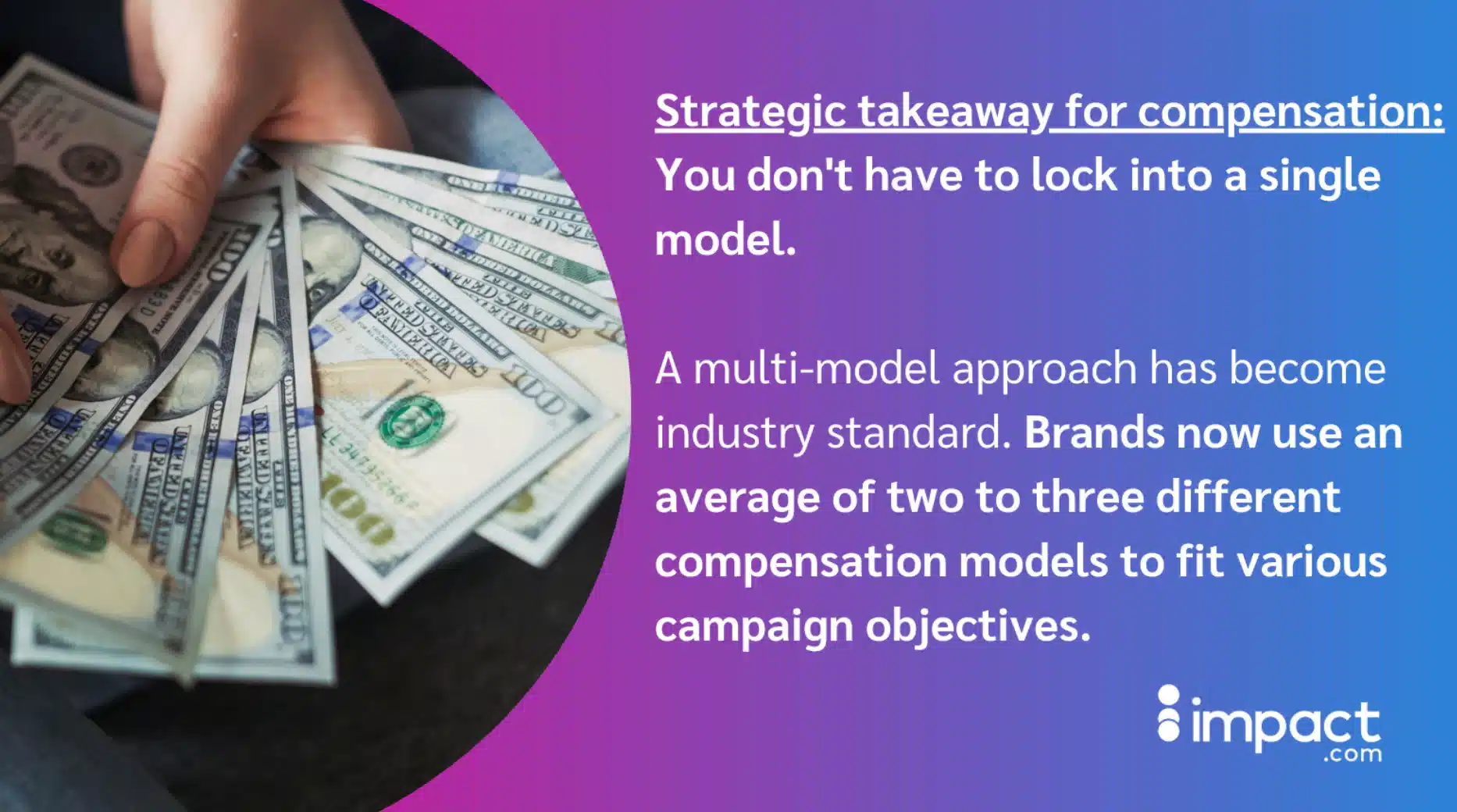
Strategic takeaway: You don’t have to lock into a single model.
This multi-model approach is becoming the industry standard. According to impact.com’s Global State of Affiliate Marketing in 2025 report, brands now use an average of two to three different compensation models to fit various campaign objectives. Hybrid models remain the gold standard for long-term partners as programs mature.
Partnership terms and workflows: Set expectations before anyone publishes
Clear terms and standardized workflows make partnerships easier to manage and are non-negotiable as your creator roster grows. By defining these elements upfront, you reduce friction for your internal team and ensure creators can stay productive as you scale.
Define these partnership terms upfront:
- Campaign length and cadence: Establish the duration and posting frequency.
- Exclusivity guidelines: Clarify if and where creators can work with competitors.
- Content ownership and usage rights: Determine how you can reuse assets across other channels.
- Performance expectations: Be transparent about what success looks like.
- Renewal and scale-up criteria: Outline what triggers a long-term partnership extension.
Put simple systems in place for execution:
- Primary points of contact: Ensure creators know exactly who to contact.
- Content approval processes: Create a structured path for reviewing drafts.
- Fast and constructive feedback cycles: Keep momentum high with clear, timely communication.
- Clear communication channels: Centralize where conversations happen to avoid lost messages.
Well-defined workflows reduce friction for your internal team and creator partners—and help partnerships stay productive as you scale.
Phase 3: Build a repeatable discovery and vetting engine
A good amount of influencer programs fail at discovery for the same reason. They treat it as a judgment call. A creator looks right, their content feels aligned, and their numbers seem clean. That intuition-based approach works fine at five partners. At fifty, it becomes the thing that quietly drains your budget.
The brands that scale past that ceiling aren’t necessarily better at spotting talent. They’ve built a vetting infrastructure that removes the guesswork, or a repeatable system that evaluates every creator against the same criteria before a single dollar moves. That’s what this phase builds.
Discovery methods: How to find potential partners
Many influencer programs use a mix of discovery channels. Each plays a different role in building a healthy creator pipeline.
Platform-based discovery
Creator marketplaces and partner platforms allow you to filter creators by audience, content style, vertical, and performance signals. This is one of the fastest ways to build a scalable discovery engine.
Manual search
Searching directly on social media platforms can surface niche creators and emerging voices that may not yet be visible in marketplaces. This approach works well for trend-driven categories and early-stage discovery, but it’s harder to scale consistently.
Inbound applications
Creators who apply to your program often bring strong brand affinity. Inbound interest is a valuable signal, but it still requires structured vetting to ensure alignment with your IIP and performance goals.
The strongest programs don’t rely on a single channel. They build a repeatable discovery pipeline that blends proactive sourcing with inbound demand.
The vetting scorecard: How to evaluate creator fit
Once creators enter your pipeline based on the IIP criteria defined in Phase 2, the vetting scorecard provides the consistent evaluation needed to turn that strategy into results.
| The creator vetting scorecard | |||
|---|---|---|---|
| Vetting dimension | Critical evaluation criteria | Target signal | Score (1-5) |
| Audience authenticity | Review follower growth patterns and audience quality. | Lack of sudden spikes or “bot-like” inflated counts. | |
| Engagement quality | Analyze comment relevance. Are they thoughtful or repetitive? | Active, sentiment-rich dialogue rather than generic emoji-only responses. | |
| Partnership track record | Identify evidence of historical collaborations that drove audience action. | Citable examples of past performance or “meaningful” content. | |
| Professional responsiveness | Evaluate reliability, communication style, and turnaround speed. | High reliability and professional behavior as the program scales. | |
Interpretive insight: A high score in “Audience authenticity” is a non-negotiable prerequisite. If a creator scores below a 4 in this category, do not proceed, regardless of their reach.
Outreach strategy: Personalize without slowing down
Strong outreach sets the tone for the entire partnership. The goal is to show creators why your brand is worth working with, without turning outreach into a manual bottleneck.
Effective outreach balances relevance with efficiency. Reference the creator’s content, audience, or recent work to show intent, while using structured templates to keep outreach scalable.
Define your value proposition
Creators want to understand what makes your program worth their time.
Be clear about:
- What you’re offering (compensation model, long-term potential, creative freedom)
- Why your brand is a good fit for their audience
- How success will be measured
Clear positioning increases response rates and attracts creators who are aligned with your goals.
Outreach best practices
A few simple principles help improve outreach performance:
- Keep messages short, clear, and respectful of creators’ time
- Lead with the value of the partnership, not just the deliverables
- Be transparent about expectations, timelines, and compensation
- Make it easy to say yes or no
Outreach channels
Different creators respond best on different channels.
Common outreach options include:
- Platform-based messaging
- Creator application forms
- Referral-based introductions
The key is to meet creators where they already manage partnerships, and to centralize communication so conversations don’t get lost as your program scales.
Timing and follow-up strategy
Response rates improve when outreach is treated as a process, not a one-off message.
- Time outreach around creators’ posting schedules and campaign cycles
- Use light follow-ups to re-engage interest without being intrusive
- Track responses so creators don’t receive conflicting messages from different team members
Simple follow-up discipline can significantly improve pipeline conversion without increasing outreach volume.
Negotiation: Set partnerships up for success
Negotiation isn’t just about rates. It’s about aligning expectations on both sides.
Key areas to clarify early:
- Compensation structure (flat, performance-based, or hybrid)
- Content scope and timelines
- Usage and repurposing rights
- Performance expectations and reporting
- Renewal and scale criteria
Clear terms create smoother partnerships and make long-term collaboration easier to scale.
Scaling discovery with technology
As programs grow, manual discovery and vetting become harder to sustain. What works for a small group of creators quickly becomes time-consuming when you’re managing dozens or hundreds of partnerships.
This is where partner platforms can support scale by helping teams:
- Expand discovery through large creator marketplaces:
Broader networks make it easier to find new partners across niches and regions, without relying solely on manual search. - Surface creators already talking about your brand or category:
Social Listening and keyword-based discovery can help teams identify creators who already have organic affinity for your product or space. - Use data signals to recommend high-fit partners:
Performance data, audience insights, and historical partnership signals can guide more consistent creator selection as programs grow. - Automate fraud detection and audience quality checks:
Built-in safeguards help teams reduce the risk of low-quality leads and inauthentic audiences at scale.
Technology doesn’t replace strategy, but it helps operationalize it. The right platform makes discovery and vetting faster, more consistent, and easier to scale across hundreds of partnerships, without losing sight of fit and performance.
Phase 4: Scale campaign execution without losing authenticity
There’s a common assumption that the way to get better influencer content is to find better influencers. Often, the problem is simpler. Creators underperform because they weren’t given clear enough direction, or got trapped in slow approval cycles, or never understood what success actually looked like for the campaign (not because they lack talent).
Campaign management is the infrastructure that removes those failure modes. A strong brief, a defined approval workflow, and a clear communication structure don’t constrain creator creativity. They protect it by eliminating the friction that forces creators to guess.
The creator brief: What to include and why it matters
A strong brief gives creators direction without scripting the content. When briefs are too vague, results are unpredictable. The difference between campaigns that perform and campaigns that don’t often comes down to six components.
| Brief component | What it covers | The failure mode it prevents |
| Campaign objectives | What the content is meant to achieve: awareness, consideration, conversion, or retention | Creators optimizing for the wrong outcome |
| Key messages & guardrails | Brand positioning, tone, mandatory claims, and explicit dos and don’ts | Off-brand content that requires costly revisions |
| Content requirements | Platform, format, cadence, and what strong performance looks like based on past data | Deliverables that miss the brief entirely |
| Timeline & deliverables | Draft deadlines, approval windows, posting dates, and reporting requirements | Campaigns that miss their launch window |
| Compensation & incentives | Payment model and what performance milestones unlock bonuses or higher rates | Creators who don’t understand what success earns them |
| FTC compliance | Required disclosure language, placement, and format | Legal exposure for both the brand and the creator |
Three tips before you send it: leave room for creative interpretation — creators know their audiences better than you do. Share mood boards and past examples alongside requirements. And centralize briefs and assets in one place so creators always know where to find the latest version.

The unignorable content checklist: 5 steps to a human-first AI Overview content strategy for affiliate reviews
Discover how to optimize your creator partnerships for AI Overviews and generative search engines to maintain visibility in 2026.
The 4-step high-velocity approval framework
Standardized workflows protect brand quality without slowing down creator momentum.
Define these four parameters to ensure repeatable execution:
- Segment reviewers: Separate creative feedback from legal or compliance checks to prevent bottlenecks.
- Cap revision cycles: Limit the allowed rounds of feedback to avoid open-ended back and forth.
- Fix turnaround deadlines: Establish strict timeframes for providing internal feedback to keep campaigns on schedule.
- Tier approval needs: Identify which content types require full review and which can move forward automatically.
Relationship management: Build partnerships, not transactions
High-performing influencer programs are built on relationships, not one-off posts. The way you communicate with creators directly impacts long-term performance.
Strong relationship management includes:
- Consistent communication. Clear points of contact and predictable check-ins build trust
- Constructive feedback. Share what’s working, not just what needs to change
- Issue resolution. Address problems quickly and respectfully to protect long-term partnerships
- Community building. Treat creators as part of your extended team—share updates, product context, and growth plans
Over time, creators who feel invested in your brand produce more authentic content—and are more likely to become long-term advocates.
Optimize for top performers
In most influencer programs, a small percentage of creators drive a disproportionate share of revenue. Identifying and investing in those top performers is one of the fastest ways to scale ROI.
Ways to double down on high-impact partners:
- Increase commission rates or introduce performance-based bonuses
- Offer early access to launches or exclusive campaigns
- Involve them in co-creation and product feedback
- Prioritize them for always-on partnerships
This approach rewards strong performance and gives creators a real reason to keep your brand top of mind.
Phase 5: Measure performance and optimize continuously
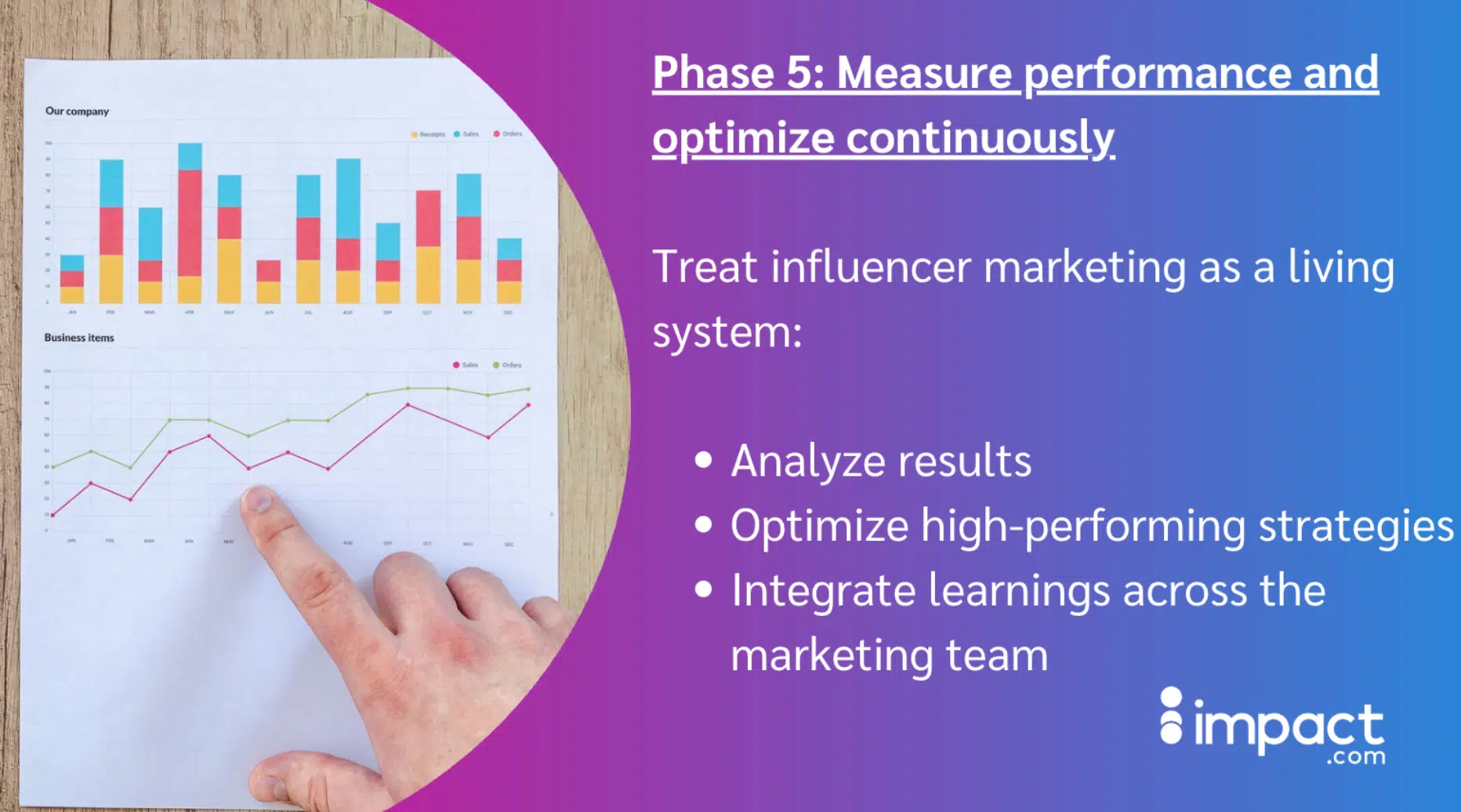
All teams should measure their influencer programs. Not enough have built the feedback infrastructure that turns measurement into compounding performance. The difference is whether your program is structurally designed to act on what the data shows.
Without that infrastructure, measurement is a reporting exercise. With it, every campaign makes the next one more efficient: better creator selection, sharper messaging, smarter budget allocation. That’s when influencer marketing stops being a content stream and becomes a performance channel.
Performance analysis: Tie creator performance to business outcomes
Start by measuring performance against the objectives you set in Phase 1.
Focus on the signals that map directly to business impact.
Common performance metrics include:
- Revenue and conversion performance: Attributed sales, conversion rate, and average order value (AOV)
- Customer quality: Lifetime value (LTV), repeat purchase behavior, and cohort performance
- Incremental lift: How creator-driven activity performs relative to baseline demand or other channels
- Upper-funnel impact: Reach, engagement rate, content saves, and assisted conversions
When you tie performance to business outcomes, it’s easier to evaluate influencer marketing alongside paid social, affiliate, and life cycle channels instead of in isolation.
Real-time analysis: Know when to pivot
Waiting until the end of a campaign to assess performance slows learning. Real-time visibility allows teams to shift budget and focus while campaigns are still live.
Examples of quick-pivot decisions include:
- Double down on top-performing creators
- Pause partnerships that aren’t driving meaningful engagement or conversions
- Shift creative direction when certain messaging resonates more strongly
- Reallocate budget to higher-performing platforms or formats
The faster your team can spot patterns, the faster you can compound results across campaigns.
Optimization cycles: Build a repeatable growth loop
High-performing influencer programs run on structured optimization cycles.
Instead of treating each campaign as a standalone effort, they use every activation as a learning opportunity.
A simple optimization loop looks like this:
Test → Measure → Analyze → Optimize → Scale
Over time, this cycle helps teams refine:
- Creator selection: Which profiles, niches, and audience types perform best
- Messaging: What hooks, formats, and value propositions convert
- Timing: When content performs best across platforms and buying cycles
Small, continuous improvements compound into significant performance gains at scale.
Integration: Amplify results across your marketing stack
Influencer content doesn’t have to live in isolation. The most effective programs treat influencer output as a performance asset that feeds other channels.
Common integration points include:
- Paid social: Repurpose high-performing creator content into paid ads to extend reach and improve creative efficiency.
- Email and life cycle marketing: Feature creator content in campaigns to add social proof and product context.
- SEO and content marketing: Use creator-generated insights and UGC to enrich landing pages, product content, and educational resources.
When you integrate influencer content across channels, its impact compounds, which supports performance far beyond the original post.
Stakeholder reporting: Make performance easy to understand
Stakeholders need various levels of visibility into program performance. Strong reporting makes performance easy to understand at every level—without overwhelming anyone with data they don’t need.
For leadership
Share clear, high-level snapshots that show impact, trends, and ROI at a glance. These views help connect influencer performance to broader business goals and make it easier to align on where to invest next.
For the team
Use more detailed reports to analyze creator performance, campaign results, and optimization success. This performance data informs decisions on what to scale, adjust, or test. Consistent reporting (monthly/quarterly, plus campaign-level for launches) ensures influencer performance visibility and alignment with growth goals.
Phase 6: Scale operations with the right team and technology
If your program stops working, doesn’t announce itself. It shows up as a creator who didn’t get paid on time, a campaign that launched without proper tracking, or a top performer who quietly stopped responding because communication had become too chaotic. Nothing broke here. The program is running on infrastructure designed for 10 creators, not 100.
This is the phase in which the infrastructure is rebuilt for the next stage of growth. The question is whether you build them proactively, before the cracks appear, or reactively, after they’ve already cost you partnerships and performance. The brands that treat Phase 6 as an operational inevitability rather than an afterthought are the ones whose programs keep compounding.
Stages of growth: How programs evolve
Many influencer programs follow a similar growth path. As your creator roster expands, the way you run the program naturally needs to evolve with it.
| Stages of influencer program evolution | |||
|---|---|---|---|
| Program stage | Operational focus | Key infrastructure | Strategic insight |
| 1–10 creators | Manual execution | Direct outreach and manual spreadsheets. | Scrappy, hands-on management is sufficient for maintaining high-touch quality. |
| 10–50 creators | Systematization | Standardized briefs, templates, and workflows. | Consistency becomes the primary driver of performance as coordination costs rise. |
| 50–100 creators | Automation and ownership | Automated payments, tracking, and dedicated staff. | Transition from “side project” to dedicated channel; automation is required to prevent “scale drag”. |
| 100–500+ creators | Platform-led scale | Centralized partnership platforms and specialized roles. | Influencer marketing matures into a primary growth channel where platform-led workflows replace fragmented tools. |
Why are tech stacks mandatory? They solve operational challenges at each program stage
As your program grows, the challenges change. What feels manageable with a small group of creators becomes harder to maintain at scale without the right tech stack.
Common pressure points include:
- Keeping the creator experience consistent. As volume increases, it’s harder to maintain the same level of communication, clarity, and support across partnerships.
- Maintaining clean tracking and reporting. More creators and campaigns mean more data to manage, and more room for gaps if systems aren’t in place.
- Managing contracts, compliance, and payments. Operational overhead grows quickly as partnerships expand across markets and compensation models.
- Protecting creative quality at scale. More content doesn’t automatically mean better content. Guardrails and feedback loops matter more as volume increases.
- Avoiding fragmented tools and data. As workflows spread across disconnected tools, visibility and coordination become harder.
Planning for these shifts early makes it easier to build systems that support growth.
The tech stack checklist for scaling influencer programs
Scalable programs are built on infrastructure that supports the full campaign life cycle. At a minimum, that includes:
- Discovery and sourcing. Finding and qualifying new creators at scale.
- Creator CRM. Managing relationships, communication history, and performance data in one place.
- Contract management. Streamlining agreements, terms, and compliance workflows.
- Payment processing. Handling payouts efficiently across geographies and compensation models.
- Tracking and attribution. Connecting creator activity to real business outcomes.
- Reporting and analytics. Turning performance data into insights that teams can act on.
Centralized systems bring workflows and data together, making it easier to maintain visibility, consistency, and control as your program matures.
Team structure: Scaling people alongside process
You can’t scale programs with technology alone. You need to tap into your teams, too.
As influencer marketing grows into a core channel, roles naturally become more specialized.
| Influencer team evolution scale | |||
|---|---|---|---|
| Program maturity | Team structure | Key areas of responsibility | Scaling requirement |
| 1–20 creators | Single owner/manager | Oversees sourcing, relationships, and reporting. | Hands-on execution. |
| 20–100 creators | Small team (defined roles) | Responsibilities split across sourcing, campaign management, and tracking. | Standardized playbooks, mood boards, and shared workflows. |
| 100+ creators | Dedicated specialist team | Specialized roles for recruitment, content ops, partnerships, and analytics. | Clear documentation and structured training. |
FAQs
Building a scalable strategy requires moving from experimental tactics to a six-phase structured growth channel. Success starts with a strategic blueprint to align goals and measurement before moving into program architecture and automated discovery. Brands must then run campaigns with structured briefs , continuously optimize performance data, and finally scale with dedicated technology. According to impact.com’s Global State of Affiliate Marketing in 2025 report, brands now use an average of two to three compensation models across these phases to ensure flexibility and ROI.
Identification must prioritize strategic fit over follower counts. Use an Ideal Influencer Profile (IIP) scoresheet to evaluate potential partners based on audience resonance (demographic overlap >70%), tonal alignment, and commercial fit. Once identified, apply a vetting scorecard to analyze audience authenticity and engagement quality. High-performing programs, like OLIPOP, use this infrastructure to manage hundreds of weekly applications, ensuring every partner can drive measurable outcomes like their 982% average ROAS.
Negotiation should focus on aligning incentives with long-term performance rather than one-off transactions. Best practices include being radically transparent about compensation guardrails—whether flat fee, performance-based, or hybrid—and setting clear expectations for usage rights and timelines. Effective outreach should lead with the strategic value of the partnership and offer creators the creative freedom they need to maintain audience trust.
The most common pitfall is treating influencer marketing as an experimental tactic rather than a structured growth channel. To avoid this, you must build the infrastructure before you scale the talent. Avoid relying on manual workflows or spreadsheets, which lead to scale drag and fragmented data. Instead, establish automated tracking and vetting systems early to ensure that creator fit is a mathematical certainty rather than a guess.
Move beyond decoration metrics like clicks to interpretive business outcomes. Track customer acquisition cost (CAC) and average order value (AOV) on a per-partner basis to identify creators driving incremental growth. Use multi-touch attribution to capture the value of creators who spark initial interest but may not win the last click. By connecting performance data to business priorities, brands can turn influencers into a predictable revenue engine.
From strategy to execution: Your next steps
Building a high-performing influencer program in 2026 is no longer about the creator you choose. It is about the infrastructure you build. The shift from experimental tactics to a structured growth channel requires a repeatable framework. This system must survive the transition from 10 partners to 500.
By strengthening your foundation today, you ensure that execution is a predictable outcome. Strategy makes growth something you can plan for rather than something you simply hope for each quarter.
Your next step: Audit your infrastructure
The next step is to resist the urge to jump straight into new tactics. Instead, identify which phase of this framework represents your current bottleneck.
- Audit your current foundation. Take one phase of this framework, such as attribution modeling or your IIP definition. Turn it into an actionable quarterly goal.
- Identify the scaling gaps. Pinpoint the specific friction points that are currently slowing your growth. These often include manual payouts or vague briefs.
- Layer in structure. Begin building the operational infrastructure you will need to support your next stage of scale.
Check out more content here:
- Ultimate guide to influencer marketing [ebook]
- The influencer portfolio approach: When to deploy micro-influencers vs macro-influencers vs celebrity partnerships [Blog]
- Building a successful influencer marketing program [Worksheet]
- Reimagining performance marketing: Partnerships, creators, and AI [Blog]
- The Marketing Strategist: Cristy Garcia on Brand Lift, Revenue Impact & the Future of AI in Marketing [Podcast]
- Discover the right creators to grow your brand [One sheet]
- Social commerce and influencer marketing: 5 proven strategies to drive sales across platforms [Blog]