

I watched hundreds of affiliate marketers lose their minds in May 2024.
Google’s site reputation abuse policy dropped like a hammer. Organic traffic disappeared overnight. Deal sites that had ranked for years—gone from search results entirely.
The Slack channels and Reddit threads were all asking the same panicked question: “Is affiliate marketing just… dead?”
Here’s the plot twist nobody saw coming. It turns out large language models care a lot about offsite content for AI overview inclusion.
McKinsey reported that over 60 percent of sources cited by generative AI originate from third-party content, including publishers, affiliate sites, and user-generated content. The exact same content Google penalized is now what ChatGPT, Perplexity, and—wait for it—Google’s own AI Overviews are citing.
Suddenly, the question wasn’t whether affiliate marketing still worked. It was how to use offsite content to increase a brand’s visibility in AI-powered search results—without repeating the mistakes and SEO tricks that triggered penalties in the first place.
The shift nobody’s talking about: offsite content and AI citations
When someone asks ChatGPT, “What’s the most romantic hotel in Saint Barts?”, AI doesn’t just pull from one source. It synthesizes answers from an entire ecosystem—review content, buying guides, comparison articles, and Reddit threads. Precisely the stuff affiliate partners have been creating for years.
But brands are still measuring affiliate success the old way: clicks and conversions. Meanwhile, the entire game has shifted to citations and influence.
Traditional search optimization was about gaining enough traffic to earn clicks. AI optimization is about being the source AI trusts enough to cite in its answer. And if you’re only tracking affiliate clicks? You’re missing the entire pre-click influence—the part where AI is shaping consideration sets and building authority signals before someone ever visits your site.
This is exactly why impact.com partnered with Evertune. It’s the first integration that actually shows brands:
- How LLMs are referencing them
- Which partners are driving those citations
- How to activate partnerships with the creators and publishers who are already AI-influential
Brands can stop guessing and start seeing what’s working.

“Our partnership with Evertune moves performance marketing beyond the click into the realm of insights and authority. Brands and publishers finally get clear visibility across the LLM ecosystem and can actually act on that intelligence.”
– David A. Yovanno, CEO at impact.com
Why 12 partners beat 200: Authority wins over volume for increasing AI visibility
Here’s a counterintuitive pattern emerging across the industry: brands working with high-authority partners are generating significantly more AI citations than volume-based programs.
Samuel Huang, CEO of Tele Ads Agency, tracks this for clients. He says, “Those who concentrate their affiliate spend on fewer than 10 high-authority review sites are getting cited in AI summaries three times more often than brands that still chase volume with hundreds of smaller partners.”
The old affiliate playbook no longer works in AI-driven search
Traditional affiliate programs assumed that more partners meant more links, more traffic, more revenue.
The brands seeing AI citations are doing the opposite.
John Beaver, founder of Desky, stopped recruiting new affiliates entirely. “We stopped looking for partners elsewhere and started working with our customers who already talk about us online,” he says. “These people write content that sounds real because it is, and AI tools prefer natural writing over scripted ads.”
He found 12 Reddit users and five YouTube creators who’d organically reviewed Desky products and made them an offer: $300 per post plus 8 percent commission on tracked sales. “We pay them for their initial content and then reward them for the sales afterwards,” he says.
But here’s what really caught my attention—conversion rates from AI-sourced traffic came in 23.5 percent higher than traditional search.
They’ve already done the research. AI pre-qualified them.
And the timeline? Jay Yap, founder of SimplyMedia and co-founder of The Affiliate Lab, has seen this pattern repeatedly. “We track this for our clients and see brands get cited in AI Overviews within 60 days of being featured in a single high-quality comparative review.”
Sixty days. Not the six-month SEO slog we’re all used to.
What offsite content “authority” actually means to AI
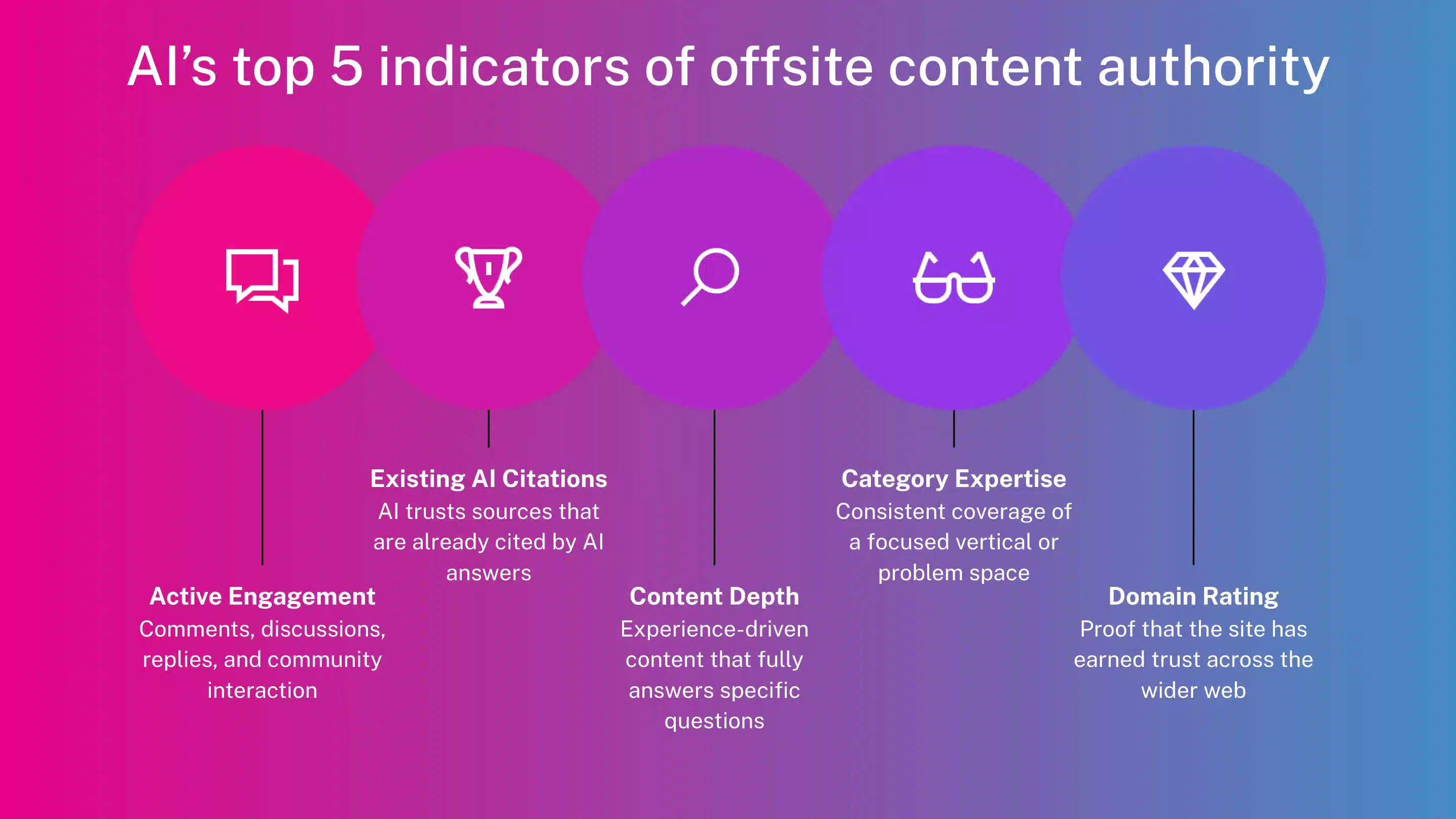
Authority doesn’t mean household names or massive traffic. After talking with dozens of brands optimizing for AI, here’s what actually moves the needle:
Domain rating 70+: This is your quantifiable threshold, measurable with platforms like Ahrefs, Semrush, or Moz. Don’t bucket this into nice-to-have. Yap’s team found that “a single placement on an authority site with a Domain Rating over 70 delivers more AI citations than 50 links from lower-tier blogs.”
Category expertise: Consistent, detailed content in a specific vertical. AI can tell when someone actually knows what they’re talking about versus regurgitating product specs. Beaver targets creators “who rank for specific searches like ‘best standing desk for lower back pain,’ since AI pulls answers from their detailed content.”
Content depth: Long-form articles that genuinely educate, not 500-word fluff pieces optimized for keywords that don’t exist anymore.
Existing AI citations: If a source is already being cited, that’s a signal it’s trusted. Success compounds. Yap’s strategy is surgical. He says, “Identify the top three ranking affiliate articles for your primary keywords and relentlessly pursue inclusion there because AI is validating existing authority.”
Active engagement: Comments, discussions, community interaction on sites like Reddit, Quora, and other forums. AI picks up on whether content sparks conversation or sits in a vacuum.
The authority paradox: Why the quiet voices often influence AI results
Sometimes the most authoritative partners aren’t who you’d expect.
Dirk Alshuth, CMO at emma, a cloud management platform, has watched this play out in the technical B2B space.”Authority doesn’t always look like traditional media. The creators who influence AI most are often mid-level engineers who run quiet blogs or active LinkedIn pages where they share honest, detailed cloud war stories,” he says.
These people may not have huge audiences. But here’s what matters—they write with what Alshuth calls “technical truthfulness.” And AI treats that as a high-value signal.
Think about it: when someone documents an actual migration project or explains how they solved a multi-cloud cost optimization problem, they’re not selling. They’re teaching.

“Because cloud users ask very technical questions, AI leans heavily on content that feels like it came from someone who has actually lived the problem.”
– Dirk Alshuth, CMO at emma
This pattern holds beyond technical products. Beaver looks for partners who’ve solved the specific problem his product addresses—chronic neck pain, lower back issues, small apartment workspace challenges. The content that gets cited isn’t generic “best standing desk” fluff. It’s someone explaining exactly how they solved their own problem.
Real experience beats polished marketing every time.
Terminology consistency: The technical detail AI notices, but nobody talks about
Alshuth also flagged something most brands completely miss. “When your docs are out of sync with your marketing site or partners’ content, AI gets confused and describes the product incompletely,” he explains. “Keeping your technical content aligned across every surface area has a bigger impact than most SEO tweaks.”
This is the terminology consistency problem on steroids. If your website says “background removal,” Partner 1 says “image isolation,” and Partner 2 says “subject extraction,” AI models encounter conflicting signals. But if your documentation uses different language than your marketing site, which uses different language than your partners? AI gets confused here.
Beaver discovered this through measurement. “We found that 45.6 percent of our mentions appear positive, but 12 percent have outdated pricing because affiliates forgot to update old posts,” he says. Desky now requires partners to update content every 3 months, with terminology alignment as part of that quarterly check.
“AI models love documentation that is clean, current, and predictable,” Alshuth says. When it’s not? AI describes your product incompletely—or fills in the blanks
The offsite content structure AI actually cites (with proof)
Analysis of affiliate content generating consistent AI citations reveals that content helping AI explain something tends to get cited. Content that only tries to sell something gets ignored.
This is where offsite content for AI overviews inclusion becomes measurable—not through rankings, but through how consistently AI systems extract and reuse answers.
The distinction matters more than any technical optimization trick you’ve learned.
Answer-first formatting: The 14 percent difference
Most offsite content is written for humans who’ll read three paragraphs to find what they need. But AI doesn’t have patience. It scans, extracts, and moves on. If your answer is in paragraph three, you’re invisible.
Beaver tested this rigorously at Desky. “We noticed 14 percent more appearances in AI results after requiring affiliates to start with direct, concise answers in the first 2-3 sentences,” he says.
AI models optimize for information density. They’re not reading for pleasure—they’re parsing content to answer questions. Lead with the conclusion. Add context second. That’s the structure that gets cited.
Quantified comparisons: The 4x citation factor
Here’s what separates content AI actually uses from content it ignores: specificity.
Vague descriptors like “excellent performance” or “very durable” tell AI nothing it can work with. But when you give it comparable data—”50% more hair regrowth than X” or “holds 220 pounds vs. 180 for competitors”—you’re giving it something it can confidently cite across different queries.
Huang has been tracking this pattern across clients for over a year. He says, “Content that explicitly compares three to five products with quantified metrics like ‘25% longer battery life’ is what our analysis shows AI models prefer.”
Not just prefer—actively prioritize. The difference in citation rates isn’t marginal.
“We see these specific formats get cited four times more often than standard narrative reviews,” Huang says.
AI models need structured, comparable data they can reuse across different contexts. A subjective claim like “strong construction” can’t be repurposed. But “holds 220 pounds” can appear in answers about weight capacity, office equipment durability, or even home gym setups.
As Huang states, “This is about feeding the machine structured data it can easily parse.” The better you structure your comparisons, the more contexts AI can cite them in.
Reddit threads as a core source for AI answers
Here’s something most brands miss about Reddit: it’s not just another social platform. It’s becoming critical infrastructure for how AI systems learn about products.
In February 2024, Reddit signed a $60 million partnership with Google to train AI models on Reddit’s content archive. That deal made official what I’ve been watching for months—Reddit captures authentic human conversation at a scale and quality that AI systems desperately need.
Nick Andrews, who’s been working Reddit affiliate strategies for over 15 years, mentioned in a podcast interview, “Reddit is probably the richest source of discussion that’s logged digitally.”
This means Reddit threads ranking high in Google search today will likely surface in tomorrow’s AI-generated answers. Your brand mentioned in a well-ranked Reddit discussion doesn’t just get search visibility—it becomes part of the training data shaping how AI systems answer product questions.

“Whoever wins the AI race will need access to authentic human conversation. That’s exactly what Reddit provides.”
– Nick Andrews, Founder of Revitrage
The promo code workaround for AI-trackable attribution
Many subreddits auto-remove affiliate links or flag them for moderator review. Promo codes bypass these restrictions while maintaining accurate tracking.
Andrews, who’s extensively tested Reddit strategies, discovered an effective psychological edge with discount structures: “I found on Reddit that if brands are offering 10 percent all the time on email campaigns, I’ll come in with 11 percent. It’s a weird number, and it will make people stop and look at it.”
The odd percentage stands out visually and signals exclusivity—this isn’t the generic discount everyone gets. More importantly, the promo code itself becomes the tracking mechanism. Brands can see exactly which Reddit posts drive conversions without triggering filters designed to catch affiliate URLs.
Why reddit matters for modern brand visibility
Hear how offsite conversations shape discovery in search and AI.
The window won’t stay open for AI visibility gains
Right now, most brands are still running volume-based affiliate programs, creating promotional content AI ignores, measuring only clicks and conversions, and treating community platforms as afterthoughts.
That’s your advantage.
Content gets indexed by LLMs within days of publication now. Citation patterns established today compound and become progressively harder to displace. As Yap says, “A brand cited in 10 different high-authority partner articles becomes a default recommendation with far higher long-term value than any single affiliate click.”
Default recommendation status. That’s the objective.
The impact.com and Evertune partnership gives brands the tools to actually see this happening—visibility into AI Brand Score, competitive positioning across LLMs, which partners drive citations, and direct activation with high-influence sources. It turns measurement into action.
But the tool only works if you’re building something worth measuring.
The competitive advantages being built this week will compound for months. Six months from now, they’ll be significantly harder to replicate.
About the author
Jerrid Grimm founded Pressboard, a content marketing analytics platform acquired by impact.com. With over 2 decades of experience in marketing, Jerrid has advised the world’s most influential brands on content partnerships and insights.
FAQs
The most effective offsite strategies focus on:
- Fewer, higher-authority publishers and creators—not broad partner volume
- Content that explains and compares, rather than promotes
- Consistent mentions across review sites, buying guides, and communities like Reddit
- Sources already being cited by AI, where trust compounds over time
If AI doesn’t trust the source, it won’t surface the brand—regardless of how optimized the content is.
AI favors content that’s easy to extract and reuse. Structure matters more than keywords.
High-performing offsite content typically:
- Leads with a clear, direct answer in the first few sentences
- Uses quantified comparisons instead of vague descriptors
- Explains why a product fits a specific use case
- Separates conclusions from supporting detail
If AI has to dig for the answer, it usually moves on.
AI visibility correlates more with authority and relevance than reach. Prioritize partners who demonstrate:
- High domain authority (over 70) or established credibility in your category
- Deep, consistent coverage of a specific problem space
- Existing AI citations or frequent inclusion in buying guides
- Organic mentions of your brand or product, even before a formal partnership
- Active engagement (comments, discussion, updates)
A single trusted source often drives more AI visibility than dozens of low-signal placements.
Affiliate briefs should shift from promotion-first to explanation-first. Effective AI-ready briefs emphasize:
- Answer-first formatting
- Honest limitations alongside strengths
- Quantified comparisons of your product with alternatives
- Terminology that’s consistent with your website and other brand materials
- Requirements on how to keep the details up-to-date
The goal is clarity instead of persuasion. AI cites content that helps it explain.
Programs that win AI visibility are intentionally smaller and more focused. High-performing programs typically:
- Concentrate spend on a handful of authoritative partners
- Prioritize comparative and educational formats
- Require partners to conduct regular content refreshes
- Align with partners on what terminology to use so it’s consistent with branded materials
- Measure success through citations and influence—not just clicks
When it comes to AI search visibility, the authority of the recommenders wins over volume.
Creators influence AI when they document real experience instead of scripted messaging. AI tends to trust people who sound like they’ve lived the problem. Look for creators who:
- Solve a specific problem your product addresses
- Share detailed workflows, results, or tradeoffs
- Write or speak in natural, experience-based language
- Already show up in AI answers or long-form discussions for relevant topics
Reddit plays an outsized role in how AI systems learn about products. Brands that earn AI citations through Reddit:
- Participate authentically months before mentioning products
- Contribute detailed, problem-solving responses
- Let the community validate recommendations organically
- Use promo codes (not links) when attribution is needed
AI rewards explanation, not promotion.