

In affiliate marketing, strong performance starts with smart affiliate marketing reporting. The difference between good and great programs often comes down to how effectively brands turn data into decisions. Yet many teams still struggle to extract meaningful insights from their reports, leading to:
- Missed revenue opportunities
- Underperforming campaigns
- Partner disengagement
- Inefficient resource allocation
Smart affiliate marketers know that data becomes powerful when you ask the right questions. This guide shows you five essential questions that transform reporting from a routine task into a strategic advantage, helping you optimize partner performance and drive measurable growth.
Using impact.com’s reporting suite, you’ll learn how to uncover the insights that matter most for your program’s success.
5 key affiliate marketing reporting questions to unlock program performance
Great affiliate programs don’t run on autopilot. They need focus, smart questions, and data that delivers real insights.
If you’ve been juggling endless reports or are unsure how to begin, these five questions will guide you toward the answers that matter.
1. What role does my affiliate partner play in the conversion path?
Understanding partner influence across the customer journey helps optimize your ROI. The Contribution and Behavior Reports together reveal the full conversion story.
Report Comparison
Before you dive into the data, it’s useful to understand how each report complements the other.
The Contribution Report focuses on individual partner performance, while the Behavior Report expands that view to capture multi-touch activity and cross-channel collaboration — including social and influencer marketing insights.
| Contribution Report Reveals | Behavior Report Adds |
|---|---|
| Partner roles (Introducer, Closer, Influencer, Solo) | Average conversion timeline |
| Credited vs. assisted actions | Steps to purchase and drop-off points |
| ROAS and AOV revenue statistics | Conversion data from desktop and mobile devices |
| Collaboration performance across affiliate partnerships | Cross-channel insights, including social commerce and influencer marketing activity |
Together, these two reports show where and how partners influence outcomes — from the first affiliate link click to final conversion.
They allow marketers to identify which marketing channels drive the strongest results and how to use affiliate marketing more strategically to increase ROI.
Implementation Requirements
To make the most of these insights, ensure your reporting setup is configured correctly.
Proper access and filtering help maintain consistency and accuracy across your data.
| Requirement | Purpose |
|---|---|
| Ensure add-on access is enabled | Provides complete visibility across your affiliate network |
| Understand insight levels | Tailor reporting depth by partner type |
| Use date range filtering | Identify shifts in partner impact over time |
With these elements in place, your reports become more than static summaries—they evolve into living dashboards that inform smarter marketing strategies and optimize affiliate marketing spend over time.
Common Challenges Solved
| Challenge | Solution |
|---|---|
| Misaligned compensation | Align payments with verified contribution levels |
| Slow or inefficient conversion paths | Optimize conversion flow using Behavior Report metrics |
| Lack of clarity across affiliate partnerships | Gain transparency into cross-partner collaboration |
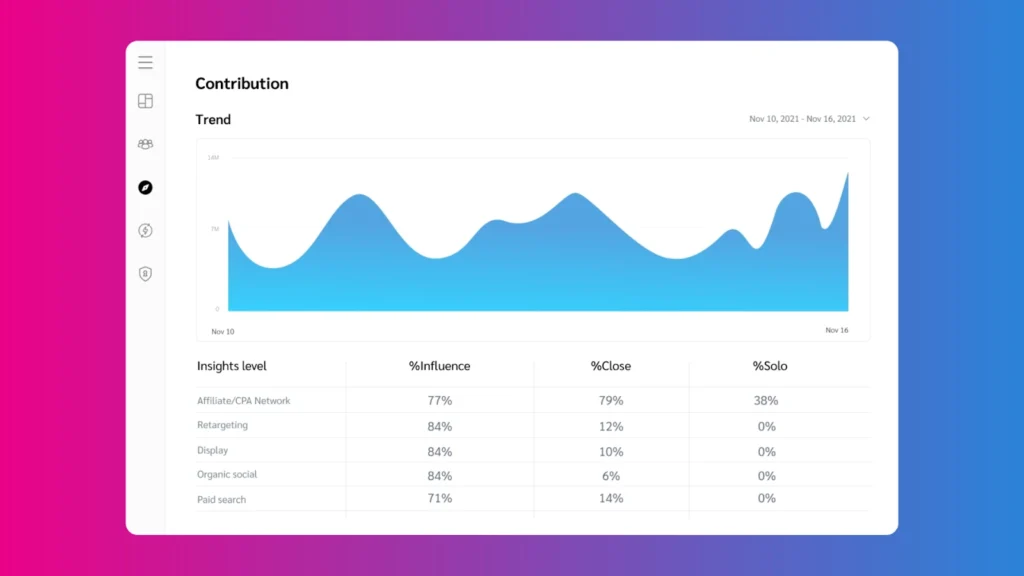
Contribution Report
Why this affiliate marketing reporting insight works:
These reports combine first-party data with AI-driven analytics to reveal partner value with accuracy and depth.
They enable affiliate marketers to create fair compensation structures, strengthen relationships, and enhance user experience across channels.
2. What are the most popular conversion paths in my affiliate program?
Understanding your top-performing customer journeys helps affiliate marketers overcome common industry challenges like fragmented attribution and inefficient spend.
The Top Paths and Events Funnel Reports give you the clarity needed to identify which marketing channels convert best while adapting to shifting consumer trends in 2025.
Report Comparison
- The Top Paths Report maps full journeys.
- The Events Funnel Report shows what happens at each stage.
Together, they expose how partners, creators, and campaigns drive conversions.
| Top Paths Report Analysis | Events Funnel Report Focus |
|---|---|
| Track conversion paths up to nine steps | Measure conversion rates between funnel stages |
| Identify roles of each affiliate marketer | Track performance across mobile devices and desktop |
| Map patterns between affiliate links and online sales | Identify where drop-offs occur in the journey |
| Understand content creators’ contribution | Analyze engagement from social commerce platforms |
These reports turn complex data into clear direction—helping marketers act fast on affiliate marketing trends and consumer behavior shifts.
Implementation Requirements
Set up reports correctly before analyzing results.
Accurate tracking means reliable insights and stronger decisions.
| Requirement | Description |
|---|---|
| Enable add-on access and action tracking | Ensure full funnel visibility |
| Configure custom filters | Segment data by partner, channel, or region (e.g., North America) |
| Define evaluation periods | Benchmark results against the affiliate marketing industry average |
Even small details matter. For instance, a brand tracking its Amazon account conversions can find weak spots—like mobile drop-offs or unnecessary mobile number fields slowing checkout.
Common Challenges Solved
| Challenge | Benefit |
|---|---|
| High funnel abandonment | Customers often quit mid-funnel due to friction or poor flow. Funnel data reveals where to simplify and recover lost conversions. |
| Unclear partner impact | When multiple affiliates or influencers contribute, attribution gets tricky. These reports show who truly adds value, improving ROI and marketing strategies. |
| Resource misallocation | Without clarity, brands overspend on low-return campaigns. Top Paths reporting redirects affiliate marketing spend to what works. |
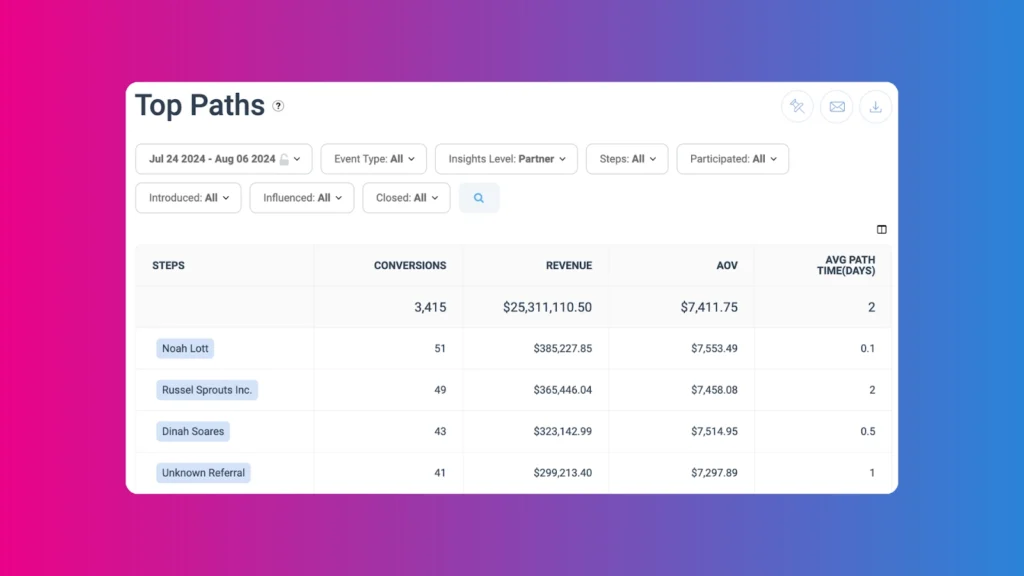
Top Paths Report
Why this affiliate marketing reporting approach works:
These reports help optimize your conversion strategy by revealing:
- Most effective partner combinations
- Critical drop-off points
- Highest-converting journeys
- Partner performance by funnel stage
For example, credit card issuers can track applications from initiation to approval, while subscription services can monitor trial-to-paid conversion rates.
3. Which partner drives new customers for my brand?
Identifying and nurturing partners who excel at acquiring high-value customers directly impacts program growth. The New Customer Value Report provides crucial acquisition insights.
Metrics to Track
Use these metrics to understand where real growth comes from. Each one links partner activity to meaningful business outcomes.
| Metric | Why It Matters |
|---|---|
| Customer acquisition numbers | Reveal which partners drive consistent new-customer growth. |
| Revenue per new customer | Evaluate each partner’s contribution to total affiliate marketing revenue. |
| Repeat purchase rate | Reveals long-term value driven by affiliate partnerships |
| First vs. repeat purchase AOV | Measures retention effectiveness |
| Margin per customer | Keep affiliate marketing spend efficient and sustainable. |
Strong acquisition data helps identify emerging trends—especially as the creator economy reshapes how customers discover brands through influencer and content-driven promotions.
Implementation Requirements
Accurate setup ensures clean data and reliable insights.
A few key configurations make all the difference.
| Requirement | Use Case |
|---|---|
| Enable customer ID and tracking access | Attribute purchases accurately to each partner |
| Define evaluation periods | Compare quarterly or annual results |
| Use first-party data where possible | Improve accuracy and compliance post–third-party cookies |
First-party data is the backbone of trusted reporting—it improves attribution accuracy and helps brands adapt to changing consumer trends in privacy and personalization.
Common Challenges Solved
Even well-run programs miss hidden insights. The New Customer Value Report exposes what’s really driving acquisition and loyalty.
| Problem | Outcome |
|---|---|
| Hidden acquisition champions | Some partners quietly drive high-value customers but go unnoticed. This report highlights those top performers so you can reward and retain them. |
| Misaligned incentives | Programs sometimes overpay for short-term wins. These insights ensure you reward affiliates who deliver repeat revenue and sustainable growth. |
| Poor retention tracking | Customer value isn’t only about the first sale. Monitoring lifetime value (LTV) helps focus incentives on long-term relationships—not one-off conversions. |
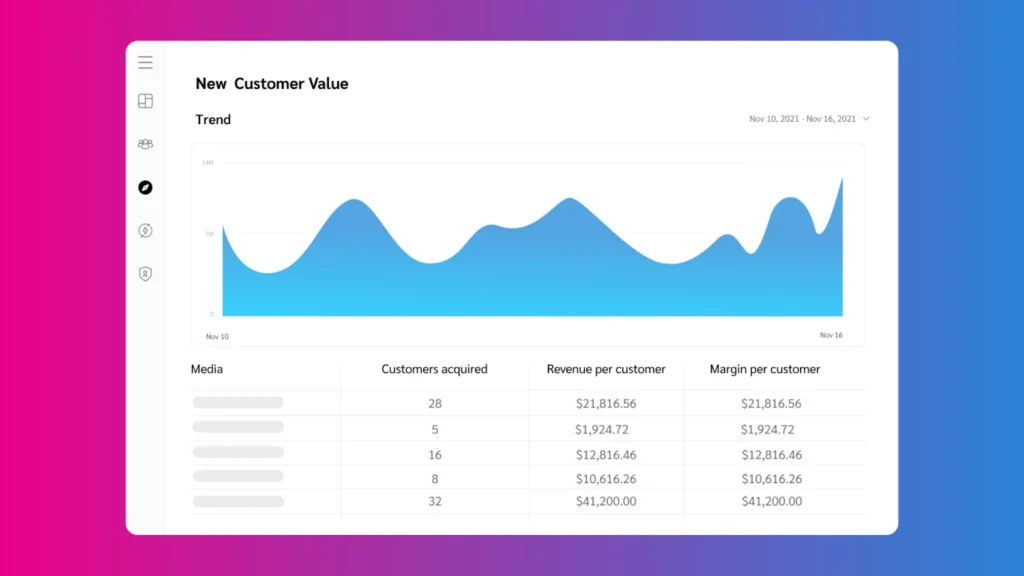
New Customer Value Report
Why this affiliate marketing reporting insight works:
The New Customer Value Report reveals:
- Partners driving repeat purchases
- High-margin customer sources
- Most valuable acquisition channels
- Long-term customer behavior
For example, subscription services can track trial-to-paid conversion patterns, while e-commerce brands can identify partners attracting high-value repeat buyers.
This data helps optimize partner rewards and focus resources on relationships that drive sustainable growth.
4. How competitive is my affiliate program in the market?
Your ability to attract and retain high-performing partners depends on how your program compares to the wider affiliate marketing industry.
The Brand Benchmarking Report provides a view of your performance relative to peers, revealing opportunities for optimization and marketing innovation.
In an era where affiliate marketing strategies and performance marketing evolve quickly, benchmarking keeps you ahead of industry trends and prepares your program for the future of affiliate marketing.
Metrics to Benchmark
Each metric helps gauge performance, spot gaps, and measure growth over time.
Together, they show how your partnerships stack up in an evolving market.
| Metric | Insight Gained |
|---|---|
| Total vs. active partner rates | Evaluate engagement health |
| Partner productivity | Measure how effectively affiliate publishers and influencers drive conversions. |
| Cost per action (CPA) and ROAS | Compare against affiliate marketing industry statistics and performance benchmarks. |
| Revenue distribution | Identify dependency risks by partner or region |
| Partner diversity | Expand reach across affiliate websites, content marketing, and digital marketing niches. |
Benchmarking data reflects the affiliate marketing industry is expected to grow steadily through 2025, supported by rising affiliate marketing revenue and diversification across affiliate platforms.
Implementation Requirements
Accurate benchmarking ensures you track meaningful metrics.
It also aligns your results with key affiliate marketing statistics recognized across the US affiliate marketing industry.
| Step | Description |
|---|---|
| Regional data selection (e.g., North America) | Compare your metrics within the US affiliate marketing industry for localized insight. |
| Industry category alignment | Benchmark growth against your marketing niche or product vertical. |
| Quarterly tracking | Monitor performance relative to the compound annual growth rate (CAGR) of your sector. |
| Data validation | Ensure compliance with Federal Trade Commission standards and reporting transparency. |
Consistent tracking builds credibility and strengthens alignment with digital marketing strategies that leverage data to increase partner engagement and optimize marketing budgets.
Common Challenges Solved
Benchmarking addresses recurring challenges in affiliate marketing and clarifies where improvement drives growth.
| Issue | Resolution |
|---|---|
| Poor partner diversity | Expand affiliate partnerships across industries |
| Revenue concentration | Balance program growth through new affiliates |
| Limited competitiveness data | Gain insights from reports such as Fintel Connect or the Financial Industry Affiliate Marketing Report 2024 |
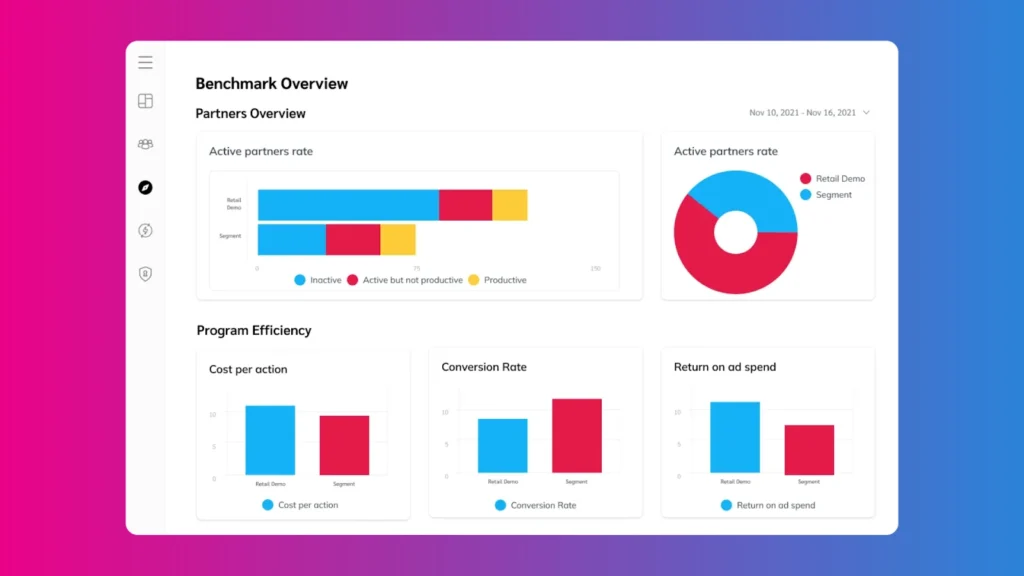
Brand Benchmarking Report
Why this affiliate marketing reporting insight works:
Benchmarking reveals competitive gaps and opportunities to optimize your program structure, commission rates, and partner mix. Use this data to build a balanced, high-performing partner ecosystem that attracts and retains top talent.
5. Am I over- or under-compensating my affiliate partners?
Fair compensation and transparent data are key to maintaining trust within your affiliate ecosystem.
The Crediting Concerns Report helps ensure that partners are credited accurately and that your program complies with consumer protection law and Federal Trade Commission standards.
Metrics to Track
These metrics expose where errors or abuse can occur—and help strengthen performance visibility.
| Metric | Purpose |
|---|---|
| Partner involvement percentages | Detect duplicate or excessive crediting |
| Conversion path overlap | Spot overlapping affiliate links or double attribution. |
| Credit distribution fairness | Promote accuracy and prevent affiliate fraud in reporting. |
| Timing and frequency of interactions | Spot irregular activity across devices or channels |
Monitoring these numbers supports ethical practices and improves the effectiveness of affiliate marketing across campaigns.
Implementation Requirements
Set up your data tracking carefully.
Accurate analysis reduces risk and helps ensure your program meets compliance standards.
| Requirement | Use |
|---|---|
| Partner/group-level insights | Compare contributors with similar engagement levels |
| Date range comparison | Identify trends and anomalies over time |
| Event-type filtering | Isolate specific conversion behaviors |
| Compliance alignment | Match reporting practices to Privacy Policy and Terms of Service requirements |
Frequent audits and website information updates improve credibility and maintain transparency—key priorities for both users and regulators.
Common Challenges Solved
Every growing program faces attribution and compensation issues. The Crediting Concerns Report resolves them with clarity and data-backed precision.
| Challenge | Resolution |
|---|---|
| Partner disputes | Use data transparency to resolve conflicts quickly |
| Unfair credit allocation | Rely on validated, first-party data instead of third-party cookies |
| Overlapping partner claims | Maintain fair distribution through verified touchpoint data |
| Attribution fraud | Detect suspicious behaviors early to maintain program integrity |
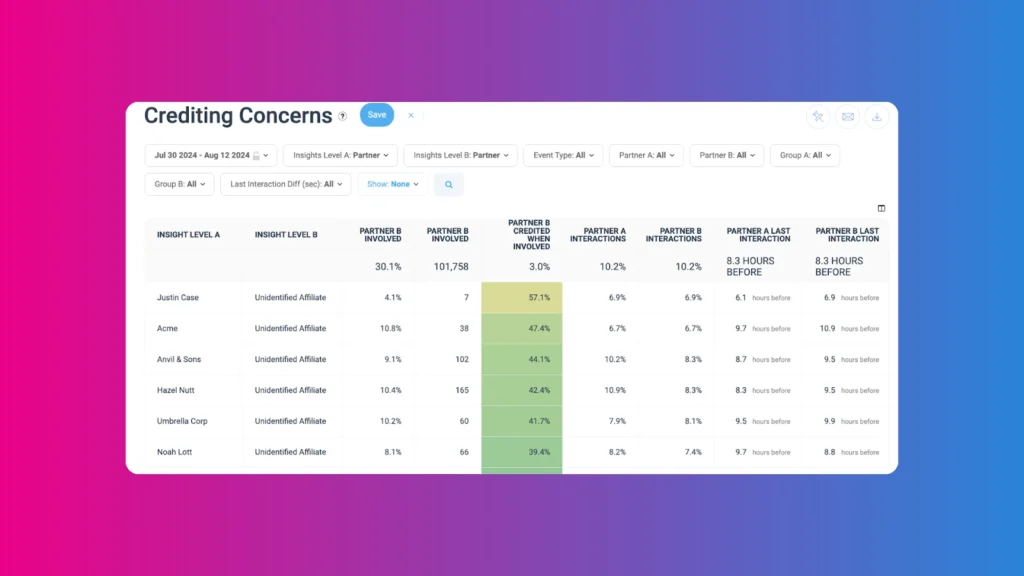
Crediting Concerns Report
Why this affiliate marketing reporting insight works:
The report reveals critical compensation insights:
- Credit distribution fairness
- Partner interaction patterns
- Contribution value analysis
- Attribution accuracy
For example, if Partner B receives credit 90 percent of the time when appearing with Partner A, but Partner A drives more interactions, your compensation model may need to be adjusted to reflect true value contribution.
Don’t lose sight of the main goal of affiliate marketing reporting
Affiliate reporting gives you the power to understand what’s driving results and where your efforts need a boost. It helps you create a program that grows stronger over time. Use the insights to:
- Identify what truly resonates with your audience.
- Build relationships with partners who deliver results.
- Create strategies that convert and grow your brand.
By focusing on the right data, you can improve performance, refine your strategy, and set the foundation for long-term success.
With impact.com, you have the tools to strengthen partnerships, make smarter decisions, and grow with confidence. Start today.
Affiliate Marketing Reporting FAQ
Affiliate marketing reports are data snapshots that track partner performance, conversions, revenue, and customer behavior across your affiliate program. These reports reveal how each affiliate, publisher, or influencer contributes to sales, helping brands understand the state of affiliate marketing and optimize performance marketing strategies.
They turn raw affiliate data into insights that drive growth. Accurate reporting helps identify top-performing partners, detect fraud risks, optimize marketing spend, and understand the latest affiliate marketing trends. For brands scaling in 2025 and beyond, reporting is essential for smarter decisions that boost revenue and improve campaign efficiency.
A strong report includes:
Conversions and revenue
AOV and ROAS
New vs. returning customers
Conversion path influence
Partner contribution (introducer, influencer, closer)
Click-to-conversion timelines
Fraud indicators
These metrics show the effectiveness of affiliate marketing and support future industry growth predictions.
Advanced partner platforms—including impact.com, ShareASale, CJ, PartnerStack, and Rakuten—provide industry-standard affiliate reporting. They offer deeper insights into customer journeys, fraud detection, and partner contribution. These tools help marketers use affiliate marketing more effectively and keep up with the latest affiliate marketing statistics and trends.
Marketing optimization is the process of improving your marketing efforts to get better results with fewer resources. It involves analyzing performance data, testing different strategies, and reallocating budget to the channels, partners, or campaigns that deliver the highest return on investment (ROI).
Marketing optimization is important because it helps you get more value from your budget. By focusing on what works, and cutting what doesn’t, you can lower customer acquisition costs, improve ROI, and drive sustainable growth without overspending.
Conversion rate optimization (CRO) is the process of improving your website, landing pages, or campaigns to increase the percentage of visitors who take a desired action, like making a purchase, signing up, or clicking a link. It’s about making small tweaks that lead to big results.
Businesses can start small by focusing on high-impact, low-cost tactics, like refining their messaging, repurposing existing content, and using free or affordable analytics tools. Prioritizing what works and testing consistently helps stretch limited resources further.
To optimize a marketing budget, identify underperforming channels, double down on what’s working, and reallocate spend based on data-driven insights. Use tools to track ROI, run tests to measure impact, and align spending with business goals.