

For Booktopia, the true source of influence didn’t lie with paid ad campaigns. It was happening in book clubs, authors’ social feeds, and podcast studios. But their marketing team couldn’t prove it.
Like most brands, they were stuck rewarding the last click—leaving every partner who created demand invisible and unpaid.
So they rebuilt. A modern influencer marketing platform gave them a clear view of the full customer journey for the first time. With these insights, the team could—for the first time—see which partners created demand and who simply captured it.
The team acted decisively. They launched an “Author Royalty Club” to pay authors for creating demand, then built flexible commission models to reward creators for their proven role in the journey.
The new system delivered the concrete data Booktopia was missing. The result: 38% year-over-year revenue growth and a 30% drop in cost-per-acquisition.
Booktopia’s story is a lesson for any marketer learning how to choose an influencer marketing platform: the true measure of a platform’s value is its ability to provide the financial proof—to demonstrate ROI, justify spend, and scale the program strategically.
Most teams are still evaluating platforms based on operational features alone. That’s the wrong test for today’s creator economy.
“Proof of performance” is now table stakes for influencer marketing platforms
Financial proof is now the price of admission for any influencer marketing program.
Today’s consumers are more deliberate and research-intensive than ever. According to Cardlytics and impact.com’s 2026 Consumer Spending Intelligence Report, this new reality is clear in the data: while click volumes rose 2% in 2025, conversion rates fell by 6%.
Shoppers are browsing more, but committing less often. This creates a new battleground for brands where victory belongs to comparison—not awareness.
At the same time, marketing budgets are tightening. When CFOs start scrutinizing every channel, influencer programs built on reach become easy targets. The programs that survive will be the ones that can prove what they’re worth.

Source: Cardlytics and impact.com’s 2026 Consumer Spending Intelligence Report
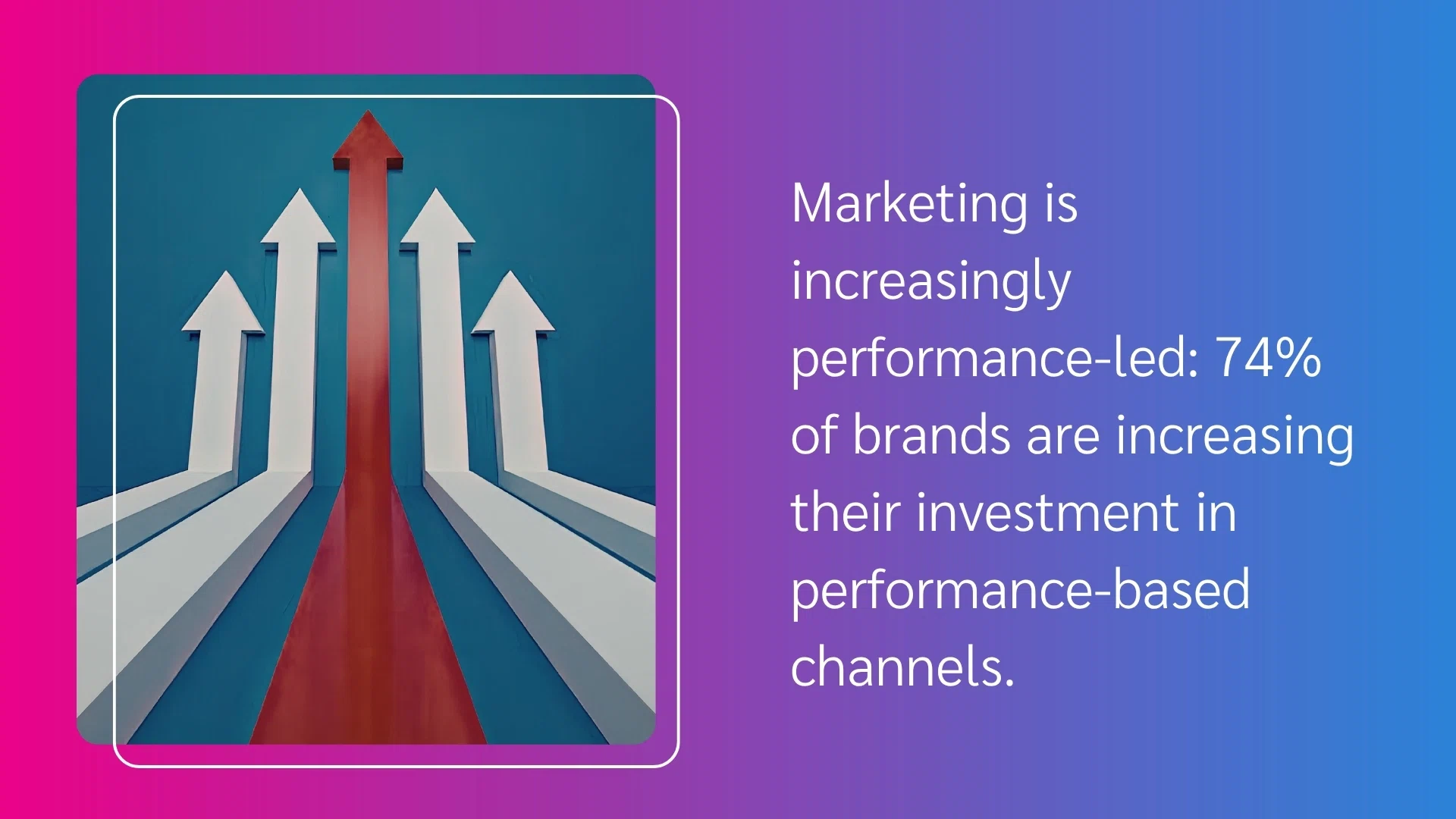
These pressures are reshaping how brands approach their programs. In fact, impact.com’s 2025 Global State of Affiliate Marketing report found that 74% of brands are increasing their investment in performance-based channels, which the report ties to rising CAC and declining efficiency in traditional media.
Influencer marketing is following the same logic: if you can’t connect creator activity to revenue, you’re going to lose the budget conversation. Performance-driven influencer marketing is the future of the channel.
This environment redefines what an influencer marketing platform actually needs to do. Workflow management and creator discovery are entry-level requirements.
The platform’s primary job now is providing financial proof, which means surfacing data that:
- Demonstrates ROI
- Defends spend
- Makes the case for scaling
Source: impact.com’s 2025 Global State of Affiliate Marketing report
Choosing an influencer marketing platform: 3 tests before you buy
A feature checklist won’t protect your budget. With marketing spend under a microscope and consumers becoming more selective, the only evaluation framework that matters is performance and whether a platform can prove it.
These three tests cover the full picture—not just whether a platform runs smoothly, but whether it can prove (and grow) your program’s value.
Test 1. Core operational and automation features
A platform that can’t handle discovery, lifecycle management, and campaign workflow can’t run a program—let alone prove its value.
Any serious platform will pass this test, but automation and efficiency alone can’t deliver financial proof or strategic growth. These features are the floor.
| Feature category | What it includes | Why it’s table stakes |
| Searchable partner network | – Direct access to partners – Recruit partners directly from the platform – AI-powered partner suggestions – Insights into audience authenticity and value | Compresses the time from “we need more partners” to “contracts signed” |
| Lifecycle management | – Tools for creator onboarding – Full CRM to manage ongoing communications | Managing partner relationships across spreadsheets and email threads limits growth |
| Campaign workflow | – Centralized content approvals – Automated task management – Clear campaign calendars | Eliminates manual bottlenecks so your team can focus on strategy instead of admin |
| Ad and creative management | – Centralized creative library for distributing assets | Prevents version control issues and maintains consistent brand standards |
| Risk and compliance management | – Vetting creators before they enter your program – Basic fraud detection flags – Customizable user permissionsFTC/disclosure compliance tools – Automatic payment suppression on suspicious events | Protects your brand, budget, and legal standing |
| Integration and connected data | – Native connections to your CRM, analytics stack, and paid media tools – API access for custom needs | Data trapped in one platform can’t drive decisions across your stack |
| AI-powered decision support | – Ability to query program data – AI-driven partner recommendation – AI content safety screening – Turns platform data into decisions without requiring manual analysis | Surfaces decisions from your data without manual analysis or a dedicated analyst |

IG Group achieved 223% ROI for its partnership channels
See how their team scaled the program.
Test 2. The ability to measure true financial impact
Features are easy to demo, but the ability to surface financial proof is harder to fake.
The capabilities in this pillar let you walk into a budget conversation armed with the right data.
Attribution and incrementality: can it prove your program’s value?
Most influencer marketing platforms will tell you which partner got the last click before a sale. A sophisticated solution moves beyond simplistic tracking to more advanced measurement capabilities that can prove true value—such as attribution and incrementality.
| Capability | What it proves | Why It’s critical |
| Multi-touch attribution | How different partners contribute to a sale (beyond last click) | Stops you from defunding the partners who create demand because last-click partners always get the credit |
| Incrementality testing | The percentage of sales that wouldn’t have happened without your program | Prove to leadership that you’re generating new revenue, not just taking credit for existing demand |
| Lifetime value (LTV) tracking | Which partners bring in your most valuable customers over time—not just one-time converters | Shifts investment toward partners who drive sustainable growth |
| Automated sales reversals | True revenue after returns and cancellations are accounted for | Ensures you’re only paying for sales that boost the bottom line and that your ROI numbers are defensible |
Flexible compensation: can it align payouts with your goals?
Most platforms surface what worked last month. Few enable you to pay for what you want to happen next month.
The right platform’s payment tools should transform compensation into a strategic play: Pay more for new customer acquisition, reward partners who drive high-margin sales, and automate bonuses when targets are hit.
| Capability | What It enables | Why It’s critical |
| Custom payment /commission rules | If/then logic that: – Pays different rates for new vs. returning customers – High-margin vs. low-margin products | Turns payments from a fixed cost into a tool for driving specific business outcomes |
| Performance bonuses | Automated bonuses triggered by: – Revenue targets – Growth milestones – Other KPIs | Gives top partners a reason to push harder without requiring negotiation every time |
| Payouts on any conversion | Payments that go beyond final sales, including: – Leads – App installs – Trial sign-ups – Any action | Lets you build full-funnel partnerships and pay for demand creation—not just demand capture |
Test 3. Tools that enable strategic growth
The final test assesses a platform’s ability to transform your influencer program from a reliable revenue channel into a differentiator. Financial proof is how you defend the program, and these tools are how you use it to outmaneuver the competition.
| Capability | Strategic question it answers | Why it’s critical for growth |
| Predictive forecasting | Based on past performance, what ROI should we expect from this partner or campaign and where should we allocate budget to maximize it? | You can make investment decisions backed by data |
| Competitive benchmarking | How does our share of voice, engagement rate, and partner mix compare to direct competitors? | Turns your platform into a competitive intelligence tool |
| Creator benchmarking | How do individual creators perform against industry peers by vertical and tier? | Turns program data into a talent management tool |
| Integrated social listening | What trends and consumer sentiments could shape our next campaign, recruitment decisions, or product direction? | Connects partnership activity to real-time market signals |
| Cross-channel journey analysis | How do creator touchpoints interact with paid search, email, and social ads to drive a conversion? | Reveals the true assisted value of your program and helps you optimize the full marketing mix |
| Automated campaign reporting | Which creators drove the most value, how did content perform, and where should our budget go next? | Closes the loop between campaign execution and the next investment decision |
16 key questions to ask when evaluating an influencer campaign platform
The three tests above are your evaluation framework, and these questions are the tool to run it. They’re designed to surface real capabilities in a demo and expose the gaps before they become your problem.
Test one questions: Operational and automation features
- Can you show us creators relevant to [your vertical] in your marketplace—not just the total network size?
- What tracking methods do you support beyond click-based tracking?
- What happens to attribution data when a shopper switches devices or uses a promo code offline?
- If I need to connect this platform to my CRM, paid media stack, and analytics tools, what does that integration require on my end?
- How does your platform handle multi-currency payouts and tax compliance for international creators?
- How long does onboarding typically take for a program our size, and what does migration from our current platform involve?
Test two questions: Ability to measure true financial impact
- Can you show me an incrementality report from a program similar to ours in size and vertical?
- How does your platform assign credit when multiple partners touch the same customer journey? Walk me through a real example.
- If a creator drives top-of-funnel demand but doesn’t get the last click, how does your platform ensure they’re compensated?
- How does your platform handle returns and cancellations? Are payment reversals automated, or does my team manage that manually?
- When fraud or invalid traffic is detected on a live partner, does your platform automatically suppress the payment or does it flag it for my team to act on?
- Can you show me how payment structures are configured for different partners? How long does it take and who manages it?
Test three questions: Tools that enable strategic growth
- What does your benchmarking data actually cover—is it my program’s performance over time, industry-level comparisons, or both?
- What does your forecasting capability look like? Can it project partner-level ROI, or is it program-level only?
- How do you surface cross-channel data? Can I see how different creator touchpoints interact with my paid search and email activity in the same view?
- How does your platform help us identify which creators are underperforming relative to their potential?
- If our program doubles in the next 12 months, what changes about our contract, our pricing, and our platform access?
Your program’s future depends on financial proof
The evaluation framework in this article exists because the budget conversation has already changed. Company leaders don’t ask about creator reach anymore—they ask about revenue contribution. That’s a different question, and it requires a different kind of platform to answer it.
Most programs are still running on tools built for the old conversation. The gap between what those platforms measure and what leadership now demands is where influencer budgets get cut.
The platform you choose determines whether you can answer the question—or whether you’re still presenting reach metrics to a room that stopped caring about them.
FAQS
You can compare influencer platforms for small business growth by rigorously applying a simple three-test framework, which prioritizes financial proof and future scalability over a simple feature checklist. For a small business, every dollar must be justified.
The tests:
- Filter on core operational capabilities (test one). The platform should be able to handle the basics of running your program without manual workarounds. This is the minimum requirement.
- Focus on the ability to measure financial impact (test two). This is the most critical step. Ask vendors to prove how their platform tracks ROI, handles attribution beyond the last click, and automates payment reversals. This data is what will help you defend your budget and prove the channel’s value to leadership.
- Assess the tools for strategic growth (test three). While a small business may not need predictive forecasting on day one, choose a platform you can grow into. Ask how the platform will help you answer strategic questions about competitive benchmarking and cross-channel impact down the line.
Choosing a platform with these advanced capabilities prevents the costly and disruptive process of migrating platforms once you’ve succeeded.
Startups should look for influencer automation software that can deliver immediate proof of value and scale with the company’s ambition. Evaluate platforms on their ability to grow with you:
- Look for core operational features. Ensure the platform has the basic automation required to run a program efficiently without relying on manual workarounds.
- Ensure you can measure financial impact. To survive early-stage budget scrutiny, look for sophisticated capabilities like multi-touch attribution and incrementality testing that can connect your spend directly to revenue.
- Find tools for strategic growth. The software should have strategic tools like predictive forecasting and competitive benchmarking—even if you don’t need them on day one.
Agencies can select influencer automation software by focusing on capabilities that prove value directly to their clients while creating internal efficiencies.
Your evaluation should prioritize platforms that provide detailed reporting on financial impact, such as multi-touch attribution and incrementality, which are essential for client retention and justifying your agency’s fee.
You should also assess the platform’s ability to assist with multi-client management, compliance tools for international creators, and automated payment systems. These are critical for protecting your clients’ brands and your agency’s margins. The best platform for an agency is one that makes your team more efficient while making your results undeniable to the client.