AI IN COMMERCE CONSUMER RESEARCH PART 2 OF 3
Why trusted publisher citations close AI-recommended sales
Confidence in AI recommendations splits narrowly between multiple sources.
Top 3 parts of an AI recommendation that give consumers the most confidence to move forward with the purchase:
27%
say links to the brand’s official website
26%
say the AI’s own written summary
24%
say links to expert or well-known sources like Wirecutter or Vogue
The leading factors that give buyers the most confidence sit within a few percentage points of each other, and they're a genuine mix—one from when the AI links to the brand website, one from the AI's own reasoning, and one from when the AI links to outside experts.
Social proof citations, such as forums or social media, give people the least confidence to move forward with an AI-recommended purchase among all sources tested (16%). Just 7% say they don't trust AI summaries or links and always perform independent research.
If you assume that owned content alone cements AI-era trust, you're only addressing part of the equation. A weak on-site or in-person experience will cost you the sale no matter how well-earned the citation was.
“The question for brands is no longer, ‘How do I rank?’ It’s ‘How do I get trusted? How do I get cited? How do I get chosen?’”

David Yovanno
CEO of impact.com
Over a third of AI shoppers won't buy without the specific source the AI cited.
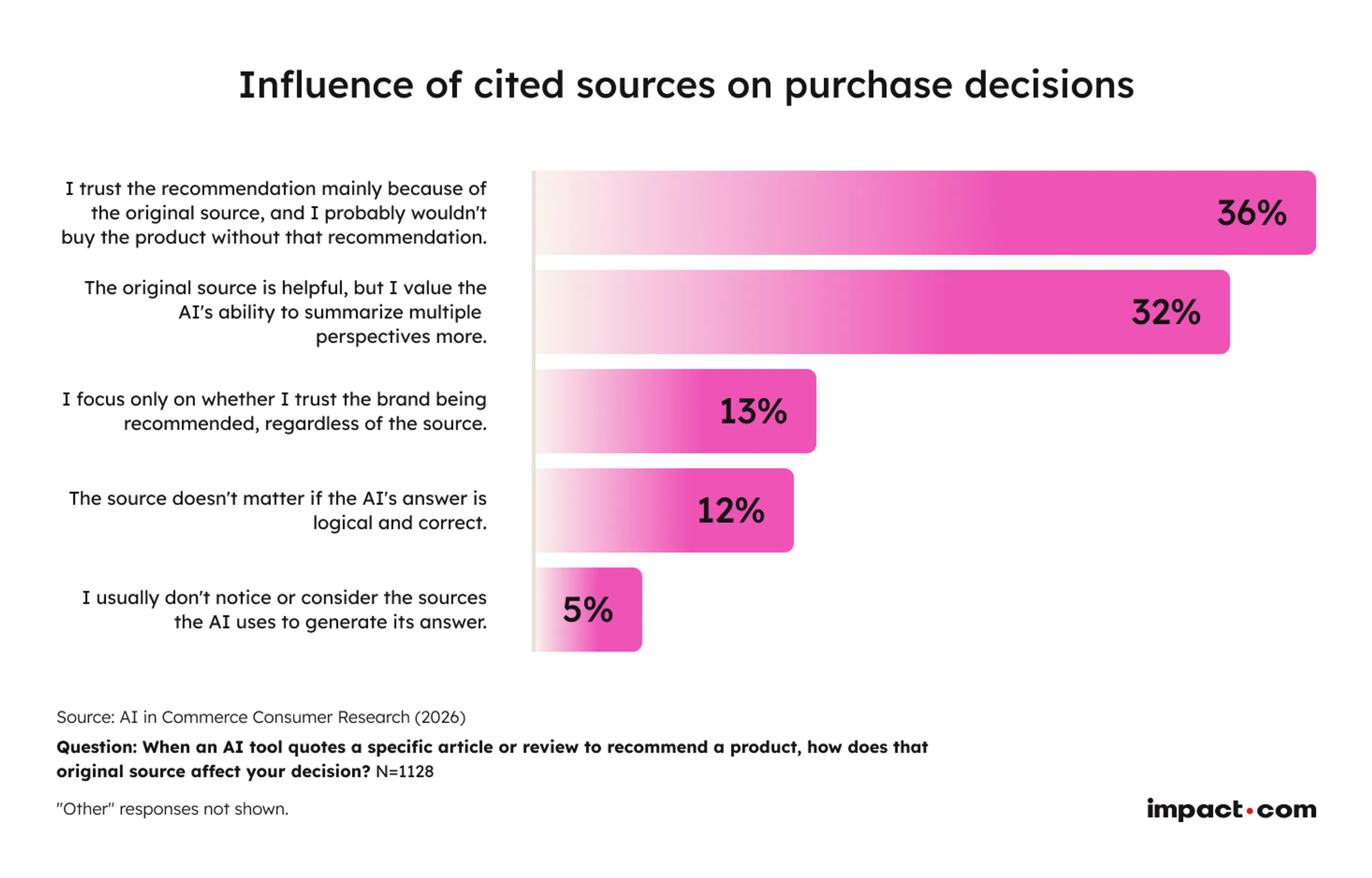
Response confidence may split narrowly across official brand links, the AI's own summary, and expert sources—but that changes the moment an AI names a source directly.
When asked how the article or review an AI cites changes their decision, consumers fall into several groups. The two largest are:
Publisher-led: Trusts the recommendation mainly because of the original source, and probably wouldn't buy without it (36%)—AI functions primarily as a discovery tool.
Coverage-led: Values the AI's ability to synthesize multiple sources over any one citation (32%), trusting consensus more than any single source.
Publisher relationships win over buyers who won't purchase without a citation, while broad, positive coverage across multiple sources sways consumers who trust consensus over a single citation. Fund only one, and you risk losing a sizable portion of potential buyers.
“If you had to summarize it simply, AI visibility comes down to: owned media (their own website, how much they’re talking about their products), earned media (with PR and more journalists or kind of independent content creators), sponsored content (through affiliate or commerce or retailer content), and social media/community (places like Reddit). Those are the big four buckets to look at when you think about the type of content that’s getting to the models.”

Brian Stempeck
CEO and co-founder of Evertune AI
Disclosure actually boosts trust in sponsored AI recommendations.
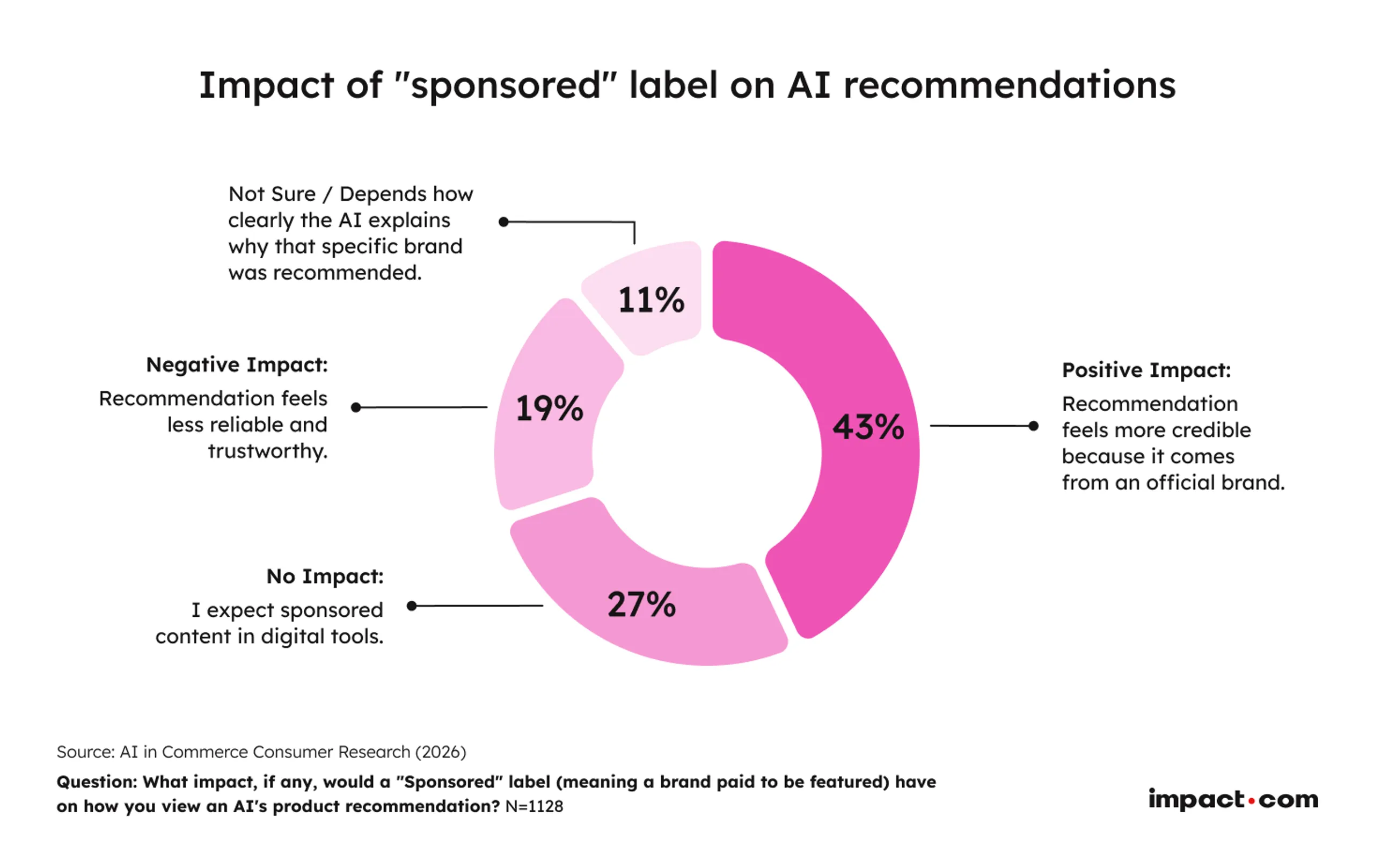
How AI is rewriting the buyer’s journey, our first research report in this series, found that 24% of consumers use AI instead of a traditional search engine to avoid sponsored results and advertisements. But sponsorships inside AI tools get a different reception.
A large share of consumers said that a “sponsored” label makes the recommendation feel more credible because it comes from an official brand (43%). Only 19% indicated that the label made the recommendation feel less trustworthy.*
A smaller group's reaction depends on context: 27% already expect sponsored content and aren't moved either way, while 11% respond to how clearly the AI explains its reasoning.
Consumers may treat sponsorship differently by format—a red flag when it disrupts a search results page, but more acceptable inside a tool they've chosen for direct answers.
*ChatGPT was the most used tool for product research in the past 30 days (61%), meaning this finding is shaped heavily by ChatGPT's specific approach to sponsorships.
The kind of citations people trust varies generationally.
Your citation strategy needs an age-aware split to ensure it’s building trust with the right audience.
Gen Z and Millennials look past the brand to validate AI’s recommendation.
46% of Gen Z and 43% of Millennials trust an AI recommendation mainly because of the original source and probably wouldn’t buy without it
Millennials are the only generation where the AI's own written summary gives them the most confidence to complete a purchase (30%)
Links to real forum and social media discussions give 21% of Gen Z the most confidence to buy, over 5x the Boomer rate (4%)
Gen X trusts the AI’s synthesis over any single source.
37% value the AI’s ability to summarize multiple perspectives more than the original source itself
An official brand link gives 33% of Gen X the most confidence to buy
Boomers value many perspectives.
Among all sources, Boomers’ top answer was that while the original source is helpful, they value the AI’s ability to summarize multiple perspectives more than the source itself (28%)
26% say they focus only on whether they trust the recommended brand regardless of source—the highest rate of any generation
28% say a “sponsored” label makes an AI recommendation feel less reliable, 1.5x the overall rate
17% say their reaction to sponsored AI-recommendations depends on how clearly the AI explains its reasoning, also the highest among any generation
Gen Z and Millennials grew up inside a content-driven economy where an article, forum thread, or disclosed sponsorship is what legitimate recommendations look like—AI is simply the newest place that logic shows up. More than half of Millennials (52%) and nearly half of Gen Z (47%) see a “Sponsored” label as a strong credibility signal, well above the overall rate of 43%.
Boomers and Gen X built their purchase trust directly with brands and retailers before third-party citations were part of the decision-making process. Unfamiliar sources may not carry the same weight, and sponsorship labels are red flags from decades of ad skepticism rather than the norm.
For partnerships teams, that means funding two distinct line items: Younger buyers call for spend on earned placements—the publishers, reviewers, and communities AI already cites. Boomers call for spend on brand-direct trust-building (loyalty, reputation, direct relationship) plus product content structured so an AI can explain the reasoning behind the recommendation.