AI IN COMMERCE CONSUMER RESEARCH PART 2 OF 3
Why AI-influenced purchases go untracked: the attribution gap explained
Over half of AI-recommended purchases are completed without AI getting the credit.
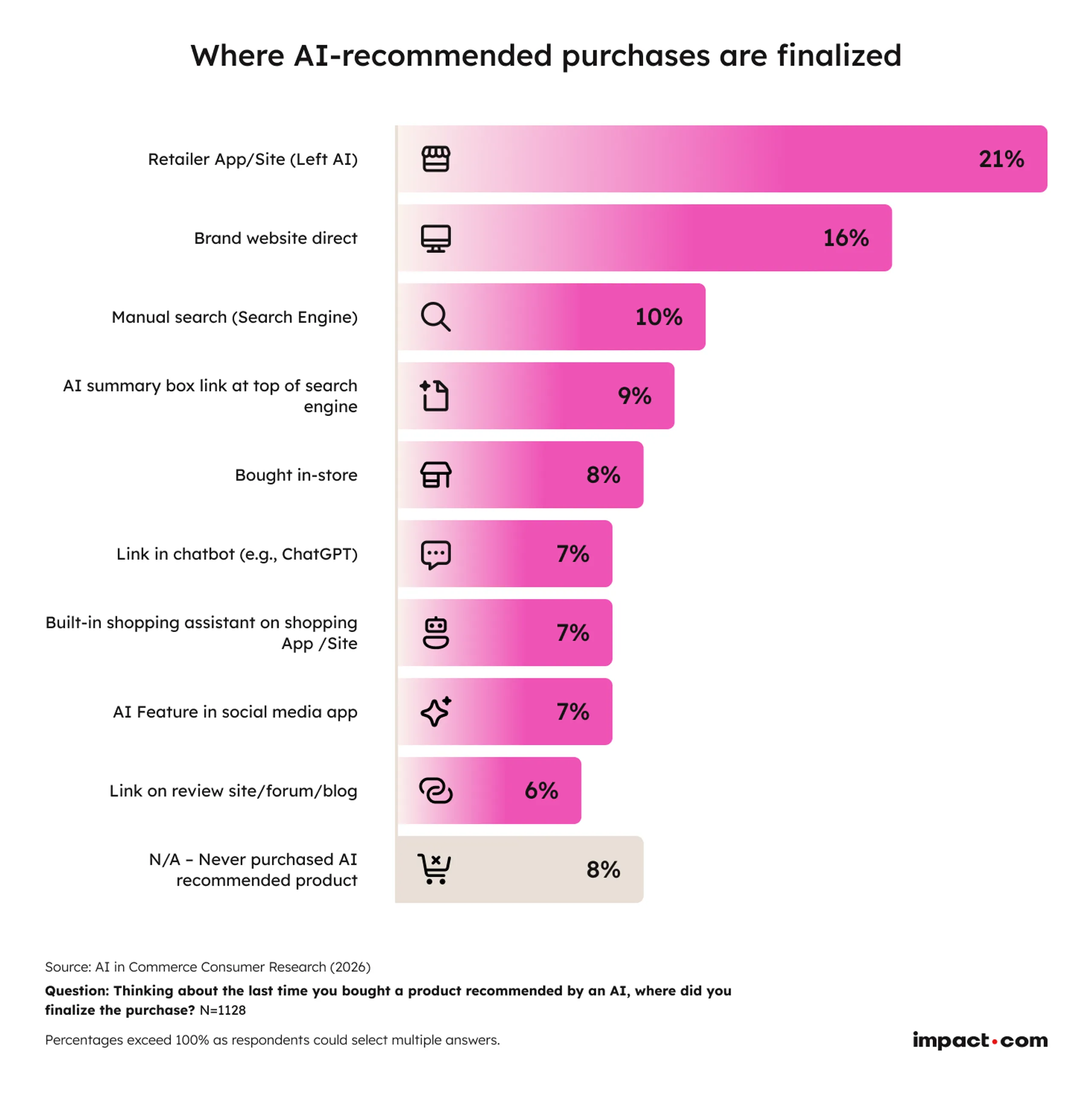
Buying products that AI recommends is already the norm, but AI rarely gets the credit for these sales. People most commonly completed their last AI-recommended purchase through a direct commerce channel instead: a retailer's app or site (21%) or the brand's official site (16%).
Just 31% clicked a trackable link directly from an AI tool to finalize their last AI-recommended sale. It’s the only path a partnerships program can currently measure, since every other exit leaves no trace.
What looks like underperformance on a dashboard could be a data leak. The sales happened, but the evidence that AI drove them didn’t show up in your reporting.
“You need to try and understand the impact AI actually has on your sales or your brand awareness with people, not the machine. We know it’s important, but we’re not seeing a lot of traffic yet come from ChatGPT or Gemini to our site. A lot of times those models don’t actually give you a link. They’re not built like search. They’re more like social media in that they’re trying to keep you in the model asking more questions.”

Brian Stempeck
CEO and co-founder
Evertune AI
Consumers leave AI to confirm pricing and consult reviews before buying.
Consumers leaving AI tools right before a purchase isn't necessarily a lost sale. It's often just verification, the same step they'd take on any channel. The catch is that a partnership program usually can't see it happening at all. But it might show up later as direct traffic or a fresh search with no AI attached.
Buyers verify for many reasons, from confirming price and stock to checking whether the recommendation was sponsored or paid for.
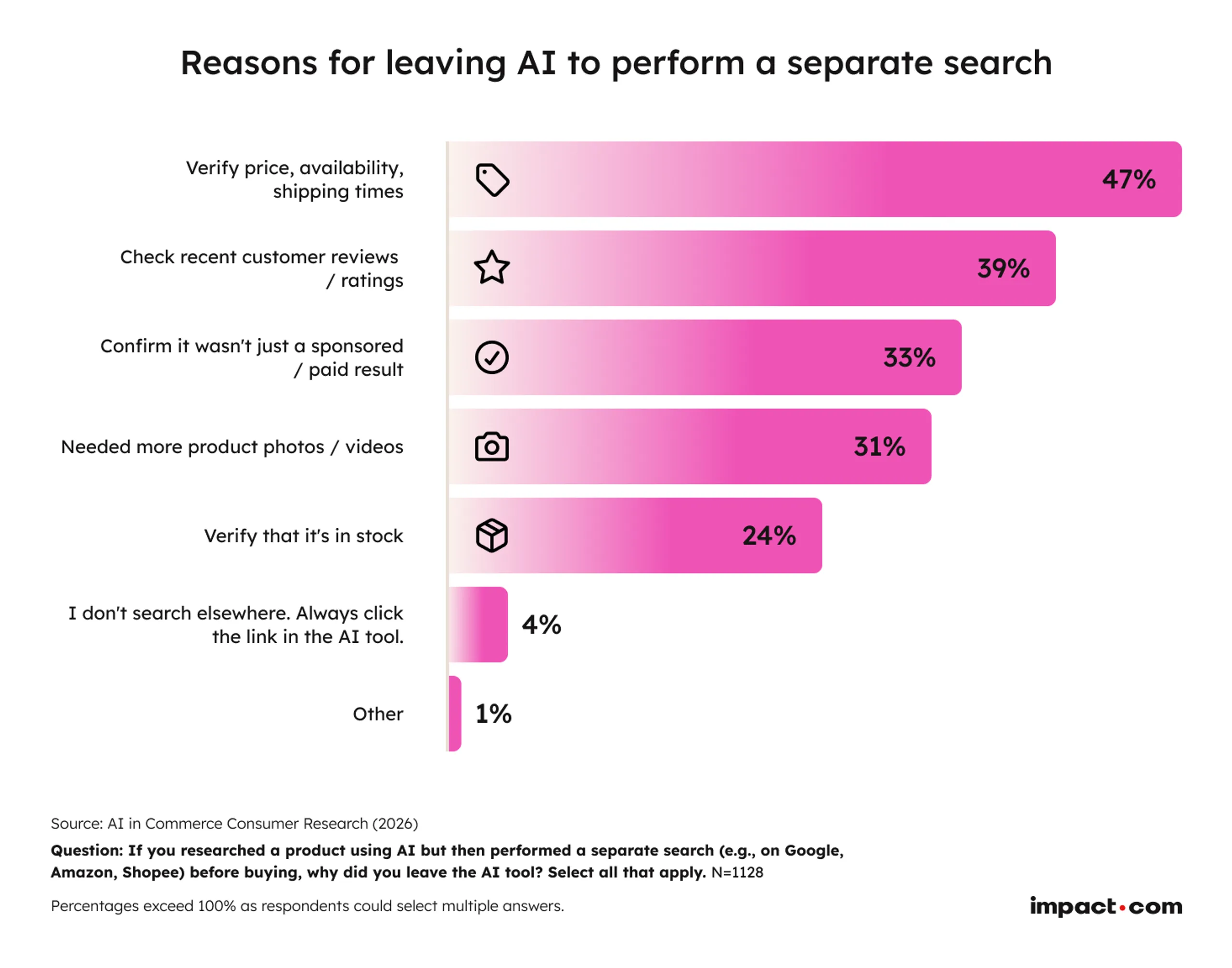
The top reason for leaving AI is logistical: confirming price, availability, or shipping (47%).
The other common reasons fall into two different buckets:
Product verification
reading customer reviews or ratings (39%) and seeing more product photos or “real life” videos (31%)
Confirming the recommendation’s integrity
making sure the AI recommendation wasn’t just recommending a sponsored or paid result (33%)
Most AI-active consumers run a separate search before buying—only 4% never search elsewhere and always complete the purchase through the AI tool's link.
Each of those steps is a chance to break the tracking chain AI started. A new search or a visit to a retailer's site is the moment when the eventual sale can no longer be traced back to the recommendation.
Shoppers use multiple paths to re-find delayed purchases.
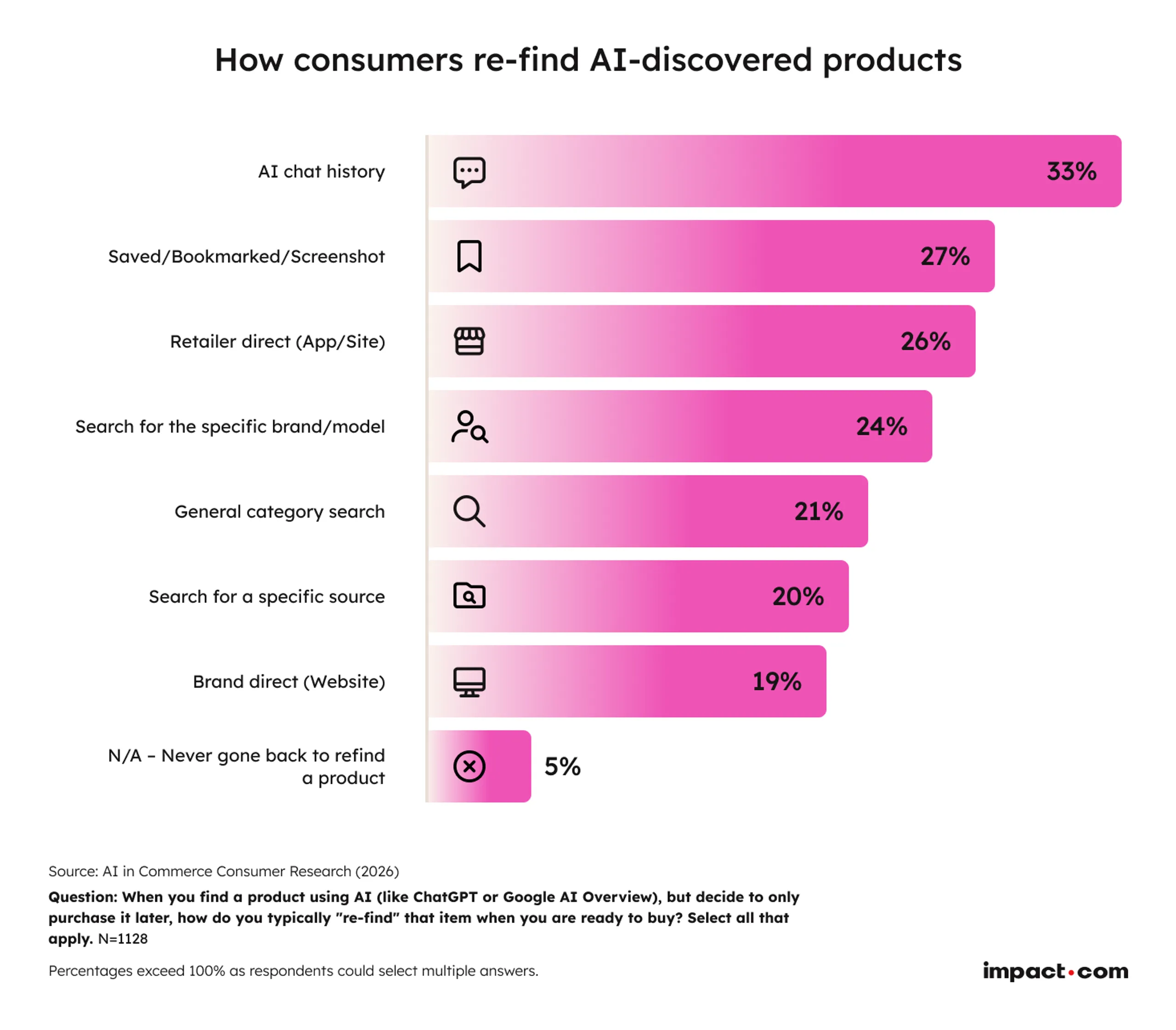
When AI recommends your product, people don't always buy right away—finding their way to you again splinters across multiple paths.
The most common return routes originate from the original AI conversation:
Delayed shoppers reopen their chat history (33%) more than any other path
Saved links, bookmarks, or screenshots taken during the original research (27%) trail close behind
One in five (20%) retraces their steps to the specific source the AI cited or linked to
People who pick up the trail at the cited source are returning to the exact publisher, review, or piece of content that earned the AI's citation. The cited source keeps pulling them back days or weeks after the AI conversation that surfaced it, beyond when you might assume the attribution window has closed.
The remaining paths skip the AI touchpoint entirely, defaulting to how consumers have always shopped:
Going directly to a retailer's app or site (26%)
Running a new search for the specific brand or model (24%)
Performing a general category search because they forgot the product name (21%)
The general category search is where a competitor could get their second chance. Winning the AI recommendation without also holding organic visibility risks losing delayed shoppers to whoever ranks when the search finally happens.
The most traditional path of all—the brand's official website—is also the least used (19%), meaning your owned properties alone won't catch people who've forgotten everything else about AI’s answer.
Earning the AI recommendation only wins one moment on the path to purchase. Show up wherever a shopper looks back: in the chat history, in the cited source, and in the organic search they fall back on when neither delivers.
The attribution gap widens with each older generation.
The attribution gap is smallest for Millennials and widens with each older generation. Gen Z and Millennials have largely adopted AI-recommended buying, and they increasingly complete purchases within a trackable AI channel.
Gen X does so less often, and Boomers less than any other generation. For them, the AI recommendation often remains a research touchpoint, and the purchase is regularly closed elsewhere.
Only 4% of Millennials and 5% of Gen Z have never bought something an AI recommended, compared to 11% of Gen X and 17% of Boomers
Boomers lean hardest on the traditional path to a purchase:
They’re the most likely of all generations to finalize a purchase through a retailer's app or site (32%) or the brand's own website (22%).
Roughly 1 in 10 Boomers skip verification entirely and buy straight off the AI's link.
Like Boomers, Gen X treats the AI recommendation as research and finalizes the purchase somewhere else:
Before making a purchase that AI recommended, 33% of Gen X will perform a separate search to find more information.
Only 5% of Gen X said they don't leave the AI tool to perform a separate search before buying.
Gen X is the most likely to finalize an AI-recommended purchase on a retailer's app or site (21%).
Gen Z and Millennials show the reverse pattern:
When re-finding a delayed purchase, Gen Z relies most on AI chat history (40%), with the AI cited source (28%) and saved links, bookmarks, or screenshots (26%) close behind.
During the original decision, Gen Z's top reason for leaving AI is verifying price, availability, or shipping (49%), followed by ensuring the AI wasn't just recommending a "sponsored" or "paid" result (39%)—both higher than the overall sample (47% and 33%).
Gen Z also over-indexes in wanting visual proof before buying (38% vs. 31% in the overall sample).
Gen Z is 4.7x as likely as Boomers to return to an AI-cited source when re-finding a delayed purchase
The attribution gap will likely adapt over time, but not evenly. Younger shoppers who already buy within AI channels will likely age into more spending power. If AI doesn’t cite you today, you risk losing those potential buyers to the competitors it does cite.