AI IN COMMERCE CONSUMER RESEARCH PART 2 OF 3
The verification point: Why shoppers skip AI links and buy direct
When AI's description isn't enough to close.
A well-earned citation builds real trust in an AI recommendation. It can't tell someone whether a lipstick shade matches their skin, confirm what's in stock right now, or explain what's buried in a warranty's fine print.
In these cases, consumers skip the AI recommendation entirely and go straight to a brand or store site instead.
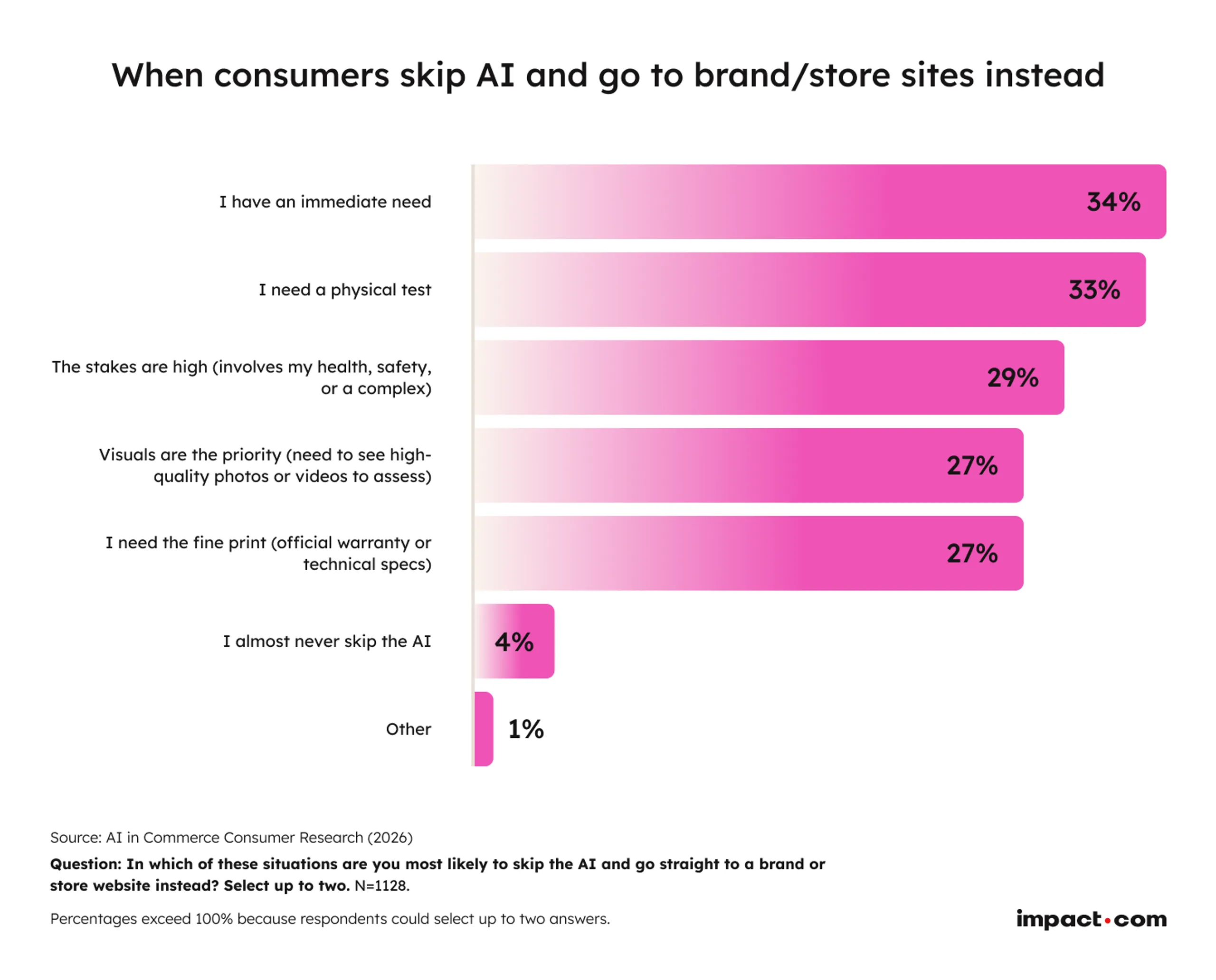
The top reason for skipping AI is urgency: 34% bypass AI when the purchase can't wait and they need to know the exact stock available to buy right now, likely because even the most current AI recommendation can't guarantee what's on a shelf at this moment.
The other common reasons are split into two buckets:
Sensory verification: need to touch, smell, or try on a product (33%) and want to see high-quality photos or video of style or fit (27%)
Risk verification: the purchase involves health, safety, or a complex financial contract (29%) and the item is expensive enough to need warranty or technical-spec confirmation (27%)
These moments hinge on proof that people can get only from the product itself or directly from the seller. If your owned-site or in-person experience can't deliver that, the sale ends there. No citation, however well-earned, will change that.
Almost no one buys from an AI recommendation without taking a validation step first.
In most cases, that validation step still takes the AI's recommendation into account. But specific moments push consumers closer to closing the sale.
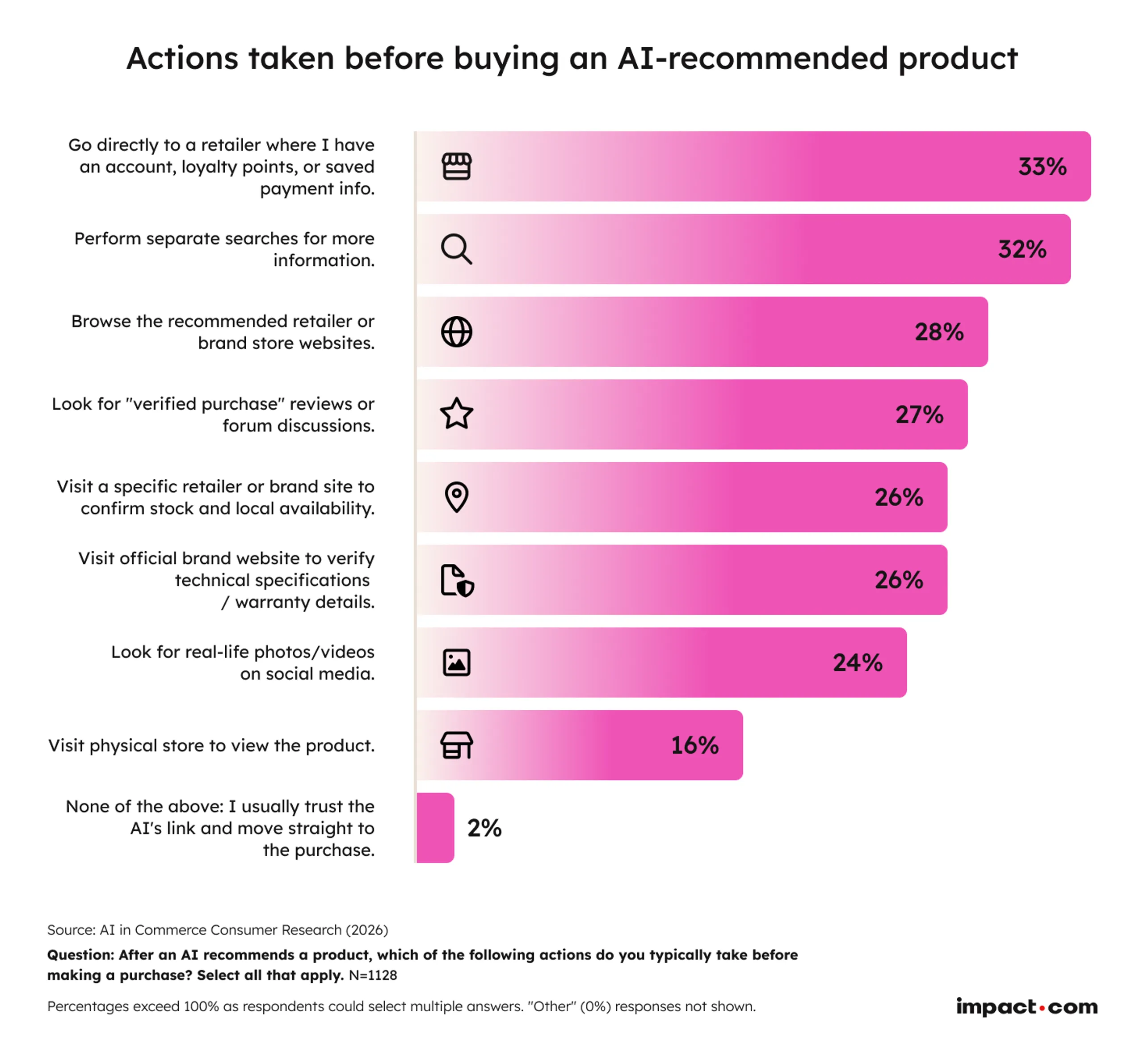
Before buying an AI-recommended product, the single most common move is going straight to a retailer where they already have an account (33%). That likely reflects convenience as much as verification. Running a separate search for more information is close behind (32%)—evidence that even a well-cited answer still gets checked before it's trusted.
The survey found 98% of AI-active consumers take at least one validation step before completing an AI-recommended purchase—only 2% skip validation entirely and buy straight off the AI’s link.
Full, no-questions-asked trust in an AI recommendation is rare. Validating first, buying second, is now the default. AI is getting shoppers to the door—it isn't closing the sale on its own.
Lack of visual proof pulls Gen Z away from AI, while real-time stock repels Gen X and Boomers.
AI can recommend the product, but it can't always convert—and what's missing depends on who's asking.
Visual proof pulls Gen Z away from AI.
Gen Z's top reason to skip AI is wanting to see high-quality photos or video, 1.8x the Boomer rate (35% vs. 19%)
Gen Z is 3.3x as likely as Boomers to seek out real-life photos or videos on social media as a validation step after an AI recommendation (33% vs. 10%)
Real-time stock and availability pulls Gen X and Boomers away.
Gen X (39%) and Boomers (38%) skip AI when they have an immediate need, above the 34% overall rate
Boomers over-index on going straight to a retailer where they already have an account (42% vs. 33% overall)—their single most common validation step
This split isn't just visual vs. logistical—it's AI-native vs. traditional.
Gen X and Boomers fold AI into a more familiar shopping habit instead: a retailer they already have an account with, a brand's own link, and confirming stock before they'll commit.
One need cuts across every generation evenly, though: touching, smelling, or trying a product before buying.
Let your audience's age guide content investment. Rich photography and video will keep Gen Z inside your channels. Real-time inventory data that AI can reach keeps Gen X and Boomers from defaulting to a competitor who answers ‘is it in stock’ faster.