AI IN COMMERCE CONSUMER RESEARCH REPORT
The growing role of personalized AI shopping agents and auto-buying
AI has crossed into the transaction stage of the buyer’s journey.
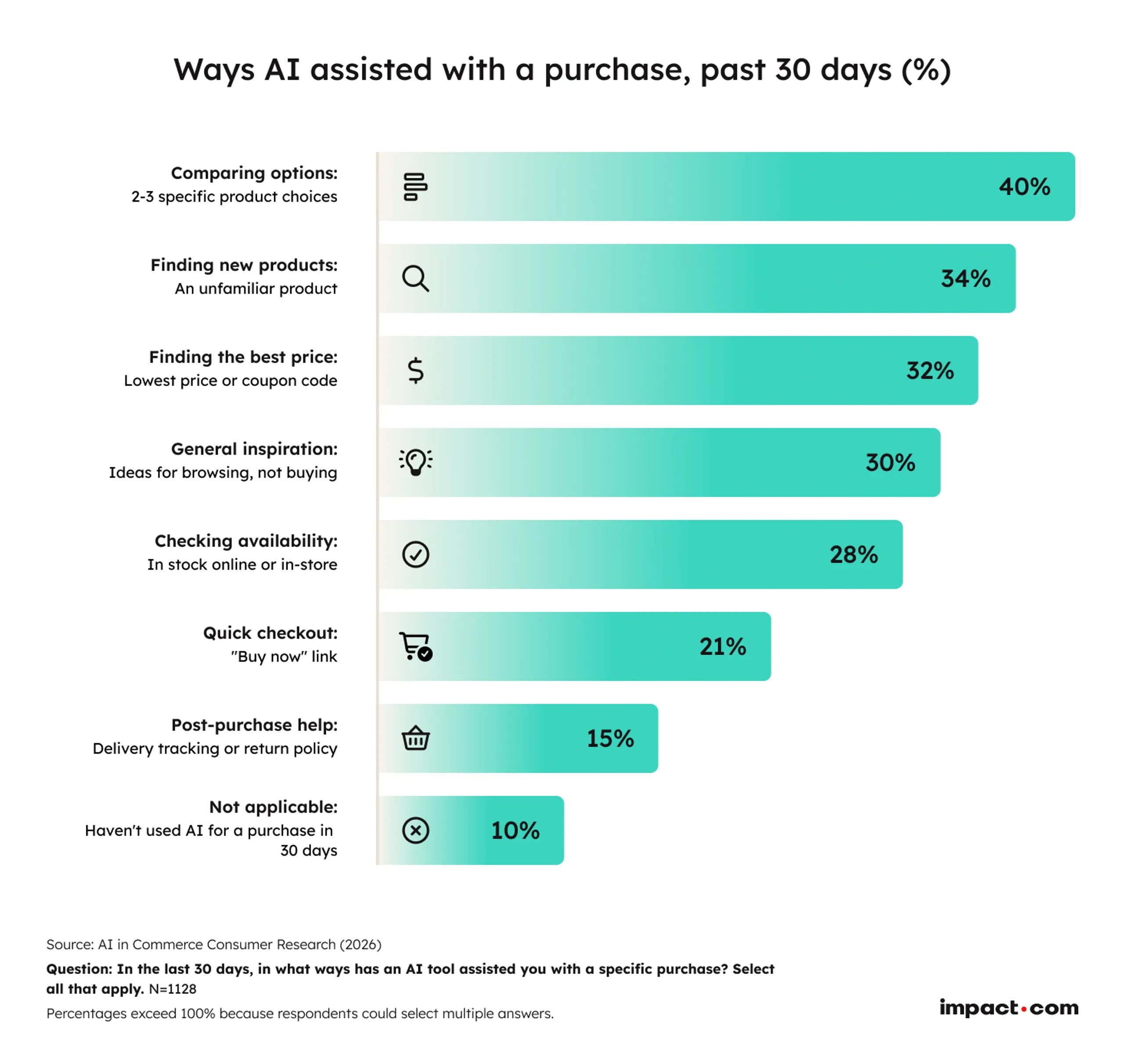
Brands have largely thought of AI in terms of discovery: a visibility challenge at the top of the funnel, with transactions completing through traditional channels. For most consumers, that frame holds—just not as firmly as brands may assume.
Among AI-active users, a large percentage used AI during the research stage: product comparison (40%) and new product discovery (34%).
Yet many extend AI use further into the transaction. Nearly a third (32%) used AI to find discount codes or coupons, and 21% used a buy-now link from AI to skip straight to checkout in the last 30 days.
21%
used a buy-now link from AI to jump straight to checkout in the past 30 days
AI purchase behavior often breaks from research reliance.
For product category definitions, see Appendix B.
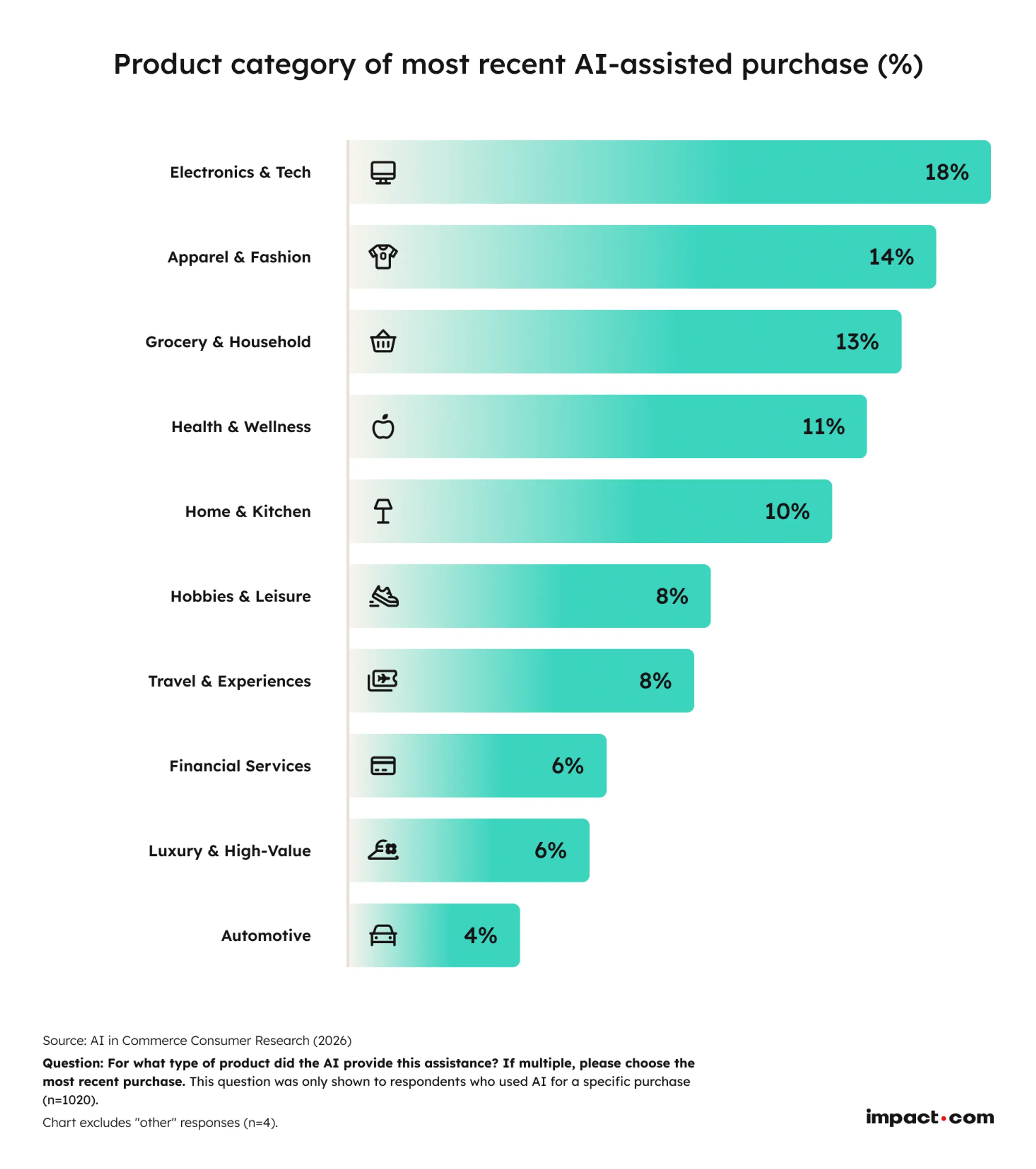
Among consumers who used AI to assist with a purchase in the last 30 days, Electronics & Tech (18%) and Apparel & Fashion (14%) lead. Set against the categories consumers said they'd rely on AI to research, three patterns emerge:
Intent and behavior match
Electronics & Tech ranks first on both research reliance (45%) and recent AI-assisted purchases (18%). Grocery & Household holds third in both (39%, 13%).
Behavior runs ahead of intent
Apparel & Fashion ranks sixth in reliance (36%) but second in purchases (14%). Frequent, low-risk buying compresses the decision window.
Purchases trail intent
Travel & Experiences falls from fourth in reliance (37%) to seventh in purchases (8%).
How often a category is bought and how much it costs explains most of these patterns. Groceries and clothes are cheap and bought constantly, so there's little to weigh up. AI research turns into a purchase in the same sitting.
Travel runs the other way: consumers use AI to plan trips, but booking takes longer than the 30 days measured.
Electronics is the outlier. Tech is expensive and bought rarely, which should slow it down. What speeds it up is having so many specs to compare that AI beats doing it manually.
This divergence shows that stated intent and actual behavior don’t align across all categories. A brand setting AI visibility priorities based solely on stated research reliance would under-invest in the categories already converting.
Consumers use AI to narrow options, but they won’t let it buy.
For many brands, AI visibility has become the new SEO—the thing they know they need to figure out without a clear playbook for how. The real question is already visible in the data: where does consumer willingness to hand decisions to AI actually stop?
The delegation threshold is a map of where trust runs out for now, and where it's headed next.
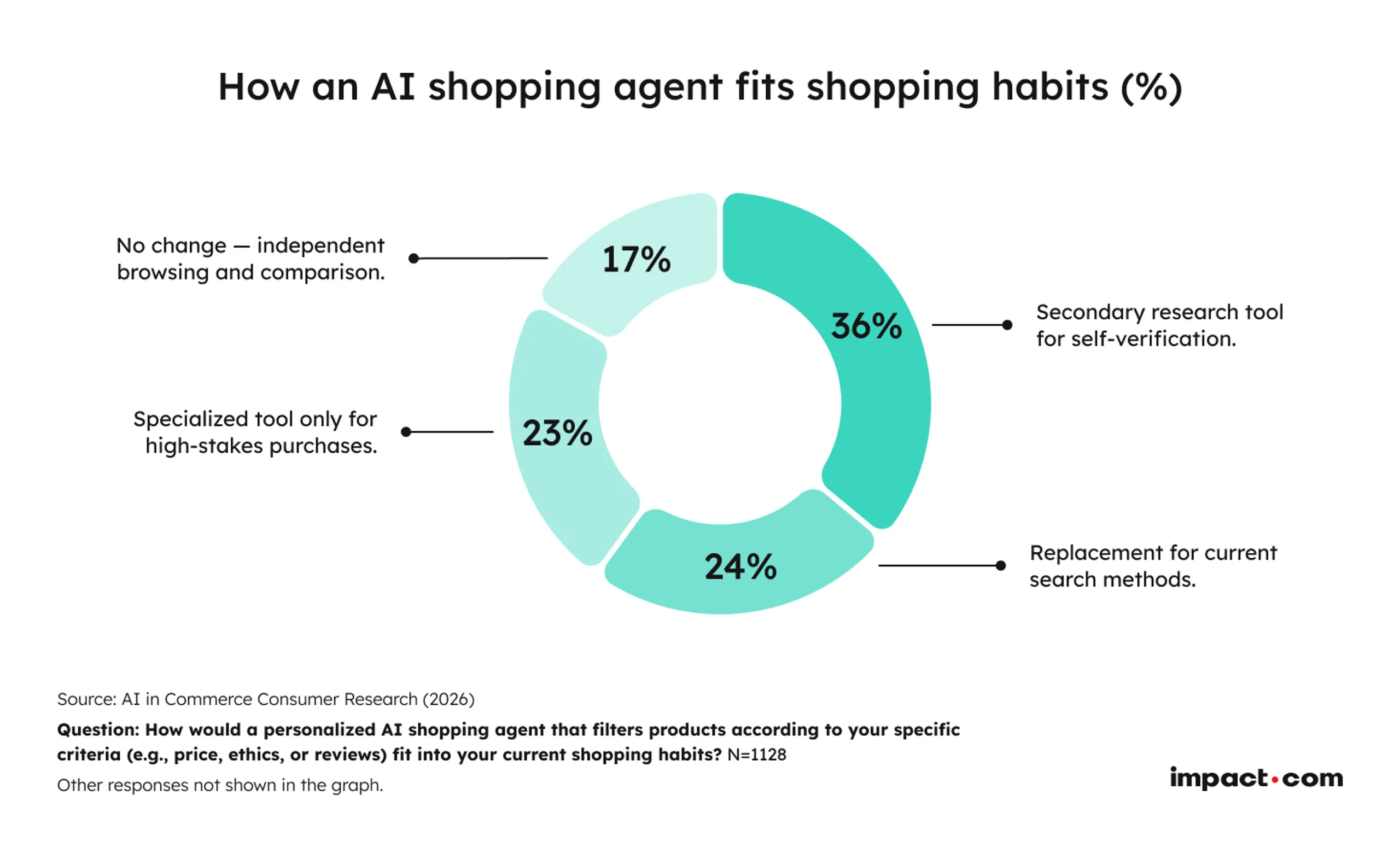
When asked how a personalized AI shopping agent would fit into their current shopping habits, 24% of AI-active consumers said it would replace their product search methods entirely.
But most stop short of full replacement:
36% would use one as a secondary tool to gather ideas before verifying manually
23% would deploy an agent for complex or high-stakes purchases only
Those who would still verify manually aren't resistant to AI—they're comfortable with agentic discovery, just not agentic decision-making.
What is a personalized AI shopping agent?
A personalized AI shopping agent automatically screens every available option against a consumer’s pre-set criteria. In this context, a brand's visibility at discovery wouldn't be determined by what it does to be found, but by whether it already matches what a consumer decided to look for.
Even more cautious consumers create a brand visibility problem. Only 17% wouldn't change their current shopping habits due to a personalized agent. Most are open to one, and even an agent used only for research still narrows the consideration set before they see a single product page.
The most desired agent features limit what the AI decides.
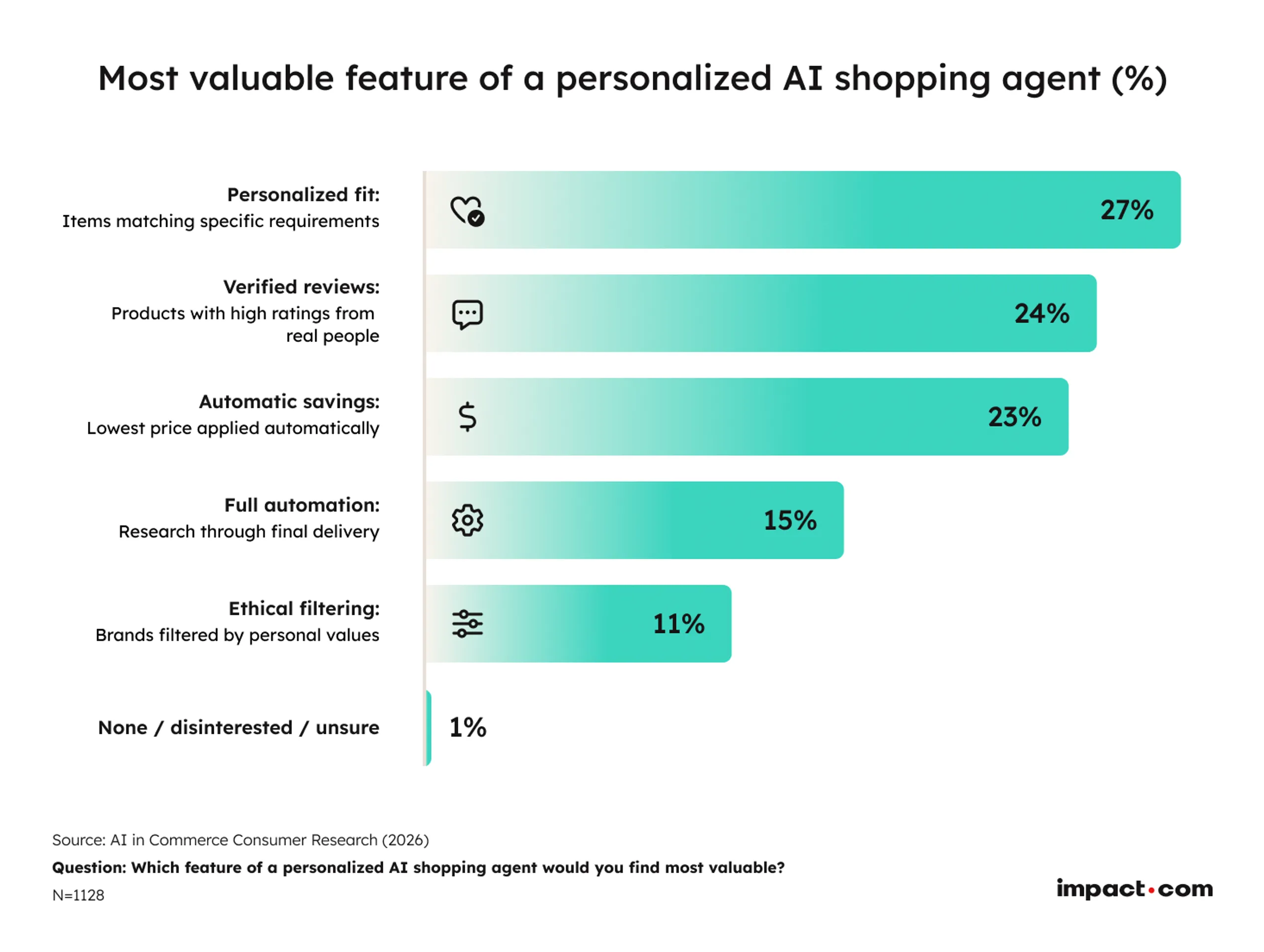
The features ranking above full automation share a common logic: an agent's job is to narrow the options and leave the actual choice to the consumer.
Personalized fit (27%) acts as a specialized filter, surfacing only options matching the consumer's specific requirements.
Verified human reviews (24%) anchor product options in quality confirmed by other buyers.
Automatic savings (23%) show that consumers will accept AI optimizing for low prices, but only after they've already decided to buy.
Full automation ranks as the second-lowest desired feature (15%).
Ethical filtering ranks last overall (11%) despite narrowing the field the same way the top-ranked features do.
Among AI-active consumers, 41% usually or always click the AI's embedded link to a brand or retailer site before making a final decision—less to override the recommendation than to confirm it themselves.
These are the same instincts in a new form. Consumers aren't ready to skip the verification step, and they aren't ready to let AI take full control of the process either.
For brands looking ahead, structured product data—accurate specifications, in-depth reviews, consistent categorization—determines whether they show up in an agent's results at all, and whether a consumer can verify once they leave the AI.
AI purchase delegation stalls in high-risk product categories.
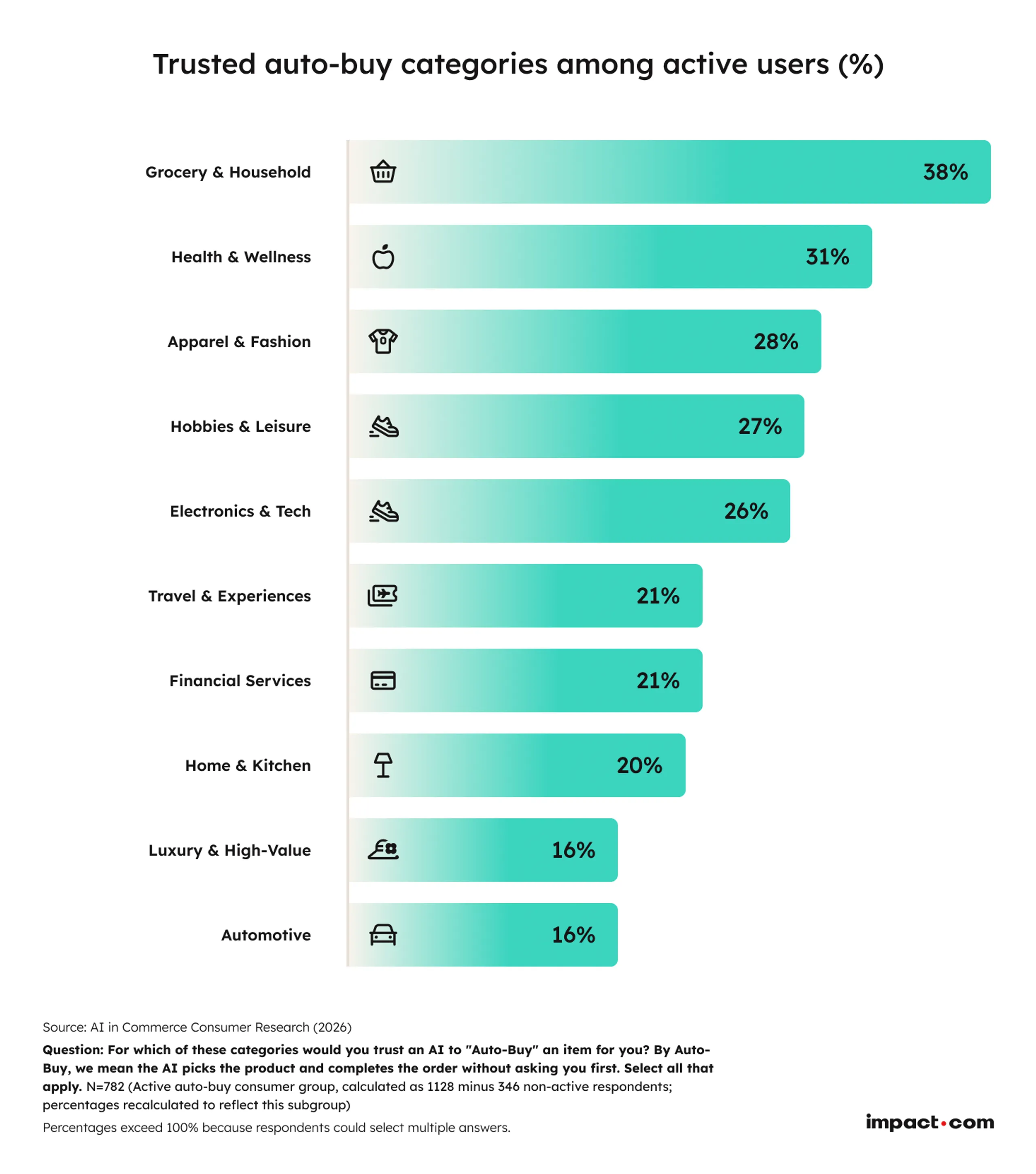
For product category definitions, see Appendix B.
A meaningful minority of AI-active consumers (31%) won't allow an agent to complete a purchase on their behalf in any category.
Among the 69% who would allow AI auto-buying, trust is narrow and specific. Consumers willing to delegate a purchase would do so in an average of 2.44 categories.
Two product types lead in AI auto-buy trust: Groceries (38%) and Health & Wellness (31%). Both are replenishment categories—the product doesn't change significantly, the price is predictable, and the cost of a wrong choice is low.
That trust disappears in more expensive and complex categories, such as Luxury & High-Value (16%), Automotive (16%), Home & Kitchen (20%), and Financial Services (21%).
Generational patterns may show where auto-buy goes next.
66%
of Boomers wouldn’t trust AI to auto-buy for them
Only 19% of Gen Z and 21% of Millennials wouldn’t trust AI to auto-buy for them
Auto-buy trust follows each generation’s existing relationship with recommendation-driven commerce:
Gen Z
They extend furthest into personal categories: Apparel & Fashion (33%) and Health & Wellness (32%), where platform feeds have long trained them to delegate taste decisions to platforms.
Millennials
They have the strongest auto-buy trust in Grocery and Household (41%)—categories where Subscribe & Save have already normalized automated replenishment.
Gen X
They’re somewhat hesitant, with over a third (37%) indicating they wouldn't trust an AI to auto-buy for them, and among those who would, trust is highest for Grocery and Household (38%) and Health and Wellness (31%).
Boomers
They’re the least shaped by recommendation-driven platforms, and are the most resistant—66% wouldn't trust AI to auto-buy in any category, and among those who would, trust concentrates in Grocery and Household (44%) and drops sharply for Financial Services (5%, compared to 25% for Gen Z) and Luxury & High-Value items (8%, compared to 16% overall).
As AI comfort broadens and consumers who've grown up with algorithmic recommendations enter peak spending years, the categories where auto-buy trust sits today is likely just where it starts.
“The future of AI is personalized, predictive, and proactive. This idea that people are going to AI to ask questions about what to shop is actually only the first step in what is going to happen.”

Allie K Miller
CEO of Open Machine and AI advisor