AI IN COMMERCE CONSUMER RESEARCH REPORT
How consumers use AI to search for products
ChatGPT now outranks search engines as a product research tool.
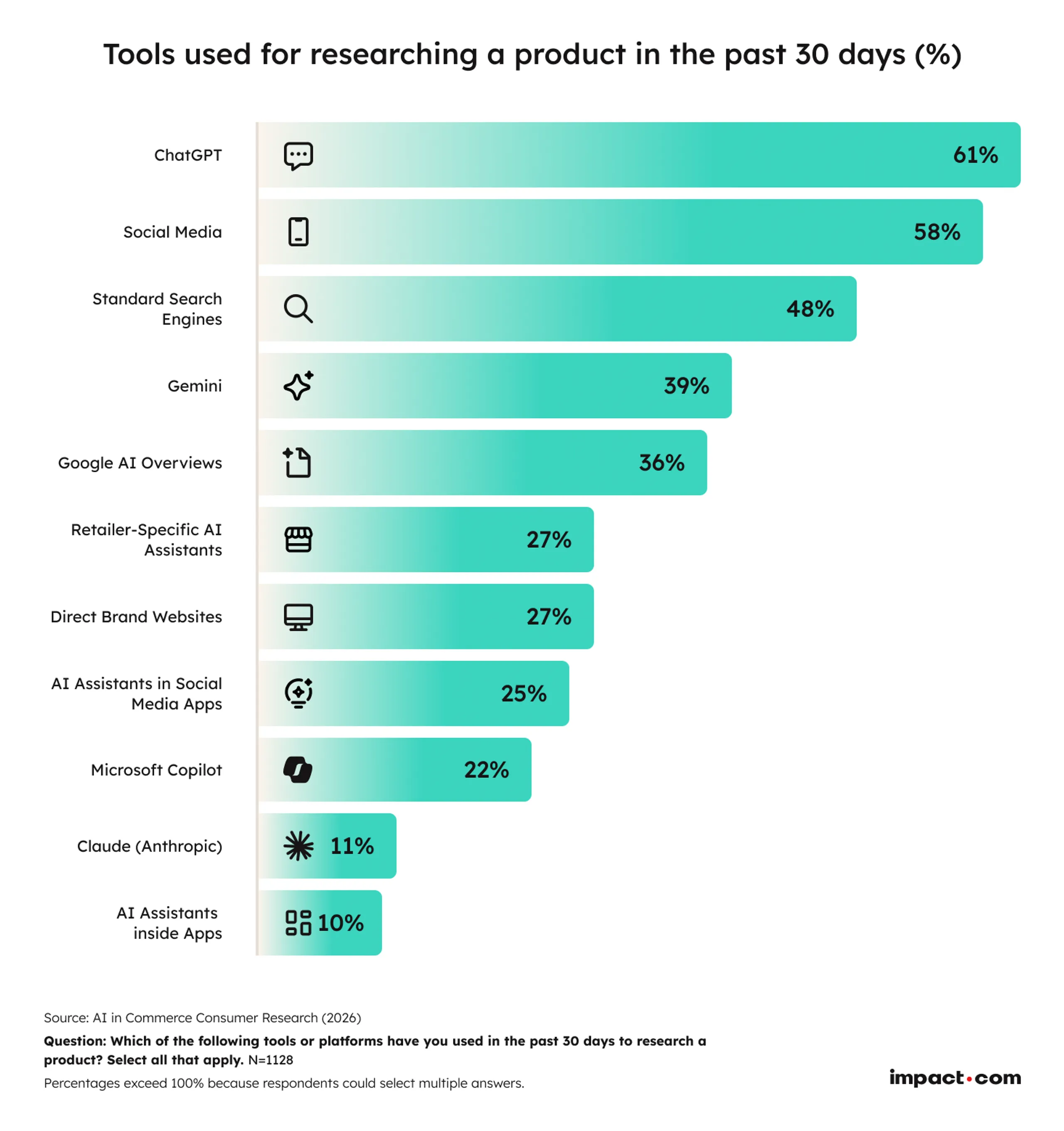
ChatGPT has become a staple product research tool, used by 61% of AI-active consumers in the last 30 days, compared to 48% for standard search.
Despite its popularity, ChatGPT doesn't own the full research journey—with research spread across 3-4 platforms (3.6 average).
Traditional search is no exception: it's one stop in the process, and not the first.
Search is no longer where research journeys start.
73%
bypass standard search engines as a starting point for product research
47%
start their research with an AI-generated response
A third of AI-active consumers began their last product search in a standalone AI platform—such as ChatGPT, Gemini, Copilot, or Claude—and 14% started in a search engine and immediately clicked into the AI Overview.
Combined, nearly half (47%) began with an AI-generated response. Of the remainder who skip search, most go directly to retailer apps (20%) or social media (6%).
Search is no longer the front door of the purchase journey. For the many consumers who start in AI, a brand that doesn't appear in that answer is out of the running at step one.
“We’ve moved from the search era to the answer era, from browsing to recommendations, from clicks to answers, decisions are getting compressed. People are no longer searching their way through endless options. Increasingly, they ask for an answer and they act on it.”

David Yovanno
CEO of impact.com
For Gen Z and Millennials, AI is already the starting point.
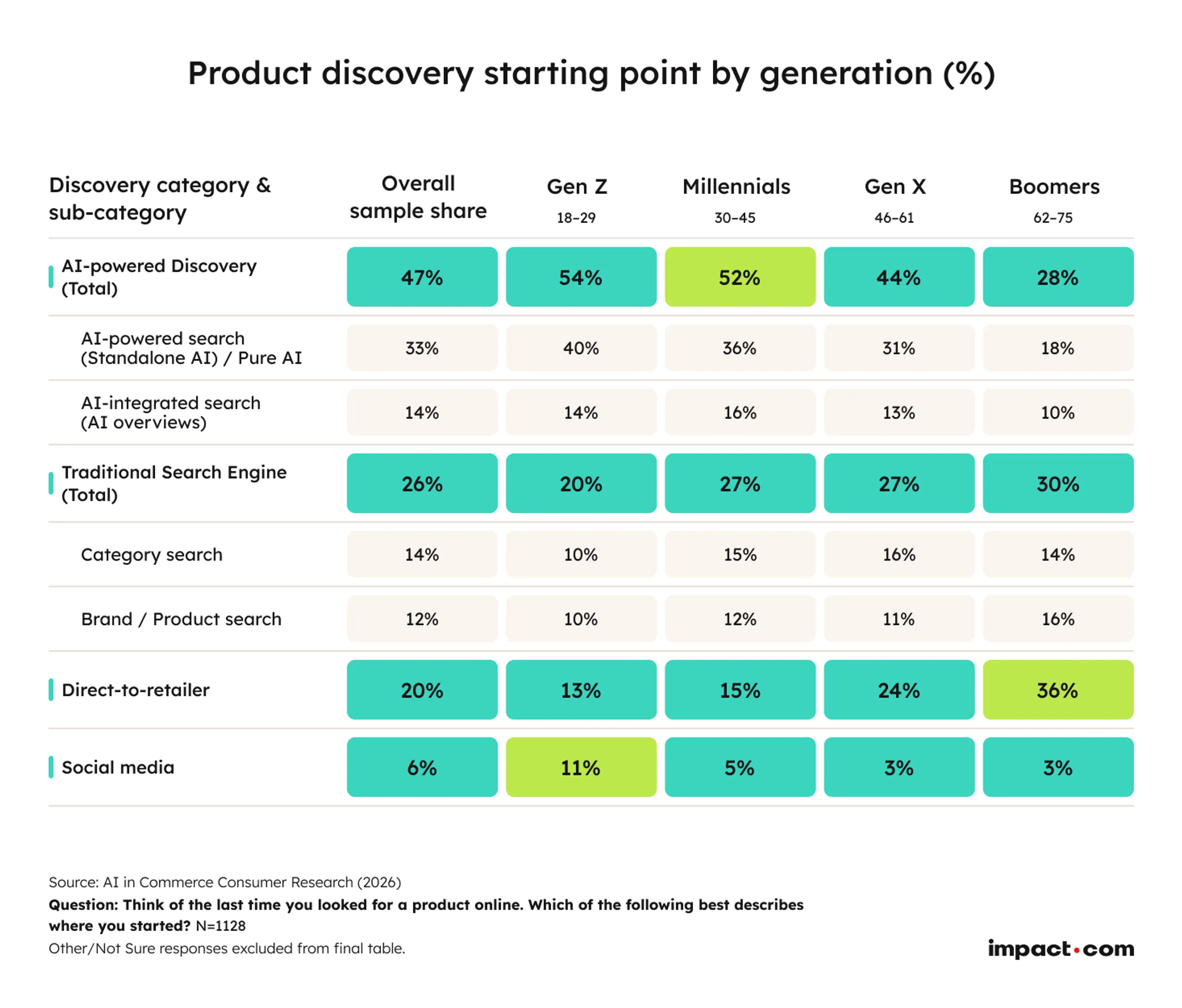
Where a product search begins tracks closely with age—and the differences go beyond how much AI each generation uses.
Gen Z bypasses traditional search at the highest rate (78%) and are the most likely to start on social media (11% vs 6% overall sample rate)—for this generation, search has largely exited the discovery process.
Millennials use more platforms on average and integrate AI heavily into their research process (52% vs 47% overall sample rate).
Gen X largely bypasses traditional search engines (71%), with only 27% starting on a traditional search engine and 24% going to the retailer directly.
Boomers go directly to a retailer site at nearly three times the Gen Z rate (36% vs. 13%).
For brands targeting younger audiences, a search-based discovery strategy misses most of the audience, since Gen Z and Millennials are already building their consideration sets elsewhere.
Only 1 in 5 Gen Zers starts their product search with a search engine.
Nearly 1 in 3 Boomers begins with traditional search.
Consumers treat AI like a faster, smarter search engine.
52%
choose AI because it gives a direct answer instead of a list of links
46%
say AI better understands complex, scenario-based needs
24%
use AI to avoid sponsored results and advertisements
The first two reasons consumers choose AI—a direct answer rather than a list of links and better handling of complex or specific needs—reflect preferences unlikely to change as AI evolves. Both are inherent to how consumer-facing AI tools function.
The third, avoiding sponsored results and ads, is different. Platforms are already introducing paid placements, and the experience consumers chose AI to escape is on the horizon.
Brands that already deliver answers consumers trust keep that position once ads appear, but brands that buy their way in need to start from scratch.
“Every marketer should think of their product in a more goal-oriented way. These systems can better react to goal-oriented wants and needs than attribute-based searches—a way for a family to bond, a way for a dog to be closer to them. Marketers should follow that lead.”

Allie K Miller
CEO of Open Machine and AI advisor
AI kicks off the buyer’s journey, but brand and retailer sites close it.
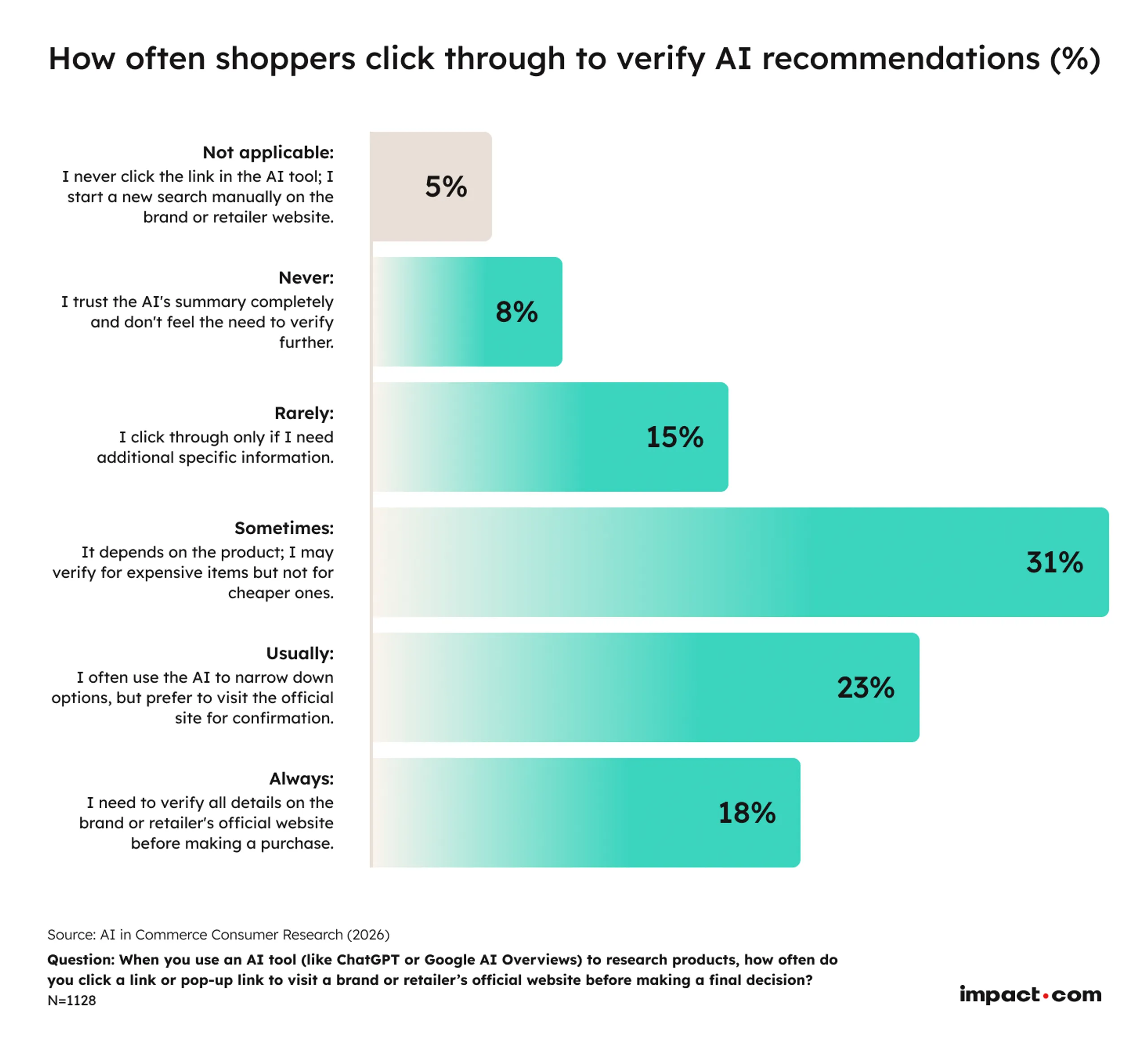
Though the majority of AI-active consumers still include a brand or retailer site in their path to purchase, they’re now the confirmation stop. With AI shaping the options list before the consumer arrives, a brand absent from that answer doesn't get the visit.
A smaller but notable share of AI-active consumers have largely dropped brand and retailer sites from the purchase process. For these consumers, the AI summary is a sufficient answer—either completely without verifying (8%), or rarely (15%), clicking through only if they need additional specific information.
Some AI-driven purchases leave no attribution trail.
If your direct or organic traffic has increased without a clear explanation, this is one potential source:
Consumer discovers or researches a product in AI
Consumer verifies on a brand or retailer site, but navigates there manually, skipping the AI's embedded link
Purchase completes and is logged as direct or organic traffic with no AI attribution
This attribution gap is already measurable. As AI adoption expands, the share of journeys that begin in AI and complete without an attributable handoff will grow.
Attribution exposure varies sharply by generation.
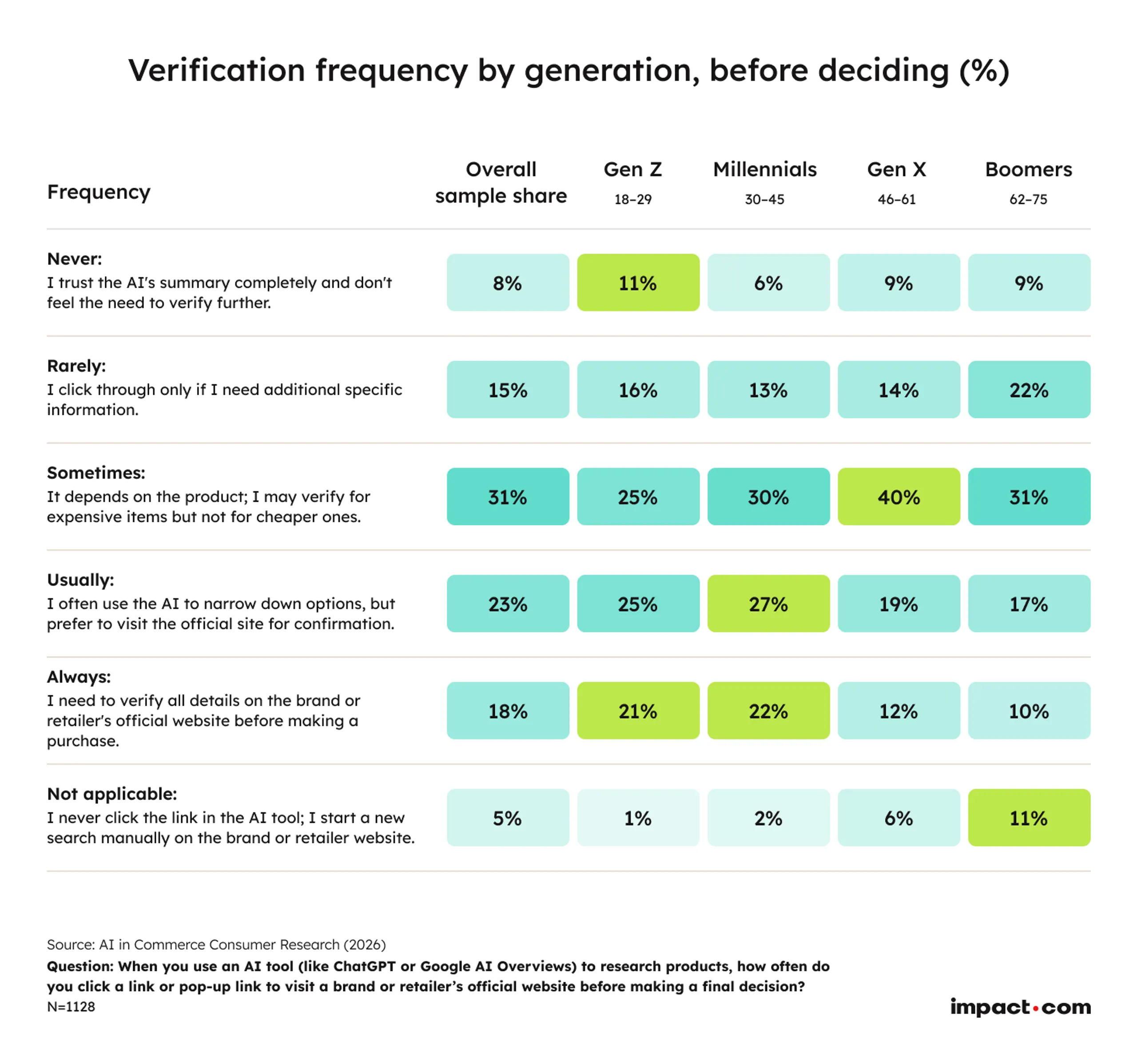
A brand's exposure to attribution gaps depends largely on the consumers it targets.
Gen Z has the widest split in verification behavior
11% never click through to a brand or retailer site, trusting the AI summary completely—the highest of any generation—while 21% always verify before buying.
Millennials are the most likely to use AI as a filter, then click its embedded link to verify on a brand or retailer site
49% usually or always follow this pattern, producing the clearest attribution trail of any generation.
Gen X are the most price-sensitive verifiers
40% say whether they check a brand or retailer site depends on the product's price, compared to 31% overall sample rate.
Boomers account for a disproportionate share of the attribution gap
At 11%, their rate of bypassing AI links and re-searching manually is eleven times the Gen Z rate at 1%.
Discover where attribution risk is already concentrated.
When consumers discover products through AI but don't follow a tracked link to purchase, AI's role in the sale goes unrecorded.
That risk is highest in categories where AI reliance is already elevated and where products are low-cost, low-risk, or repeat purchases.
Categories face two distinct problems:
Visibility: AI doesn’t surface the brand, meaning it may not enter the consideration set at all.
Attribution: Consumers still verify on a brand or retailer site, but the path there leaves no AI footprint in the data.
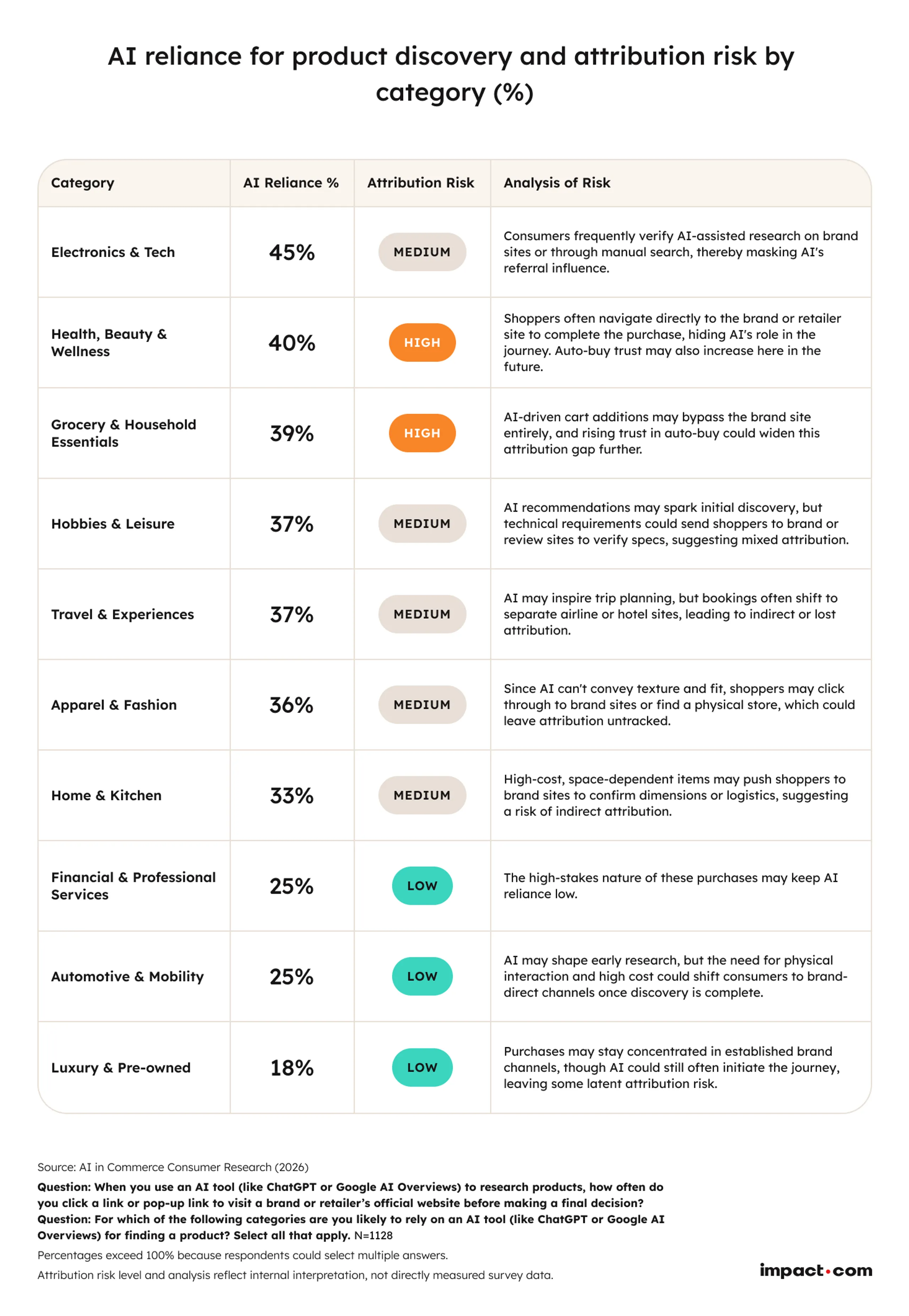
For product category definitions, see Appendix B.