

Your CMO asks what ChatGPT and other AI tools are doing for sales. The only thing you can show is a partner report, and it says the publishers AI probably trusts aren’t converting. Meanwhile, direct and organic traffic keeps climbing with no campaign to explain it.
You suspect the channel is undercounted, but you can’t prove it. You need to quantify revenue impact from AI attribution, and the data isn’t there.
That’s because those sales aren’t being tracked. According to impact.com’s 2026 “The AI attribution gap” report, a survey of 1,128 AI-active US consumers, 92% had bought something an AI tool recommended, but only 31% finished their most recent such purchase through a trackable link. Most (55%) left the AI tool and bought somewhere else, including on a retailer’s app, the brand’s site, a store, or a new search.
Your partner report can’t see those sales. That’s a measurement problem, and weak numbers don’t always mean weak partners. If you pay on last click alone, you may be underpaying the partners AI relies on.
Now, you can’t track the sales AI starts, but you can see which partners AI cites in your category and fund them on that influence alongside the last click. That gives you something to bring your CMO this quarter, before attribution is solved.
Why AI optimization increases attribution problems for partnership teams
The more visibility your partners earn, the more sales are likely to start with an AI recommendation. But most of those shoppers finish the purchase somewhere else.
Picture a shopper who asks ChatGPT what to buy, checks the price on a retailer’s site, and buys there. Nothing in your reports links that sale to the recommendation. Sales like this create the AI attribution gap. AI started them, but your reports don’t credit AI.
Where the tracking chain breaks
Almost no one buys straight from an AI recommendation. In impact.com’s report, 98% of AI-active consumers took at least one validation step before completing an AI-recommended purchase, and they averaged 1.8 extra steps.
Those steps are ordinary shopper behavior and they’re also where the trail ends.
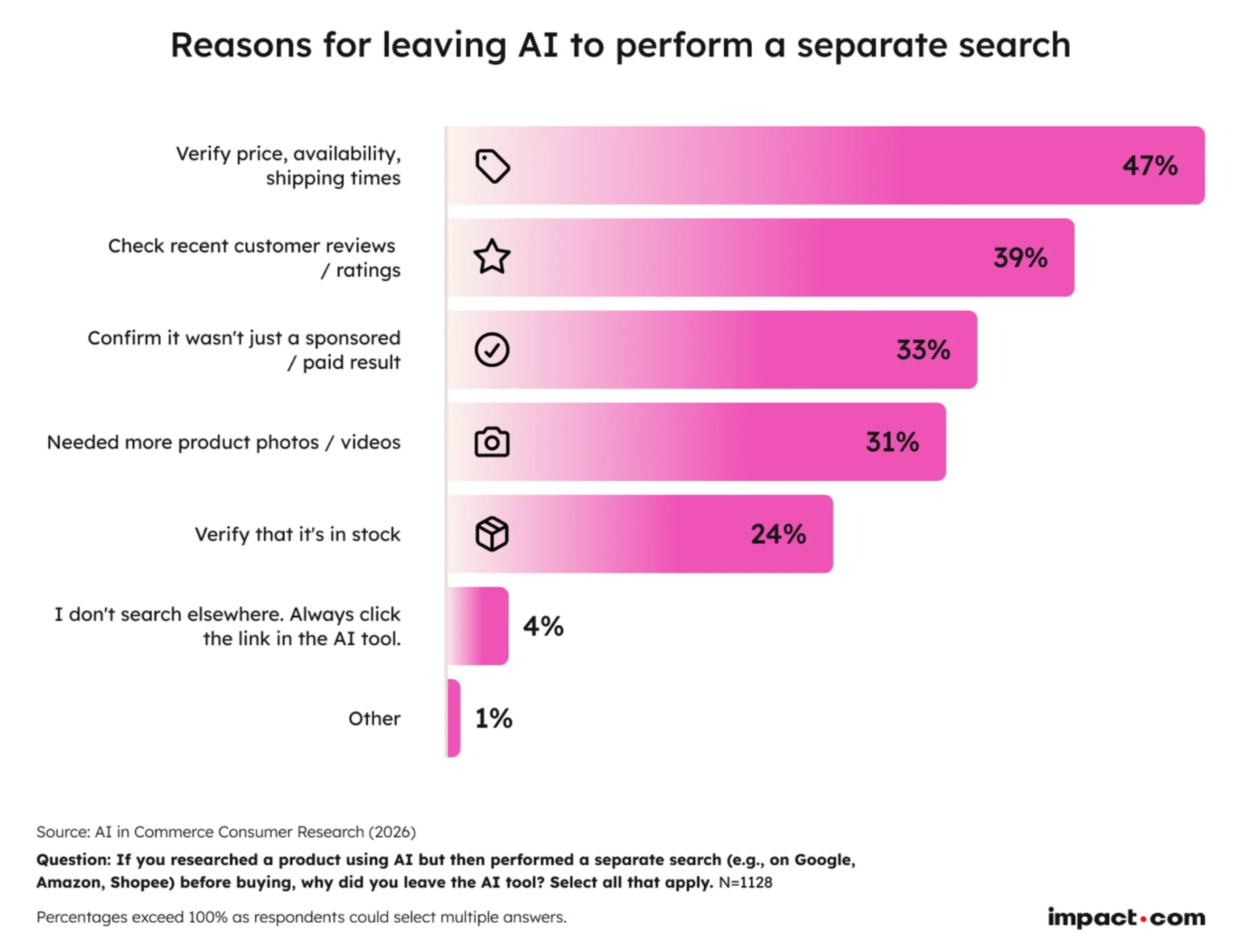
Source: impact.com, “The AI attribution gap,” 2026
Each reason is a stop where a different partner or channel can earn the shopper’s trust: a price-check partner for price and availability, a review site for ratings. Last click credits only the last tracked touch.
Where the credit lands instead
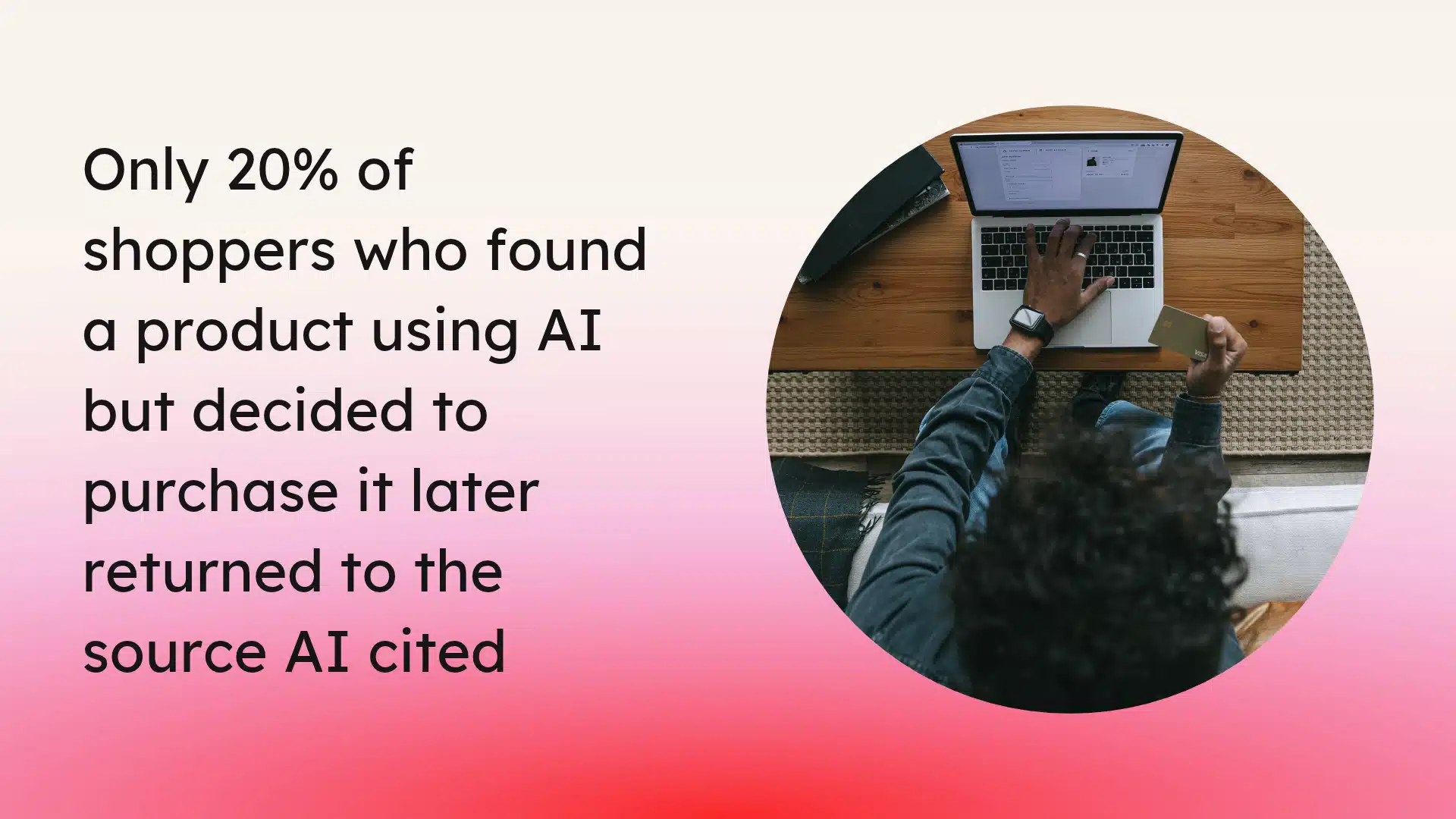
The same impact.com report found that shoppers who wait to buy AI-discovered products mostly come back through paths that skip the partner who earned the citation, such as their chat history (33%), using a saved link or screenshot (27%), or going directly to the retailer app or site (26%).
Only 20% of shoppers return to the source AI cited, a pattern that could explain why those partners look weak in a last-click report.
If your program pays on last click, you may be underpaying the partners AI relies on.
Source: impact.com, “The AI attribution gap,” 2026
How to see which partners earned the AI recommendation
AI answers draw mostly on voices that aren’t yours. McKinsey’s 2025 article “New front door to the internet: Winning in the age of AI search” found that in many cases a brand’s own sites make up only 5-10% of the sources AI search references, and the rest comes from a broad array that includes your partners.
Some partnership teams still can’t name which of them AI cites for their products, because that takes a dedicated AI-citation monitoring tool.
What you can see today
Per impact.com’s report, 36% of AI-active consumers trust an AI recommendation mainly because of the cited source and probably wouldn’t buy without it. So the next question is which ones AI cites for your category. You can answer part of that today.
You don’t have to guess. Tools that monitor AI answers can show which sources get cited. impact.com’s AI Source Opportunities report, powered by Evertune AI, adds the partner view. They show which publishers and articles AI cites when it answers questions about your category, and whether each publisher is already in your program.
You can’t prove that one citation produced one sale. You can name the partners sitting in the sources AI draws on and fund them for that influence, which gives your CMO a named list and a reason.
impact.com’s AI Source Opportunities Report shows the domains, articles, and partners AI assistants cite for your category’s prompts, and which you can activate as partners on the platform.
Fund partners by the job they do, not the click they get
When measuring ROI from zero-click searches, it’s important to track:
- Input metrics (new partners activated, content volume)
- Visibility metrics (AI mention frequency, competitor AI mentions)
- Output metrics (branded search volume lift, conversion rate lift for organic and direct, AI post-purchase survey responses)
Those layers tell you whether AI is working for your program, but not which partners are doing the work. Two partners can look identical in your numbers while doing very different jobs.
To decide who to pay, split the AI-influenced path to purchase into four stages, then fund each partner type for the job it does.
| Stage | Ask about the partner | Where credit leaks | Where to look for the proof |
|---|---|---|---|
| Introduce | Does AI cite it for your category? | Only 31% of consumers finished an AI-recommended purchase through a trackable link, meaning you can’t see that the sale came from AI | Citation data, such as impact.com’s AI Source Opportunities Report |
| Verify | Does its content answer price, review, or “is this paid?” questions? | 98% of AI-active consumers take at least one validation step before completing an AI-recommended purchase, and last-click only credits the final touch | The partner’s own pages or a report that shows a partner’s role in the conversion path, such as impact.com’s Contribution Report |
| Re-find | Would it surface in a category search, or is it the source shoppers return to? | When consumers find a product with AI and decide to buy it later, 45% of consumers turn to search to re-find the item—either by running a new search for the specific brand or model (24%) or a general category search (21%) | A search of your category terms or tools that allow you to see partner search visibility, such as impact.com’s MCP get_website_metrics tool |
| Close | Does it complete the sale? | Last click tends to credit these channels, whatever started the sale | Your last-click partner report |
Source: impact.com, “The AI attribution gap,” 2026
How to quantify revenue impact from AI attribution without overclaiming
You can’t put a revenue number on AI’s influence yet. You can measure some things, though, and watch others move.
Sort what you have into three groups. Some of it you can count, some of it moves alongside AI visibility, and one thing you can’t show yet. Tell your CMO which is which before they ask, and the whole case is easier to trust.
What you can put in front of an executive
Two measures come straight from the citation data, and each answers a question your CMO is likely to ask first:
- Presence in AI answers. How often your brand appears for your high-intent queries, across the prompts and models you track.
- Cited-publisher overlap. How many of the publishers AI cites in your category already work with your program.
Here’s how you might present it: “AI cites [X] publishers in our category, and [Y] already work with us. That’s our starting position.” Frame both as where you stand instead of a revenue claim.
What moves alongside AI visibility
Three signals can rise when your AI visibility rises:
- Branded search volume
- Conversion rate on direct and organic traffic
- Post-purchase survey answers that name a review, blogger, or expert as how the shopper found you
Treat all three as directional. Any of them can rise for other reasons, so don’t overstate their role. You could put it to an executive this way: “These moved while our AI visibility grew. That could indicate AI influence.”
What you can’t show yet
You can’t tie a specific sale to a specific citation. Direct LLM-to-sale attribution isn’t generally available yet.
Say that first, before anyone asks. Then name the limits that stay true however good your data gets:
- A citation shows influence, not causation.
- Survey answers, including post-purchase ones, are self-reported.
- Category-level, simulated data can’t show what a specific cited article did for your sales.
Here’s how you might say it. “We can’t tie a sale to a citation. We can show who AI cites in our category, and we’re funding those partners for that influence.” Funding on citation influence is the best signal available, not a perfect one, and saying so is what makes the case credible.
Move from last-click to citation-based funding in three steps this quarter
You don’t need a new attribution model. Keep last-click as your record of tracked sales, and add citation influence as a second factor when you decide where to put partner budget. The three steps below are a plan to try this quarter. Start small and adjust as you learn.
Move 1: reframe the dashboard
Look back for periods when direct or organic traffic rose and no campaign explains it. Some of that growth may be demand partners cited by AI created. Put those periods next to your partner report and show them to your CMO.
They don’t prove AI drove the sales, but they make a stronger case than any industry stat, because the numbers come from your own program.
Move 2: audit your partners against citation visibility
Pull the list of publishers AI cites for your category’s high-intent queries, then compare it to your partner roster. Every partner lands in one of three groups.
| Group | What it means | What to do |
|---|---|---|
| Cited and in your program | AI cites the publisher, and it already works with you | Protect the relationship and fund it for putting your brand in front of shoppers |
| Cited and not in your program | AI cites the publisher, and you have no relationship with it | Recruit it |
| In your program but not cited | The partner drives clicks, but AI doesn’t cite it for your category | Keep funding it for the job it does, but don’t pay it as a citation partner |
A partner that doesn’t appear may still influence buyers, so use the third group to dig into whether other signals, like branded search or post-purchase answers, point to their influence.
Move 3: fund two lines by audience
Split the budget by who your buyers trust, with one line for each group.
- Earned placements. Fund the publishers, reviewers, and communities AI already cites. This suits audiences that trust cited sources.
- Brand-direct trust and product content. Invest in loyalty, reputation, and product content detailed enough for an AI to summarize accurately. This suits audiences that rely on brands and retailers.
impact.com’s 2026 “How AI is rewriting the buyer’s journey” report points to an age split. Gen Z (46%) and Millennials (43%) lean on the cited source more than the full sample (36%). Meanwhile, Gen X (33%) and Boomers (36%) lean more on official brand links than the full sample (27%). Treat that as a starting hypothesis and test it against your own audience data.
Pay for the recommendation, not just the last click
The partners AI trusts are being measured by a model that can’t see them. You can’t fix that this quarter, but you can weigh citation influence alongside last-click results when you set partner budgets.
Audit which publishers AI cites in your category, check which already work with your program. Map out a plan for how to compensate them for their influence. Then take that list to your CMO as your answer to what AI is doing for the brand.
More on measuring and funding AI-influenced sales:
- Your partnership program is driving AI-influenced sales—your attribution model just can’t prove it [blog]
- How AI is rewriting the buyer’s journey [research]
- The AI attribution gap: 92% of shoppers buy AI recommendations, just 31% click trackable links [research]
FAQs
The AI attribution gap is the difference between the sales AI recommendations start and the sales a partnership program can trace back to them. It’s a measurement gap, not a partner performance gap. Shoppers often take an AI recommendation and buy somewhere else, so the partner report never connects the sale to it. The partners AI draws on may be doing their job, but their results don’t show up.
Partnership programs can’t track these sales because shoppers check before they buy, and many finish somewhere else. In impact.com’s 2026 “The AI attribution gap” report, , 98% of AI-active consumers took at least one step to validate the recommendation, such as confirming the price or reading reviews. Most (55%) left the AI tool and finished the purchase in a retailer’s app or site, the brand’s site, a physical store, or a new search.
Nothing in those sales links back to the AI recommendation, so a program has nothing to trace. Direct LLM-to-sale attribution isn’t generally offered today.
A brand can find them in the AI Source Opportunities Report from impact.com. It shows the publishers AI cites for a category and whether each one is already in the brand’s program. Evertune AI, a strategic partner of impact.com, supplies the data, which comes from simulated prompts run across ChatGPT, Google AI Overviews, and Microsoft Copilot.
Brands should fund partners on citation influence alongside last-click sales. Last-click stays the record of tracked sales, and citation influence adds a second input for the partners AI cites whose sales close somewhere else. A citation shows influence, not causation, so use it to weigh funding decisions rather than to claim a partner caused a specific sale.
Brands can’t yet prove AI-driven sales impact to executives, but they can build a credible case in three parts:
- Consumer evidence. In impact.com’s 2026 “The AI attribution gap” report, 92% of AI-active consumers had bought something an AI tool recommended, and only 31% finished their most recent such purchase through a trackable link.
- A category-level view of the publishers AI cites. It shows which publishers AI cites for your category and which of them already work with your program.
- Movement in proxy signals. Branded search lift, direct conversion lift, and post-purchase “where did you hear about us” responses can rise alongside your AI visibility.
Be upfront about the limits an executive will test. Together these show influence, not causation, and the survey data is self-reported. This case doesn’t produce a revenue number, so don’t promise one.