

In eight months, premium mattress brand Sweet Zzz grew affiliate revenue 290% on just 16% more traffic. The team paid partners on a commission range of 8-20%, with higher rates for new customers and premium sales. Short-term rate bumps during priority pushes, flat fees for select placements, and product gifting were included with the base range.
Compensation worked at the program level as a standing structure that campaigns topped up, rather than a new decision with every brief.
Most answers to ‘how do brands pay influencers’ stop at debating flat fee vs. commission. But according to impact.com’s Global State of Affiliate Marketing 2025 report, brands use an average of two to three compensation models, matched to partner type and campaign goal.
The brands winning with creator compensation aren’t the ones with the biggest budgets. They ask what creators value before they decide what to pay, and the answer is often a lever cash can’t replicate. Getting there means answering three questions in order: what’s the goal, what does this specific creator want, and which lever actually serves both.
How do brands pay influencers? The decision tree for matching compensation to campaign goals
The brands getting the most from creator compensation start by asking what a creator values, not by defaulting to whichever lever is easiest to compare.
Follower count is still the default basis for creator compensation because it’s easy to compare. But in an algorithm-driven feed, followers no longer decide who sees a post. The content does. A brand can pay a premium for a big following and get little back, while a smaller creator whose content performs can reach far more people.
“It’s not just about sales,” said Jeff Melton, Senior Director of Global Creator Strategy at impact.com. The fix he described goes further than swapping follower count for a commission rate. “It is, at the end of the day, aligning outcomes—impressions or engagements or clicks and, yes, sales—to compensation so that brands are only paying when a creator’s driving outcomes.”
That thinking shapes an emerging branch of the decision tree, one that pays for what a creator delivers across the funnel, from impressions and clicks to sales.
Pay that tracks every stage of the funnel works in both directions. A creator who drives impressions or reach gets paid for the volume they drive, even when the final sale occurs elsewhere, and the brand stops paying for reach that never happens.
Outcome-based pay also assumes a creator can take cash in the first place, and some can’t. In-house brand ambassadors and employees recruited as creators often can’t earn commission or flat fees. A points-based currency gives them something to work toward, with points they redeem for non-cash rewards like time off, products, or status. Compensation rules vary by role and region, so run the setup past your legal team.
| Matching creator compensation levers to campaign goals | |||
|---|---|---|---|
| Campaign goal | Cash-first lever | Value-first alternative | Use value-first when… |
| Brand awareness/reach | Flat fee | Early product access, event invite | Budget is fixed and impressions matter more than tracked sales |
| Conversion/sales | Commission, performance bonus | Storefront unlock, tiered discount | Creator has a proven audience-to-sales fit already |
| Retention/always-on advocacy | Retainer | Status tier, community access, dedicated support | You want the creator to stay past a single campaign |
| Full-funnel (emerging) | Hybrid base + commission | Pay aligned to impressions, clicks, and sales together | You can track multiple funnel stages, not just last-click sales |
Building program tiers that actually motivate: setting the bar with data, not guesswork
Knowing what a creator values only pays off if the tier thresholds inside your program are calibrated to real behavior. A value-first ladder built on guesses is as arbitrary as the flat fee it replaced.
Not all creators start at the same place
Creators don’t arrive at a program as equals. They differ in affiliate experience, the platforms they publish on, and the support they need to succeed.
A single blended program average hides those differences and leaves brands managing everyone to a number that fits no one. Building tiers solves this by grouping creators into cohorts with their own benchmarks, incentives, and enablement, so each group is measured against realistic peers and given the tools that match its skill gaps.
The structure should scale with the program, from simple early-stage tiering to mature frameworks of seven or more levels, and it can evolve from gross merchandise value (GMV) evaluation to a fuller view that weighs engagement signals such as posting frequency, clicks, and conversion rate alongside value signals, including revenue per click, average order value (AOV), and storefront adoption.
The strategic payoff is twofold: tiers give every cohort a clear path to level up, and they make it easier to recognize and retain top performers, because performance insights arrive in context and translate directly into action.
Set the bar just past the average
Base each tier’s benchmark on what creators in your program already achieve, such as their average sales, engagement, or clicks per post.
It’s tempting to set your first tier right at that number. But a tier that matches current performance only describes what’s already happening.
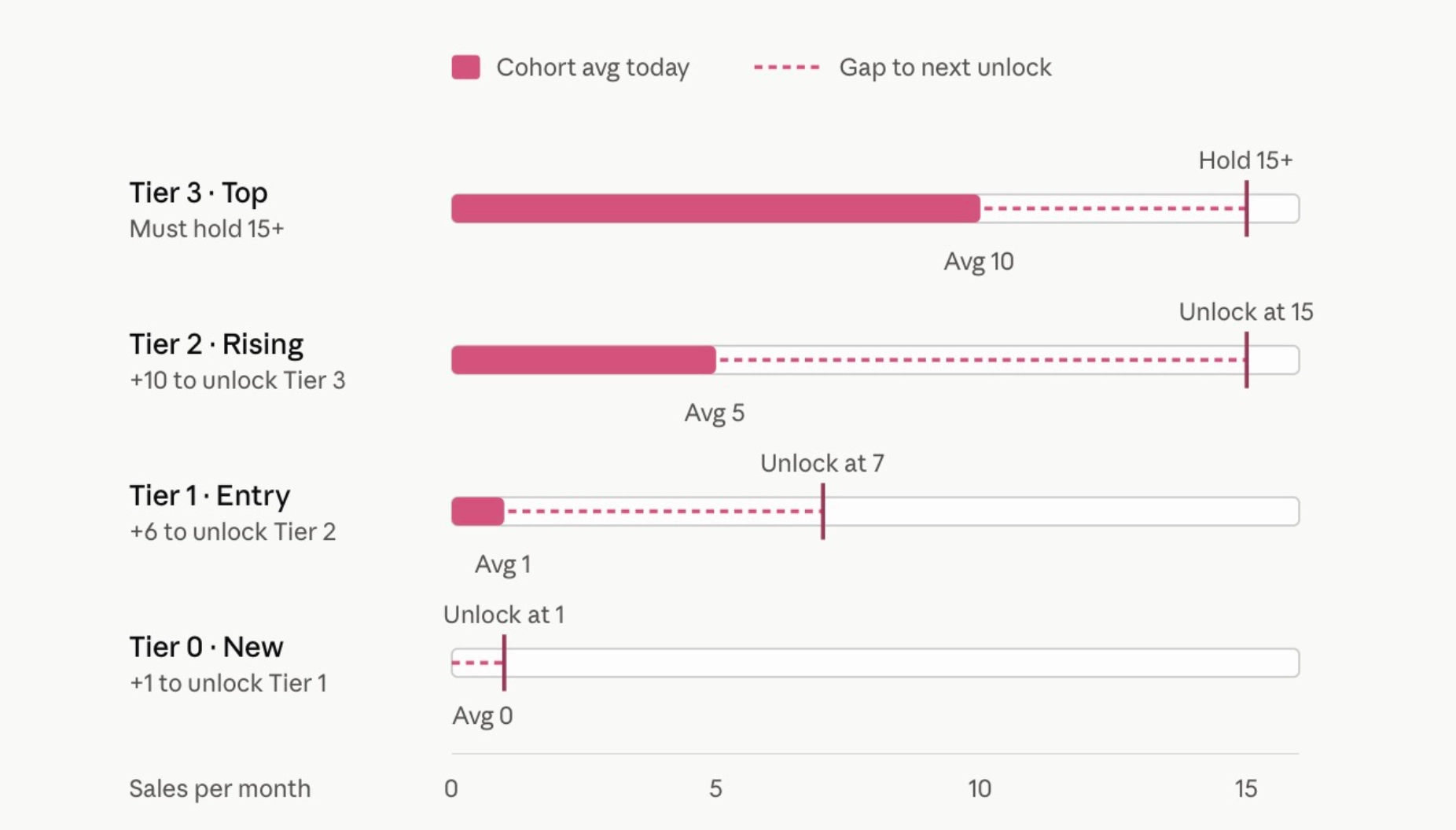
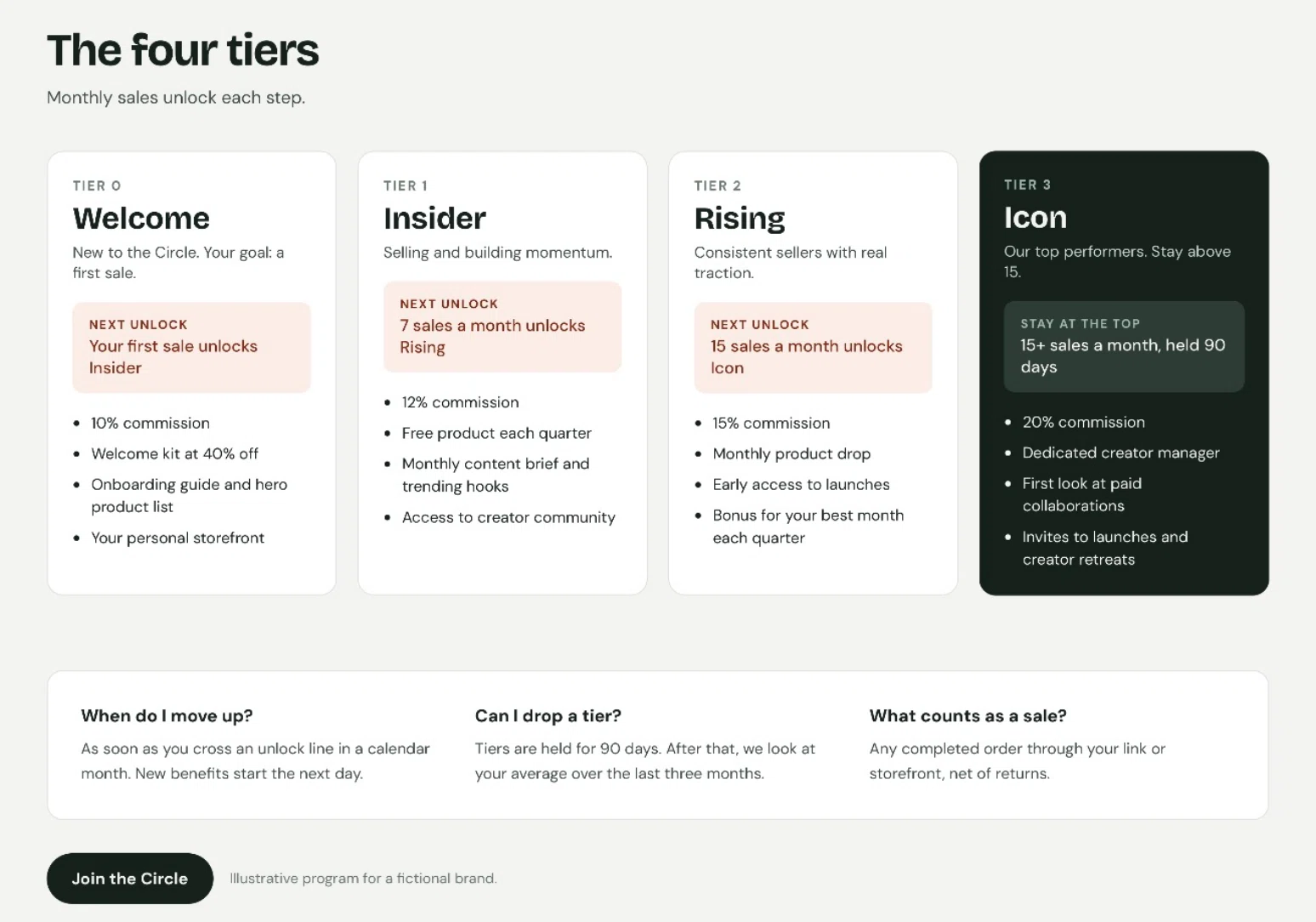
The better move is to set the bar slightly beyond it. “You’re moving the goal line right beyond what the average is for each cohort tier,” Melton said, “to encourage the average to do more.” A tier just out of reach gives the typical creator a reason to stretch, and it turns the ladder into something that lifts performance instead of simply measuring it. For example, in the image below, the cohort of Rising creators (Tier 2) drive an average of 5 sales per month. So set the goal of the next tier (Tier 3) at 15. This motivates the Rising creators to drive incremental sales to unlock the next tier and its benefits.
Test with real creators, then adjust
Before you roll out a structure, run it past a small group of creators. Their answers tell you where to set each target.
Ask what would actually motivate them to reach the next tier. It’s the same question behind the decision tree, applied to thresholds instead of levers.
Then launch and expect to adjust. Watch for two signals:
- Everyone hits the top tier right away: The bar is too low, and the ladder no longer drives growth.
- Almost no one advances: The bar is too high, and creators stop believing the ladder is climbable.
Either one is a cue to go back to the data and reset the thresholds.
What the right bar looks like
A well-set tier produces steady, incremental movement in outcomes, not a flood or a freeze. Each month, a handful of creators climb. More are close behind them. The entry tier keeps filling with new joiners instead of emptying out. That’s the bar doing its job: pulling the average up without making the climb feel out of reach.
Change the rules, not the target
When you move the bar, announce it as an update to the program’s rules for every creator. A change aimed at one person’s performance reads as a penalty and erodes trust in the whole ladder.

“You’re moving the goal line right beyond what the average is, to encourage the average to do more.”
— Jeff Melton, Senior Director of Global Creator Strategy at impact.com
Designing the value-first ladder: where non-cash incentives do what cash can’t
This is where asking what creators value stops being a philosophy and becomes a structure they can actually see and climb.
Cash is easy to compare. A creator can weigh your commission against another brand’s in seconds. Status, access, and experiences are harder to match because they only exist inside your program.
Put the best non-cash rewards at the top
Non-cash rewards can show up at any level of a program, but they carry the most weight at the top. “In our experience, the non-monetary forms of compensation tend to live at that highest level,” Melton said, “as the coolest form of the incentive.”
That placement changes what the reward means. At the top tier, it stops functioning as a perk and starts signaling where a creator stands within your program. Frame the whole ladder as a career path instead of a checklist. Each level shows creators what they’re working toward next and gives them a reason to stay, the same way a job has a next title.
Run cash and non-cash side by side
Cash and non-cash compensation don’t compete. Sweet Zzz paired its dynamic commission range with product gifting to support content and flat-fee editorial placements where they made sense. Both levers ran in the same program.
Build from what your brand already has
The right non-cash lever isn’t generic. It’s whatever your brand already has that a fan would genuinely want.
| Non-cash compensation ideas by brand category | |
|---|---|
| Category | Non-cash levers to consider |
| Consumer packaged goods | Samples, limited editions |
| Software | Beta access, feature previews |
| Fashion and lifestyle | Events, exclusives |
| Food and beverage | Recipe collabs, limited-run flavors, tasting events |
| Travel and hospitality | Complimentary stays, destination trips, loyalty status upgrades |
| Health and fitness | Free memberships or classes, branded gear, wellness retreats |
| Gaming and entertainment | In-app currency or items, closed beta access, creator tournaments |
Show creators the whole ladder
Before launch, mock up a simple explainer, such as a one-pager or landing-page style visual, that shows every tier and what it unlocks. A list of rules tells creators what to do. A visual ladder shows them where they’re going, and a climb you can see is easier to commit to.
“In our experience, the non-monetary forms of compensation tend to live at that highest level, as the coolest form of the incentive.”
— Jeff Melton, Senior Director of Global Creator Community and Consulting at impact.com
Illustrative worked example: the value-first ladder for your brand
Say you’re a consumer packaged goods brand. Here’s how the climb could look for a creator in your program. The numbers are illustrative, not benchmarks.
The details will change by category, but the pattern holds. Early tiers reward creators for joining and posting consistently. The biggest rewards, the ones cash can’t buy, sit at the top.
| Example: value-first creator compensation ladder by tier | ||||
|---|---|---|---|---|
| Level | How to unlock | Commission & points | Non-cash unlocks | Notes |
| Starter | Free to join. Apply and you’re in, no performance bar | 8% commission.1 point per $10 sold. | Private creator community.Starter kit (samples + brand assets). | Entry level, rewards joining, not selling. |
| Builder | Post about the brand once a week for four weeks | 12% commission.1.5x points. | Personal bundle page (combine products into a higher-value cart).15% product discount. | Rewards consistency, not sales. Going inactive drops the creator back to Starter. |
| Pro | Drive $1,000+/month through the bundle page for 3 straight months | 18% commission.2x points + one-time bonus. | Early access to launches (7 days ahead).30% product discount.Featured on the brand’s channels. | Hold a high average order value and earn an ongoing commission kicker. |
| Elite | Drive $5,000+/month at a high average order value for 3 straight months | 25% commission (ceiling).3x points + quarterly cash bonus. | Dedicated partner manager.Ongoing free product.Invite-only annual creator summit. | Capstone: Creator pitches their own limited edition bundle and earns a share of every sale if produced. |
To build your own, keep the structure and customize the numbers, program size, and non-cash rewards your brand already has.
Before sharing with creators, ask your creative team to design the framework into something visual—here’s what that could look like for a different program:
Getting leadership buy-in for non-cash compensation
Asking what a creator values only pays off if you can get leadership to approve acting on the answer. Many marketers assume leadership will push back on “soft” perks, so they skip the conversation and ask for a bigger cash budget instead.
In Melton’s experience, that assumption is usually backward. When brands bring non-cash ideas to leadership, “there’s usually very little pushback on the non-monetary things,” he said. “They tend to get really excited about that.”
It helps that non-cash levers often draw on assets the brand already has. The ask is to put existing assets to work, not fund something new.
Pitch resourcefulness, not spend
Change the question you bring to leadership:
| How to reframe the leadership pitch: spend vs. resourcefulness | |
|---|---|
| Instead of asking | Ask |
| Can we increase the creator budget? | What assets do we already have that we could carve out for creators? |
| How much more do top creators need? | Which sponsorship, event, or early access could we open to our top tier? |
That’s a resourcefulness pitch, and it’s the easier one to win. It also keeps you from defaulting back to cash.
Illustrative example: pitching the ladder to leadership
Leadership cares about two numbers:
- What each tier adds in cost
- What cash it helps you avoid
Here’s what that pitch could look like on paper, using the same ladder from earlier.
| Non-cash reward cost vs. cash budget avoided, by tier | ||||
|---|---|---|---|---|
| Tier | Non-cash asset used (already owned) | Incremental cost to the brand | Cash budget this replaces | Why leadership says yes |
| Starter | Existing community channel, existing brand assets | Near zero, repurposed assets | N/A, this tier has no cash equivalent | Costs nothing to launch, pure upside for program reach |
| Builder | Product samples already in inventory | Cost of goods only, no new spend | A flat per-post fee brands typically pay at this activity level | Uses stock that already exists instead of a new line item |
| Pro | Early access to a launch the brand is already planning | Zero additional cost, timing shift only | A mid-tier retainer or bonus | The reward is a time shift only (no additional expenses) |
| Elite | An event, sponsorship, or asset the brand already owns | Marginal cost of adding attendees to something already budgeted | The largest cash bonus tier brands typically build in | This is the resourcefulness pitch in action: the biggest perk costs the least incremental cash |
Read down the last column. As rewards get more valuable to creators, the case to leadership gets easier.
FAQs
Flat-fee, performance-based, and hybrid influencer compensation differ in what a brand pays for: the content, the results, or both.
A flat fee pays a set amount for agreed deliverables regardless of results, and suits awareness campaigns where reach matters more than tracked sales.
Performance-based pay ties earnings to outcomes like sales, working best once a creator has proven they can convert.
A hybrid model combines a base fee with performance pay, giving guaranteed income while rewarding results.
Paying influencers with gifting or perks instead of cash makes sense when a creator values what your brand can offer more than a bigger rate. That’s often true for access, status, and experiences, like early product launches, events, or an invite-only community, which is harder for a competitor to copy than a commission rate.
Perks also work well at the top of a tiered program, where they signal a creator’s standing, and for creators who can’t accept cash, such as employees acting as brand ambassadors. Many strong programs blend both, paying commission alongside gifting rather than choosing one.
Brands can decide which compensation model fits a creator or campaign goal by working through three questions in order: the goal, what motivates the creator, and which lever serves both. Awareness campaigns often suit a flat fee or early product access, while conversion goals suit commission or performance bonuses once a creator has proven they can sell.
For long-term advocacy, status tiers and community access give creators a reason to stay. The quickest way to learn what motivates a creator is to ask them directly, then set any performance thresholds from your program’s real data rather than guesswork.
Build the compensation decision tree before you build the budget
The brands ahead of this shift aren’t the ones spending the most. They’re the ones who asked what their creators actually wanted before they ever set a rate.
Many brands already mix cash and non-cash rewards, choosing each one based on the campaign goal and the creator. If you still pay every creator the same flat rate, you’re competing on price alone, and any brand with a bigger budget can outbid you.
Treat your decision tree as a starting point. Creator preferences will change, with more interest in access, ownership, and long-term growth, so plan to test it and update it as you go.
Three places to start now:
- Audit your current compensation against the decision tree table and note where you default to cash out of habit rather than fit.
- Find one non-cash lever your brand already has but hasn’t offered creators.
- Set your next-tier threshold based on real creator data.
Building the compensation decision tree is the easy part. You already know that the answer to what motivates a creator is often something cash can’t replicate — the real test comes the first time one asks for it, and you already know what else you can offer.
Discover more content here:
- In-house vs. managed services for influencer programs: How to decide what yours actually needs [blog]
- Why a 1–2% commission difference matters more than you think
- The Partnership Economy podcast: Running YouTube’s largest creator program w/ Steve Messa of BetterHelp
- Building your influencer portfolio: A strategic framework for scaling brands [ebook]
- How to run an influencer marketing campaign: Why most brands fail before they start [blog]